
Free Flight: Duration
Bob Meuser
Grass Roots PR
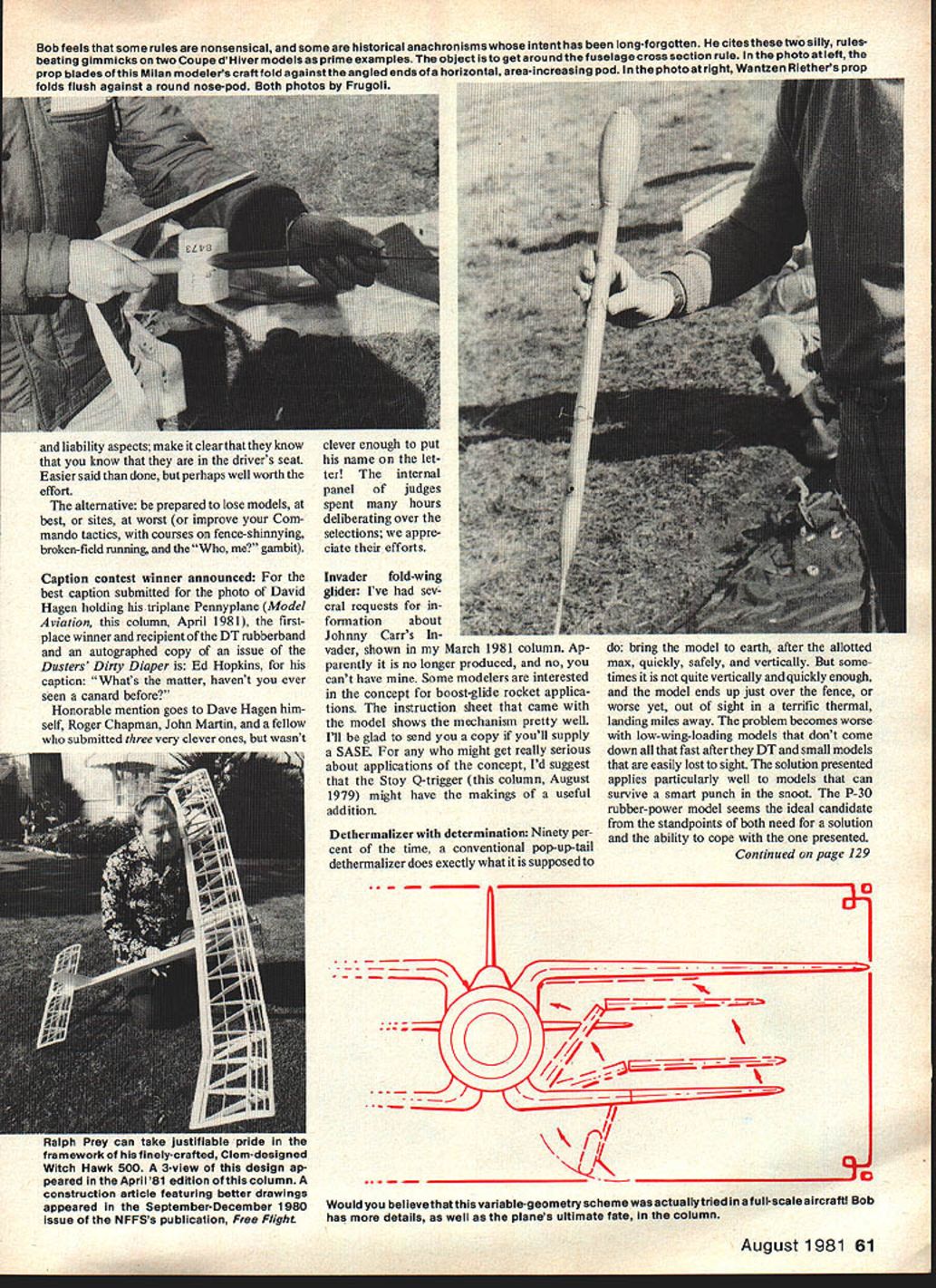
All Free Flight flying sites are too small, in the sense that sooner or later a model is going to drift off and land in potentially hostile territory: a local farmer's wheat field; a local resident's patio, roof, or picture window. Tramping through a farmer's land or scrambling over backyard fences and rooftops at 7:30 a.m. on a Sunday morning is not likely to endear us to the locals, and might lead to loss of the privilege of flying in those all-too-dear and all-too-few sites. On the flip side, good relations with the neighbors might lead to the return of models that might otherwise be deliberately trashed or destroyed.
The Planesmen of Fort Worth, TX have considered a proposal that seems at least a partial solution. The plan was to distribute a "letter of introduction and goodwill" to all households within the fallout area of their flying site. The goals: improve relations in instances of trespassing on private property; promote return-rate of found aircraft; and reduce damage-rate of returned aircraft. If deftly executed, such a mailing seems like a good bet in a compact residential area, although it would be easy to spend a lot on printing and mailing if one tried to saturate an area even a quarter-mile thick around a mile-square site. In rural or other low-population-density areas, personal contact would probably be more appropriate. In either case, what is done is less critical than how it is done — it is easy to visualize scenarios that would have a net negative effect.
When you approach neighbors, explain what you're up to; convince them that you are responsible adults or supervised youngsters (and be prepared to prove it); invite their participation or observation (but be prepared to cope when they do show up); explain the insurance and liability aspects; and make it clear that you know they are in the driver's seat. Easier said than done, but perhaps well worth the effort.
The alternative: be prepared to lose models, at best, or sites, at worst — or improve your Commando tactics (courses on fence-shinnying, broken-field running, and the "Who, me?" gambit).
Caption Contest
For the best caption submitted for the photo of David Hagen holding his triplane Pennyplane (Model Aviation, this column, April 1981), the first-place winner and recipient of the DT rubberband and an autographed copy of an issue of the Dusters' Dirty Diaper is:
- Ed Hopkins, for his caption: "What's the matter, haven't you ever seen a canard before?"
Honorable mention goes to Dave Hagen himself, Roger Chapman, John Martin, and a fellow who submitted three very clever ones but wasn't clever enough to put his name on the letter. The internal panel of judges spent many hours deliberating over the selections; we appreciate their efforts.
Invader Fold-Wing Glider
I've had several requests for information about Johnny Carr's Invader, shown in my March 1981 column. Apparently it is no longer produced, and no, you can't have mine. Some modelers are interested in the concept for boost-glide rocket applications. The instruction sheet that came with the model shows the mechanism pretty well; I'll be glad to send you a copy if you'll supply a SASE. For anyone seriously interested in applications of the concept, I suggest that the Stoy Q-trigger (this column, August 1979) might be a useful addition.
Dethermalizer with Determination
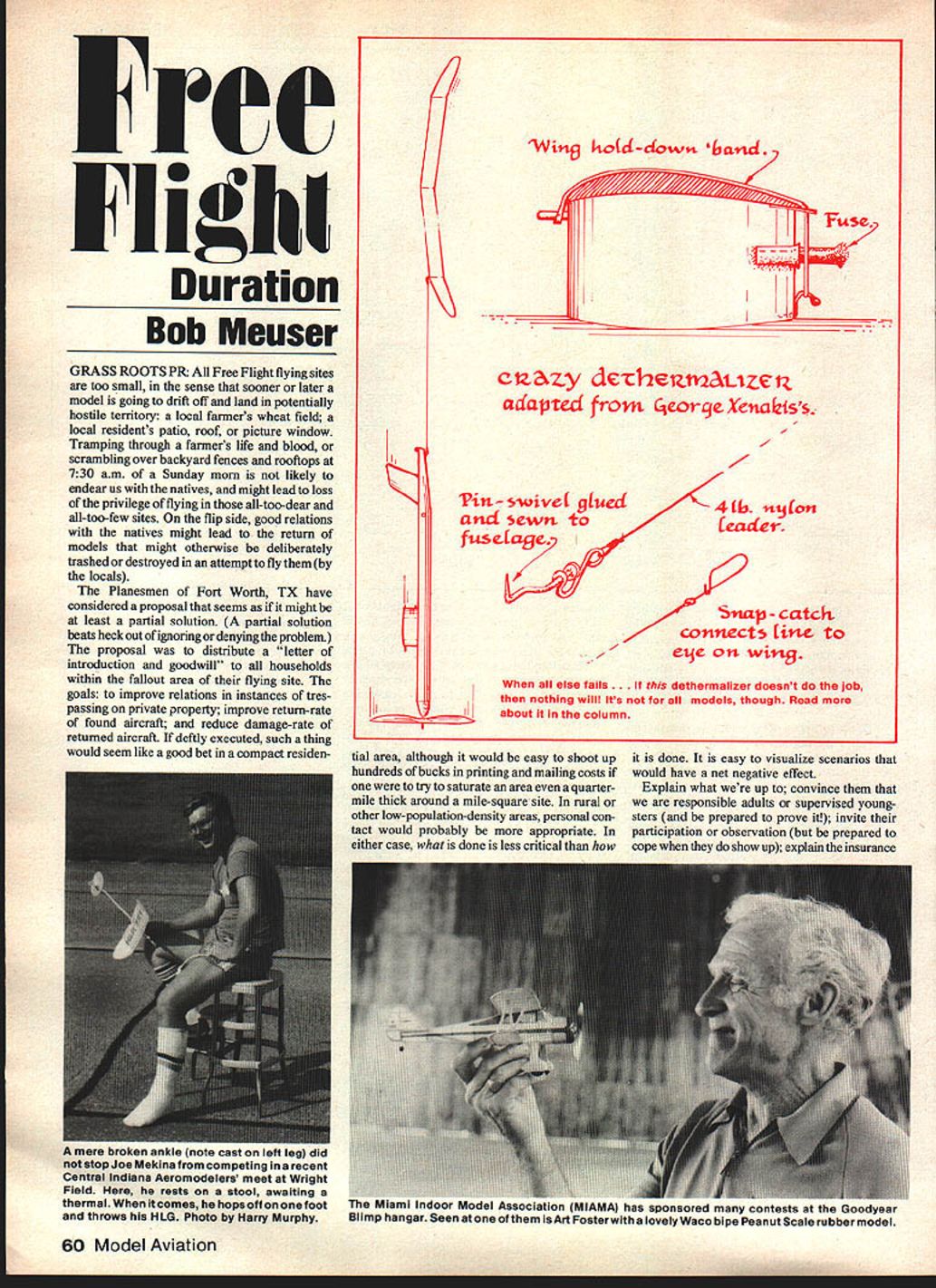
Ninety percent of the time, a conventional pop-up-tail dethermalizer does exactly what it is supposed to do: bring the model to earth, after the allotted max, quickly, safely, and vertically. But sometimes it is not quite vertically and quickly enough, and the model ends up just over the fence, or worse yet, out of sight in a terrific thermal, landing miles away. The problem becomes worse with low wing-loading models that don't come down all that fast after they DT and with small models that are easily lost to sight. The solution presented here applies particularly well to models that can survive a smart punch in the snoot. The P-30 rubber-power model seems the ideal candidate from the standpoints of both need for a solution and ability to cope with the one presented.
The basic idea is that a short fuse burns through the wing hold-down rubberbands and the wing pops off the model. Because a string is provided to keep body and wing together (attached to the aft end of the fuselage and to some point near the tip of the wing), the whole assembly comes down in a well-behaved fashion. The fuse assembly hangs nose-down, suspended by the rapidly rotating wing.
For a P-30, the rate of descent is about right: fast enough to get it out of boomers, slow enough to ensure survival. It isn't quite as simple as it sounds; a few details require attention:
- Provide swivels to accommodate wing rotation, or you may get a horribly snarled line or a line twisted in two.
- The wing rubberbands must touch the fuselage but not squeeze it so tightly as to snuff out the fuse before it does its duty.
- When the wing pops off, it must do so so the string doesn't wrap around the stab. The DT line must pass over the top of the stab and be short enough so it can't slip under the stab.
- Light monofilament fishing line or leader stock makes a good line.
- There must be a swivel at either end (preferably both ends) of the line, and a snap catch at one end for convenience.
I made the swivels from pins, copying George Xenakis' arrangement, but you can buy small swivels with or without snap catches at stores selling fishing tackle.
Contest Tips and Anecdotes
When you go to a contest, take three well-trimmed planes if you possibly can. There is nothing more frustrating than losing your only trimmed plane and having no backup. Since you have a DT on your plane, use it! Not lighting the DT is a surefire way to hook a thermal and lose your plane.
An experience that demonstrates the results of not following these suggestions: at the 1975 Nats I came within 24 seconds of becoming the first person to win the 25-year-old Tulsa Glue Dobbers Trophy twice. I had only one trimmed glider, and I didn't light the DT — only to watch the plane disappear over Lake Charles. Then I blew the launch on my trimmed backup ship and finished second to Joe Mekina.
Finally, remember Murphy's Law: anything that can go wrong, will. The secret is to have it go wrong in practice, when no one is watching, so things won't go wrong at the contest.
NFFS News Items
NFFS Digest: New Editor
If you are a member of the National Free Flight Society, you may already know this: due to circumstances within my control (but bungled somehow), I once again find myself editor of the Western Hemisphere's most prestigious all–Free-Flight publication, Free Flight (familiarly known as The Digest).
Cover dates have slipped substantially behind publication dates over the years, so it will take some fancy footwork (and a bit of lying and cheating) to catch up. This will have no effect on the number of pages you get per subscription dollar. The goal is to maximize the amount of material members are likely to find interesting and informative, per square inch. The type will be 17% smaller, for one thing, but still easily readable. Ad prices are being adjusted to discourage overly large ads and to make ad revenues at least cover the cost of publishing them, while keeping costs reasonable for small sellers.
We inherited a lot of good material from the previous editor, John Oldenkamp, and have received much since. But we can always use more. As always, we'll need help with drafting—nothing fancy, just good, clean pencil work. Photographic and journalistic coverage of major meets—especially the Nats—would help too.
Membership
Adult memberships, including subscription, cost:
- $15 for one year
- $27 for two years
For persons 18 and under:
- $7.50 for one year
- $13.50 for two years
Send money to: Kit Soren, 8616 Maple Grove Ct., Sacramento, CA 95828.
NFFS Awards for 1981
Hall of Fame awards went to:
- Maxwell Bassett — introduced internal combustion engines to competition Free Flight in the 1930s
- William L. Effinger — of Berkeley Models, developer and manufacturer of many award-winning kits
- Duke Fox — developed and produced competition engines at reasonable prices and started the trend toward "hot" fuels
- Joe Lucas (deceased) — expert teacher and writer of model aviation subjects and winner of the Mulvihill Trophy in 1926 and 1928
- Joe Ott — author, kit manufacturer and designer, still producing imaginative designs for models and man-carrying light aircraft
Model awards include:
- Nordic Towline Glider: Jim Wilson's Simple Toy
- Wakefield Rubber-Power: Ron Pollard's Vitar
- FAI Power: Mario Rocca's Modello No. 2 bis
- Large Gas-Power: Joe Foster's Duck
- Small Gas-Power: Jim Clem's Witch Hawk
- Outdoor Rubber-Power: Bob White's Beau Coupe
- Indoor Rubber-Power: Irv Rodemsky's World Champs–winning Grand Prix
Special awards:
- Ralph Frey — for his article on trimming Free Flight gas-power models
- Gyorgy Benedek — for development of airfoils
- Dr. Wil Nakashima — for incisive cartoons
It isn't too early to start thinking about awards for 1982. For Hall of Fame suggestions, write to A. J. Italiano, 1655 Revere Drive, Brookfield, WI 53005. For Model of the Year awards, contact Steve Geraghty, 194 Vista Del Monte, Los Gatos, CA 95030.
Variable-Configuration Aircraft, Continued
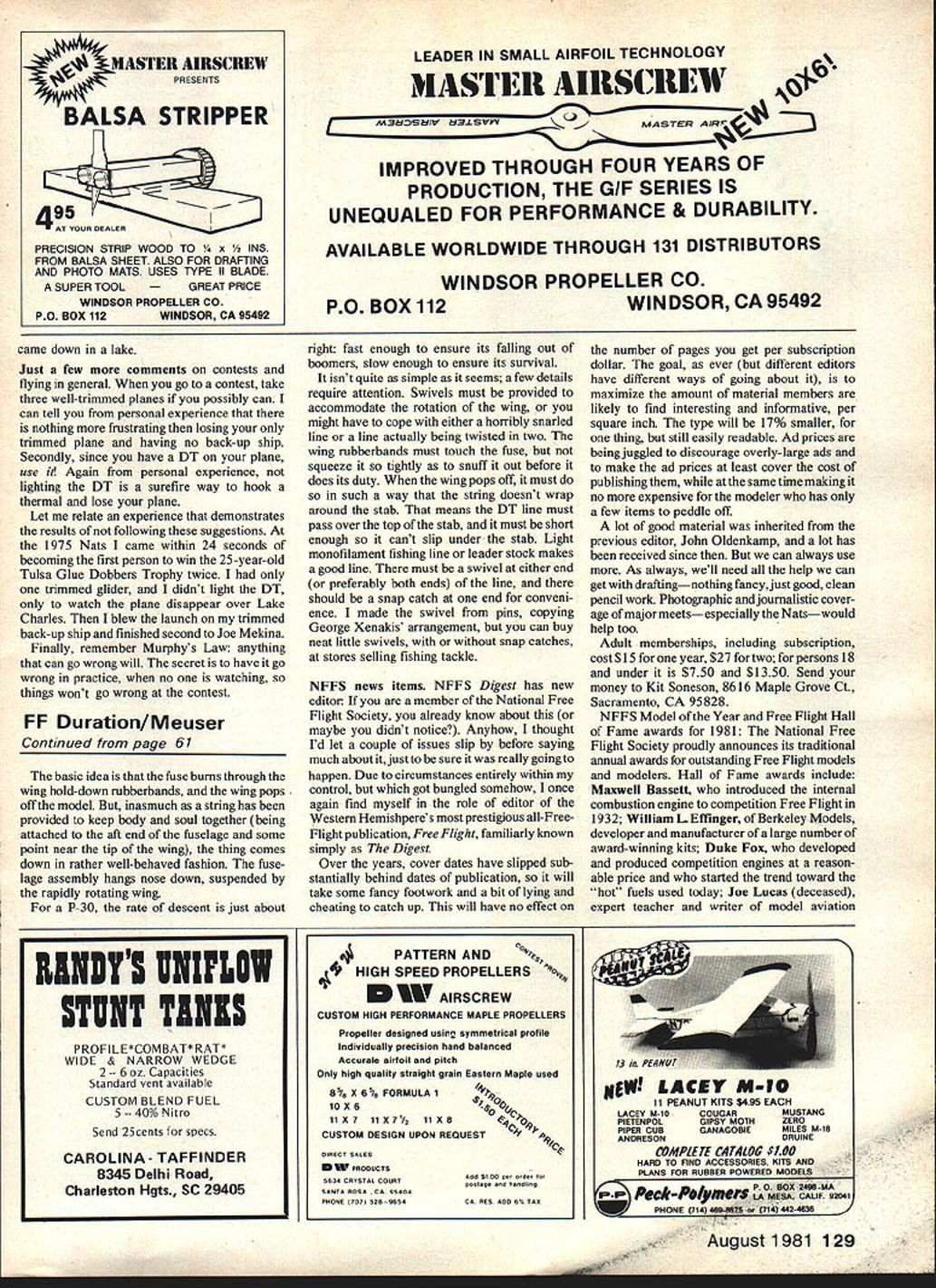
One of the most novel variable-configuration aircraft ever seen, the Nikitin-Sevchenko IS-1, attempted to combine the takeoff/landing characteristics and extreme maneuverability of a biplane with the speed of a monoplane. The pilot could convert from one to the other at will. Despite relatively successful flight trials, it was decided that the marginal improvement over conventional biplanes did not justify the complexity, and the project was scrapped. Potential applications to competition Free Flight: none that my nimble mind can conjure. But a working rubber-power model would certainly evoke the respect and admiration of one's peers — and perhaps a few new laws to boot. (For more information, see War Planes of the Second World War, W. Green.)
Directory Update
Curiously absent from my recent FF Product Directory (May–June 1980) is the name of Bob Wilder, proprietor of Wilder's Model Machine Works, manufacturer of the peerless indoor and outdoor rubber-power accessories. Eighteen months ago Bob said he was temporarily out of business but would tell me when the situation changed. He didn't, and the grapevine told me he had been peddling some neat outdoor winders, so I wrote to ask what was going on. He explains:
- He never intended to go into business; the shop started as something he made for himself and then friends asked for one too. He prefers to keep it a hobby and doesn't advertise or promote widely, though he appreciates being written about.
- Current offerings: new-design outdoor winders with 5:1 gear ratio, resettable timers, counter, enclosed smooth gears — $135.00 plus $3.00 postage. First batch sold; more expected in about six to eight months, possibly early 1982.
- Indoor winders planned, hoped to have finished in May; price $30.00 plus $2.00 postage.
- Indoor torque meter priced at $19.00 plus $1.00 postage.
- Outdoor torque meters in two ranges: 30 in.-oz. (Coupe range) and 120 in.-oz. (Wakefield range), priced at $22.50 each plus $1.50 postage.
- Plans to make an indoor stooge with a universal flex joint and an unwind device; no price or date yet.
- He is taking orders now only for indoor winders. If interested in other supplies, don't send money; let him know what you want and he'll place your name on a list and notify you when items near completion.
Bob Wilder's address: 2010 Boston, Irving, TX 75061.
Free Flight Helicopter Gliders
Anyone interested in Free Flight helicopter gliders should check with Boomerang Man, 311 Park Avenue, Monroe, LA 71201 for catalog and information.
(Editor's Note: Believe it or not, there's also a United States Boomerang Association, Box 96, Clifton, VA 22024. They print a newsletter and hold a Nationals — crazy people everywhere.)
Contact
Bob Meuser 4200 Gregory St., Oakland, CA 94619.
Transcribed from original scans by AI. Minor OCR errors may remain.

