

Free Flight: Duration
By Bob Meuser
Solvent safety — MEK and MEKP
I dream of Emmy‑Kay, with her light brown hair. Actually, she was a bit of a turkey, as I remember, but I remember her name mostly because "Emmy‑Kay" is the way we pronounce MEK, which stands for methyl‑ethyl‑ketone, an industrial solvent. It is dangerous enough by itself, but the name is easily confused with a curing agent for polyester resins called methyl‑ethyl‑ketone peroxide (MEKP) — the real dangerous stuff, eyeball‑wise.
I know I've harped on this sort of thing before, but it's worth re‑emphasizing. Solvents such as MEK and dope thinner can be dangerous. At the 1981 U.S. F.F. Champs a man who knew better closed himself in the bathroom of his motor home to dope a wing so the fumes wouldn't bother others. He ended up semi‑conscious on the floor, vomiting, and wiser. He could have ended up dead. Worse, the effects of many solvent constituents are cumulative — once you have damage, it may be permanent.
MEK is roughly in the same league as acetone. Splash acetone in the eye and it will hurt badly, but quick flushing with water (or whatever's handy) will probably prevent permanent damage. Splash MEKP (the curing agent) in the eye and the result can be catastrophic. A Fine Woodworker reader related his experience: "A year ago, I permanently blinded myself when I accidentally got some MEKP peroxide into my eye while preparing resin... The effect was both painful and immediate. In less time than it took me to run across the yard from the garage to my house, my eye had become a hardened, brown lump. Doctors confirmed my fears that the blindness was indeed permanent, and that the MEKP had altered the eye tissue beyond repair."
MEKP is the stuff that comes in the little squeeze bottles furnished with casting resin, auto‑body repair kits, and resins used for fiberglassing. The warning on the bottle, if any, is the innocuous sort of thing most of us would probably ignore — if we even bothered to read it.
Model boxes revisited — Gatorfoam
In my November 1980 column I addressed some aspects of the model‑box problem using conventional materials such as plywood. I didn't mention Gatorfoam then because it seemed specialized and rather expensive, but it has a lot going for it and might be worth your attention. Rodemsky and Romak have used it for indoor model cases, and Steve Garaghty plans to carry his outdoor models in a Pierre Trebod box after the World Champs.
Gatorfoam is basically a foam core with facings of a very tough material. It's similar to the foamboard sold in art‑supply houses, but the surface is much tougher and the weight considerably less. Published manufacturer figures suggest a core density of about 2 lb./cu. ft., with facing densities contributing to overall panel weights.
Retail weights and prices for single 4‑ft. x 8‑ft. panels (from one supplier) are:
- 3/16 in. — weight 9.7 lb. — price $27.00
- 1/2 in. — weight 10.7 lb. — price $34.50
- 3/4 in. — weight 12.2 lb. — price $41.00
- 1 in. — weight 13.6 lb. — price $48.00
- 1‑1/2 in. — weight 16.1 lb. — price $65.00
Bud Romak simply butts the joints and tapes them with cloth‑based stickum tape. Piano‑hinge stock joins the lid to the box. A variety of extruded plastic and metal stock shapes suitable for reinforcing tender areas can be found at hardware stores or dealers in do‑it‑yourself interior wall paneling. The 1/4‑in. thickness (facing?) is about right for most applications. Incidentally, Gatorfoam takes paint well and can be painted with just about anything.
You'll find it at graphic‑arts suppliers. The manufacturer is International Paper Company, Uniwood Division, Highway 90, P.O. Box 5380, Statesville, NC 28677. If you have trouble finding the material, a letter to the manufacturer may bring you the name of a retail outlet in your area.
Towhook available
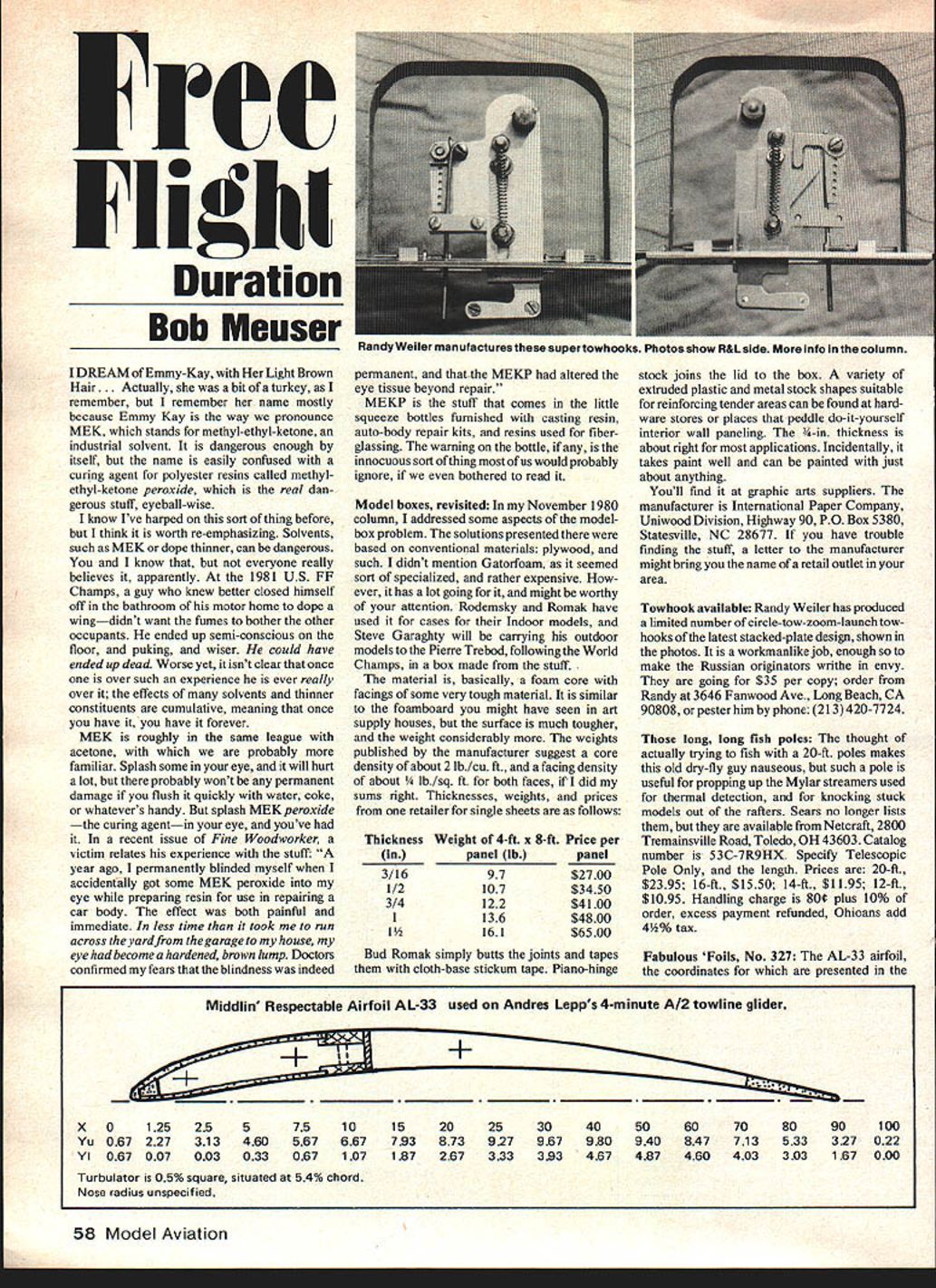
Randy Weiler has produced a limited number of circle‑tow‑zoom‑launch towhooks of the latest stacked‑plate design. They are a workmanlike job — enough so to make the Russian originators writhe in envy. Price is $35 per copy. Order from:
- Randy Weiler, 3646 Fanwood Ave., Long Beach, CA 90808
- Phone: (213) 420‑7724
Long telescopic poles
The thought of actually fishing with a 20‑ft. pole makes this old dry‑fly guy nauseous, but such a pole is useful for propping up Mylar streamers used for thermal detection and for knocking stuck models out of rafters. Sears no longer lists them, but they are available from Netcraft:
- Netcraft, 2800 Tremainsville Road, Toledo, OH 43603
- Catalog number: 53C‑7R9HX
- Specify "Telescopic Pole Only" and the length.
Prices:
- 20 ft. — $23.95
- 16 ft. — $15.50
- 14 ft. — $11.95
- 12 ft. — $10.95
Handling charge is $0.80 plus 10% of the order; excess payment refunded. Ohio residents add 4½% tax.
Airfoils and new reference
Presses for new airfoils pop up all the time. Malkin's recent book thoughtfully provides forms in the back on which you can fill in coordinates and sketches yourself. It also includes a short chapter on airfoil plotting, which should ease the pain of plotting 'foils to a desired chord width, and a list of suggested airfoils for various types of models.
Somewhat disconcerting is the absence of nose‑radius specifications on most of the 'foils; perhaps those details simply weren't available. A list of sources for the coordinates might have been helpful, although for most readers it probably wouldn't have justified extra cost. Decades ago one magazine scrambled coordinates and designations, so many popular airfoils have been wrongly identified ever since. That raises the question of whether to publish the correct coordinates and designations, or the ones commonly used — decisions, decisions.
The book is available from NFFS Plans and Publications, c/o Fred Terzian, 4588 Moorpark Ave., San Jose, CA 95129. Price is $6.50; regular NFFS handling charges apply. Mail options and handling (as listed):
- One copy: $2 handling
- Any number of copies (including Sympo reports): $3 total handling
- Surface mail: anywhere in the world
- Air mail: $4 per copy in the U.S.; $4 Europe; $5 Far East and Pacific
Payment in U.S. dollars, payable to NFFS. Save postage: order for the whole club at once.
Directory update and supplies
- Blue Ridge Models (makers of Coupe, P‑30, and HLG kits, and suppliers of FF goodies) has moved. New address:
- Blue Ridge Models, P.O. Box 429, Skyland, NC 28776
- Both NFFS Supplies and NFFS Plans and Publications have new items and new price lists. NFFS members will have received the new lists in the NFFS Digest. Others may send an SASE to:
- NFFS Supplies: 1602 Encanto Pl., Walnut Creek, CA 94596
- NFFS Plans and Publications: 4885 Moorpark Ave., San Jose, CA 95129
If you aren't big on building from kits, Blue Ridge will sell you just the ribs from its Coupe d'Hiver kit. Romak builds Wakefield models using those Coupe ribs, and the glide is terrific.
Bob Meuser 4200 Gregory St., Oakland, CA 94619
Transcribed from original scans by AI. Minor OCR errors may remain.

