
Free Flight: Duration
Bob Meuser
Nominations: NFFS Model of the Year & Free Flight Hall of Fame Awards
Nominations are now being accepted for the NFFS Model of the Year Awards and the Free Flight Hall of Fame Awards for 1982. Deadline for nominations is January 1, 1982 — but why wait?
- Model of the Year awards: Presented annually for outstanding models with a good competition record. The award can also be given for models or non-models that represent an outstanding facet of Free Flight technology (examples: Fulton Hungerford's tiny Ford Trimotor, Old-Timer, Peanut Scale, Pennyplane events, the Seelig timer, the Rossi engine).
- Send nominations to: Gil Graunke, 15260 Heather Hill Dr., Brookfield, WI 53005.
- Free Flight Hall of Fame awards: Presented to individuals who have made noteworthy contributions to Free Flight, either by outstanding competition performance or other significant contributions.
- Send nominations to: A. J. Italiano, 1655 Revere Drive, Brookfield, WI 53005.
Trick: Trailing Edge (TE) joints
In earlier days builders simply glued the rib to the trailing edge and hoped for the best. With super-thick airfoils such as Eiffel 400 and RAF-32 little trouble occurred, but as airfoils got thinner trailing edges began to warp up or down unpredictably.
Common solutions and their tradeoffs:
- Slotted TE — reduces stiffness and strength.
- Triangular gusset — adds weight.
- Low-shrink or non-shrink glues (cyanoacrylates, aliphatics, epoxies) — make smooth sanding difficult.
Alternative (from Ralph Prey's Satellite, reported by Ed Hopkins, used by Tom McLaughlan):
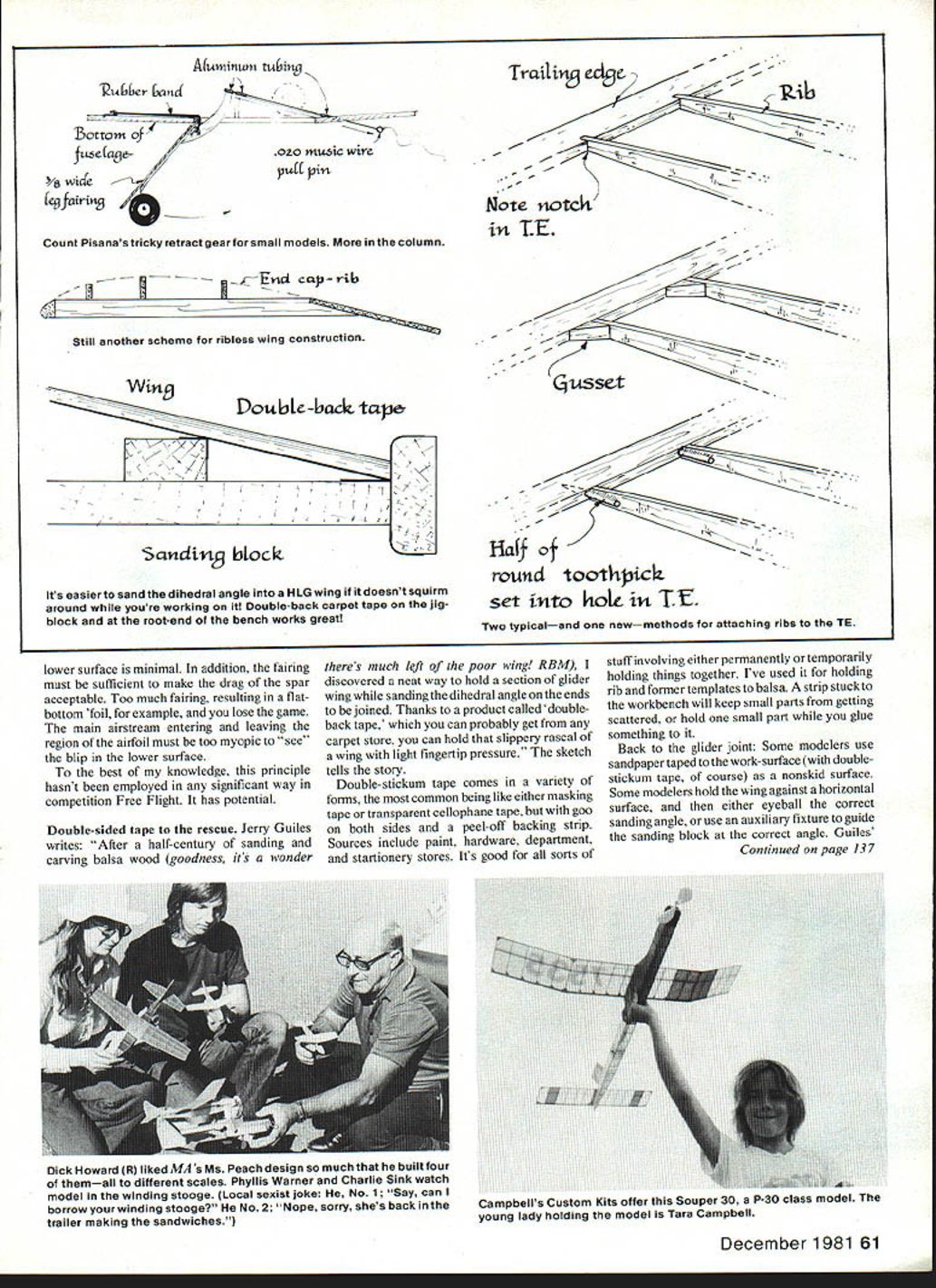
- Glue a short piece of round toothpick or hors d'oeuvre pick into a drilled hole in the TE and glue it to the side rib.
- Pros: Weakens the TE less than slotting, weighs less than a gusset, simpler than cutting gussets or slotting.
- Cons: Adds some weight and requires drilling/cutting effort.
Seredinsky airfoil
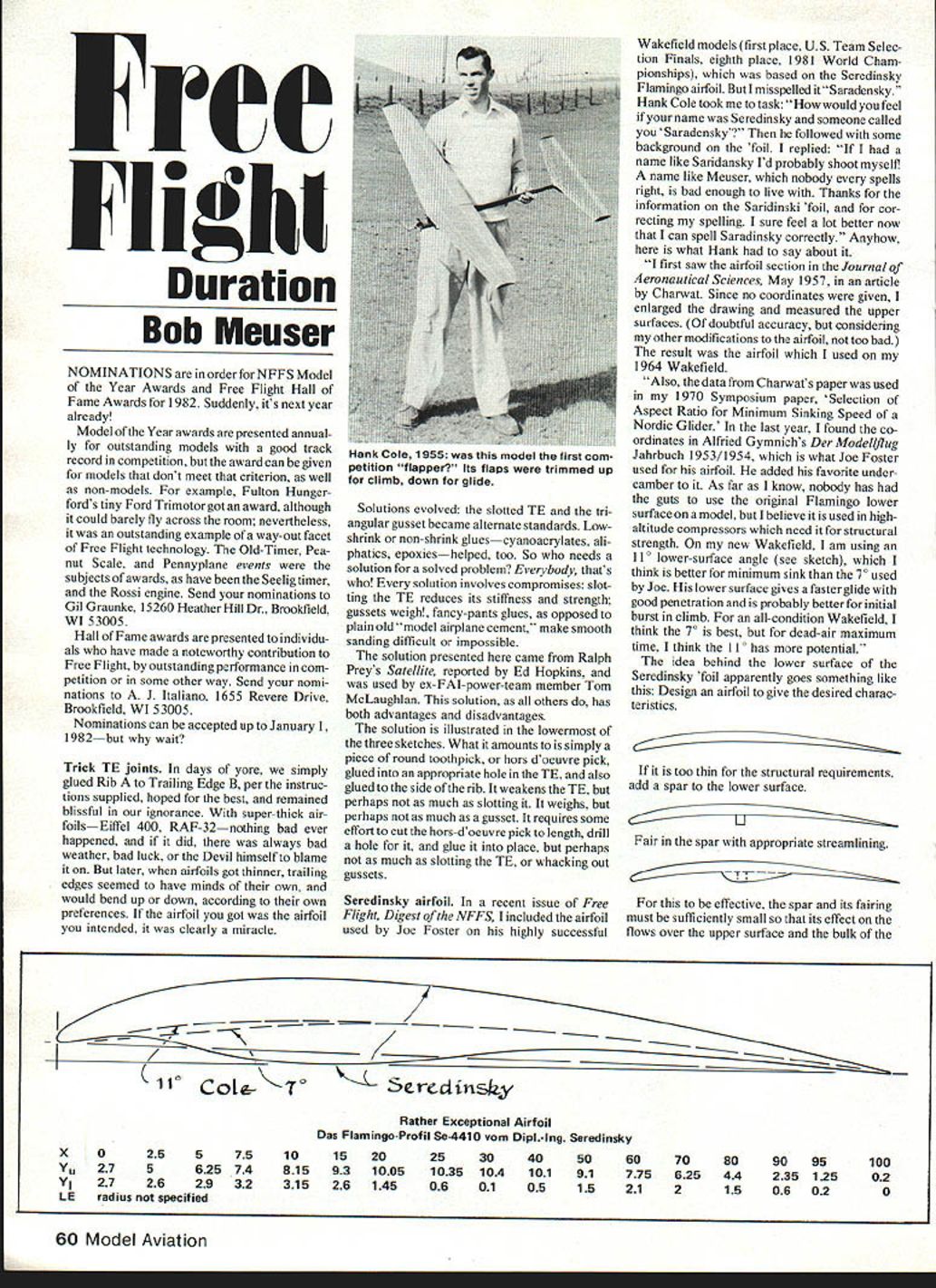
A recent Free Flight Digest item described the airfoil Joe Foster used on his successful Wakefield models (1st place U.S. Team Selection Finals; 8th place, 1981 World Championships). The foil is based on the Seredinsky (Flamingo) airfoil — corrected spelling thanks to Hank Cole.
Background:
- First saw in Charwat's article, Journal of the Aeronautical Sciences, May 1957. No coordinates were given; Hank enlarged and measured the drawing to obtain usable form.
- Charwat's data were used in a 1970 Symposium paper, "Selection of Aspect Ratio for Minimum Sinking Speed of a Nordic Glider."
- Coordinates were later found in Alfried Gymnich's Der Modellflug Jahrbuch 1953/1954 — the version Joe Foster used, to which he added his preferred undercamber.
Notes on lower-surface angle and performance:
- Joe Foster used a 7° lower-surface angle: gives faster glide, good penetration, and likely better initial burst in climb.
- Hank Cole has used an 11° lower-surface angle on a new Wakefield: he believes it yields better minimum sink and more potential for dead-air maximum time.
- For an all-condition Wakefield the 7° may be best; for dead-air maximum time 11° might be preferable.
Structural idea behind the Seredinsky lower surface:
- Design the airfoil for desired aerodynamic characteristics.
- If too thin structurally, add a spar on the lower surface.
- Fair and streamline the spar.
- The spar and fairing must be small so they do not significantly disturb flow over the upper surface or most of the lower surface; fairing must be sufficient to keep spar drag acceptable. The main airstream entering and leaving the region must effectively "ignore" the lower-surface blip.
- This principle has not been widely used in Free Flight competition but has potential.
Double-sided tape to the rescue
Jerry Guiles reports a neat method for holding a glider wing while sanding dihedral on the wing ends: use double-sided ("double-back") tape available from carpet, paint, hardware, department, or stationery stores.
Uses and tips:
- Double-stick tape has adhesive on both sides with a peel-off backing strip.
- Hold slippery parts with fingertip pressure while sanding.
- Tape sandpaper to the work surface to create a nonskid surface.
- Use a strip of tape on the bench to keep small parts from scattering or to hold parts while gluing.
- Useful for holding rib and former templates to balsa.
Ribless construction, revisited
- Meuser's "ribless" wing uses stripwood (or, if undercamber is desired, Indoor-style uniform-depth sliced ribs).
- A similar scheme, credited to Harold Osborne and seen in Scale News and Views, uses sheet balsa for the trailing edge set at an angle to produce undercamber.
- Recommendations: use quarter-sawn (C-grain) sheet and plasticized dope to avoid warps. Non-ribs may be zigzagged for added stiffness.
Trick LG (landing gear)
Count Pisani (same address as Bill Warner) sent a pull-pin sketch for actuating retractable landing gear:
- The pull-pin (music wire or heavy monofilament) holds the gear in the takeoff position and is secured to the launch surface with a length of thread.
- Intended for Embryo Endurance class models required to take off from a table top; could apply to Rubber-Power Speed, AMA Outdoor Rubber-Power Scale, etc.
- Check contest rules — this device might be considered "dropping parts in flight."
- The 3/8-in.-wide leg fairing may add drag that helps the gear retract (or acts like an oar).
Non-climbing rubber hook, revisited
Paul McIlrath's non-climbing rubber hook (described in June) was used successfully at SNART Indoor, but issues appeared when motor length approached twice the hook spacing. Other fliers with even longer motors had no problem. Variations reported:
- S-shaped hooks (difficult to form by hand).
- Paul's original design.
- Diamond-shaped or plain round hooks (often associated with climbing).
Conclusion: performance may depend on rubber type, winding technique, or other variables.
Microfilm trimming tool (Walter Erbach)
- Tiny disposable battery-powered cauteries (used by physicians for wart removal) work as handheld hot knives for trimming microfilm in the field after repairs.
- They look like a pencil flashlight and run on two penlight cells; cost ~ $6 apiece. Under heavy load the battery life is short.
- They are intended disposables, but can be modified (batteries replaced) by those inclined.
- Alternative: rechargeable battery-powered soldering pencils (~$20), though not recommended for medical use.
1981 NFFS Symposium Report
The fourteenth NFFS Symposium report is now available.
Transcribed from original scans by AI. Minor OCR errors may remain.

