
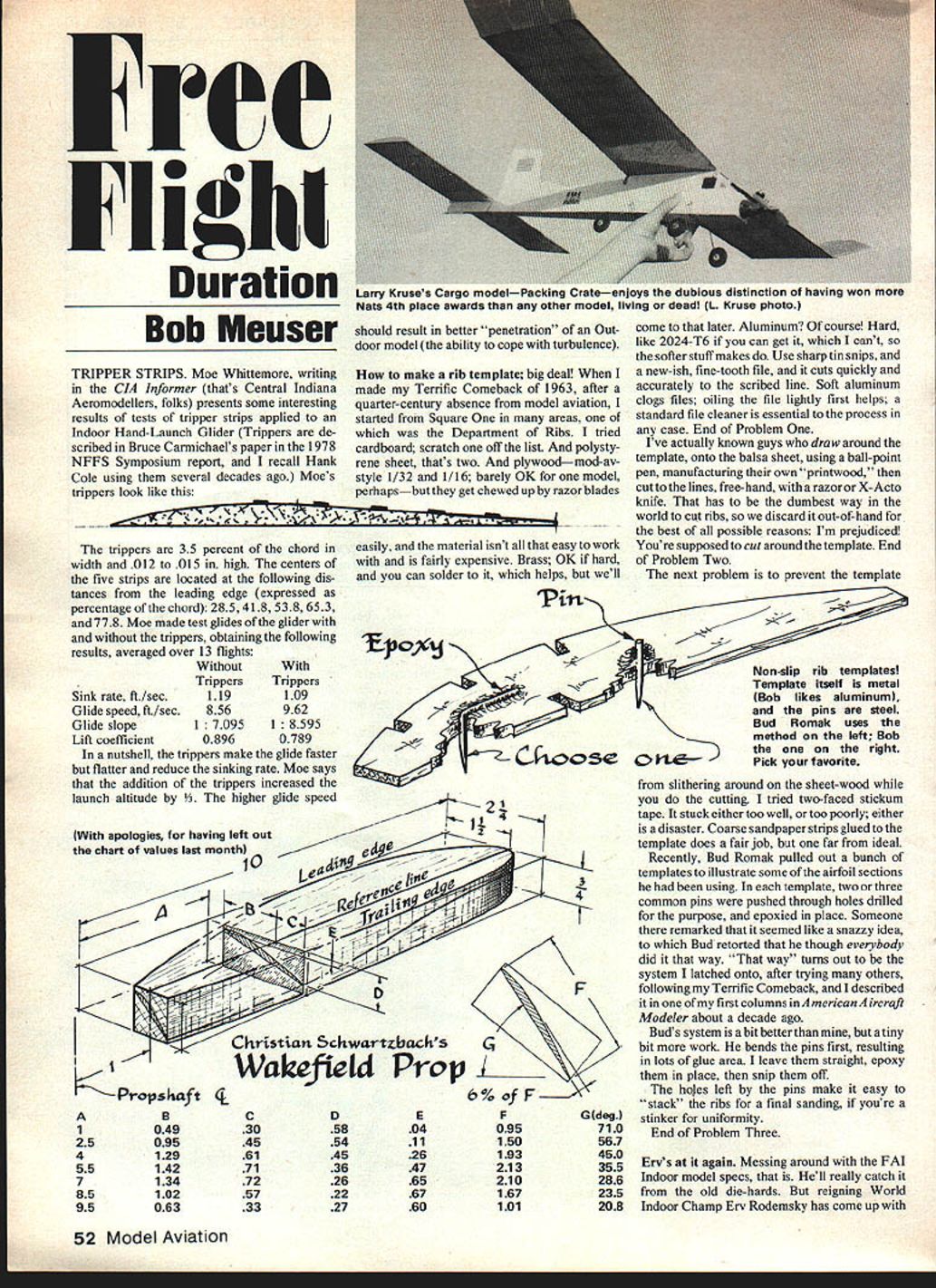
Free Flight: Duration
Bob Meuser
TRIPPER STRIPS
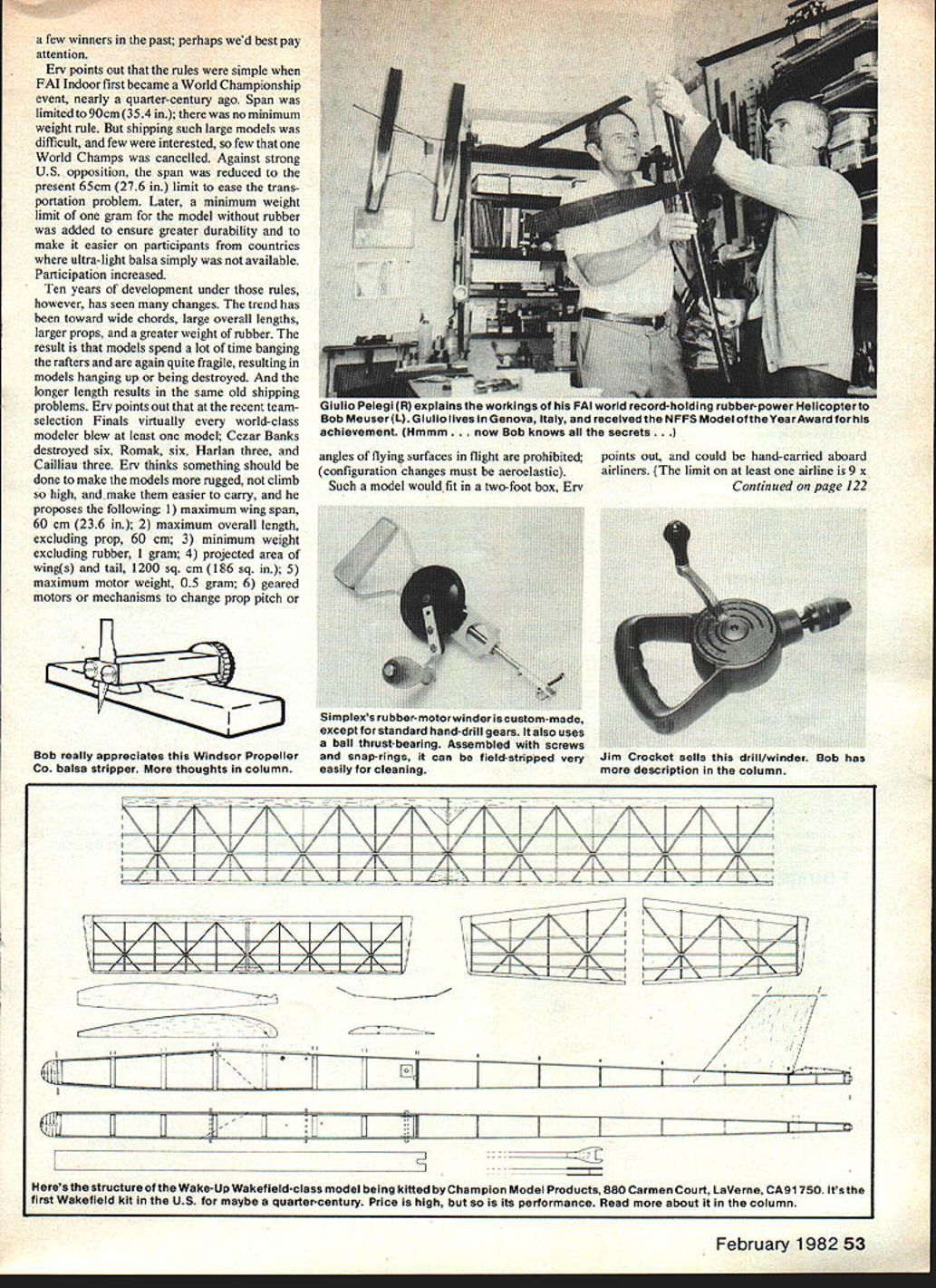
Moe Whittemore, writing in the CIA Informer (that's Central Indiana Aeromodellers), presents some interesting results of tests of tripper strips applied to an Indoor Hand-Launch Glider. Trippers are described in Bruce Carmichael's paper in the 1978 NFFS Symposium report, and I recall Hank Cole using them several decades ago. Moe's trippers look like this:
The trippers are 3.5 percent of the chord in width and 0.012 to 0.015 in. high. The centers of the five strips are located at the following distances from the leading edge (expressed as percentage of the chord): 28.5, 41.8, 53.8, 65.3, and 77.8. Moe made test glides of the glider with and without the trippers, obtaining the following results, averaged over 13 flights:
- Without Trippers:
- Sink rate, ft./sec.: 1.19
- Glide speed, ft./sec.: 8.56
- Glide slope: 1 : 7.095
- Lift coefficient: 0.896
- With Trippers:
- Sink rate, ft./sec.: 1.09
- Glide speed, ft./sec.: 9.62
- Glide slope: 1 : 8.595
- Lift coefficient: 0.789
In a nutshell, the trippers make the glide faster but flatter and reduce the sinking rate. Moe says that the addition of the trippers increased the launch altitude by one-third. The higher glide speed should result in better "penetration" of an outdoor model (the ability to cope with turbulence).
How to make a rib template
When I made my Terrific Comeback of 1963, after a quarter-century absence from model aviation, I started from square one in many areas, one of which was the Department of Ribs. I tried cardboard—scratch that off the list. And polystyrene sheet—scratch two. And plywood—most any style 1/32 and 1/16; barely OK for one model, perhaps—but they get chewed up by razor blades easily, the material isn't that easy to work with, and it's fairly expensive.
Brass: OK if hard, and you can solder to it, which helps, but we'll come to that later. Aluminum? Of course! Hard, like 2024-T6 if you can get it (which I can't, so the softer stuff makes do). Use sharp tin snips and a new-ish, fine-tooth file, and it cuts quickly and accurately to the scribed line. Soft aluminum clogs files; oiling the file lightly first helps. A standard file cleaner is essential to the process in any case. End of Problem One.
I've actually known guys who draw around the template onto the balsa sheet using a ball-point pen, manufacturing their own "printwood," then cut to the lines free-hand with a razor or X-Acto knife. That has to be the dumbest way in the world to cut ribs, so we discard it out-of-hand for the best of all possible reasons: I'm prejudiced! You're supposed to cut around the template. End of Problem Two.
The next problem is to prevent the template from slithering around on the sheet wood while you do the cutting. I tried two-faced stickum tape. It stuck either too well or too poorly; either is a disaster. Coarse sandpaper strips glued to the template do a fair job, but one far from ideal. Recently, Bud Romak pulled out a bunch of templates to illustrate some of the airfoil sections he had been using. In each template, two or three common pins were pushed through holes drilled for the purpose and epoxied in place. Someone there remarked that it seemed like a snazzy idea, to which Bud retorted that he thought everybody did it that way.
"That way" turns out to be the system I latched onto after trying many others following my Terrific Comeback, and I described it in one of my first columns in American Aircraft Modeler about a decade ago. Bud's system is a bit better than mine, but a tiny bit more work. He bends the pins first, resulting in lots of glue area. I leave them straight, epoxy them in place, then snip them off. The holes left by the pins make it easy to "stack" the ribs for a final sanding, if you're a stinker for uniformity. End of Problem Three.
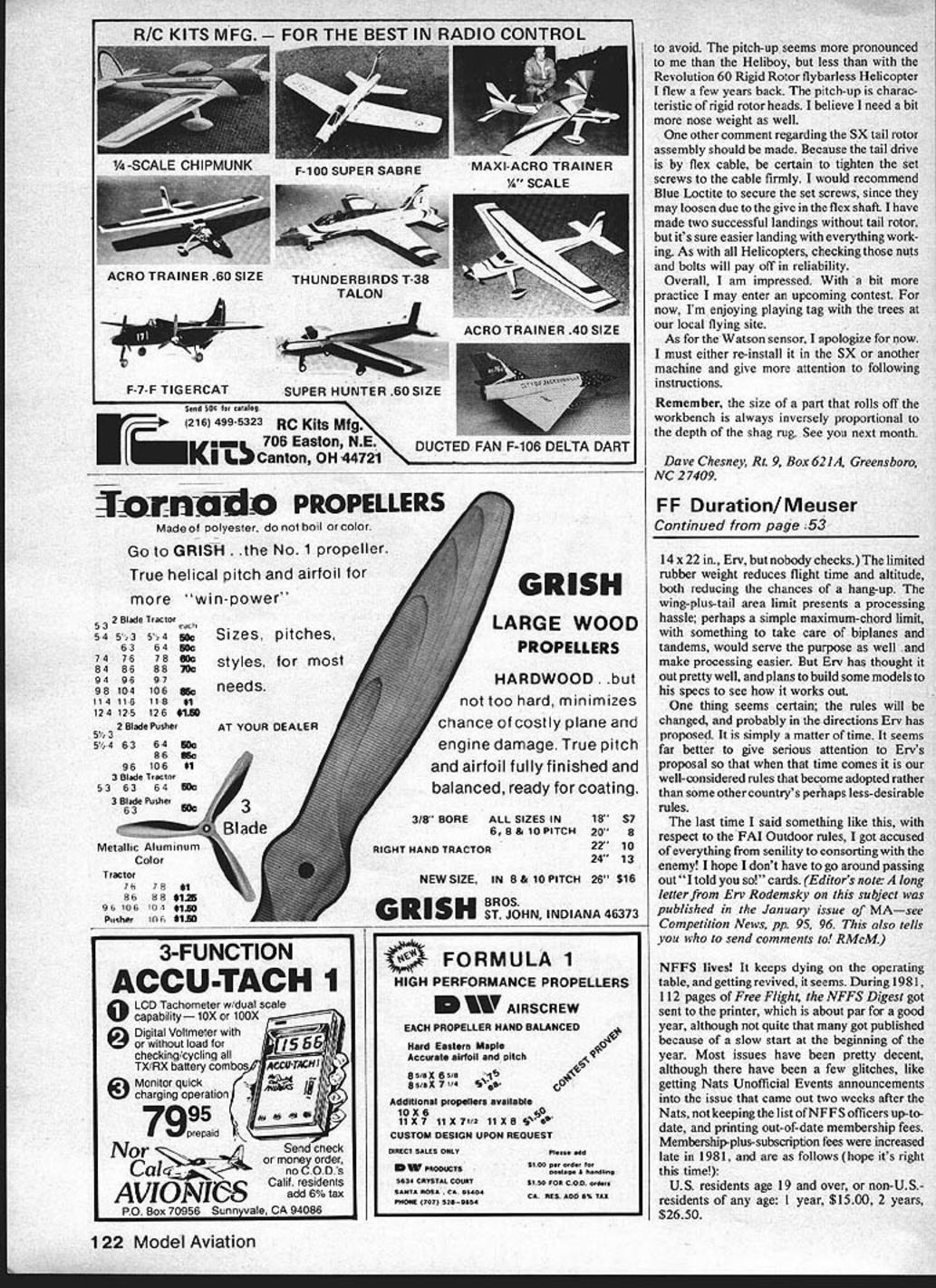
Christian Schwartzbach's Wakefield Prop
Propshaft A B C D E G(deg.) 1 .49 .30 .58 .04 .95 71.0 2.5 .95 .45 .54 .11 1.50 56.7 4 1.29 .61 .45 .21 1.93 45.0 5.5 1.42 .71 .36 .47 2.13 35.5 7 1.34 .72 .26 .65 2.10 28.6 8.5 1.02 .57 .22 .67 1.67 23.5 9.5 .63 .33 .27 .60 1.01 20.8
Erv's at it again (FAI Indoor model specs)
Erv Rodemsky has been looking at the FAI Indoor model specifications. He'll really catch it from the old die-hards, but reigning World Indoor Champion Erv Rodemsky has come up with a few winners in the past; perhaps we'd best pay attention.
Erv points out that the rules were simple when FAI Indoor first became a World Championship event, nearly a quarter-century ago. Span was limited to 90 cm (35.4 in.); there was no minimum weight rule. But shipping such large models was difficult, and few were interested—so few that one World Champ was cancelled. Against strong U.S. opposition, the span was reduced to the present 65 cm (27.6 in.) limit to ease the transportation problem. Later, a minimum weight limit of one gram for the model without rubber was added to ensure greater durability and to make it easier on participants from countries where ultra-light balsa simply was not available. Participation increased.
Ten years of development under those rules, however, has seen many changes. The trend has been toward wide chords, large overall lengths, larger props, and a greater weight of rubber. The result is that models spend a lot of time banging the rafters and are again quite fragile, resulting in models hanging up or being destroyed. The longer length also results in shipping problems. Erv points out that at the recent team-selection finals virtually every world-class modeler blew at least one model: Cezar Banks destroyed six, Romak six, Harlan three, and Cailliau three. Erv thinks something should be done to make the models more rugged, not climb so high, and make them easier to carry, and he proposes the following:
- Maximum wing span: 60 cm (23.6 in.).
- Maximum overall length, excluding prop: 60 cm.
- Minimum weight excluding rubber: 1 gram.
- Projected area of wing(s) and tail: 1200 sq. cm (186 sq. in.).
- Maximum motor weight: 0.5 gram.
- Geared motors or mechanisms to change prop pitch or angles of flying surfaces in flight are prohibited (configuration changes must be aeroelastic).
Such a model would fit in a two-foot box, Erv points out, and could be hand-carried aboard airliners. The limited rubber weight reduces flight time and altitude, both reducing the chances of a hang-up. The wing-plus-tail area limit presents a processing hassle; perhaps a simple maximum-chord limit, with something to take care of biplanes and tandems, would serve the purpose as well and make processing easier. But Erv has thought it out pretty well and plans to build some models to his specs to see how it works out.
One thing seems certain: the rules will be changed, probably in the directions Erv has proposed. It is simply a matter of time. It seems far better to give serious attention to Erv's proposal so that when that time comes it is our well-considered rules that become adopted rather than some other country's perhaps less-desirable rules.
(The last time I said something like this, with respect to the FAI Outdoor rules, I got accused of everything from senility to consorting with the enemy! I hope I don't have to go around passing out "I told you so" cards. — Editor's note: A long letter from Erv Rodemsky on this subject was published in the January issue of MA — see Competition News, pp. 95–96. This also tells you who to send comments to! RMcM.)
NFFS lives!
NFFS keeps dying on the operating table and getting revived, it seems. During 1981, 112 pages of Free Flight, the NFFS Digest, got sent to the printer, which is about part of a good year, although not quite that many got published because of a slow start at the beginning of the year. Most issues have been pretty decent, although there have been a few glitches, like getting Nats Unofficial Events announcements into the issue that came out two weeks after the Nats, not keeping the list of NFFS officers up-to-date, and printing out-of-date membership fees.
Membership dues/subscription fees will be increased late in 1981, and are as follows (hope it's right this time):
- U.S. residents age 19 and over, or non-U.S. residents of any age:
- 1 year: $15.00
- 2 years: $26.50
Transcribed from original scans by AI. Minor OCR errors may remain.

