
Free Flight: Duration
Bob Meuser
UNOFFICIAL EVENTS: "Hey, let's have a contest for..." is the way it starts out, and the next thing you know a new free-flight event is born. Some die a-borning or in early infancy, some go into hibernation for long periods to enjoy occasional rebirth, and a few grow and mature into official events. But growth into official status is not often a goal; if such an event provides pleasure and satisfaction on even one occasion it has served a purpose.
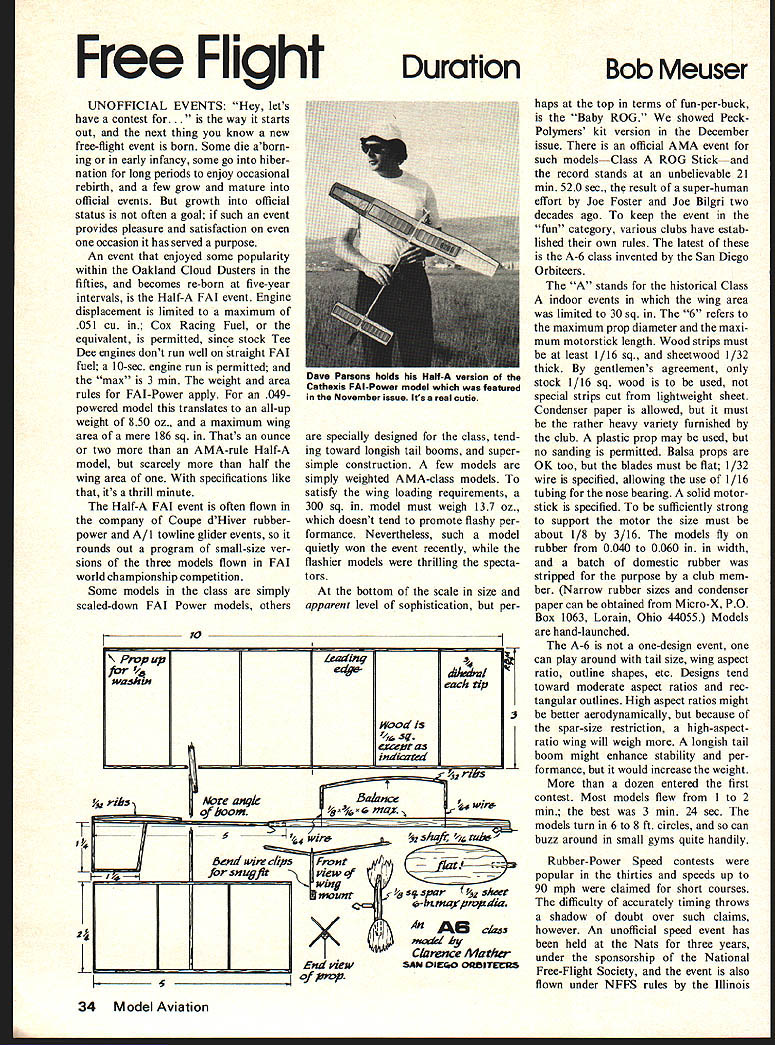
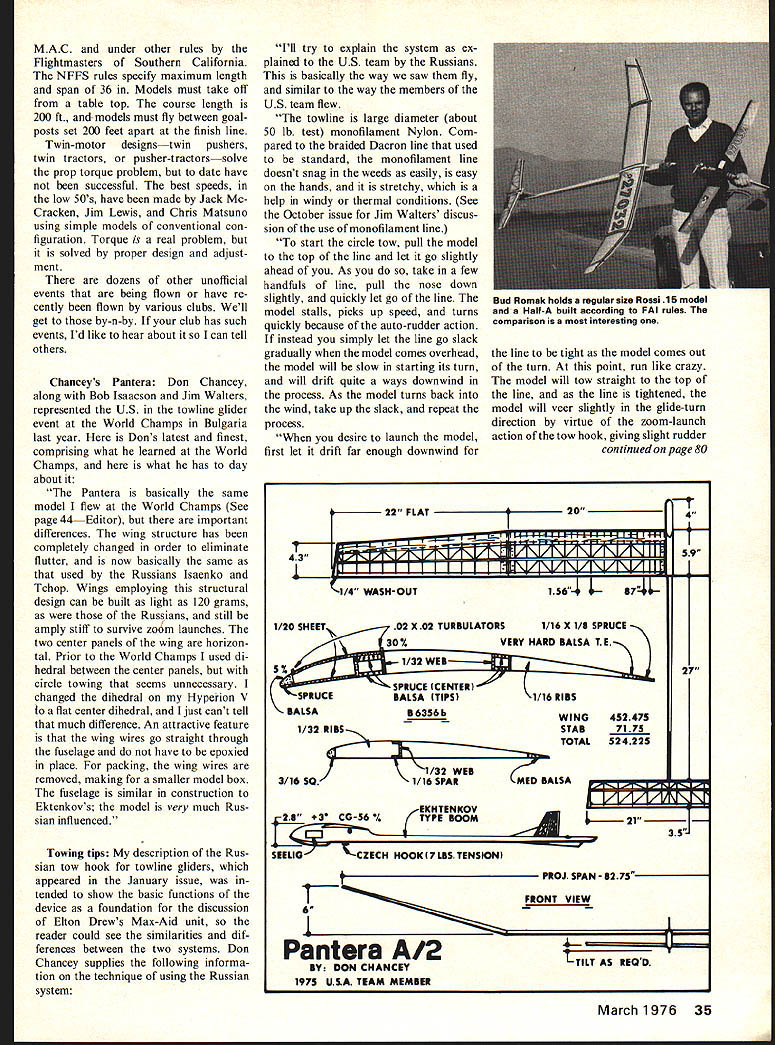
An event that enjoyed some popularity within the Oakland Cloud Dusters in the fifties, and becomes re-born at five-year intervals, is the Half-A FAI event. Engine displacement is limited to a maximum of .051 cu. in.; Cox Racing Fuel, or the equivalent, is permitted, since stock Tee Dee engines don't run well on straight FAI fuel; a 10-sec. engine run is permitted; and the "max" is 3 min. The weight and area rules for FAI-Power apply. For an .049-powered model this translates to an all-up weight of 8.50 oz., and a maximum wing area of a mere 186 sq. in. That's an ounce or two more than an AMA-rule Half-A model, but scarcely more than half the wing area of one. With specifications like that, it's a thrill-a-minute.
The Half-A FAI event is often flown in the company of Coupe d'Hiver rubber-power and A/1 towline glider events, so it rounds out a program of small-size versions of the three models flown in FAI world championship competition.
Some models in the class are simply scaled-down FAI Power models, others are specially designed for the class, tending toward longish tail booms, and supersimple construction. A few models are simply weighted AMA-class models. To satisfy the wing loading requirements, a 300 sq. in. model must weigh 13.7 oz., which doesn't tend to promote flashy performance. Nevertheless, such a model quietly won the event recently, while the flashier models were thrilling the spectators.
At the bottom of the scale in size and apparent level of sophistication, but perhaps at the top in terms of fun-per-buck, is the "Baby ROG." We showed Peck-Polymers' kit version in the December issue. There is an official AMA event for such models—Class A ROG Stick—and the record stands at an unbelievable 21 min. 52.0 sec., the result of a super-human effort by Joe Foster and Joe Bilgri two decades ago. To keep the event in the "fun" category, various clubs have established their own rules. The latest of these is the A-6 class invented by the San Diego Orbiteers.
The "A" stands for the historical Class A indoor events in which the wing area was limited to 30 sq. in. The "6" refers to the maximum prop diameter and the maximum motorstick length. Wood strips must be at least 1/16 sq. in.; and sheetwood, 1/32" thick. By gentlemen's agreement, stock 1/16 sq. wood is used; special strips are cut from lightweight sheet. Condenser paper is allowed, but it must be the rather heavy variety furnished by the club. A plastic prop may be used, but no sanding is permitted. Balsa props are OK too, but the blades must be flat; 1/32" wire is specified for the nose bearing. A solid motorstick is specified. To be sufficiently strong to support the motor the size must be about 1/8" by 3/16". The models fly on rubber from .040 to .060 in. width, and a batch of domestic rubber stripped for the purpose is available to club members. Narrow rubber sizes and condenser paper can be obtained from Micro-X, P.O. Box 1063, Lorain, Ohio 44055. Models are hand-launched.
The A-6 is not a one-design event; one can play around with tail size, wing aspect ratio, outline shapes, etc. Designs tend toward moderate aspect ratios and rectangular outlines. High aspect ratios might be better aerodynamically, but because of the spar-size restriction, a high-aspect-ratio wing will weigh more. A longish tail boom might enhance stability and performance, but it would increase the weight. More than a dozen entered the first contest. Most models flew from 1 to 2 min.; the best was 3 min. 24 sec. The models turn in 6 to 8 ft. circles, and so can buzz around in small gyms quite handily.
Rubber-Power Speed contests were popular in the thirties and speeds up to 90 mph were claimed for short courses. The difficulty of accurately timing throws casts a shadow of doubt over such claims, however. An unofficial speed event has been held at the Nats for three years, under the sponsorship of the National Free-Flight Society, and the event is also flown under NFFS rules by the Illinois Model Aviation Club and under other rules by Flightmasters, Southern California. NFFS rules specify maximum span 36 in. Models must take off from a table-top; course length is 200 ft.; and models must fly between goalposts set 200 ft. apart (finish line). Twin-motor designs—twin pushers, twin tractors, pusher-tractors—solve prop torque problems. To date successful best speeds in the low 50s have been made by Jack McCracken, Jim Lewis and Chris Matsuno using simple models of conventional configuration. Torque is a real problem, but it is solved by proper design and adjustment.
There are dozens of other unofficial events that are being flown or have recently been flown by various clubs. We'll get to those by-n-by. If your club has such events, I'd like to hear about it so I can tell others.
FF Duration/Meuser continued from page 35
deflection. The veering starts when the model is about two-thirds of the way to the top.
"At the desired moment, give an extra hard pull; do not let slack in the line. The model will veer sharply and climb into its glide circle."
Don's description implies that the unlatching of the two-ring keeper and the release of the tow ring take place simultaneously. This implies that the tow hook slopes downward. If the tow hook slopes upward, as does the one in the upper-left photo on page 43 of the January issue, the ring won't come off the hook until the line is allowed to go slack, usually accomplished by jumping wildly into the air. Some fliers have reported occasional difficulty in getting the line to release from the hook. Apparently the Russians have that licked, and the problem of premature unlatching of the ring keeper. One variation the Russians have tried employs an aileron that goes into action starting a few seconds after the model is launched. The part of the Seelig timer that is normally used for engine timing is used to actuate the aileron, and the dethermalizer part of the timer is used in its normal fashion. The timer is started by the unlatching of the line keeper, according to a Russian publication, so it seems clear that they are rather confident that the unlatching won't occur prematurely. Don continues:
"When flying in thermals, use the fact that the line is securely attached. When lift is encountered, don't simply pull the model to the top and let it off. If you have to, let the model circle in the lift until you are absolutely sure of it, making three or four turns if necessary. Then, when you are sure you have good lift, zoom-launch. The Russians zoom-launch in this manner, not just in calm-air flights.
"If you think there is lift downwind or crosswind from you, get the model overhead and out in front of you, get it turned into the right direction, then run as fast as you can toward the thermal, taking in the line hand-over-hand as you go. As long as you keep tension in the line, the autorudder will keep the model going straight. The Russians did this a lot.
"When flying in very calm air, change to a Dacron towline—one that won't stretch. With the stiffer line the hook tension required for unlatching will not have to be decreased for calm-air flying."
(My address is: 4200 Gregory St., Oakland, CA 94619.)
Transcribed from original scans by AI. Minor OCR errors may remain.

