
Free Flight: Duration
Bob Meuser
FF NATS NEWS
Now that Lakehurst, NJ, is out as a Nats site and Lincoln, NE, has been selected, a big effort is under way to have the outdoor Free Flight action take place closer to Lincoln rather than at somewhere in the great beyond—such as Mead—according to usually reliable sources and my personal FFCIA. The local free fliers, upon whom all depends (it's Nature's way), have their eyes on three or four sites, one of which is a 1.5‑mile square (that counts as 36 squares Out West, I think) of pasture land close to Lincoln. The intent is to have a unified Nats, if indeed such a thing is desirable, possible, or has really ever occurred before.
Indoor events would be in the Lincoln Coliseum (with a second quasi‑Nats at West Baden? … or would Lincoln be the more quasi of the two?). If all else fails, outdoor Free Flight would be at Wright Field, with indoor at West Baden. By now you probably know all of this, but it would surely be nice to scoop Competition Newsletter on something, sometime!
Free Flight newsletters
There are a dozen or so really fine Free Flight newsletters kicking around. I'd hate to have to rank them in order of benefit per buck (that's a lie; I'd love to, but I simply don't have the time). All of them are great; some are greater than others. A few that have impressed me by their quality, consistency, and that little spark of something else:
- NFFS Digest
Contact: Hal Woods, 707 Second Street, Davis, CA 95616. (Any resemblance of that address to Doug Galbreath, doing business under the name The Printer, is strictly intentional.)
- C.I.A. Informer (Central Indiana Aeromodelers)
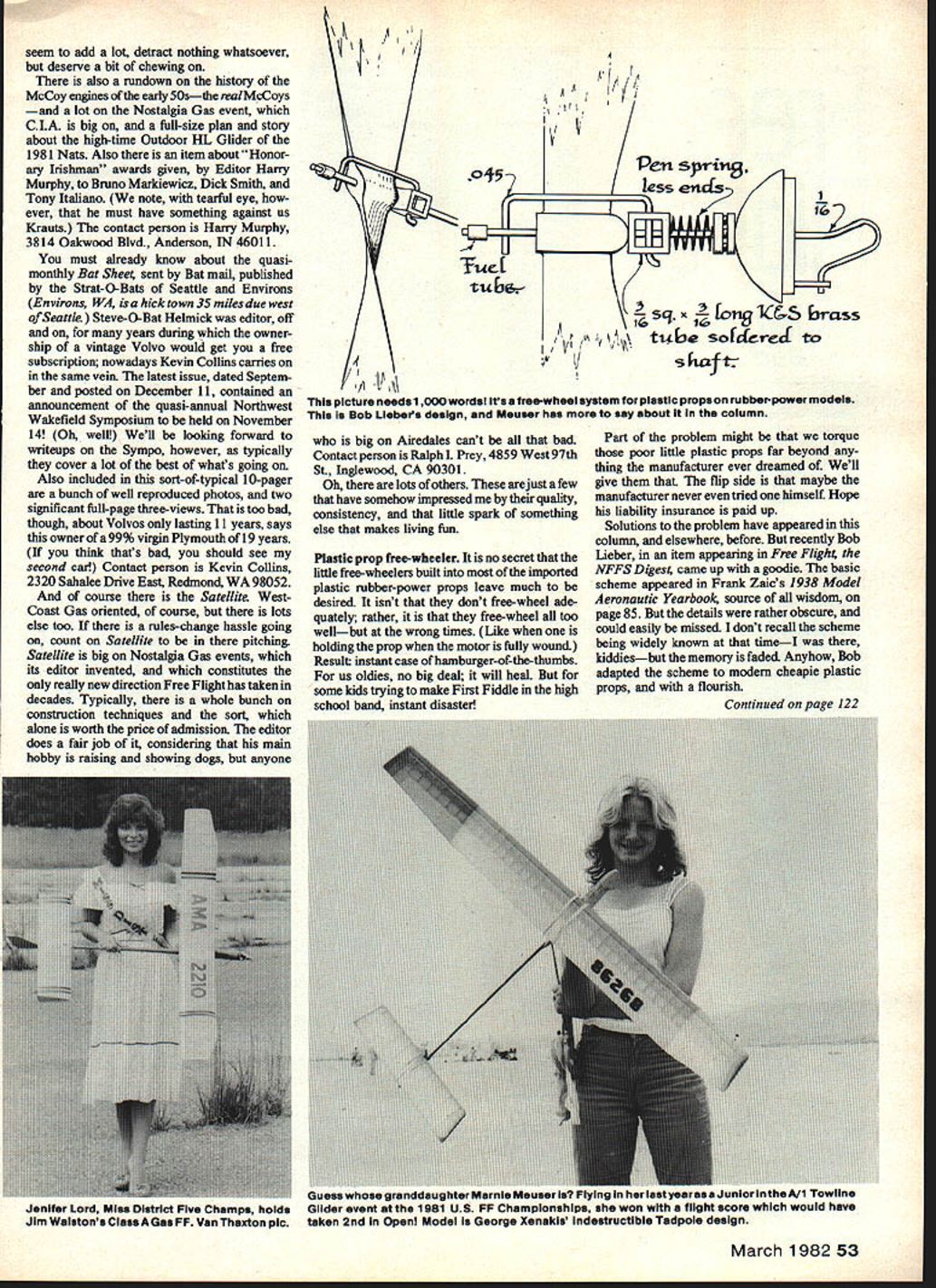
Contact: Harry Murphy, 3814 Oakwood Blvd., Anderson, IN 46011. The December 1981 issue (12 pages) is big on Payload Gas with a full page of very good photos (slightly degraded by reproduction). New rules for this challenging event are proposed and deserve attention. There is also a rundown on the history of McCoy engines of the early ’50s and a lot on the Nostalgia Gas event; a full‑size plan and story about the high‑time outdoor HL glider of the 1981 Nats; and an item about "Honorary Irishman" awards given to Bruno Markiewicz, Dick Smith, and Tony Italiano.
- The Bat Sheet (Strat‑O‑Bats of Seattle and Environs)
Contact: Kevin Collins, 2320 Sahalee Drive East, Redmond, WA 98052. The quasi‑monthly Bat Sheet typically contains well‑reproduced photos and full‑page three‑views. The latest issue (dated September, posted December 11) announced the quasi‑annual Northwest Wakefield Symposium.
- Satellite
Contact: Ralph I. Prey, 4859 West 97th St., Inglewood, CA 90301. West‑Coast Gas oriented but covering a lot more. If there is a rules‑change hassle going on, count on Satellite to be in there pitching. Satellite is big on Nostalgia Gas events (which its editor invented) and usually includes valuable construction techniques.
Oh, there are lots of others. These are just a few that have caught my eye.
Payload Gas and a mathematical correction
One small correction: mathematics is touted as the "universal language," but sometimes things get lost in translation—like in my January 1982 column where the square‑root sign in the compound‑angle formula was omitted. The formula should read:
A = √(ST^2 + DT^2)
Plastic prop free‑wheeler
It is no secret that the little free‑wheelers built into most of the imported plastic rubber‑power props leave much to be desired. It's not that they don't free‑wheel adequately; rather, they free‑wheel all too well—but at the wrong times (like when one is holding the prop when the motor is fully wound). Result: instant hamburger‑of‑the‑thumbs. For us oldies, no big deal; it will heal. But for some kids trying to make First Fiddle in the high school band, instant disaster!
Part of the problem may be that we torque those poor little plastic props far beyond anything the manufacturer ever dreamed of. On the flip side, maybe the manufacturer never even tried one himself.
Solutions have appeared here and elsewhere before. Recently Bob Lieber, in the NFFS Digest, adapted a scheme that originally appeared in Frank Zaic's 1938 Model Aeronautic Yearbook (page 85). The basic idea uses a wee bit of square brass tubing (available at any respectable hobby shop) as a hub reinforcement. Trying to drill a hole in the center of round tubing often produces an off‑center hole; square tubing makes the job easier and more repeatable. The Lieber system as presented is intended for P‑30‑size props and motors but can be readily adapted to other sizes—Outdoor Scale, Embryo Endurance, Peanut Scale, Bostonian Outdoor, Formula "Frisco," etc.
Fly by proxy
Bill Hannah writes: "I feel a lot of modelers are missing out on a good thing if they don't participate in the various proxy contests, especially those that are international in scope. Many—if not most—of us simply cannot afford to travel to distant contests, but nearly anyone can swing the price of sending a model, even with today's postal rates."
Proxy flying has an old and honorable background in model aviation that deserves continuation. In spite of the ill‑advised FAI switch away from proxy flying, the practice will likely continue in many parts of the world. Hannah describes how to prepare and pack a model for proxy shipment to minimize damage and the "proxy log" method of announcing times and results. For full details, write Bill Hannah, 20 South 9th Street, Newark, NJ 07102. (I may have miscopied the numbers, so check before you ship.)
My own proxy experiences were limited. One was with a Manhattan‑formula model—the proxy flyer managed better performance than I ever had. I never got that Manhattan Serenade model back (I'd like the prop I borrowed from my wife and the plywood case I made). On another occasion I won a meet and was presented a handsome plaque. I also placed second in an international paper‑airplane meet sponsored by the San Francisco Chronicle and received one of six first‑place awards in the Great International Paper Airplane Competition sponsored by Scientific American (over 10,000 entrants). So, you win some, you lose some.
All of the dozen or so NFFS‑sponsored unofficial events held at the Nats—and many events sponsored by other organizations—can be entered by proxy, although lining up someone to fly your model can be a hassle. In those cases, contest sponsors will arrange to get a qualified flier to run your model; in other cases it is up to you.
Contest sponsors and organizers can help by sending me information on meets where proxy flying is permitted or encouraged, whether you must dig up your own proxy or whether the organizers will, and when and where to ship your model. Give me at least a three‑month head start, preferably four or five, if you expect results.
Check your rule books!
The 1980–81 rule book states (page 7): "In order for flights to be eligible for national record purposes in classes or events having categories, the meet must be run by the rules of only one category." Recently a whole bunch of outdoor records were set in all three categories at a single contest, which would seem to violate that rule. The explanation was that the "contest" was in fact three contests—one for each category—administered by three different Contest Directors at the same place and time. Fancy footwork at its finest.
That interpretation seems to square with the statement on page 1 that ". . . where the language is clear, there should be no question of sticking by a rule exactly as written." The language is crystal clear. The little creep that sits on my shoulder while I write keeps muttering about "the intent of the rules," but the rule was invented a decade ago and I suspect the intent was clear then as now.
As I remember it, the intent behind the rule was one I don't particularly regard as honorable: it seemed the East Coast interests were afraid the West Coast fliers would run off with all the records in all three categories, which is precisely what has happened despite efforts to rig the rules to prevent that. The next time I get a shot at changing the rules through established procedures, I'm going to take a crack at getting that rule on page 7 scrubbed! Having to obtain three sanctions when one would do nicely is an unnecessary administrative hassle, of which we already have too many.
Whenever I write something with a "!" after every third sentence, I know I'm going to be in trouble. End of harangue—but there'll be more.
Bob Meuser 4200 Gregory Street, Oakland, CA 94619
Transcribed from original scans by AI. Minor OCR errors may remain.

