

Free Flight
DURATION
Bob Meuser
Symposium deadline
Sympo '82, last call! There is barely time to get a paper accepted for the 1982 NFFS Symposium Report. Deadline is April 1. If you are a hardship case, you may be able to negotiate with the editor: Jim Bennett, 324 Helfenstein Ave., St. Louis, MO 63119.
Laminar-flow airfoils for free flight
A usually reliable source reports that three-time FAI Free Flight World Champion Thomas Koster has been experimenting with laminar-flow airfoils for FAI power models. Normally we'd prefer turbulent flow on the upper surface, at least, to help prevent separation during the glide. For the climb, however, laminar flow would reduce profile drag and be advantageous.
Risks remain: separation can cause large drag increases and could occur on both upper and lower surfaces even at near-zero lift if the foil isn't shaped correctly (laminar-flow foils typically have the maximum thickness point well aft). Laminar flow during the glide might occur only at very low lift coefficients, which implies faster glides—contrary to the usual minimum-sink strategy. But a lower profile drag coefficient could flatten the glide at higher speed, reducing induced drag (via lower lift coefficient) and possibly favoring lower aspect ratios (greater chord), which increases Reynolds number and reduces skin-friction drag. Koster reportedly has wind-tunnel access and the thoroughness to potentially develop useful new answers.
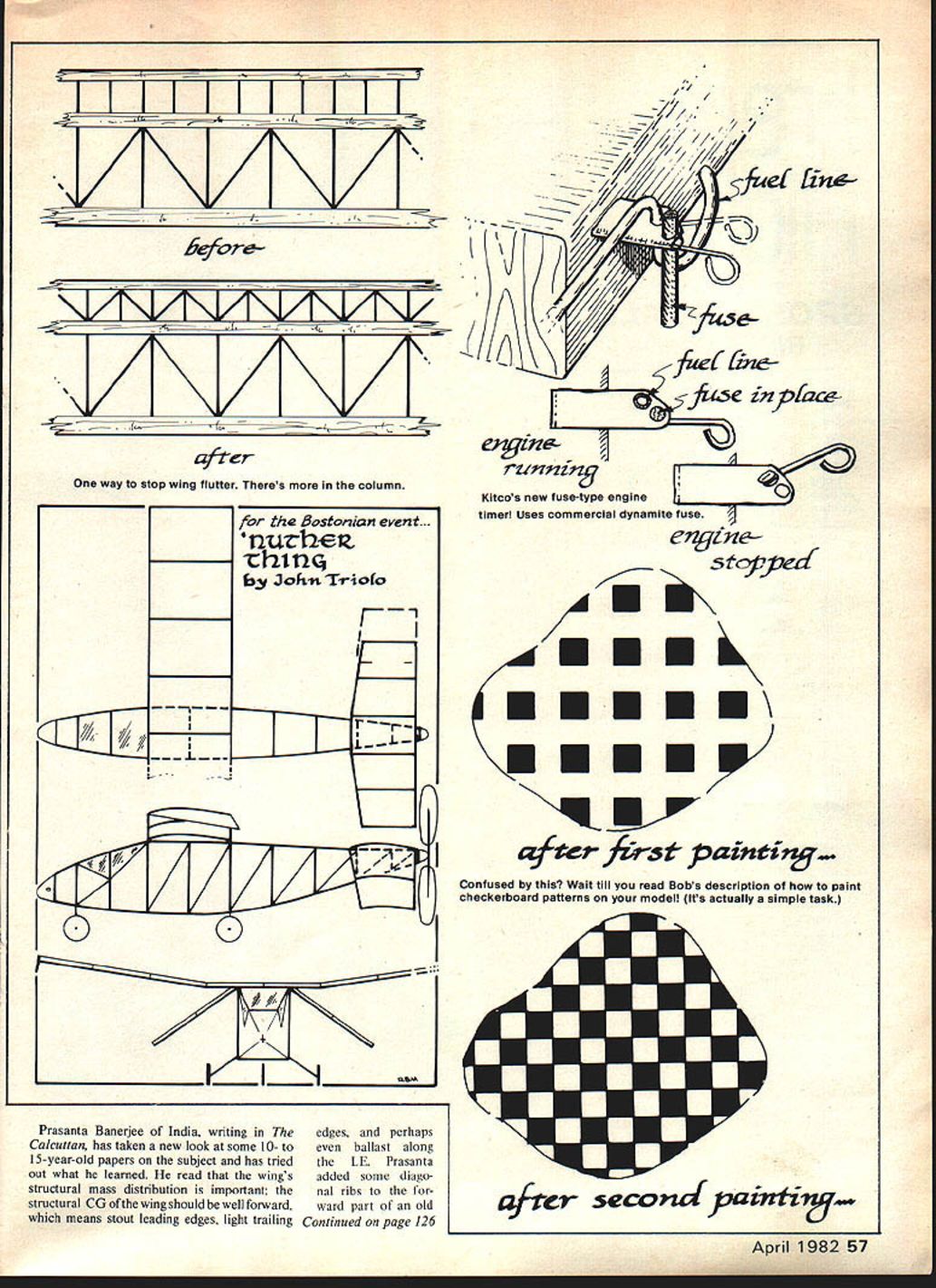
Fuse-type engine timer (Kitco)
Using a fuse as a dethermalizer timer is common; Kitco has introduced an engine timer that uses commercial dynamite fuse for predictable burn speed.
Description:
- The Kitco device is a simple mechanism made from music wire and aluminum tubing. It must be well anchored in the fuselage to prevent tearing out during setup.
- To cock it, push the wire spring to one side and insert a stiff fuse into a hole in the tube. When the fuse burns past the wire, the wire snaps over and pinches the surgical-tubing fuel line, positively shutting off fuel flow.
- The fuse is ignited after the engine starts by means of a “punk” made from a length of Sig DT fuse. Once lit, the fuse cannot be turned off—pinching or dunking in water will not stop it.
Notes:
- It is inherently somewhat risky; users should rehearse the routine carefully.
- Installed weight is about 0.6 oz (saves roughly 0.4 oz over a Tatone-type timer and a few grams over a modified Tomy Toy motor).
- Price (mechanism, fuel tubing, engine fuse, a bit of DT fuse punk, and instructions): $7.50. Order from Kitco, 4327 McDermed, Houston, TX 77035. Add 10% for postage.
Cure for wing flutter
Wing flutter is a common problem across FF competition classes and has become severe for towline gliders as zoom-launch speeds have increased. Increasing torsional stiffness helps:
- Sheet covering
- Boxed-in leading edge
- Diagonal ribs
An example: adding diagonal ribs both increased torsional stiffness and moved the wing's center of gravity forward, which together virtually eliminated a formerly severe flutter problem.
Deluxe fluffy dispenser (cattail thermals)
Cattail “fluffies” are useful thermal-detecting aids but can be messy. Rex Hinson (reported in FMA News) offers a neat dispenser:
Materials:
- Plastic golf club tubes
- Small waxed-paper cups
- Cattails
- Rubber bands
Makeup:
- Cut golf-tube sections slightly longer than the cattail.
- Poke a hole in a paper cup and put the cattail stem through it.
- Insert the cattail into the tube and rubber-band the cup over one end.
- Rubber-band another cup over the other end.
Use:
- When ready, remove one paper cup and push part of the cattail out of the tube.
- After use, retract the unused part into the tube; it can be discarded without making a mess.
Saran film, painting, and repairs
- Saran film (F&M Saran Wrap) is softer than Mylar and tends to scuff on hard landings. Scuffed spots are easily repaired with a bit of 5-minute epoxy or by patching with Mylar.
- The Saran film may be painted on the inside before application; most spray paints work. This gives a factory-painted look at lower cost and improves moisture exclusion (the “Scotch Monocoat” approach).
- Press down tape edges carefully when masking; seal with a clear coat of dope before applying colored coats to prevent seepage.
SFC (Styrofoam/foam + paper + glue) construction — conclusions and experience
It may seem improbable that a flimsy piece of foam can become stiff and strong with only paper and glue, but covering long, thin wings transforms the foam dramatically. Results to date:
- The foam fleet has won nine trophies in five contests using first-generation hardware.
- SFC has been applied successfully to Hand-Launched Gliders, P-30, Coupe, Unlimited Rubber, A-1 Towline Gliders, catapult gliders, and all classes of AMA Gas (.020s through Class D). It’s also natural for CL Combat wings.
- Of roughly 45 models built so far, three were RC; there is potential in Quarter Scale.
- Tapered wings can be SFC-built with only a modest increase in effort. The thicker, wider airfoil often eliminates the need for many silkspan layers at the center, resulting in lighter, more efficient models.
- After years of R&D, SFC could eventually rival balsa, provided modelers remain open-minded and relative material pricing doesn’t change drastically.
For more detailed SFC data and special materials, contact the author: 3744 E. Nye Lane, Carson City, NV 89701. Please include a SASE when inquiring.
Painting checkerboard patterns — step-by-step
It's easier than it sounds. You only need a pair of perpendicular guide lines anywhere in the pattern and masking tape of the correct width (or make it from wider tape).
Steps:
- First paint the background color.
- Lay down horizontal strips of tape, edge to edge.
- Remove every second horizontal strip.
- Repeat steps 2–3 with vertical strips of tape.
- Paint (you are now half finished).
- Remove the vertical strips.
- Replace the horizontal strips that were removed in step 3.
- Remove the horizontal strips that were not removed in step 3.
- Replace all vertical strips, then remove those not removed in step 4.
- Paint the remaining color.
- Remove all remaining tape.
- Admire the work!
Masking tips:
- Press tape edges down carefully; apply a clear-dope seal coat before colored dope.
- To avoid sticky residue or damage when removing tape:
- Use drafting tape (from artist supply stores), or
- Stick masking tape to slick paper first, cut away the paper so only about 1/16 in. of tape edge is exposed, or
- Always remove tape by pulling parallel to the surface, not perpendicular.
Bostonian events (Indoor)
The Bostonian event (as flown in the East) rules:
- Maximum projected wingspan: 16 in.
- Maximum chord: 3 in.
- Maximum prop diameter: 6 in.
- Power: one or more rubber motors only.
- Minimum weight without motor(s): 7 grams (East Coast rule).
- Maximum overall length without prop: 14 in.
- Fuselage must contain a theoretical “box” measuring 1.5 x 2.5 x 3 in. or larger; longerons must support the motor (no motor-sticks).
- Fuselage must have a forward-facing windshield and a window on each side, each at least 1 sq. in.
- Landing gear must be fixed, with two or more wheels of at least 3/16-in. diameter, rigid enough to support a hand-glide landing.
- ROG takeoffs required.
Scoring:
- Charisma factor: judge rates each model for appeal (construction neatness, scale details, uniqueness). Rating scale 1.00 to 1.10.
- Unlimited flights allowed. Score is the total flight time of the best three flights multiplied by the charisma factor.
Notes:
- East Coasters like the 7-gram minimum, though many build lighter and add ballast.
- Bostonian West (San Diego Orbiters) modifications:
- Minimum weight: 14 grams.
- Chord limit applies per wing if multiple wings; total wing area limit: 48 sq. in. (tough on biplanes/tandems).
- Forward windshield rule clarified: projected frontal area counts.
- Open-cockpit models need 1 sq. in. of side vision for an imaginary pilot.
- Some meets require models to carry pre-World War II military insignia.
A larger charisma factor (e.g., 1.2) would encourage more scale detailing, but it only matters if judges use the full scale. Personally, increasing the length limit (e.g., to 20 in.) would better accommodate canards and deltas.
P-24 and beginner classes
P-24 is an indoor event for plastic-prop models with maximum dimensions (span and length) of 24 in., originating in the Pacific Northwest; best time so far is close to five minutes. Dave Hagen suggests a better beginner event would have dimension limits in the 15–20 in. range (Novice Pennyplane fits well), with a plastic-prop requirement to simplify entry for newcomers.
Dave also suggested requiring ROG and permitting flat-blade sheet-balsa props, but ROG and built landing gear add unnecessary hassle for beginners. A plastic-prop Novice Pennyplane would let beginners advance to AMA Novice Pennyplane with relatively little trouble.
Indoor winder
R.M.S. Tooling has introduced an indoor winder with a 16:1 ratio, similar in size to the old metal-case Wilson winder (now apparently out of production). It is not as smooth as the 20:1 Bob Wilder winders and lacks a turns counter, but it is much less expensive.
- Retail price: $11.95; fully guaranteed.
- Dealer discounts for five or more.
- R.M.S. Tooling, 11370 El Dorado Ave., San Fernando, CA 91340.
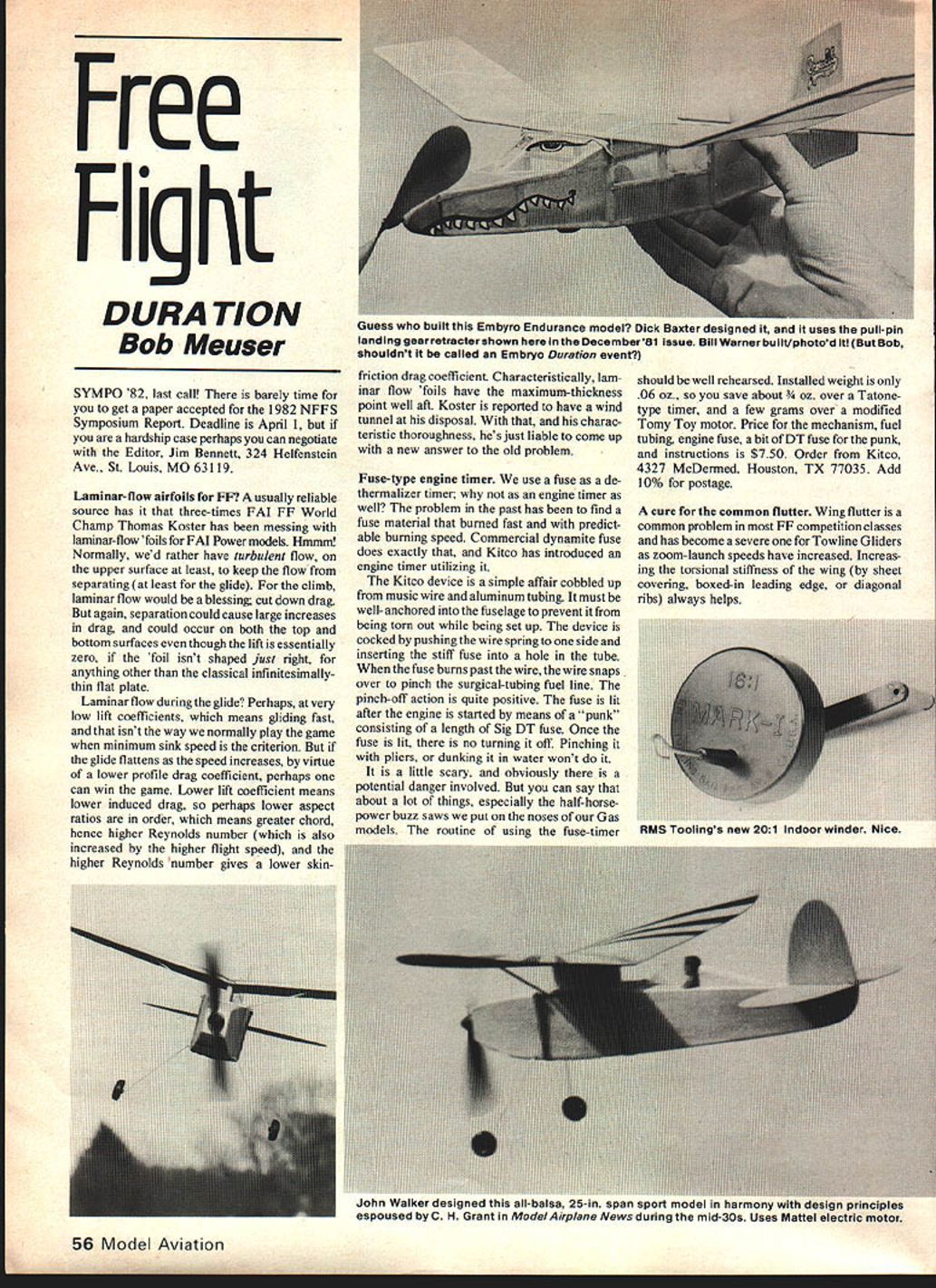
Embryo endurance
Model Aviation once featured an Embryo Endurance model designed by Dick Baxter that uses a pull-pin landing gear retractor (Bill Warner built and photographed the example). The Embryo concept has evolved—duration winners have adapted hubs and designs going back to C. H. Grant’s mid-1930s ideas. Small electric motors and other modern tweaks have updated the basic idea.
Note on leading-edge mass distribution
U. Prasanta Banerjee (Calcutta) revisited 10–15-year-old papers on leading-edge mass distribution and ballast. He found that structural mass distribution matters: internal ribs for the rear part of the wing should be placed well forward. Traditional practice of a stout leading edge and light trailing edge is partly conventional; reconsider mass distribution for better structural behavior.
Transcribed from original scans by AI. Minor OCR errors may remain.

