
Free Flight: Duration
Bob Meuser
The jug — my indispensable shop tool
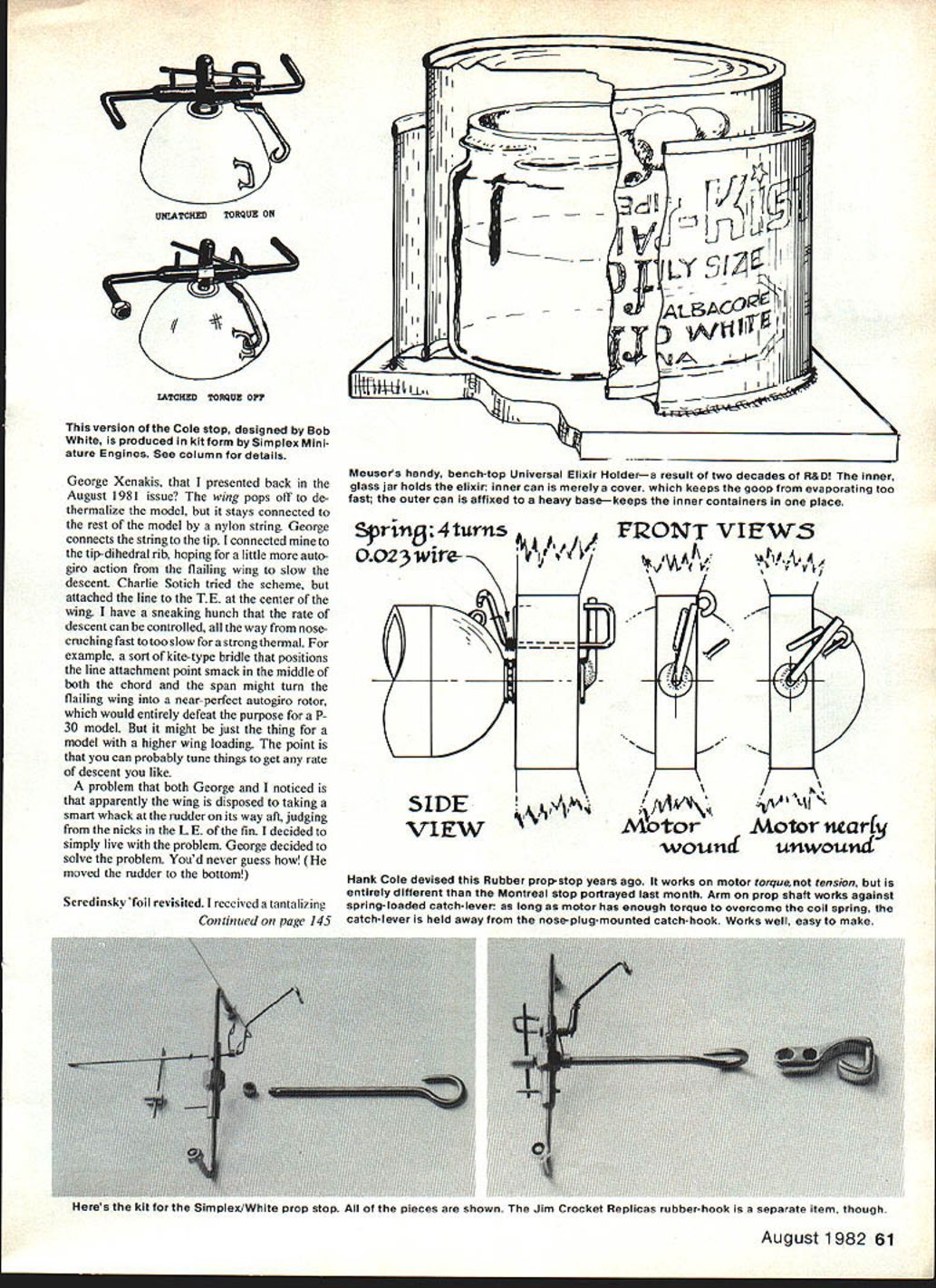
If you were to ask what's the handiest, most often-used, most indispensable tool in my messy, totally disorganized shop, I'd have to say it's my "jug" — it gives me instant, one-hand access to a virtually unlimited supply of Meuser's Patent Elixir, Thinner, and Universal Solvent for cleaning or softening dope brushes, or diluting whatever it is I'm using that needs a bit of diluting. "One-hand" is the key word; no monkey business of laying down what I'm holding in my other hand in order to use both hands to unscrew the lid from a gallon can. And since the Elixir is an ad hoc combination of every solvent and thinner known to modern or ancient man or beast, it will dilute or dissolve most anything in town, except perhaps the glass jar that contains it. I'd swear that sometimes even that got a mite limp!
The previous two-stage version (Mk I) consisted of a Skippy peanut jar, circa 1962, and a can that precisely fit over it with what is known in the trade as a "tunking" fit. The Mark IV version survived for 19 years before crashing onto the concrete and spattering glass and elixir all over the place, me, the dog, and a couple of total strangers. The Mark II version takes two cans plus a glass jar, as I wasn't so lucky in finding things that fit closely. A new feature is that the outer can is epoxied to a heavy piece of metal to ensure that it will survive for more than 19 years this time around. During a long, hot summer a third of the contents will evaporate, so it's best used in a well-ventilated shop. (Mine is well-ventilated, but it hasn't always been that way. The boards just keep falling off.)
Montreal, and other stops revisited
Last month I presented Roger Gregory's rendition of the classic Montreal stop for rubber-powered models. Like the venerable tension stop, it prevents the motor from going completely slack, and it also stops the prop in a definite position so that the blades fold properly. However, unlike the tension stop, the Montreal stop responds to motor torque rather than to tension. There must be some friction or the Montreal stop won't work. Too much friction, as produced by a grain of sand between sliding parts, can prevent it from working.
Some Israeli Wakefielders, no strangers to flying at sandy sites, neatly enclose the works in a spinner, and also have things arranged so the spinner pops back into contact with the nose block when the thing locks, preventing sand from getting in by that route. The opposite philosophy is to have the works exposed, as in Roger's version, where it is almost sure to get dirty, but by the same token it is easily cleaned and checked.
Hank Cole's torque-responsive stop
About a decade ago, Hank Cole invented a torque-responsive stop that is quite different from the Montreal stop. For one thing, rotary motion rather than sliding motion is employed, so it is more tolerant of sand in the works, and it doesn't depend on friction. Instead, the torque results in a force that fights a safety-pin-type spring in a very direct way. When the motor torque pops out, the spring force overcomes the torque-produced force, allowing a hook on the hub to engage a loop on the nose block.
The version shown in my drawing is Hank's second one, cobbled up in a half-hour on one of his more conventional Wakefields, made from music wire and brass tubing (Hank's typical style), combined with a variable-pitch mechanism and miscellaneous other features — he used it on the pusher he flew at the Albuquerque FAI team finals.
Bob White, Simplex production model, and the "hold" feature
Bob White adapted Cole's mechanism to his typical style for making things, and has been using it for many years. The production model of Bob's version, produced by Simplex, is shown in the second illustration and some of the photos. On several I have built I got a fringe benefit in the form of the "hold" feature. If the hook is engaged while the motor is fully wound, then the prop stays locked, and you can use your prop-holding hand for something more important (like scratching something that itches). When you want to launch the model, simply grasp the prop, turn it against the motor torque, and the hook releases. The end of the hook must be shaped just right for this scheme to work reliably.
The kit for this stop is made by John Morrill's company, Simplex Miniature Engines, 143 Richmond St., El Segundo, CA 90245, and it sells for $15 plus 50¢ postage. It is also available from:
- Che Hobbies
- Mike Mulligan's Oldtimer Models
- Jim Crockett Replicas
- Campbell's Custom Kits
(Addresses for all of these cottage-industry folks can be found in my directory, last printed in the May and June 1981 issues of Model Aviation.) All of these companies have lots of good free-flight stuff, so you might want to write for their catalogs.
Wing pop-off to de-thermalize
George Xenakis' idea that I presented back in the August 1981 issue: the wing pops off to de-thermalize the model, but it stays connected to the rest of the model by a nylon string. George connects the string to the tip. I connected mine to the tip-dihedral rib, hoping for a little more autorotational action from the flailing wing to slow the descent. Charlie Sotich tried the scheme, but attached the line to the trailing edge at the center of the wing.
I have a sneaking hunch that the rate of descent can be controlled, all the way from nose-crunching fast to too slow for a strong thermal. For example, a sort of kite-type bridle that positions the line attachment point smack in the middle of both the chord and the span might turn the flailing wing into a near-perfect autorotor, which would entirely defeat the purpose for a P‑30 model. But it might be just the thing for a model with a higher wing loading. The point is that you can probably tune things to get any rate of descent you like.
A problem that both George and I noticed is that apparently the wing is disposed to taking a smart whack at the rudder on its way aft, judging from the nicks in the leading edge of the fin. I decided to simply live with the problem. George decided to solve the problem. You'd never guess how! (He moved the rudder to the bottom!)
Seredinsky's foil revisited
I received a tantalizing note from Bill Bogart. It seems that a friend of Bill's dredged up a report written by Seredinsky when both the friend and Seredinsky were working at Grumman. So far, all I have is the title page and one interior page that Bill thought I might find interesting. It shows airfoil cross sections labeled "The Modifications on Airfoil Sec 4410." The four sections are:
- the original with a 1% leading-edge radius,
- a modified version with a 3% nose radius,
- one with a turbulator wire ahead of the foil,
- and one apparently with something like sand stuck to the top surface over the first 20% of the chord.
Number five is the now-familiar "flamingo" foil. Also shown are CL vs CD polars for the five sections, derived from model flight tests in the Reynolds-number range of 45,000 to 30,000 (that's where we live!).
The curves seem a little too smooth, and no experimental points are shown, which makes me feel a little uneasy; nevertheless — worst of the bunch was the 2% nose; a big loss was the unmodified Se 4410 with the 1% nose. Then came the sandy-surface modification; then the original foil with a turbulator of 1/8" diameter situated 7% ahead of the leading edge; and finally the "flamingo," with its 0.7% leading-edge radius. The basic foil looks something like a thinned-down RAF-32 or Eiffel 400, of all things.
The report says it is "Edited by Dr. A. Raspet, Mississippi State College," which is about as good as you can get, credentials-wise. Gus Raspet is one of my heroes, having done really fine work in low-Reynolds-number aerodynamics, and especially the aerodynamic characteristics of soaring birds. He got wiped out in a glider crash, as I recall.
Maybe we'll get at the root of this Seredinsky business yet. Bill has offered to loan me a copy of the report. I'll get back to you with whatever seems interesting. Stay tuned, OK?
Toobee — the thinking man's Frisbee?
I'd seen the Toobee on the telly and in local news publications. It was conjured up by some youngsters in Berkeley, and they built machines to neatly cut the cans, roll the edges, and print the flying instructions on the inside of the can. Thrown with a bit of spin, one goes for quite a distance. I had to have one — but try to find it! Finally, I bumbled into a basketful of them at a knick-knack gift shoppe at some tourist-trap up the coast, exchanged the required coin-of-the-realm for a pair, and proceeded back to Heritage House (scene of the movie Same Time, Next Year) for a test flight on the lawn (I was holed up there, so I wasn't trespassing). A fellow strolling past remarked to his wife, "Imagine a grown man throwing around a piece of old beer can." Quick as a whip I countered: "That's the good part; the bad part is a grown man paying $1.89 for a piece of an old beer can, and an empty one at that!"
You can whittle one out yourself, of course, but the sharp edges tend to get blood on the carpet. The center of gravity has to come out at about 25% of the chord, as you might have imagined. So what's this got to do with Free Flight model aviation? Well, it flies, and it doesn't carry a person, and there are no strings or radio.
"Smatter, ain'tcha ever seen a spin-stabilized, axisymmetric hand-launch glider before?"
Bob Meuser 4200 Gregory St. Oakland, CA 94619
Transcribed from original scans by AI. Minor OCR errors may remain.

