
Free Flight: Duration
Bob Meuser
Twin Pushers
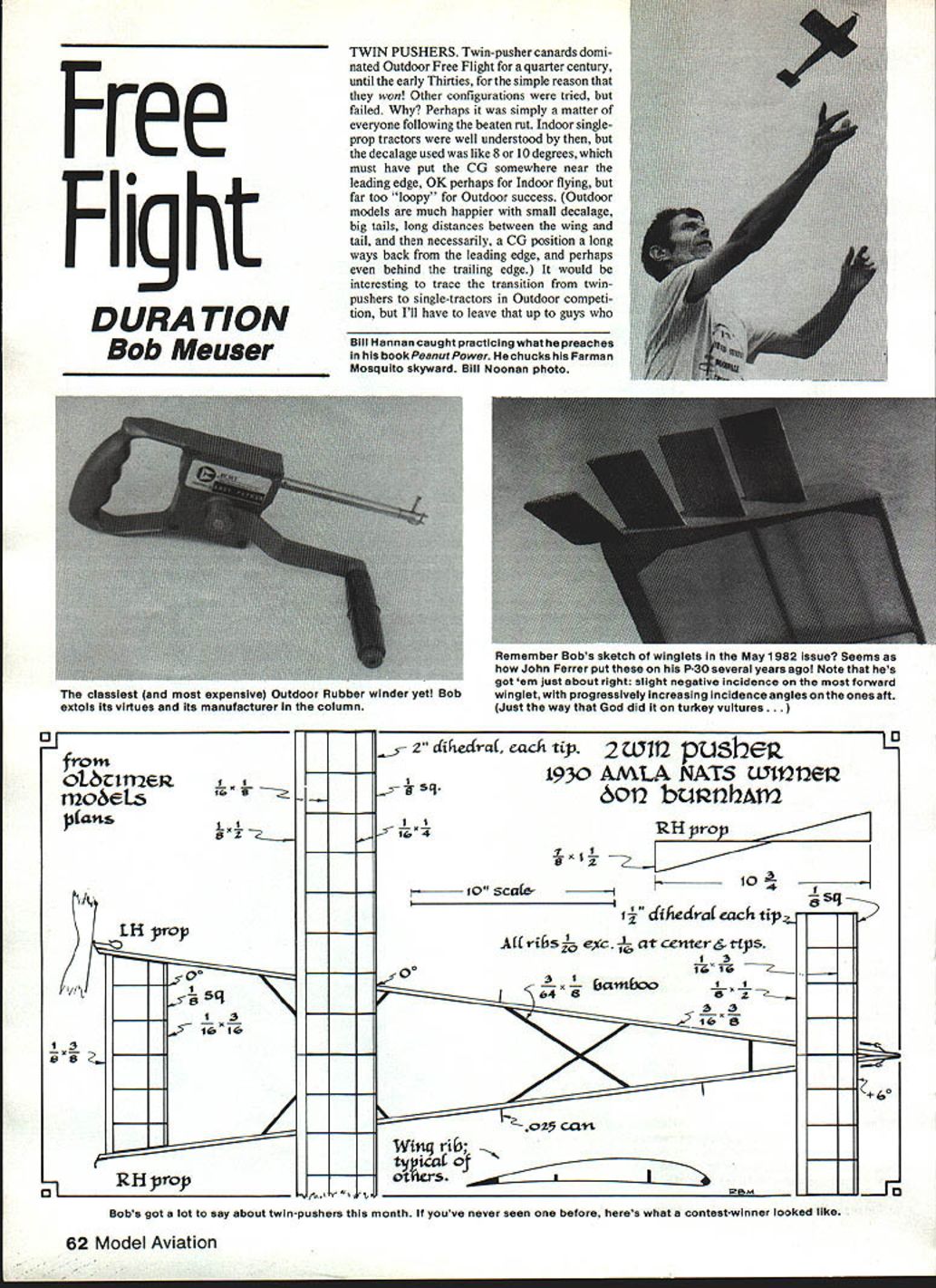
Twin-pusher canards dominated Outdoor Free Flight for a quarter century, until the early Thirties, for the simple reason that they won. Other configurations were tried but failed. Why? Perhaps it was simply a matter of everyone following the beaten rut. Indoor single-prop tractors were well understood by then, but the decalage used was like 8 or 10 degrees, which must have put the CG somewhere near the leading edge—OK perhaps for Indoor flying, but far too "loopy" for Outdoor success. Outdoor models are much happier with small decalage, big tails, long distances between the wing and tail, and then necessarily a CG position a long ways back from the leading edge, and perhaps even behind the trailing edge. It would be interesting to trace the transition from twin-pushers to single-tractors in Outdoor competition, but I'll have to leave that up to the guys who were there, and there aren't many left.
The one shown in my sketch—Don Burnham's—is pretty typical of the more advanced twin-pushers of the early Thirties. Later, some guys gussied them up with motors enclosed in rolled balsa tubes and such, but by then they didn't make much impact. I'm told that twin-pushers are easy to adjust; I can't vouch for that myself. Build everything straight as a die, tilt the foreplane—as they called it—left-tip-up for a right circle, or rotate it about its vertical axis left-tip-forward. Move the mainplane (wing, that is) fore or aft until the glide is OK. If that makes it too loopy in the climb, decrease the angle of incidence of the foreplane and readjust the wing position for a good glide. Thrust-line angle adjustments were not used in those days, so using a double-ended thrust bearing is tantamount to cheating.
If you don't know what a "can" is, as specified on the drawing, I'll try to tell you, but I'd suggest you get an old book on model aviation from the library. A can is simply a 3/4-turn loop of wire secured to the motor stick, with the open side up. After winding the motor(s) you simply pop it (them) into the tops of the cans. The cans keep the unwound motor(s) from sagging all over the place and also help prevent the motor stick from buckling if it is a bit too limp.
The model shown in the sketch was copied from plans available from Oldtimer Models. John Pond's plans service probably has a bunch of twin-pushers available, too. You will also find many in earlier issues of Frank Zaic's Model Aeronautics Yearbooks and in Bert Pond's '76 Commemorative Book (both of the latter are available at reduced prices from AMA Supply and Service). Bill Baker presented an article on TPs in the August/September 1982 issue of the NFFS Digest.
HLGs for Juniors
There aren't too many Outdoor Hand-Launch Glider designs that are suitable for youngsters in the 9 to 12 age bracket. As a solution, Fred Terzian suggests getting reduced-size Xerox (or similar) copies. Several commercial machines that you are likely to find in instant-print shops have something around 77% as a standard ratio, which brings an 18–20 in. span down to 14–15½ in., which is just about right for younger arms. Fred's youngest, Christopher, at age nine can handle a model of that size quite nicely and got two maxes at the U.S. FF Champs with his Eaglet of about that size. Eleven-year-old David Terzian has been flying a scaled-down Foster's Freeze but is now big enough to handle the full-size gliders; he got two maxes and third place using a Polly.
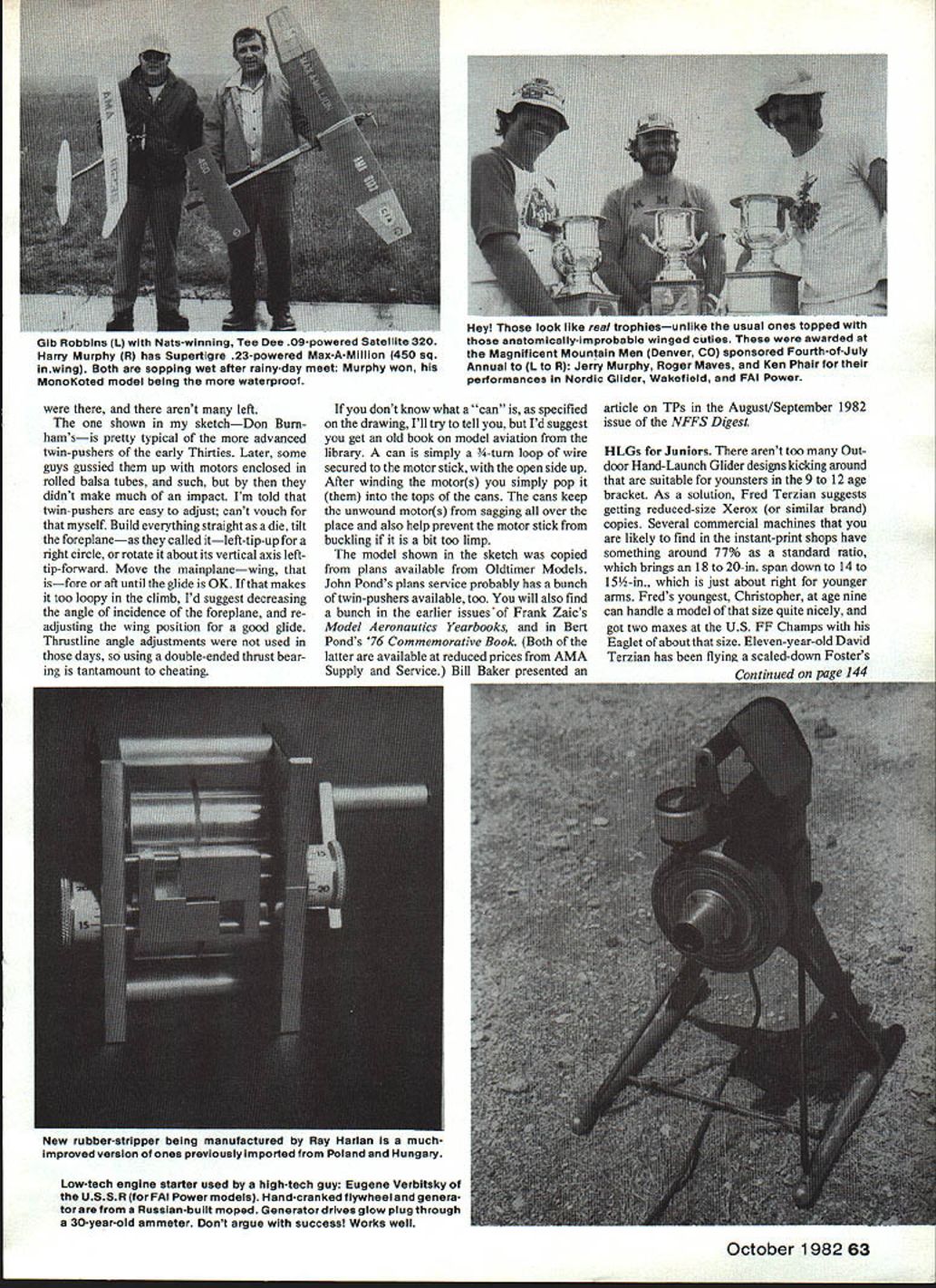
Yet another Outdoor rubber winder
The price tag on this baby will knock your hat off, but then what doesn't, nowadays? It is built by Burt Precision, headed by Mike Di Martino. The housing is hogged out of a block of aluminum alloy, anodized blue for corrosion and scuff resistance, and it is absolutely gorgeous. The speed switch is by a set of helical gears. All bearings are anti-friction types: ball, roller, and needle. Bob Piserchio has been using a prototype for several years without a hitch.
Helical gears are a wee bit on the scary side: essentially they amount to a worm-gear set run the wrong direction, but that's OK if they are aligned and lubed properly. Larry Parsons built one some 40 years ago which worked fine for about 25 years, then started binding up. It turned out to be a lube problem, easily cured.
The Burt Precision device is lubed with a Teflon-loaded goop that is supposed to stay put and not wipe off. Let me know in 25 or 30 years whether the claims are true; I'd like to know. The base price is (gulp!) $162; white sidewalls, radio, and air conditioning are available at slight extra cost. Order from Burt Precision, c/o Bob Piserchio, 5257 Stone Court, San Diego, CA 92115.
New rubber-stripper available
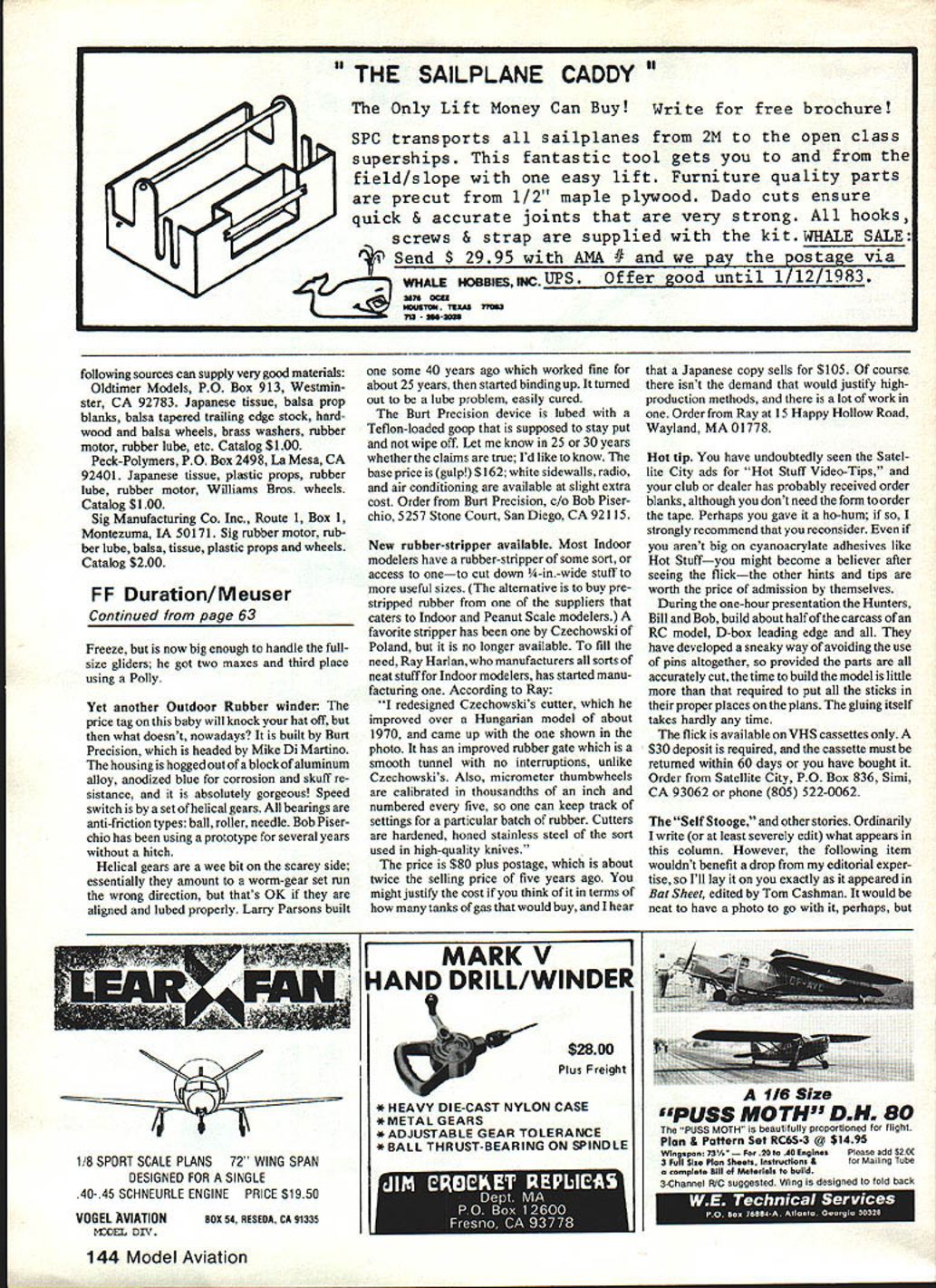
Most Indoor modelers have a rubber-stripper of some sort, or access to one—to cut down 1/4-in.-wide stuff to more useful sizes. (The alternative is to buy pre-stripped rubber from one of the suppliers that cater to Indoor and Peanut Scale modelers.) A favorite stripper has been one by Czechowski of Poland, but it is no longer available. To fill the need, Ray Harlan, who manufactures all sorts of neat stuff for Indoor modelers, has started producing one.
According to Ray: "I redesigned Czechowski's cutter, which he improved over a Hungarian model of about 1970, and came up with the one shown in the photo. It has an improved rubber gate which is a smoother tunnel with no interruptions, unlike Czechowski's. Also, micrometer thumbscrews are calibrated in thousandths of an inch and numbered every five, so one can keep track of settings for a particular batch of rubber. Cutters are hardened, honed stainless steel of the sort used in high-quality knives."
The price is $80 plus postage, which is about twice the selling price of five years ago. You might justify the cost if you think of it in terms of how many tanks of gas that would buy, and I hear that a Japanese copy sells for $105. Of course, there isn't the demand that would justify high-production methods, and there is a lot of work in one. Order from Ray at 15 Happy Hollow Road, Wayland, MA 01778.
Hot tip
You have undoubtedly seen the Satellite City ads for "Hot Stuff Video-Tips," and your club or dealer has probably received order blanks, although you don't need the form to order the tape. Perhaps you gave it a ho-hum; if so, I strongly recommend that you reconsider. Even if you aren't big on cyanoacrylate adhesives like Hot Stuff—you might become a believer after seeing the flick—the other hints and tips are worth the price of admission by themselves.
During the one-hour presentation the Hunters, Bill and Bob, build about half of the carcass of an RC model, D-box leading edge and all. They have developed a sneaky way of avoiding the use of pins altogether, so provided the parts are all accurately cut, the time to build the model is little more than that required to put all the sticks in their proper places on the plans. The gluing itself takes hardly any time.
The film is available on VHS cassettes only. A $30 deposit is required, and the cassette must be returned within 60 days or you have bought it. Order from Satellite City, P.O. Box 836, Simi, CA 93062 or phone (805) 522-0062.
The "Self Stooge," and other stories
Ordinarily I write (or at least severely edit) what appears in this column. However, the following item wouldn't benefit a drop from my editorial expertise, so I'll lay it on you exactly as it appeared in Bat Sheet, edited by Tom Cashman. It would be neat to have a photo to go with it, perhaps, but some things are better left to the mind's eye.
"Al Borer dazzled us with a few moves not previously seen in local competition. First was the concept of the 'Self Stooge.' Al invented this when he discovered that his rather unusual Coupe wouldn't fit into a conventional stooge. He sort of hunkers down like someone preparing for the standing broad jump, with his Coupe positioned below his posterior, nose forward, wings lodged in back of his flexed knees. Next he engages his winder in the rubber hook, and holding the winder bass-ackwards he extends his arms full length to stretch the rubber. Then he begins winding with all the grace of an octopus falling out of a tree.
"The winding becomes very cautious as he approaches full turns—obviously the motor could break and severely damage Al's equipment. The Coup could be hurt too....
"The other innovative concept was the Yo-Yo Launch. This followed the Self Stooge ritual as soon as a timer had been procured. Al would assume a heroic stance and vigorously launch the model. It would immediately return to his hand! It seems that it's really easy to wind the rubber counter-clockwise when employing the Self Stooge system."
Unlimited Mulvihill event
This event will be held for the sixth consecutive year at the 1983 U.S. Free Flight Champs, but there will be a change: previously it has been held on Saturday (the first day of the meet), but from here on it will be held on Sunday, the second day of the meet.
It has been a long time since I sent the rules for the event around to various clubs, and I don't think they have ever been published, so it seems high time to do so. I suggest that other clubs flying such an event use the same rules simply for the sake of standardization.
#### Model Design and Construction
- AMA rules for Mulvihill Outdoor Rubber models apply, except as specified herein.
- Wing and tail surfaces must be either solid wood construction or framed construction covered on both sides.
- Rubber motor(s) must be fully enclosed within the model structure.
- Minimum weight of model: 60 grams including rubber motor, or 30 grams without rubber motor—use whichever is more lenient.
#### Procedures
- A contestant is allowed one flight. Any attempt to make a flight where the model leaves the contestant's hand is considered a "flight."
- The timekeeper may move about, but only in the immediate area of the model-launching site, and only to the extent necessary to prevent the model from being obscured from sight by local objects. Optical aids of any sort are permitted.
- Models must be launched between 6:00 a.m. and 6:20 a.m.
- Times are to be recorded in minutes and seconds; fractions of seconds are to be dropped.
- Score is to be recorded by the timekeeper, with his signature, on a standard 3x5 file card giving the contestant's name and AMA number.
- Proxy flying is permitted. Contest management will not provide proxy fliers.
#### General
- Timekeepers tend to be scarce at 6:00 a.m., so bring a friend if possible.
- In keeping with the goal of the event, if the weather conditions are such that models are likely to go out of sight, in the opinion of the Event Director, the event will be postponed.
- Build light, trim deftly, practice lots, live clean, and beat Bob White!
The 6:00 a.m. start time used in these rules represents the time of sunrise at Taft on Memorial Day. If you're going to fly at a different site and date, adjust your starting time to agree with sunrise at your meet.
FF Hall of Fame
The National Free Flight Society has announced the recipients of the Free Flight Hall of Fame Award for 1982. The Society is proud to recognize their achievements.
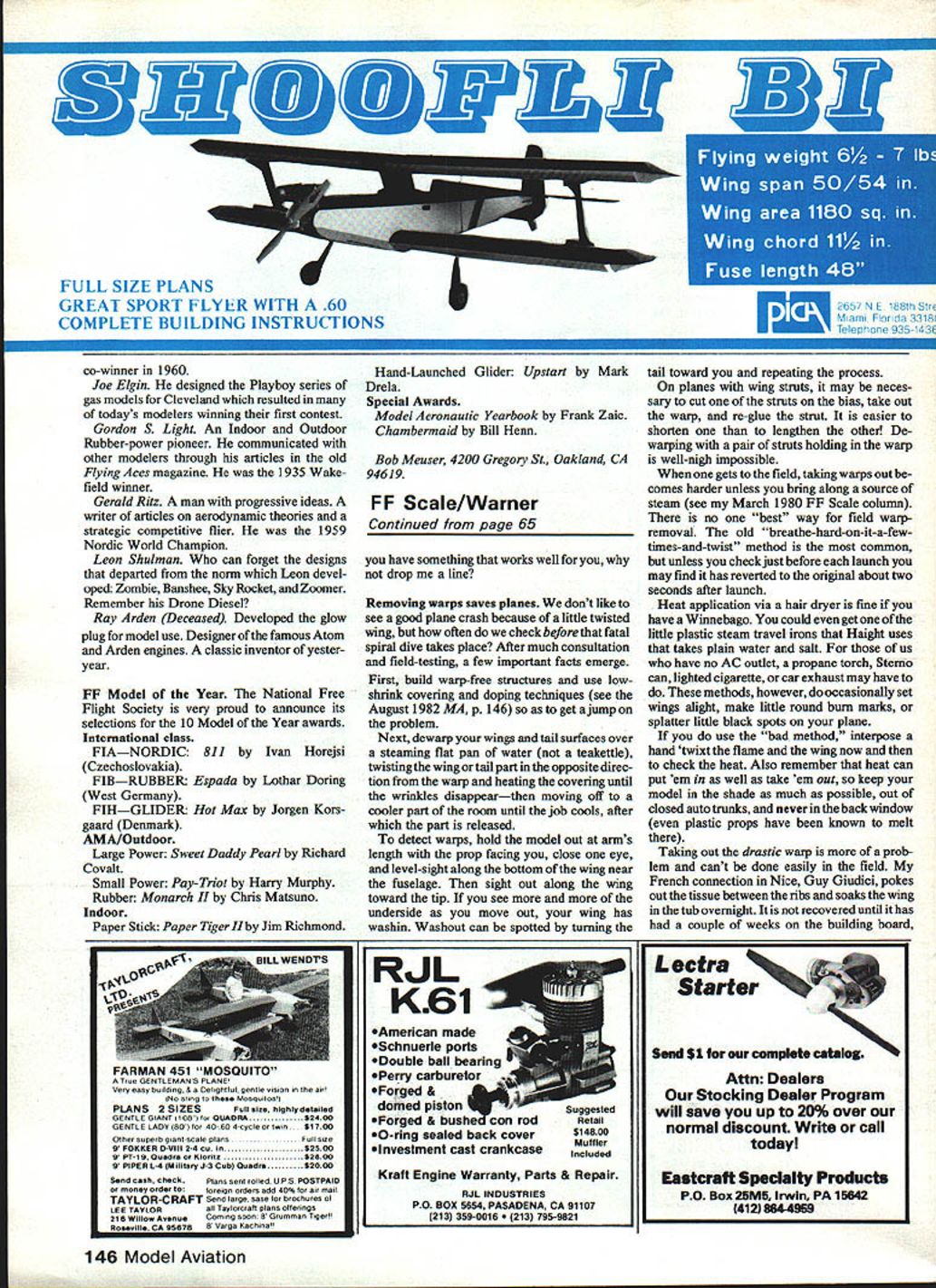
- Lawrence Conover — His articles in American Modeler ("No Strings Attached") were the source of much modeling know-how for other builders. He set a standard of FAI Power models with his Lucky Lindy design and was a co-winner in 1960.
- Joe Elgin — Designer of the Playboy series of gas models for Cleveland, which resulted in many modelers winning their first contest.
- Gordon S. Light — An Indoor and Outdoor rubber-power pioneer. He communicated with other modelers through his articles in the old Flying Aces magazine. Wakefield winner in 1935.
- Gerald Ritz — A man with progressive ideas; writer on aerodynamic theories and a strategic competitive flier. 1959 Nordic World Champion.
- Leon Shulman — Known for designs that departed from the norm: Zombie, Banshee, Sky Rocket, and Zoomer. Remember his Drone Diesel?
- Ray Arden (deceased) — Developed the glow plug for model use. Designer of the famous Atom and Arden engines. A classic inventor of yesteryear.
FF Model of the Year
The National Free Flight Society announces its selections for the 10 Model of the Year awards.
International class
- F1A—NORDIC: 811 by Ivan Horejsi (Czechoslovakia).
- F1B—RUBBER: Espada by Lothar Doring (West Germany).
- F1H—GLIDER: Hot Max by Jorgen Korsgaard (Denmark).
AMA/Outdoor
- Large Power: Sweet Daddy Pearl by Richard Cowalt.
- Small Power: Pay-Triot by Harry Murphy.
- Rubber: Monarch II by Chris Matsuno.
Indoor
- Paper Stick: Paper Tiger II by Jim Richmond.
- Hand-Launched Glider: Upstart by Mark Drela.
Special awards
- Model Aeronautic Yearbook by Frank Zaic.
- Chambermaid by Bill Henn.
Bob Meuser 4200 Gregory St., Oakland, CA 94619.
Transcribed from original scans by AI. Minor OCR errors may remain.

