
Free Flight: Duration
Bob Meuser
A Real Old-Timer
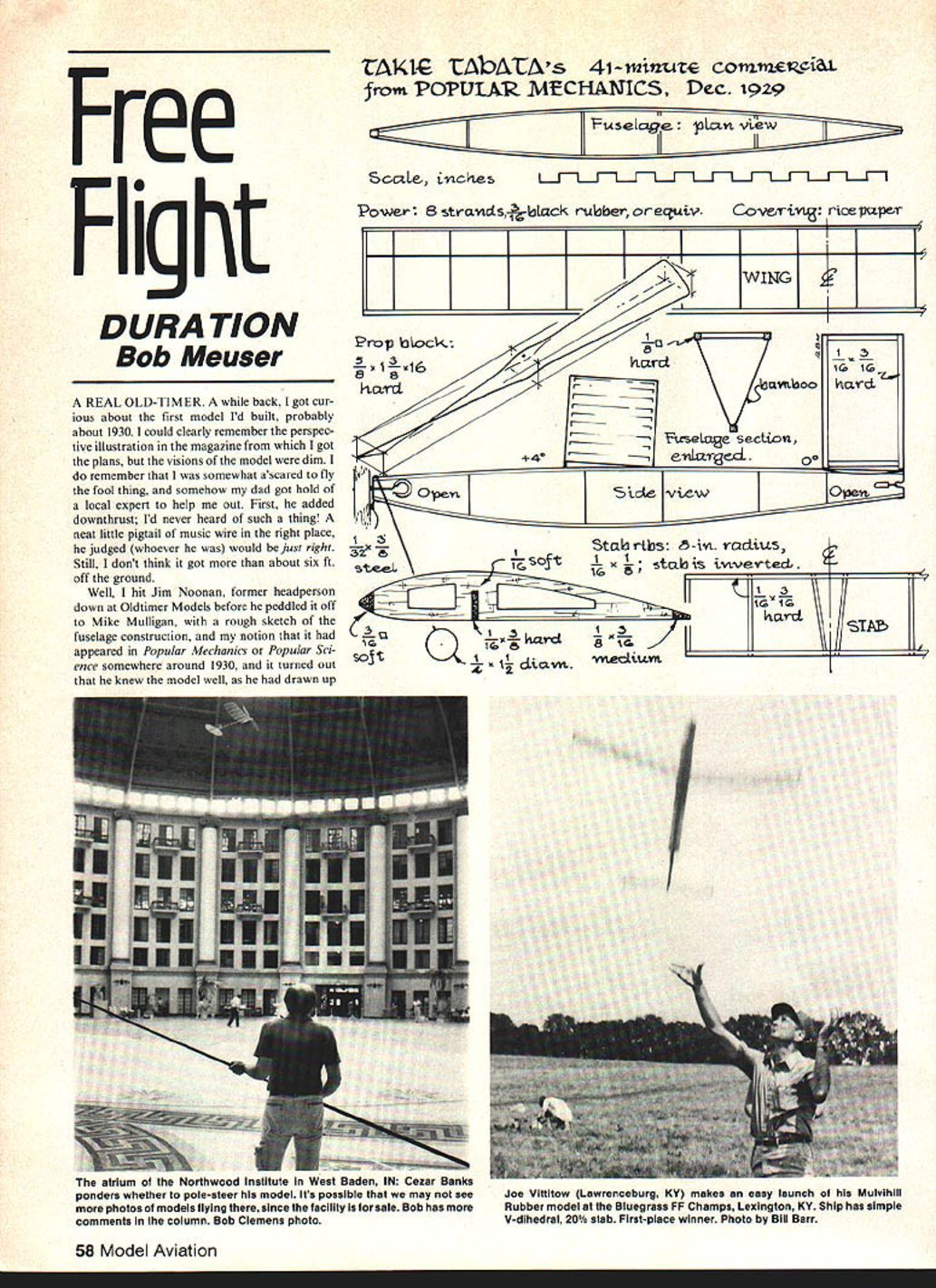
A while back I got curious about the first model I'd built, probably around 1930. I could clearly remember the perspective illustration in the magazine that provided the plans, but visions of the model itself were dim. I was somewhat afraid to fly the thing, and somehow my dad got hold of a local expert to help. First, he added downthrust — I'd never heard of such a thing. A neat little pigtail of music wire in the right place, he judged, would be just right. Still, I don't think it got more than about six feet off the ground.
I contacted Jim Noonan, former head person at Oldtimer Models before he sold it to Mike Mulligan, with a rough sketch of the fuselage construction and the notion that the plan had appeared in Popular Mechanics or Popular Science around 1930. It turned out he knew the model well, as he had drawn up the plans. I ordered Mulligan plans, some black tissue and a bit of other material. The drawing indeed looked right: at least four feet long yet only 29 inches in span, crazy thick cut-out ribs, an inverted stab, a huge rudder, and bamboo fuselage formers — everybody nowadays knows bamboo is the proper stuff.
Airfoils and Reynolds Number
I got hooked on experimenting. RAF 32, Clark Y and others were tried. The Wright brothers proved by tests in a tiny wind tunnel that thin airfoils were the way to go. Tony Fokker, by pure hunch, decided otherwise: thick wings can enclose structure and need not create excessive drag. That's been the practical approach ever since.
What others missed was the Reynolds-number effect, despite Osborne Reynolds having made the scale effect crystal clear decades earlier. Reading between the lines, it became evident that thin airfoils are better at the low Reynolds numbers where model airplanes live. Modelers had slavishly copied the thick airfoils used on full-size aircraft, and it took a long time to turn things around. W. F. Schmitz's book in the Forties and its interpretations helped, and simply constructed, effective Ritz foils must have had influence too. By the mid-Fifties it became clear thin foils made great models — but thin wings are difficult to make strong enough to survive competition flying. Strength versus aerodynamic excellence has been the name of the game ever since.
Atrium Blues
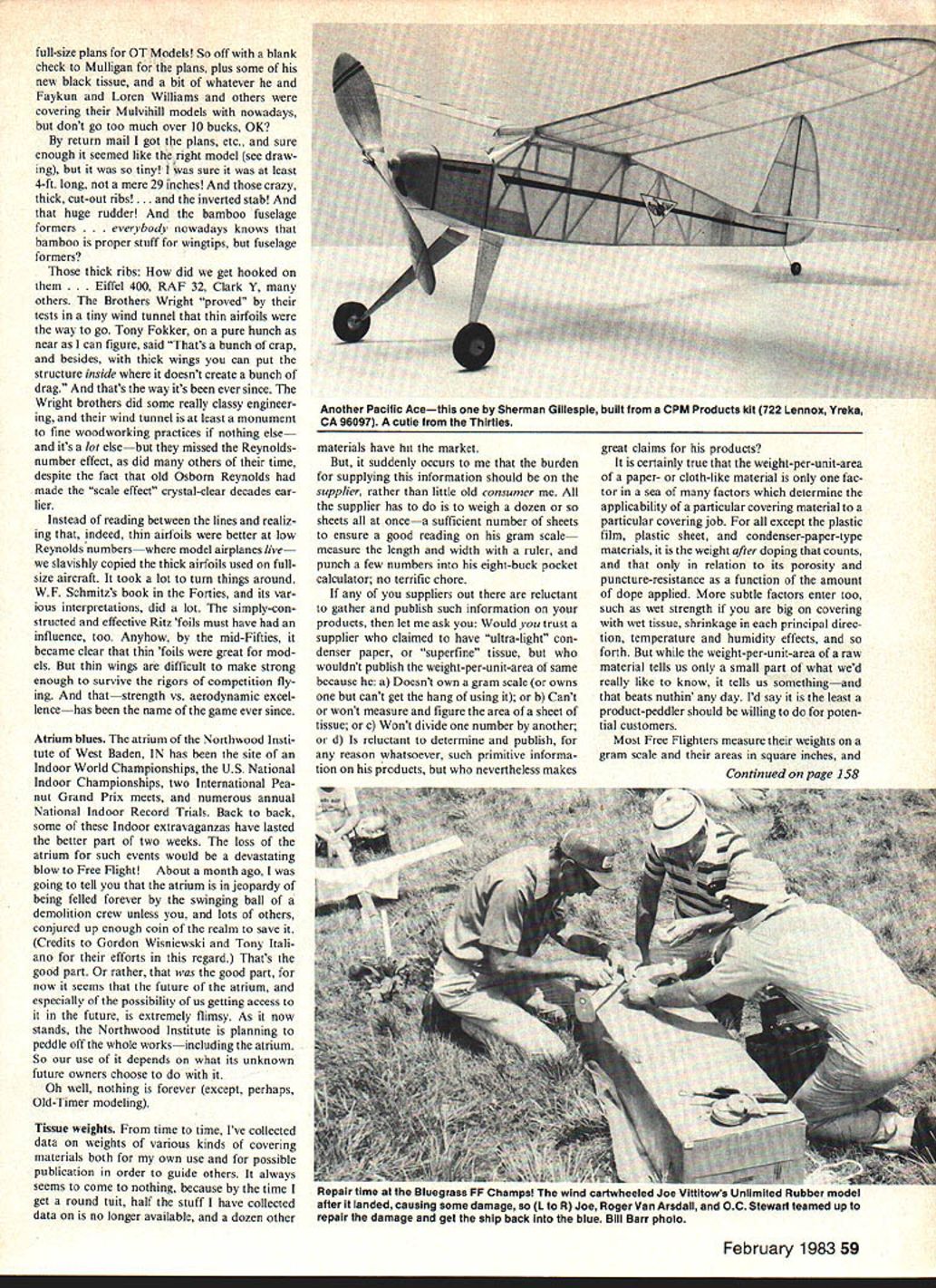
The atrium at Northwood Institute, West Baden, Ind., has been the site of Indoor World Championships, U.S. National Indoor Championships, two International Peanut Grand Prix meets, and numerous annual National Indoor Record Trials. In the heyday some indoor extravaganzas lasted the better part of two weeks. Loss of the atrium for such events would be a devastating blow.
About a month ago I planned to report that the atrium was in jeopardy — being felled forever by demolition unless a lot of people conjured up enough coin to save it. Credit goes to Gordon Wisniewski and Tony Italiano for their efforts. The good part is they tried; the bad part is the future of the atrium — and the possibility of our getting access — is extremely uncertain. Northwood Institute is planning to sell the whole property, including the atrium, so future use depends on whatever the unknown future owners choose. Oh well — nothing forever except perhaps Old-Timer modeling.
Tissue Weights
From time to time I've collected data on weights of various covering materials, both for my own use and as a possible guide for others. It always seems to come to nothing because time gets away from me. Half the material I've measured is no longer available, and a dozen new materials have since hit the market. It suddenly occurs to me that the burden for supplying such information should be on the supplier, not the consumer. All the supplier has to do is:
- Weigh a dozen or so sheets at once to ensure a good reading on a gram scale,
- Measure the length and width of a sheet,
- Compute the weight-per-unit-area and publish it.
If any supplier is reluctant to publish such information, ask yourself: would you trust a seller who claimed to have "ultra-light" condenser paper or "superfine" tissue but would not publish the weight-per-unit-area because he:
- a) Doesn't own a gram scale (or owns one but can't use it),
- b) Can't or won't measure and figure the area of a sheet,
- c) Won't divide one number by another,
- d) Is reluctant to determine and publish this basic information for any reason?
Weight-per-unit-area is only one factor among many that determine a covering material's suitability. For most materials (except plastic film, plastic sheet, and condenser-paper types) it is the weight after doping that counts, and that only in relation to porosity and puncture-resistance as a function of the amount of dope applied. Other factors include wet strength (if you cover with wet tissue), shrinkage in principal directions, and temperature/humidity effects. Still, raw weight-per-unit-area tells us something, and that's better than nothing. It is the least a product-peddler should publish for potential customers.
Most Free Flighters measure weights in grams and areas in square inches. Most models weigh a few tens of grams and have on the order of a hundred square inches of wing area, give or take. I suggest expressing covering weights in grams per 100 square inches (despite the mixed English and metric units). If you're committed to metric purity, tell me where I can buy a pressure gauge that reads in pascals, and explain why most metric countries still express small forces in grams rather than newtons.
I put this idea, in a slightly less caustic form, to Mike Mulligan at Oldtimer Models. He agreed, but it may take about a year until a new catalog is printed. So it will take a while to get the ball rolling, but it is a ball that needs rolling.
Tom Hutchinson Memorial Trophy
You may already have heard that Tom Hutchinson died. There was immediate talk about a perpetual trophy in his name. Initially I pictured some garish oversize affair or a home-brew concoction, but the dust has settled: there will be a trophy, and it will be designed and built by a professional.
Tom's favorite event was Nordic A/2 Towline Glider, so the trophy will be awarded for the top A/2 score at the U.S. Free Flight Championships each year.
Donations toward the purchase of the trophy should be sent to: Steve Geraghty 194 Vista Del Monte Los Gatos, CA 95030
Book Reviews
We have a couple of reprints for you this month and a few previews.
Darned Good Airfoils
Compiled by Bob Stalick, this book includes drawings, coordinates, and nose radii (when known) for 45 airfoils published in the column earlier written by Bob and later by the late Tom Hutchinson. It includes a table of contents, an alphanumeric index, and reprints of "The Eppler Effect" by Tom Hutchinson and "How to Read Darned-Good-Airfoil Charts, or How I Became an Instant Airfoil Expert in One Painless Lesson." It would have been nice to include the original commentary that accompanied the airfoils, but that would have doubled the size and cost of the book. At $2 (plus $5 postage and handling) it's a bargain.
Order from: Bob Stalick 5066 N.W. Piccadilly Circle Albany, OR 97321
ABC's of Model Airplane Building (Megow reprint)
This 20-page Megow reprint (enlarged for easier reading) is packed with how-to construction tips: making a wire bender and a balsa stripper; plans for a simple HL glider, a baby ROG stick model, a 15-inch span fuselage model, and a rubber-powered Monocoupe; and lots of information about bending bamboo and balsa, making propshafts, S-hooks, and shock-absorbing landing gears. There's a section on "solid" display models and a glossary of model aviation terms. It was an excellent beginner's guide.
Price: $3.95. Available from: John L. Frost P.O. Box 317 Covington, LA 70434
Frost, now nearing sixty, has been in aviation since childhood, flew TBFs in anti-submarine service and later piloted everything from DC-3s to jets. He has several more reprints in the works, including The Boys' Model Airplane Book (1911), the complete Megow catalog, Model Aeroplanes and Their Engines (1917), Aircraft Armament (1917), various tech manuals on early aircraft and engines, and original factory drawings of the Curtiss JN4-D Jenny — an ambitious undertaking.
Digital Dethraller Timer
A single-function timer for Towline Gliders and rubber-powered models is manufactured by Thomas Koster of Denmark. The unit is based on a more expensive and complex FAI power-model timer but is still fairly expensive at $55. If it saves one flyaway or one short DT it might be worth the price.
Specifications and features:
- Claimed accuracy: better than 1/100 sec.
- Time range: 6 sec. to 9 min. 54 sec., in 1-sec. steps.
- Setting: two rotary switches (minutes and seconds).
- DT release: mousetrap arrangement (no rotating disk).
- Mounting plate: 2.6 x 0.7 in.; depth 0.55 in.
- Weight: 1.75 grams for the unit plus 17 grams for the rechargeable battery (800–1,200 actuations between charges).
- Charger: available for $20–$25; charging can also be done with a 9 V transistor-radio battery.
Operation: a switch connected by a 6-in. wire resets the timer to zero when pressed and starts timing when released. The switch can be placed ahead of a swinging towhook; a forward pull resets the timer and release or towline break triggers the timing.
Order from: Koster Digital Timers PO Box 54 DK-3400 Hillerod Denmark
First Intergalactic Ornithopter Postal
Flappers, get ready by December 1, 1983! This is a "postal": you make your flights at any contest or records trial sanctioned by the FAI or any of its affiliates (such as the AMA), and you mail in your scores.
Event definition and rules (summary):
- An ornithopter is a freely flying model aircraft which derives its lift and propulsion primarily from flapping wings. The event director may rule that flapping-prop models are not permitted.
- Total supporting surface must not exceed 1,000 sq. dm. (15,500 sq. in.).
- Supporting surface includes all surfaces used to obtain lift or pitch control.
- Areas are measured by tracing outlines.
- The sum of areas of any fixed supporting surfaces must not exceed one-half the area of the flapping surfaces.
- Power: strung or extensible rubber only.
- No restrictions on model weight or rubber weight.
Note: These rules differ from AMA ornithopter rules and will exclude some AMA-legal models while allowing some models that AMA rules would not. For more information contact: David W. Erbach 1738 St. Mary's Road #702 Winnipeg, Manitoba R2N 1G8 Canada
Bob Meuser 4200 Gregory St. Oakland, CA 94619
Transcribed from original scans by AI. Minor OCR errors may remain.

