
Free Flight: Duration
Bob Meuser
THE RULES
The AMA Cargo event — check ’em out; they’re in the AMA rule book. Pretty simple. Basically a small-field event; they don’t come smaller. Using a Cox .020 engine (or a pair of .010s), the main idea is to see how much gross weight you can carry for at least 40 seconds, with a maximum of a 20-second engine run, and a wingspan restriction of 48 inches. Clearly you aren’t going to have a problem keeping the model in sight.
Back in my March 1977 column I presented a sketch of Roman Ramirez’s record‑breaking model, which carried a three‑flight total of 76 oz. Somewhere along the line he upped it to 82 oz., and then in 1979—according to my August 1980 column—he pushed it to 83.42 oz. I might have lost track of him since, but last September he raised it to a totally ridiculous figure of 100.21 oz., or about two pounds per flight! Try that on your local .020; most models would scarcely get off the ground, if at all, let alone make flight times of twice their engine‑run times.
An ultra‑sophisticated model with winglets and a super computer‑designed airfoil? Nope — the same old square‑tip turkey he’s been flying all along, with a plain NACA 6409 airfoil from the Twenties/Thirties. A simple model, well flown, beats the rest (as usual).
Tissue tips
Taking note of several items regarding the virtues of various covering tissues that have appeared in recent columns, Al Lidberg supplies the following information.
I agree that “real” Japanese tissue is nice stuff. Art supply stores (and some hobby shops) sell tissue for arts‑and‑crafts projects such as flowers. It’s cheap (10¢–15¢ per sheet) and comes in about two dozen colors, black included. I’ve used golden yellow and red on a couple of models with good results.
None of this craft tissue is colorfast with water, so use a very fine mist for shrinking. I use an airbrush to avoid large drops that make blot marks. For black trim strips and numbers, the tissue works great — it can be stuck down with thinner just like real tissue.
I’ve also used khaki brown on my Sperry Messenger (recently appeared in MAN). The brown is pretty terrible in strength; it resists tears and holes far worse than anything I’ve used, though the color was just right. Each color of this tissue seems to have different qualities: some (black, brown) have a shine on one side like good tissue but don’t work well for covering; others (red, yellow, blue) are dull on both sides yet work perfectly.
New gas‑power event
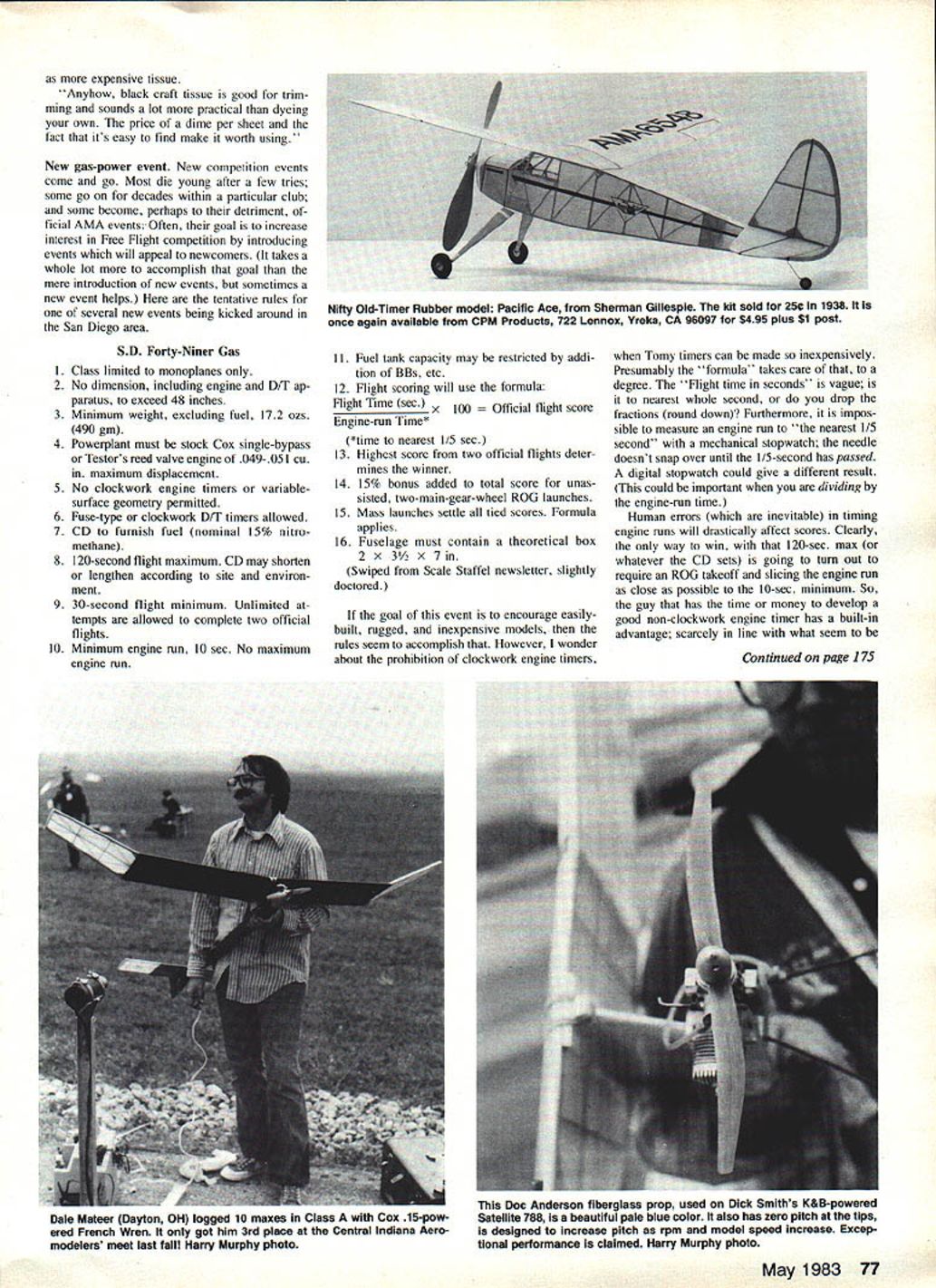
New competition events come and go. Most die young after a few tries; some persist within a club for decades; some become, perhaps to their detriment, official AMA events. Often their goal is to increase interest in Free Flight competition by introducing events that will appeal to newcomers. Here are the tentative rules for one of several new events being kicked around in the San Diego area.
S.D. Forty‑Niner Gas
- Class limited to monoplanes only.
- No dimension, including engine and D/T apparatus, to exceed 48 inches.
- Minimum weight, excluding fuel: 17.2 oz (490 gm).
- Powerplant must be stock Cox single‑bypass or Testors reed‑valve engine of .049–.051 cu. in. maximum displacement.
- No clockwork engine timers or variable‑surface geometry permitted.
- Fuse‑type or clockwork D/T timers allowed.
- Contest director (CD) to furnish fuel (nominal 15% nitro‑methane).
- 120‑second flight maximum. CD may shorten or lengthen according to site and environment.
- 30‑second flight minimum. Unlimited attempts are allowed to complete two official flights.
- Minimum engine run: 10 sec. No maximum engine run.
- Fuel tank capacity may be restricted by addition of BBs, etc.
- Flight scoring will use the formula:
Flight Time (sec.) x 100 = Official flight score Engine‑run Time* (*engine run time to nearest 1/5 sec.)
- Highest score from two official flights determines the winner.
- 15% bonus added to total score for unassisted, two‑main‑gear‑wheel ROG launches.
- Mass launches settle all tied scores. Formula applies.
- Fuselage must contain a theoretical box 2 x 3½ x 7 in.
(Swiped from Scale Staffel newsletter, slightly doctored.)
If the goal is to encourage easily built, rugged, inexpensive models, the rules seem to accomplish that. However, I wonder about the prohibition of clockwork engine timers when Tomy timers can be made so inexpensively. Presumably the formula takes care of that, to a degree. The phrase “Flight time in seconds” is vague — is it to the nearest whole second, or do you drop fractions (round down)? Furthermore, it is impossible to measure an engine run to “the nearest 1/5 second” with a mechanical stopwatch; the needle doesn’t snap over until the 1/5‑second has passed. A digital stopwatch could give a different result, which matters when you are dividing by engine‑run time. Human errors in timing engine runs will drastically affect scores.
Clearly, the only way to reliably win with that 120‑sec max (or whatever the CD sets) is to ROG and slice the engine run as close as possible to the 10‑second minimum. So the competitor with time or money to develop a good non‑clockwork engine timer gains an advantage — scarcely in line with the apparent goals. Nit‑picking perhaps, but rules, however bad, have a way of becoming cast in concrete and therefore hard to change. Good rules are difficult to design — I’ve probably found only a fraction of the loopholes. Still, the basic structure of the event has merit; it will be interesting to see what comes of it.
Unlimited Mulvihill (again)
In the January issue I discussed this annual event, held in Taft over the Memorial Day weekend at the U.S. Free Flight Championships, mentioning that Loren Williams and his co‑conspirators were after Bob White’s tailfeathers — Bob being the perennial winner of this crazy event. I promised more details on the Team Williams approach; “soon” takes a while around here.
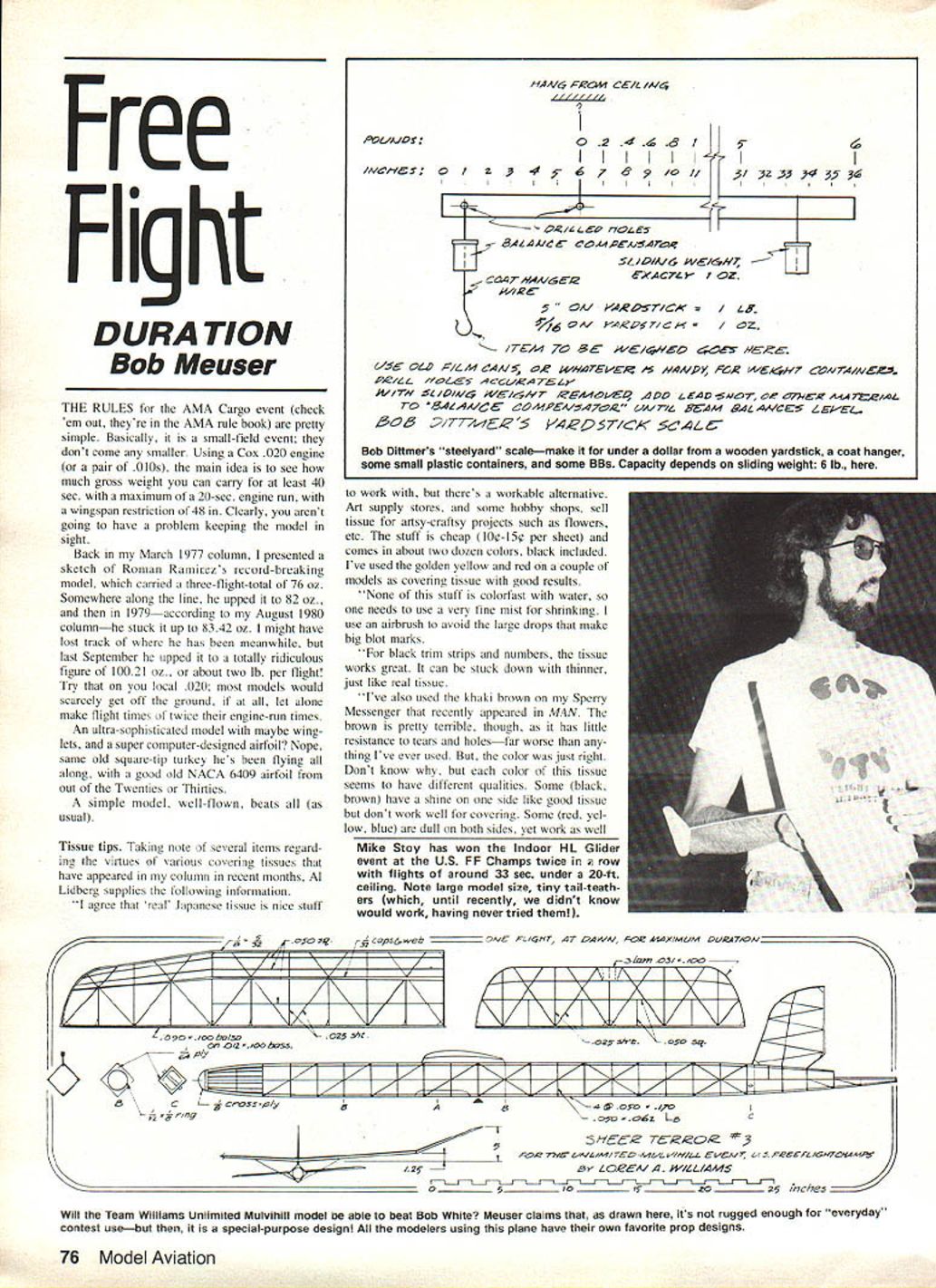
So here’s a three‑view. I’ve crammed as much detail as I could into a few square inches, but it still leaves a lot untold.
Be warned: this machine is not for the timid or weak. It was designed for one purpose — to take the Oakland Cloud Dusters perpetual trophy away from Bob White. For contest‑after‑contest Mulvihill events this is not the machine to use, although if all the wood sizes were increased to the next commercially available sizes and stout wood used for critical members (spars, longerons), the design would be at least as good as many others.
For example, the fuselage, weighing a mere 10 grams uncovered, must cope with the pent‑up energy of some seven times its own weight of Pirelli rubber, capable of lifting itself to a height of upwards of 3,200 feet.
At present Team Williams consists of Loren Williams, Andy Faykun, Dick Siefried, Mike Mulligan, Mik Mikelson, and — of all people — ex‑Indoor World Champ Bud Romak. Total model weights, using tissue covering sold by Oldtimer Models, will be 70 grams or less. Motors of 20–22 strands of 1/8‑inch Pirelli (or equivalent), without much slack, will weigh less than 70 grams, favoring a low sinking speed from minimum overall weight. Props? The three‑view carefully avoids the issue; it’s up for grabs, with everyone doing his own thing (Larabee, Schwartzbach, etc.).
Book reviews
In my February column I talked about Bob Stalick’s book of airfoils and stated that two bucks for coordinates of 45 airfoils was the biggest boggin in town. A reader from Oregon wrote to inform me I was about 60 short; the book contains 105 airfoils, which makes it an even better boggin. A mere $2.50, including postage, gets it to you. Write to Bob Stalick, 5066 Picadilly Circle, Albany, OR 97321.
Making an inexpensive weighing scale
You start with a cheap wooden yardstick, a couple of coat hangers, paper clips, and snap‑top plastic containers. Twenty minutes later you end up with a steelyard‑type scale equal to those costing upwards of $50. Not bad! A fringe benefit is that it doesn’t take up workbench space; the flip side is that you (or I) may not appreciate a screw eye in the dining room ceiling. The generic name for such things is “steelyard,” independent of the material from which it’s made.
From Bob Dittmer (SAM Speaks): “How many times have you wished you had a scale to weigh that new gas job? Here are plans for a simple, easy‑to‑make beam balance that is as accurate as you could ask for.
Materials required:
- One yardstick
- Buckshot as required
- Coat hanger
- Large paper clip
- Two snap‑top plastic containers (1‑in. dia. x 2‑in. long and 2‑in. dia. x 2‑in. long)”
Supernormal Flight (SNF) and applications
Researchers at Dynamic Engineering, Inc. are giving serious consideration to the application of supernormal flight (SNF) for full‑size aircraft. “Supernormal” is the name the authors give to flight with a fully stalled wing in which the aircraft is controllable: the wing is stalled but the tail surfaces are not, so the aircraft can be maneuvered. One essential feature is an all‑moving tail, or something close to it. The authors mention the passive D/T we use, rightly crediting Carl Goldberg, and note having done free‑flight tests.
The notion of D/T‑ing a “real” airplane clear to the ground isn’t too far out if the wing loading is low enough to limit descent rate to what landing gear and occupants can absorb. If the alternative is a crash and certain death, SNF may offer a survivable option. During descent, the tail surfaces would not be stalled and so the pilot would retain some control. Specially designed devices might be used to slow descent to a rate lower than that provided by a conventional wing in deep stall.
NASA has demonstrated SNF controls effective in spin recovery of lightly loaded general aviation aircraft with normal spin characteristics, and SNF spin recovery has also been demonstrated in heavily loaded fighter models that normally have flat, fast‑spinning characteristics that make recovery difficult with conventional techniques.
SNF controls might be used for fuel‑usage reduction during early landing phases of a V/STOL aircraft; during final landing phases, normal vectored thrust would be applied. The authors studied applications to a lightweight fighter (LWF), including sudden deceleration to cause an attacker to overshoot, sudden turns in the SNF condition at moderate speeds, and enhanced aiming and pointing of weapons at low speeds.
They also suggest SNF controls could allow certain aircraft to fly nose‑up without loss of altitude at very low forward speeds. Historically, some WWI fighters could mop along under full power at very low speeds; the concept merits further study.
Tip of the month
Bob Womack observes: the next time you have to apply rubber lube to a motor, put the rubber in a sandwich bag (polyethylene, not paper), add the required amount of lube, close the bag, then rub the bag between your hands. Presto — a nicely lubed motor and no sticky, greasy palms.
Bob Meuser 4200 Gregory St., Oakland, CA 94619.
Transcribed from original scans by AI. Minor OCR errors may remain.

