
Free Flight: DURATION
Bob Meuser
Lockheed-Georgia "Ring Wing"
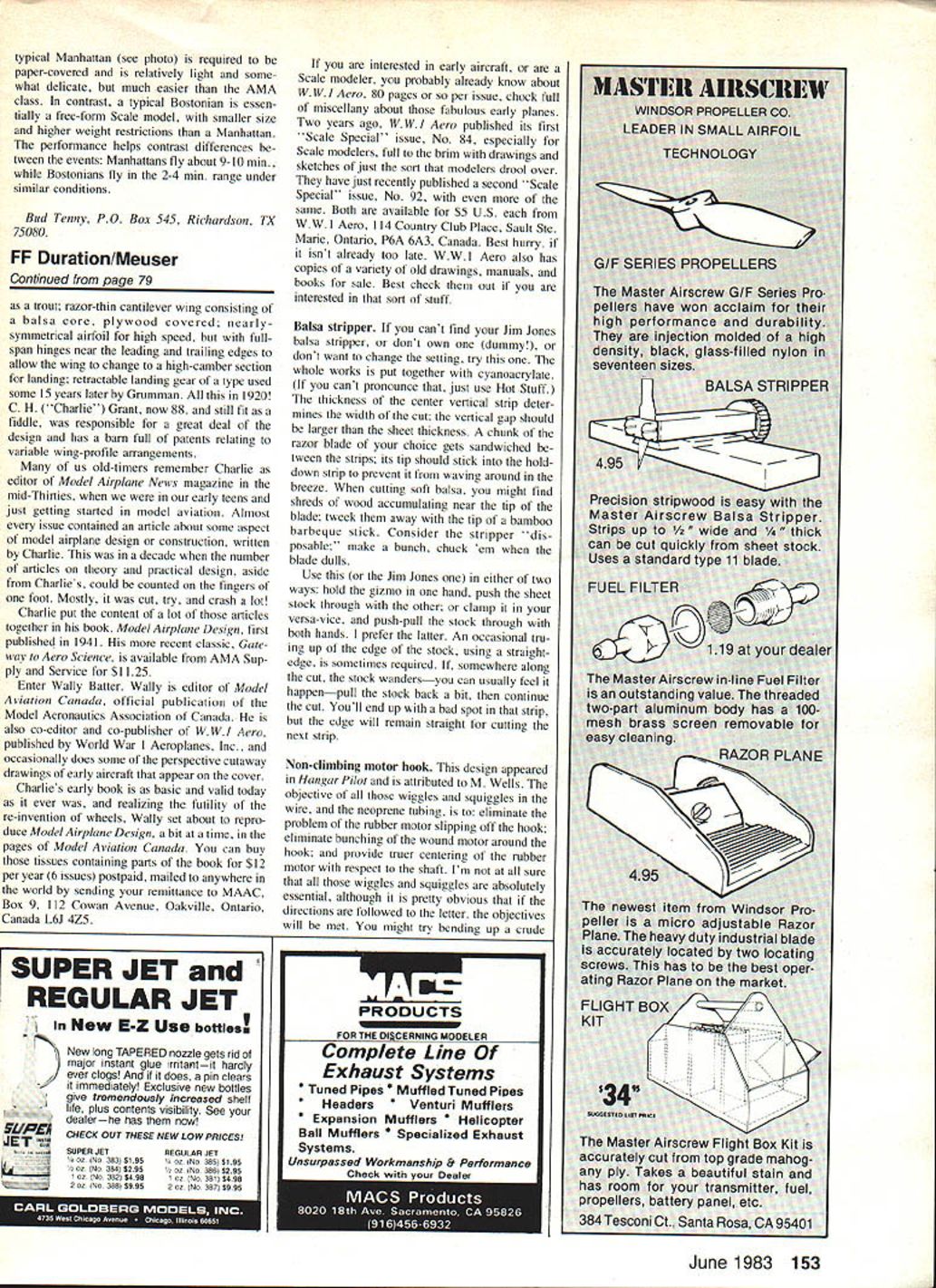
Not all wings are flat. Lockheed-Georgia's "Ring Wing" is a prime example. About the time I ran an item on the spin-stabilized, cylindrical-wing, hand-launch glider in the August 1982 issue (which looked suspiciously similar to a third of an empty beer can), the press release on the Ring Wing hit the streets; several readers sent me clippings from Machine Design magazine. Their design isn't spin-stabilized (at least, we hope not) and they are the first to point out that ring wings are nothing new. They were never the height of success, either (Lee-Richards No. 3 notwithstanding). In its post-2000-year concept study, Lockheed engineers figured the configuration might have some advantages over conventional ones—potentially lower drag and lighter structural weight, they say.
Note in the photo that the wing sweeps back from bottom to top, and that the top is tacked onto a swept-forward fin. "This geometric arrangement provides for a structure reacting to chordwise loads, where the two surfaces meet, and incorporation of a top rudder in the swept-forward vertical surface to provide roll control." Getting roll control with the rudder doesn't leave much else to steer with, and you must admit that sticking ailerons on it might be a bit of a problem. And how about full-span flaps?
I guess you can tell I'm a technological reactionary. It's a comfort to know, however, that not everyone is. "Before year-end, Lockheed-Georgia Company will conduct preliminary wind tunnel tests on the design concept," they say. (What they didn't say is what year!)
Competition notes
Unlimited-Mulvihill
Unlimited-Mulvihill fliers note: Contrary to the notice in the NFFS Digest and various club newsletters, this event at the U.S. Free Flight Championships will be held on Sunday (not on Saturday, as in the previous announcements). My column in the October 1982 Model Aviation has the rules for this event.
San Valeer Club — Ralph Prey Perpetual Trophy
To encourage San Valeer Club members to develop new designs, Ralph Prey will award a perpetual trophy for the highest time accumulated in any of the AMA Gas classes flown at the San Valeer Annual with a model of original design, built from scratch, and flown by the designer.
- No monkey-business: a Galaxie wing on a Satellite is not an original design for these purposes, nor is a minor modification of an existing design, such as shifting the rudder from the top to the bottom.
- To qualify, the forward flying surface(s) must have an area no larger than 50% of the area of the main wing(s), and there cannot be additional stabilizing surfaces to the rear of the wing(s).
- The "s" business is because either the wing(s) or stabilizer(s) can be multiplanes: biplane, triplane.
Central Indiana Aeromodelers — New Payload Event
The Central Indiana Aeromodelers (CIA) are adding a new Payload-type event similar to the PAA-Load classes of the mid-1950s. The rules are similar to the .020 Payload event in the AMA rule book, with the following exceptions:
- Wing span and area: no limit.
- Engine displacement: greater than .025, no larger than .050 cu. in.
- Dummy pilot: four ounces, dimensions 1/2 x 1 1/2 x 3 in., including a 3/4-in. cubical head. (Note that a solid aluminum dummy, which is just right for the present .020 class, would be a bit too heavy unless drilled out.)
- The head must be able to look to the front and sides through a transparent windshield of area 3/8 sq. in. or larger.
- Minimum gross weight: nine ounces.
- Engine runs for the various categories are not stated, but would be shorter than those for the .020 class.
Pacific Ace inter-club contests
A half-dozen clubs in Washington and Oregon are having inter-club contests using the old Pacific Ace design, a 30-inch rubber-power cabin model. Models can be built from plans or kits but must use an unmodified commercial plastic prop.
George Perryman awarded prestigious honor
The annual Meuser Memorial Modeler of the Year Award goes to George Perryperson (formerly known as George Perryman, until he had it legally changed because of obvious social pressures). In a recent letter, humble George casually let it sort of slip out that he had won 29 first-place awards in 11 different categories during the 1982 contest season. At the Nats, he made 40 flights in 14 events and copped nine firsts, did most of his own chasing under a grant from the Department of Agriculture for the evaluation of the corn crops in the area, and lost only one model, his notorious Lanzo Stick.
George received this award only by the skin of his teeth, because of a major fault in his personality. He'll stand there, waiting for a thermal with a fully-wound motor, and everyone else is nervous as he... then he'll start telling one of his Southern jokes—and despite the number of thermals that come through meanwhile, he refuses to launch until he has finished his joke.
I'll never forgive him for an incident that occurred at the 1979 World Champs. There I am, just dozing off at 1:30 a.m. after the usual round of parties, when my wife—Hurricane Joanne, I call her—starts giggling her head off. She had just remembered one of George's stories.
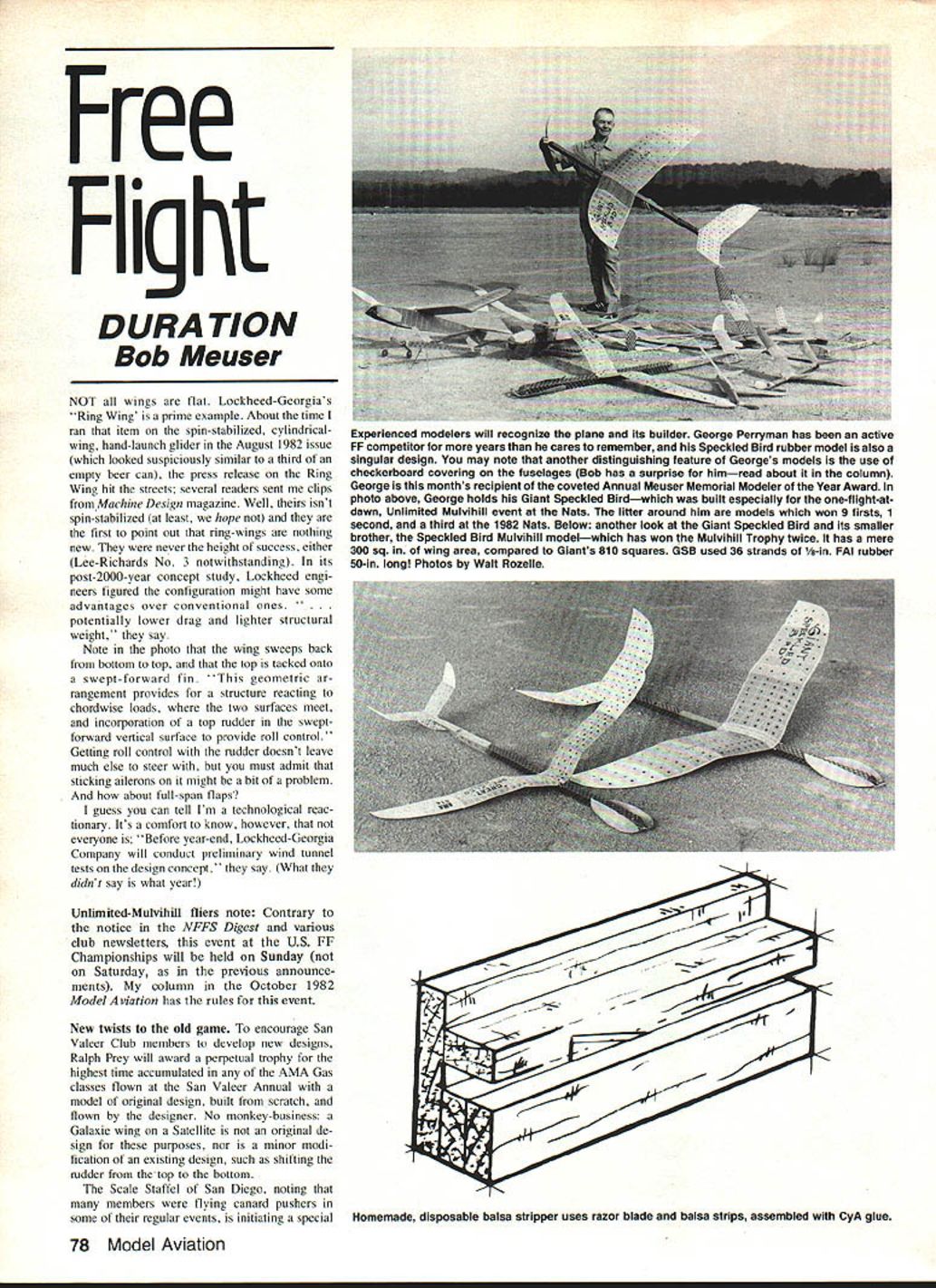
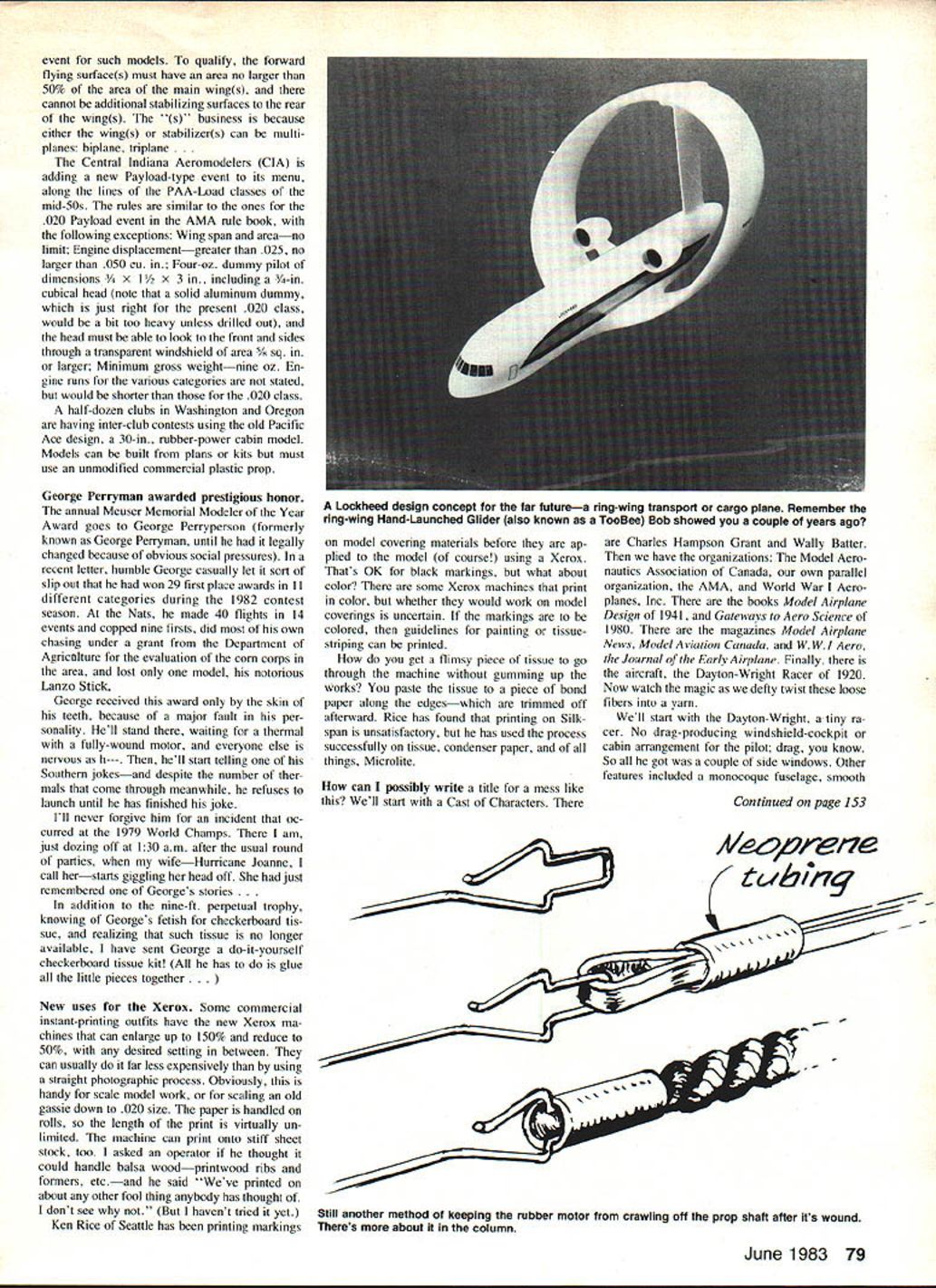
In addition to the nine-foot perpetual trophy, knowing of George's fetish for checkerboard tissue, and realizing that such tissue is no longer available, I have sent George a do-it-yourself checkerboard tissue kit! (All he has to do is glue all the little pieces together...)
New uses for the Xerox
Some commercial instant-printing outfits have new Xerox machines that can enlarge up to 150% and reduce to 50%, with any desired setting in between. They can usually do it far less expensively than by using a straight photographic process. This is handy for scale model work, or for scaling down gas models to .020 size. The paper is handled on rolls, so the length of the print is virtually unlimited. The machine can print onto stiff sheet stock, too.
I asked an operator if he thought it could handle balsa wood—pithwood ribs and formers, etc.—and he said, "We've printed on about any other fool thing anybody has thought of. I don't see why not." (But I haven't tried it yet.) Ken Rice of Seattle has been printing markings on model covering materials before they are applied to the model (of course!) using a Xerox. That's OK for black markings, but what about color? There are some Xerox machines that print in color, but whether they would work on model coverings is uncertain. If the markings are to be colored, then guidelines for painting or tissue-striping can be printed.
How do you get a flimsy piece of tissue to go through the machine without gumming up the works? You paste the tissue to a piece of bond paper along the edges—which are trimmed off afterward. Rice has found that printing on Silkspan is unsatisfactory, but he has used the process successfully on tissue, condenser paper, and, of all things, Microlite.
If colored markings are required, consider printing the layout on the covering, then hand-painting or striping to add color.
Cast of Characters and Early Aircraft
How can I possibly write a title for a mess like this? We'll start with a Cast of Characters: Charles Hampson Grant and Wally Batter; the organizations—the Model Aeronautics Association of Canada, our own parallel organization the AMA, and World War I Aeroplanes, Inc.; the books Model Airplane Design (1941) and Gateway to Aero Science (1980); the magazines Model Airplane News, Model Aviation Canada, and W.W.I. Aero, the Journal of the Early Airplane; and finally, the aircraft—the Dayton-Wright Racer of 1920. Now watch the magic as we deftly twist these loose fibers into a yarn.
We'll start with the Dayton-Wright, a tiny racer. No drag-producing windshield-cockpit or cabin arrangement for the pilot—drag, you know. So all he got was a couple of side windows. Other features included a monocoque fuselage, smooth lines, a razor-thin cantilever wing consisting of a balsa core, plywood covered; a nearly-symmetrical airfoil for high speed, but with full-span hinges near the leading and trailing edges to allow the wing to change to a high-camber section for landing; and retractable landing gear of a type used some 15 years later by Grumman. All this in 1920! C. H. ("Charlie") Grant, then young and now long-lived, was responsible for a great deal of the design and has a barn full of patents relating to variable wing-profile arrangements.
Many of us old-timers remember Charlie as editor of Model Airplane News magazine in the mid-Thirties, when we were in our early teens and just getting started in model aviation. Almost every issue contained an article about some aspect of model airplane design or construction, written by Charlie. This was in a decade when the number of articles on theory and practical design, aside from Charlie's, could be counted on the fingers of one foot. Mostly, it was cut, try, and crash a lot!
Charlie put a lot of that content together in his book Model Airplane Design, first published in 1941. His more recent classic, Gateway to Aero Science, is available from AMA Supply and Service for $11.25.
Enter Wally Batter. Wally is editor of Model Aviation Canada, the official publication of the Model Aeronautics Association of Canada. He is also co-editor and co-publisher of W.W.I. Aero, published by World War I Aeroplanes, Inc., and occasionally does some of the perspective cutaway drawings of early aircraft that appear on the cover.
Charlie’s early book is as basic and valid today as it ever was, and realizing the futility of re-inventing the wheel, Wally set about to reproduce Model Airplane Design, a bit at a time, in the pages of Model Aviation Canada. You can buy those issues containing parts of the book for $12 per year (6 issues) postpaid, mailed anywhere in the world by sending your remittance to:
- MAAC, Box 9, 112 Cowan Avenue, Oakville, Ontario, Canada L6J 4Z5.
If you are interested in early aircraft, or are a scale modeler, you probably already know about W.W.I. Aero—about 80 pages or so per issue, chock full of miscellany about those fabulous early planes. Two years ago, W.W.I. Aero published its first "Scale Special" issue, No. 84, especially for scale modelers, full to the brim with drawings and sketches of the sort that modelers drool over. They have just recently published a second "Scale Special" issue, No. 92, with even more of the same. Both are available for $5 U.S. each from:
- W.W.I. Aero, 114 Country Club Place, Sault Ste. Marie, Ontario, P6A 6A3, Canada.
W.W.I. Aero also has copies of a variety of old drawings, manuals, and books for sale. Best check them out if you are interested in that sort of stuff.
Manhattan vs. Bostonian (brief comparison)
A typical Manhattan model is required to be paper-covered and is relatively light and somewhat delicate, but much easier than the AMA class. In contrast, a typical Bostonian is essentially a free-form scale model, with smaller size and higher weight restrictions than a Manhattan. The performance helps contrast differences between the events: Manhattans fly about 9–10 minutes, while Bostonians fly in the 2–4 minute range under similar conditions.
Bud Tenny, P.O. Box 545, Richardson, TX 75080.
Tips and Shop Notes
Balsa stripper
If you can't find your Jim Jones balsa stripper, or don't own one (or don't want to change the setting), try this home-made version. The whole works is put together with cyanoacrylate (if you can't pronounce that, just use Hot Stuff). The thickness of the center vertical strip determines the width of the cut; the vertical gap should be larger than the sheet thickness. A chunk of a razor blade gets sandwiched between the strips; its tip should stick into the hollow down strip to prevent it from moving around. When cutting soft balsa, you might find shreds of wood accumulating near the tip of the blade; tweak them away with the tip of a barbecue stick. Consider the stripper "disposable"; make a bunch and chuck them when the blade dulls.
Use this (or the Jim Jones one) in either of two ways:
- Hold the gizmo in one hand and push the sheet stock through with the other.
- Clamp it in your vise-grip and push-pull the stock through with both hands (my preference).
An occasional truing up of the edge of the stock with a straightedge is sometimes required. If the stock wanders somewhere along the cut—you can usually feel it happen—pull the stock back a bit, then continue. You'll end up with a bad spot in that strip, but the edge will remain straight for cutting the next strip.
Non-climbing motor hook
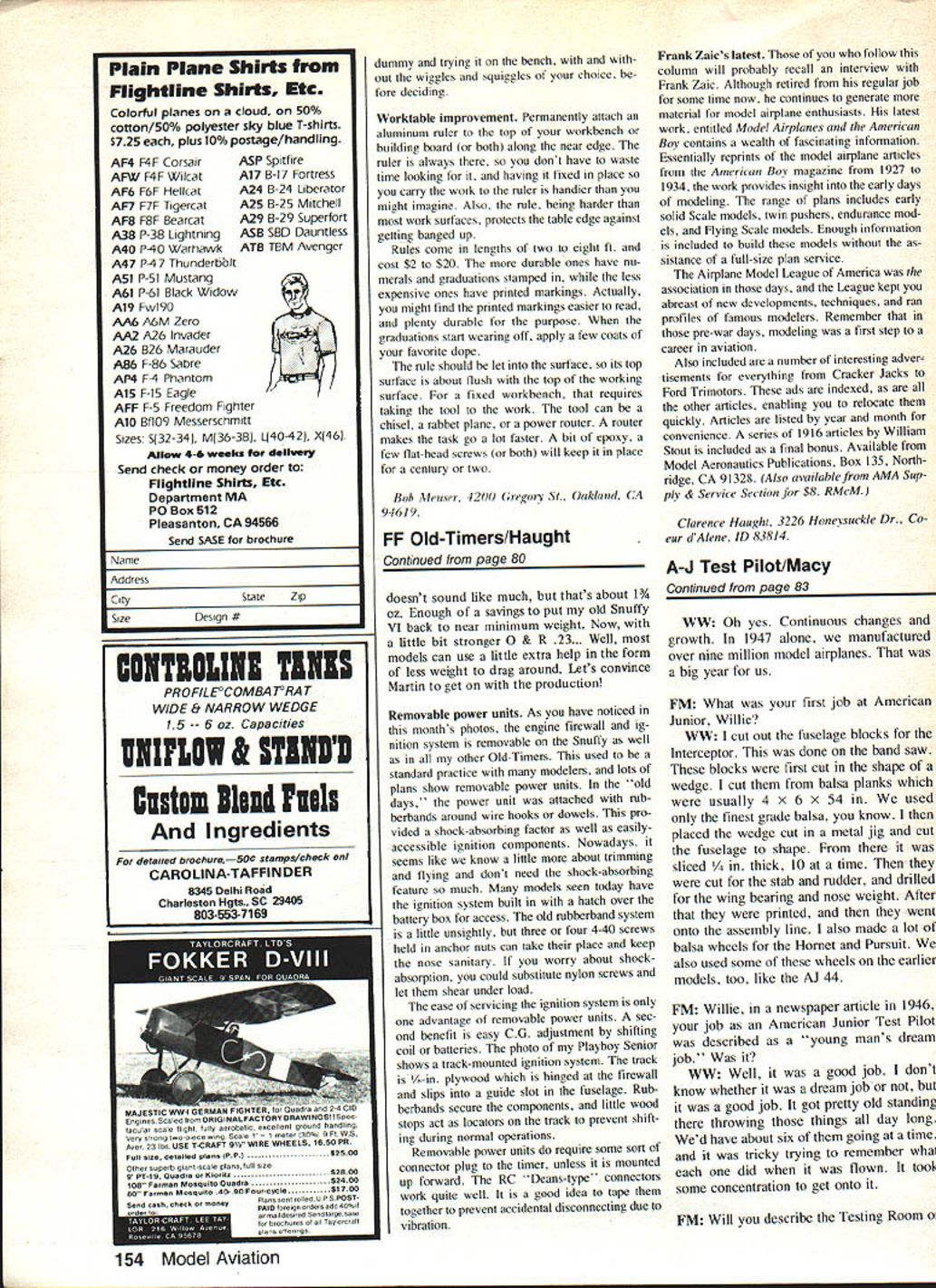
This design appeared in Harvard Pilot and is attributed to M. Wells. The objective of all those wiggles and squiggles in the wire, and the neoprene tubing, is to eliminate the problem of the rubber motor slipping off the hook; eliminate the bunching of the wound motor around the hook and provide truer centering of the rubber motor with respect to the shaft. I'm not at all sure that all those wiggles and squiggles are absolutely essential, although it is obvious that if the directions are followed to the letter, the objectives will be met. You might try bending up a crude dummy and testing it on the bench, with and without the wiggles and squiggles, before deciding.
Worktable improvement
Permanently attach an aluminum rule to the top of your workbench or building board along the near edge. The ruler is always there, so you don't have to waste time looking for it, and having it fixed in place so you carry the work to the ruler is handier than you might imagine. Also, the ruler, being harder than most work surfaces, protects the table edge against getting banged up.
- Rules come in lengths of two to eight feet and cost $2 to $20.
- More durable ones have numerals and graduations stamped in, while less expensive ones have printed markings. Printed markings can be easier to read and are plenty durable for this purpose.
- When the graduations start wearing off, apply a few coats of your favorite dope.
The rule should be let into the surface so its top is about flush with the top of the working surface. For a fixed workbench, that requires taking the tool to the work—a chisel, rabbet plane, or power router. A router makes the task go a lot faster. A bit of epoxy and a few flat-head screws (or both) will keep it in place for a century or two.
Bob Meuser, 4200 Gregory St., Oakland, CA 94619.
Transcribed from original scans by AI. Minor OCR errors may remain.

