

Free Flight: DURATION
Bob Meuser
Time out! Yes, even our tireless Contributing Editor Bob Meuser needs to take a little time off every now and then. We've asked long-time Free Flight flier, writer, editor, and publisher Bill Hartill to take over for Bob this month.
Defining Free Flight — Duration
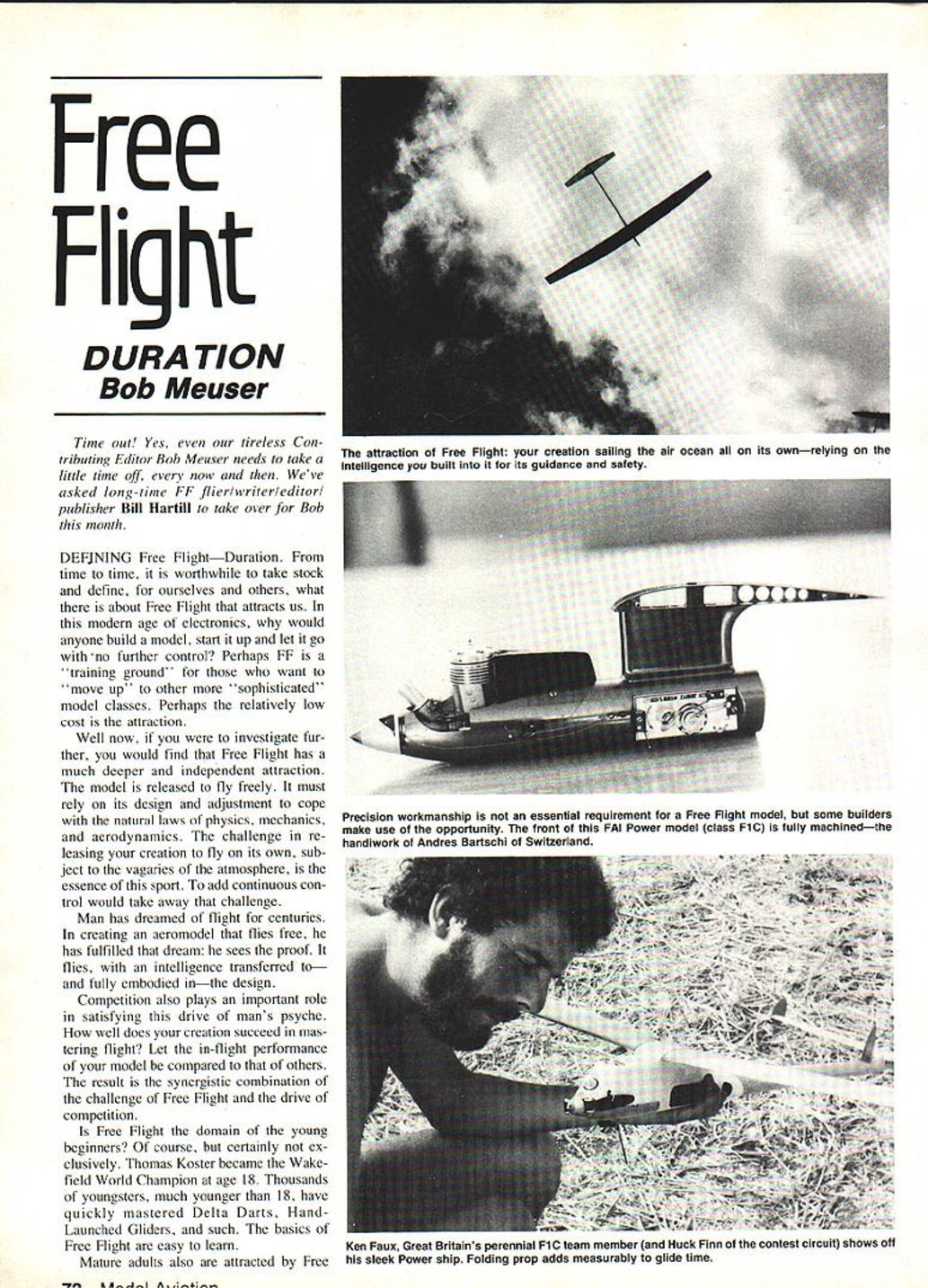
From time to time it is worthwhile to take stock and define, for ourselves and others, what there is about Free Flight that attracts us. In this modern age of electronics, why would anyone build a model, start it up, and let it go with "no further control"? Perhaps Free Flight is a training ground for those who want to move up to other, more sophisticated model classes. Perhaps the relatively low cost is the attraction.
If you investigate further, you find that Free Flight has a much deeper and independent attraction. The model is released to fly freely; it must rely on its design and adjustment to cope with the natural laws of physics, mechanics, and aerodynamics. The challenge in releasing your creation to fly on its own, subject to the vagaries of the atmosphere, is the essence of this sport. To add continuous control would take away that challenge.
Man has dreamed of flight for centuries. In creating an aeromodel that flies free, he has fulfilled that dream: he sees the proof. It flies, with an intelligence transferred to — and fully embodied in — the design.
Competition also plays an important role in satisfying this drive. How well does your creation succeed in mastering flight? Let the in-flight performance of your model be compared to that of others. The result is a synergistic combination of the challenge of Free Flight and the drive of competition.
Is Free Flight the domain of young beginners? Of course, but certainly not exclusively. Thomas Koster became the Wakefield World Champion at age 18. Thousands of youngsters, much younger than 18, have quickly mastered Delta Darts, hand-launched gliders, and similar designs. The basics of Free Flight are easy to learn.
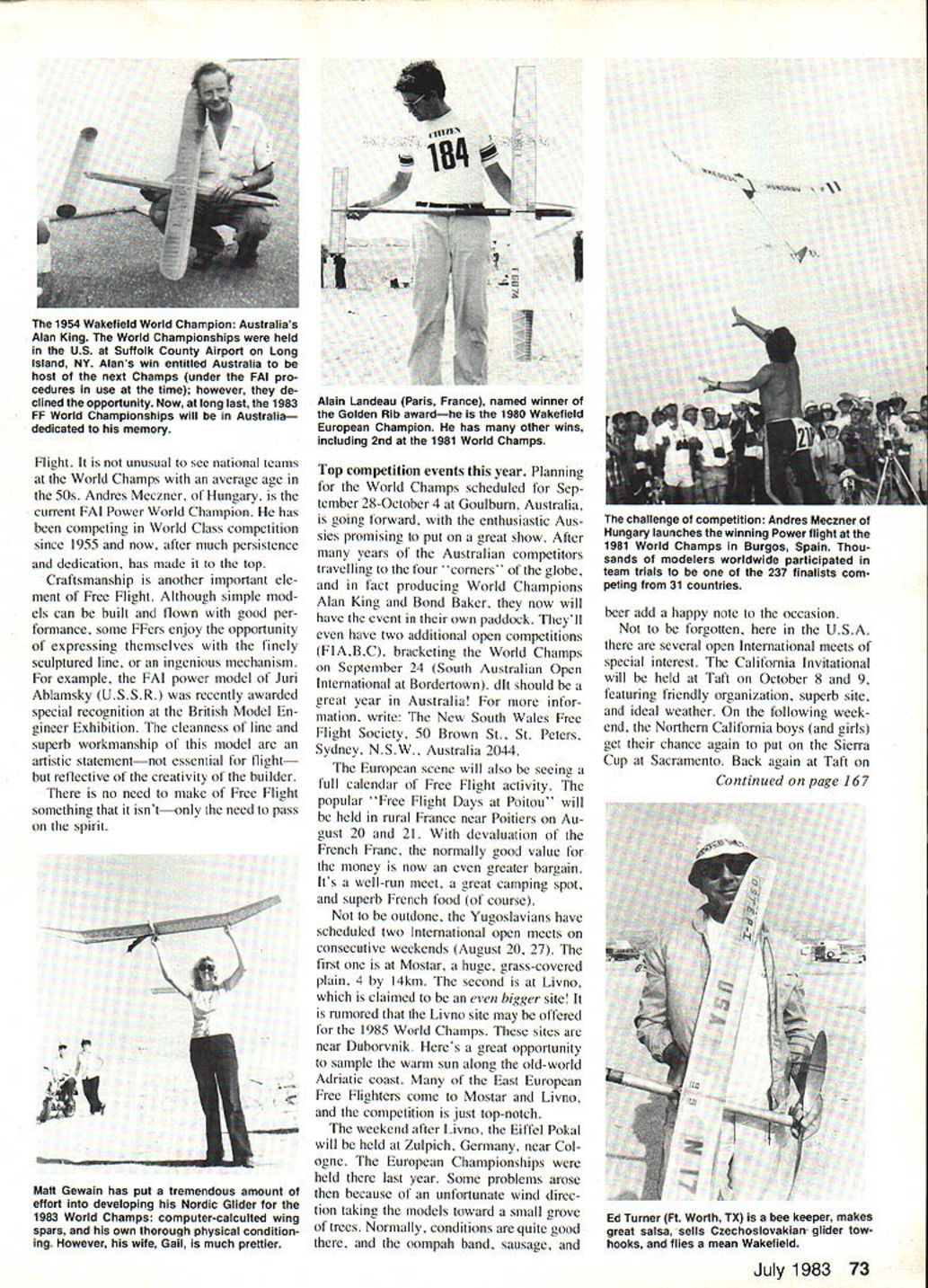
Mature adults are also attracted to Free Flight. It is not unusual to see national teams at the World Champs with an average age in the 50s. Andres Meczner, of Hungary, is the current FAI Power World Champion. He has been competing in World Class competition since 1955 and, after much persistence and dedication, has made it to the top.
Craftsmanship is another important element of Free Flight. Although simple models can be built and flown with good performance, some fliers enjoy expressing themselves with finely sculptured lines or ingenious mechanisms. For example, the FAI power model of Juri Ablamsky (U.S.S.R.) was recently awarded special recognition at the British Model Engineer Exhibition. The cleanness of line and superb workmanship of this model are an artistic statement — not essential for flight — but reflective of the creativity of the builder.
There is no need to make Free Flight something that it isn't — only the need to pass on the spirit.
Top competition events this year
Planning for the World Champs, scheduled for September 28–October 4 at Goulburn, Australia, is going forward, with the enthusiastic Aussies promising to put on a great show. After many years of Australian competitors travelling to the four corners of the globe — and in fact producing World Champions Alan King and Bond Baker — they will now have the event in their own paddock. They'll even have two additional open competitions (F.I.A.B.C.), bracketing the World Champs on September 24 (South Australian Open International at Bordertown). It should be a great year in Australia.
For more information, write:
- The New South Wales Free Flight Society, 50 Brown St., St. Peters, Sydney, N.S.W., Australia 2044.
The European scene will also be busy. The popular "Free Flight Days at Poitou" will be held in rural France near Poitiers on August 20 and 21. With devaluation of the French franc, the normally good value for the money is now an even greater bargain. It's a well-run meet, a great camping spot, and superb French food.
The Yugoslavians have scheduled two international open meets on consecutive weekends (August 20 and 27). The first is at Mostar, a huge grass-covered plain 4 by 14 km. The second is at Livno, claimed to be an even bigger site. It is rumored that the Livno site may be offered for the 1985 World Champs. These sites are near Dubrovnik — a great opportunity to sample the warm sun along the old-world Adriatic coast. Many East European Free Flighters come to Mostar and Livno, and the competition is top-notch.
The weekend after Livno, the Eiffel Pokal will be held at Zulpich, Germany, near Cologne. The European Championships were held there last year. Some problems arose then because of an unfortunate wind direction that took models toward a small grove of trees. Normally, conditions are quite good there, and the oom-pah band, sausage, and beer add a happy note to the occasion.
In the U.S.A., there are several open international meets of special interest:
- California Invitational at Taft, October 8–9 — friendly organization, superb site, and ideal weather.
- Sierra Cup at Sacramento — the following weekend, organized by Northern California fliers.
- Jim Patterson Challenge back at Taft, November 27–28.
All these competitions will be for F1A, F1B, and F1C and feature first-rate organization, good weather, good sites, and banquets.
Personalities
Mr. Alain Landeau of Paris, France, has become the first recipient of the Nervure d'Or (Golden Rib) award. The prestigious magazine Vol Libre established this award for the Free Flight modeler who, nationally and internationally, has established the most noteworthy record in competition.
Alain has figured at the top for years in national and international competitions in both Wakefield (F1B) and Power (F1C). He flies Nordic, too. He has contributed to the development of stability and performance analysis of Wakefields. Another of his prominent characteristics is modesty: quiet and unassuming, he lets the model speak for him. Could that be why his Power model is named Boom-Boom? It appears unknown where Alain does his testing, since he lives in the heart of Paris, close to Notre Dame. That's all the more credit.
Alain placed second in Wakefield at the 1981 World Champs. The 1982 European Championships also saw him in second place.
Andre Schandel, editor of Vol Libre, would like to hear nominations for this award for 1983. Write to:
- Andre Schandel, 16 Chemin de Beaulencourt, 67000 Strasbourg Robertsau, France.
Ask him about Vol Libre while you're at it — it's a Free Flight festival of information!
Ken Faux of Great Britain joins Stafford Screen and Ray Monks in forming the British F1C power team for Australia. This report comes from Burgos, Spain. Ken reports that conditions were good at their team trials — which was lucky, since immediately before the first rounds he crashed both models he had campaigned so successfully in Europe during 1982. This left him with only his high-aspect-ratio model, last used in the 1980 European Champs flyoff in Mostar. He had trimmed the power a couple of evenings before the trials and had given it only one glide flight.
Though it has consistently been his best-performing model for the last couple of years, it has also had a tendency to spin in off the top of the climb. It did this a couple of weeks before the trip to Sciznovo Usti, and though it was repaired, it never left the model box while he was on the continent. On his return from that tour (having won both the Bohemia Cup and Poitou), he crashed this model. The difficulty was found to be a sticking V/T (variable-incidence tailplane) arm: the vertical part of the arm was binding against the trailing edge of the stab, so the stab was reluctant to return to the glide setting.
Ever since curing this problem, the model has behaved beautifully. With good trials weather and this airplane, he managed 14 flights that would all have been worth five minutes. For Australia, Ken is building a conventional but high-aspect-ratio model (over 80 in. span). He would like to try metal-foil covering but hasn't obtained the material yet.
While on the subject of F1C models, here in the U.S.A. glider fliers Juan Livotto, Hector Diez, Jose Dona, and Craig Cusick are currently working diligently on power models for 1983. It should be quite a season. See you downwind.
Thank you, Bill Hartill. We hope you'll have an enjoyable and successful flying season this year. In the meantime, photos, news, correspondence, and similar items should continue to be sent to:
Bob Meuser, 4200 Gregory St., Oakland, CA 94619.
Transcribed from original scans by AI. Minor OCR errors may remain.

