
Free Flight
Duration
Bob Meuser
Forty-Niner Power Class, revisited
In my May column I ran an item on this event and credited it to the Scale Staffel Club because the rules I published were taken from its publication. However, the event originated with the Orbiteers, and the most recent rules differ slightly from those I presented. The differences are:
- Maximum dimensions: 49 by 49 in. (not 48 in.).
- Engine: stock, reed-valve, direct-drive Cox or Testors .049.
- Minimum official flight time: 40 seconds.
- Unlimited attempts are permitted to make three official flights.
- In the scoring formula, the engine run is recorded to the nearest whole second (not to the nearest 1/2 second).
The event’s first running went well. The winner was T. A. Wilson flying a simple, almost-all-balsa model, and everyone had a good time. I suspect we’ll be seeing more of this event.
Glitch department
A few errors appeared with the wooden steelyard scale drawing and its accompanying text (May issue):
- On the drawing, the weight of the slider should be exactly 1 lb., not 1 oz.
- In the next-to-last paragraph of the item, replace “half-oz. weight” and “one-oz. weight” with “half-lb. weight” and “one-lb. weight.”
Also, my comment about using an aluminum yardstick needs clarification: under high loads, a thin aluminum yardstick can become unstable and flip onto its side — it depends on the yardstick’s thickness. I suggested aluminum to avoid balance changes resulting from moisture adsorption and desorption; this has been a problem with several indoor scales I have built. Dittmer (the designer) notes that small changes can occur.
Tomy timers again
According to Jack Pitcher (Nor’Westers FF MAC newsletter, Portland, OR), Tomy has produced a smaller, lighter timer—a version of the wind-up motor found in Rascal Robot and similar toys. The new toys, called Pencil Pets, clip onto the ends of ordinary pencils: the powered front section clips to one end and the unpowered rear section to the other. Two versions are available: Dachshund (dog) and green caterpillar. Cost is about $3 at discount toy marts.
Details:
- Motor design is similar to earlier toy motors but smaller and somewhat harder to modify.
- Weight: about 19 grams (vs. 28 grams for the older type); the smaller version seems to run smoother.
- Pitcher’s modifications generally followed the Lindley–Stoy article (Model Aviation, June 1982). The simplest modification is removal of the drive spring.
If you send an SASE, I will send a Xerox copy of Pitcher’s article.
NFFS news and publications
NFFS Publications, 4858 Moorpark Ave., San Jose, CA 95129, offers two specials good through August 1, 1983:
- Any three issues of NFFS Symposium reports (including the World Champs Tech Report): $20.
- Six issues: $35.
- Surface postage included. Nonmembers please add $4 per order.
Available issues include 1968, 1969, 1970, and 1975, plus one-year sets and other back issues. Free Flight NFFS Digest offered for $18 postpaid regardless of NFFS membership. Make checks payable to NFFS.
Staff and distribution changes:
- Don Hughes is the new Membership and Subscription Manager (replacing Hal Wood). Address: 8383 Zancanaro Ct., Citrus Heights, CA 95610.
- Effective January, publications are handled by Fred Terzian at the San Jose address above. Plans are now handled by Manny Andrade, who also handles NFFS supplies. Manny’s address: 1602 Encanto Place, Walnut Creek, CA 94596.
Write to Fred and Manny for complete price lists and available supplies.
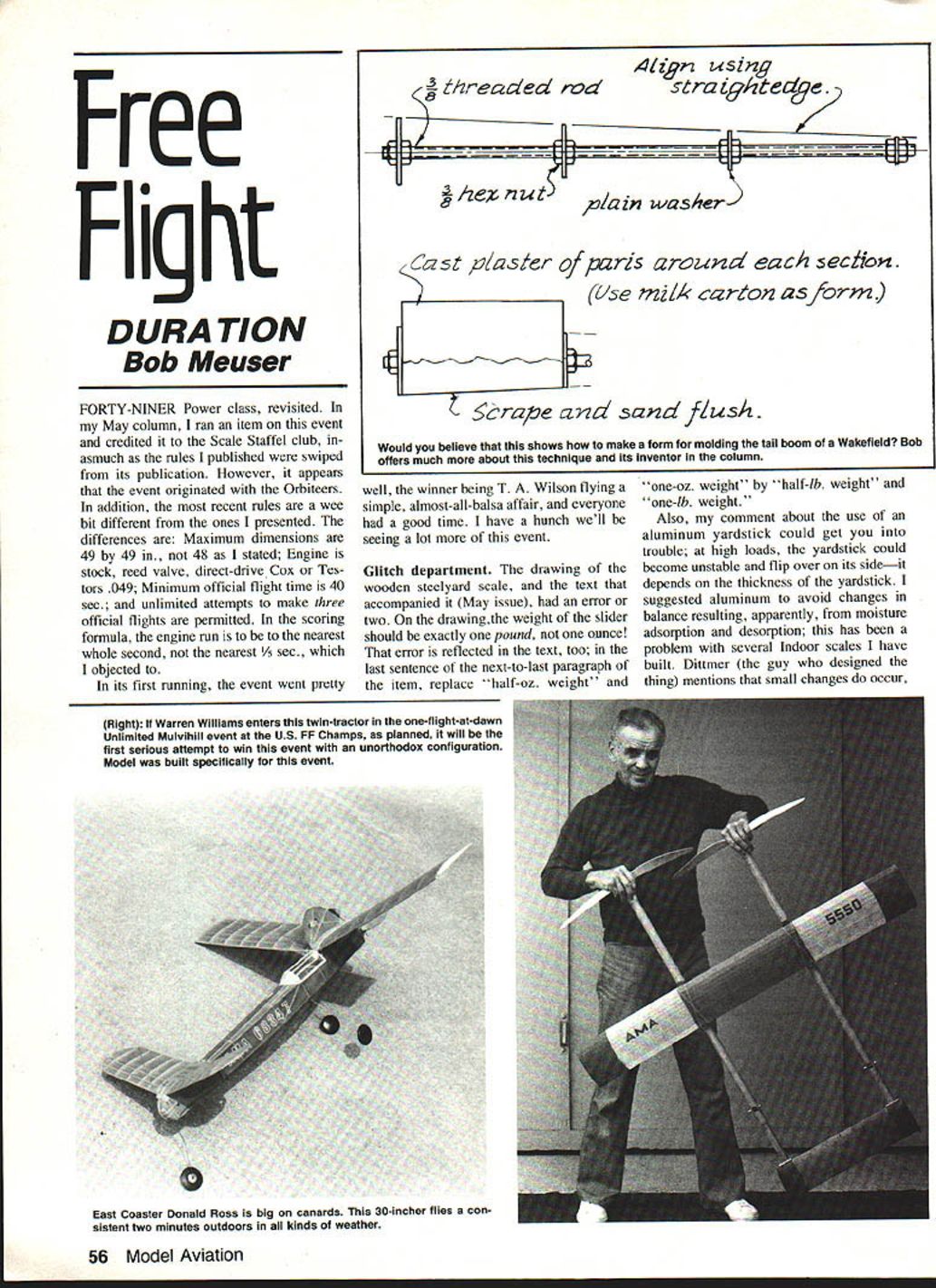
Tailboom form (Don Hughes)
When Don Hughes got interested in Wakefield rubber-power models, he decided a tubular fuselage was best. Motor-tube forms were easy to find, but tailboom forms were difficult. After trying pool cues and many other attempts, he devised a simple, low-cost form:
- Buy a 3-ft length of 3/8-in. threaded rod, a handful of nuts, and washers of diameters approximating the boom profile (e.g., 1/8, 1/4, 3/8, 1/2 in.).
- Space the washers along the rod to form the desired taper (Don used washers spaced for a 34-in. boom). Drill out some washers if necessary to fit the rod.
- Lock the washers in place with nuts after checking the taper along a straightedge. Trigonometry helps but trial and error works.
- Mix plaster of Paris and fill between two adjacent washers using a milk-carton strip as a form. Peel off the paper soon after the plaster begins to set.
- Shave excess plaster with a hacksaw (used like a spoke shave) while the plaster is still somewhat soft; finish sanding with metallic “sandpaper” (e.g., Dragonskin) and then conventional sandpaper.
This yields a solid, accurate tailboom form without a lathe.
FF Duration — Meuser
Beginners' problem
Too often, would-be FAI-event modelers are intimidated by designs that appear to require a fully equipped machine shop. In many cases, simple hand tools, ingenuity, and a “what-the-heck” attitude will suffice.
The “Juniors Problem” (better termed the “Beginners Problem”) remains crucial and under-addressed. A few individuals and groups have made outstanding efforts (Ed Whitten’s long-standing program is notable), and there have been local initiatives, but what’s lacking is a committed, organized, long-range plan and follow-through by someone or some organization.
A small but meaningful effort has been the “Beginners’ Corner” in Free Flight, the NFFS Digest edited by Frank Gue. Frank started the column and sustained it despite a demanding schedule, but he must now give it up. We need a volunteer to take over this important work. Volunteers?
Nitrate dope returns
After a lapse of at least five years, Sig Manufacturing Company is again offering nitrate dope. Free Flight modelers appreciate its advantages over butyrate dope. Sig notes these benefits:
- Compatible with epoxy and enamel paints.
- Plain fabric can be nitrate-doped and then painted, eliminating the need for iron-on coverings.
- Shrinks only moderately compared with butyrate.
- Better adhesion to structures.
- Higher solids content; fills with fewer coats.
- Ideal for light rubber-power models where fuel resistance is not required (a fuel-proof topcoat can provide resistance where needed).
Cautions:
- Butyrate can be applied over nitrate, but nitrate over butyrate is unwise (it can cause cracking and other problems). Always test when switching brands or finishing systems.
- Sig does not stock a thinner specifically for nitrate dope; its regular dope thinner and retarder work. I have used acrylic lacquer thinner and inexpensive lacquer thinner with nitrate dope successfully, but test before using on important work.
Free Flight Hall of Fame Awards (1983)
The National Free Flight Society announced the 1983 Free Flight Hall of Fame recipients. These individuals have contributed significantly to Free Flight activities:
- Reginald Denny (deceased) — designer; known for the Dennyplane engine.
- John Gard — scientific designer of Wakefield and Nordic models; applied aerodynamic theory practically.
- Don McGovern — longtime editor of Flying Models; prolific designer and draftsman.
- John Pond — influential in “Old-Timers” activity since the 1930s.
- George Reich — Wakefield Cup winner (1961); developed widely emulated rubber-powered designs.
- Lawrence Smithline — noted for construction articles in early hobby magazines; influential to many modelers.
Model of the Year Awards (1983)
Jim Wilson, Model of the Year Chairman for NFFS, announces the 1983 awards.
International Classes
- F1A: Matt Gevain — Pacer 14
- F1B: Alain Landreau
- F1C: Andreas Meckner — Delfin
AMA Power
- Small: Roman Ramirez — Cargo
- Large: Hal Woods — Summerwind
- Large: Doug Galbreath — 744
Other Categories
- Hand-Launched: Phil Hainer Jr. — Kwik Flip II
- Launched: Phil Hainer Sr.
- Glider: Stan Chilton — Sweet 16 EZ-B
- Indoor: Bob White — Unlimited
- Rubber: Don Snell — Santos DuMont
- Scale: Don Snell — Santos DuMont
- Special: Ed Dolby — FAI Rubber
The awardees have been invited to display and discuss their models at the NFFS Symposium held at the AMA Nationals in July. Drawings, photos, and stories will appear in the NFFS Symposium Report, available at the Nationals or by mail order. For further information, contact Jim Wilson, 1030 Avenue D, Redondo Beach, CA 90277.
Notes and contacts
- Bob Meuser, 4200 Gregory St., Oakland, CA 94619.
Transcribed from original scans by AI. Minor OCR errors may remain.

