
Free Flight: DURATION
Bob Meuser
New and different: the "Called-Time" event
As invented by John Ferrer, the competition concept is applied to ROG outdoor rubber-power models, but it seems applicable to other classes as well. It's simple. Announce a predicted flight time. Make a flight. The absolute difference between the actual and predicted flight time is your score. Lowest total score for three flights wins. Enter as often as you like.
At the first trial of the event, the lowest three-flight score was nine seconds. Scores on individual flights ranged from 1½ sec. to 45 sec. The event was greeted with enthusiasm by the Thunderbugs membership and will be included in future contests. Irv Acker has donated a trophy for the first person to post a three-flight score of less than one second.
(Catch a thermal, and you lose! I wonder if this will lead to the development of non-thermal detectors?)
New covering film
Ray Harlan is marketing a new polyester film material, intended for indoor models, that is both lighter and tougher than any other film on the market. It is easily trimmed to the outline of the framework using a soldering pencil, and it cuts almost as readily as microfilm. It is easily attached to frameworks with the spray-on mounting adhesives sold in art supply shops. Ray is experimenting with applying some techniques used with microfilm to the new material, for example: covering the wing while it is flat, then putting in the dihedral afterward.
Called Ultrafilm, the material costs $6 for a 10-ft. roll—enough for half a dozen Pennyplanes. Include $1.25 for postage and handling, unless you order other Harlan goodies—scale, balsa stripper, tail boom form—at the same time. Ray's address is 15 Happy Hollow Rd., Wayland, MA 01778.
Tow a glider—with a FF model!
Some lads from the San Diego area (Frank Allen, Frank, Jr., Charlie Yost, and Tommy Wilson) have been fooling around with this, and it seems like fun. The tow plane was a Cox Pee Wee–powered, all-sheet profile biplane of about 21-in. wingspan. The glider was an all-sheet affair with a 15-in. span having a towhook on the nose. A 12- to 15-ft. length of thread with a loop at the end connected the two.
A rather open towhook is required; if it is closed too much, the towline won't fall off. But when all goes well (as it did for a number of flights until the glider went off into the blue on a thermal), when the engine cuts the tow plane stalls a bit, the towline releases, and the glider is off and away.
NFFS Distinguished Service Award
The Free Flight community has maintained a tight bond when it comes to matters of Free Flight. This bond exists because of a common interest, plus the willingness of a few to perform effort above the average. The Board of Directors of the NFFS now feels that these individuals should be recognized. Accordingly, the Distinguished Service Award has been created.
The award is based upon an individual's contribution (technical, monetary, literary, educational, supportive, et al.) to the furtherance of the NFFS in particular, and Free Flight in general. The Distinguished Service Award will be awarded as the need arises, and not necessarily at a specific event. This award does not in any way replace or influence the Free Flight Hall of Fame, but rather supplements it. Anyone can nominate an individual, but the nomination must be accompanied by some very good cogent reasons for its submittal. Remember the title: "Distinguished." The person's deeds must be above average.
Please submit your nominations in writing (that is very legible) along with the individual's address and phone number as well as your own. We would also be interested in knowing if the person is a member of NFFS, NIMAS, SAM, AMA, etc. Mail your nomination to either:
- Hardy Brodersen, P.O. Box 1104, Birmingham, MI 48012
- A. J. Italiano, 1655 Revere Dr., Brookfield, WI 53005
Folding props for gas engines
K&W Enterprises of 7824 Lexington Ave., Philadelphia, PA 19152 is marketing a folding prop, and selling it by the piece. The hub assembly, suitable for engines from .15 to .21 cu. in. displacement, goes for $28. The fiberglass blades go for $4 each and are available in:
- 7 x 2½
- 7 x 3
- 7 x 3½
- 8 x 4
K&W continues to market its Stop-A-Prop engine brakes, spare parts, adapters, and so forth.
Book preview: Scrapbook of Scale: 3-Views and Nostalgia
This preview is a bit skimpy, necessarily, inasmuch as this is not your definitive Scale-buffs-only column. (And besides, I haven't even seen a copy of the book yet.) But, knowing the author's track record, I think I'm safe in assuming that the pre-publication flyer is accurate, and that you'll get your money's worth. The title is Scrapbook of Scale: 3-Views and Nostalgia, and the author is Bill Hannan.
Primarily, it seems to be a collection of articles and three-views—about a dozen or so of the latter—of full-size aircraft. Much of it consists of material which has appeared in other publications between 1964 and the present, but some of the sources might not be at your fingertips: Le Fanatique de L'Aviation (France), Popular Rotorcraft Flying, Cross and Cockade Journal, for example. The three-views include obscure pioneer monoplanes, a Golden Age racer, a biplane, a triplane, two canards, an autogiro, a gyroptre (whatever the devil that is), and three different Farman Mosquitos from England, France, Germany, Spain, and the U.S.
Also included are ready-to-use construction drawings of three flying models:
- a simple catapult glider
- a rubber-power profile model
- a Peanut Scale model
Format is 8½ x 11, 56 pages long. Price: $8.95 plus $1.00 per book postage. (California residents add 6% sales tax.) Bill's previous book—Peanut Power—is still available for the same price. Ask Bill to autograph your copy, if you like. Order from W. C. Hannan Graphics, P.O. Box A, Escondido, CA 92025.
Those Tomy timers, again
Jack Pitcher wasn't the only person to bungle into the fact that the Tomy "Pencil Pet" toys have windup motors that are even smaller than the earlier ones (this column, August 1983) and to realize their potential as the makings of an ultra-lightweight dethermalizer timer; Bill Gieseking has been playing with these new ones, too. A while back (Model Aviation, June 1982), Don Lindley and Stan Stoy presented an article on modifications to the older and larger Tomy motors. The gist of their modification was to abandon the spring drive entirely, discard the part of the case containing it (thereby reducing the thickness by about 50%), and supply the needed power by means of an external rubberband. Gieseking uses essentially the same scheme, but adds a few touches of his own.
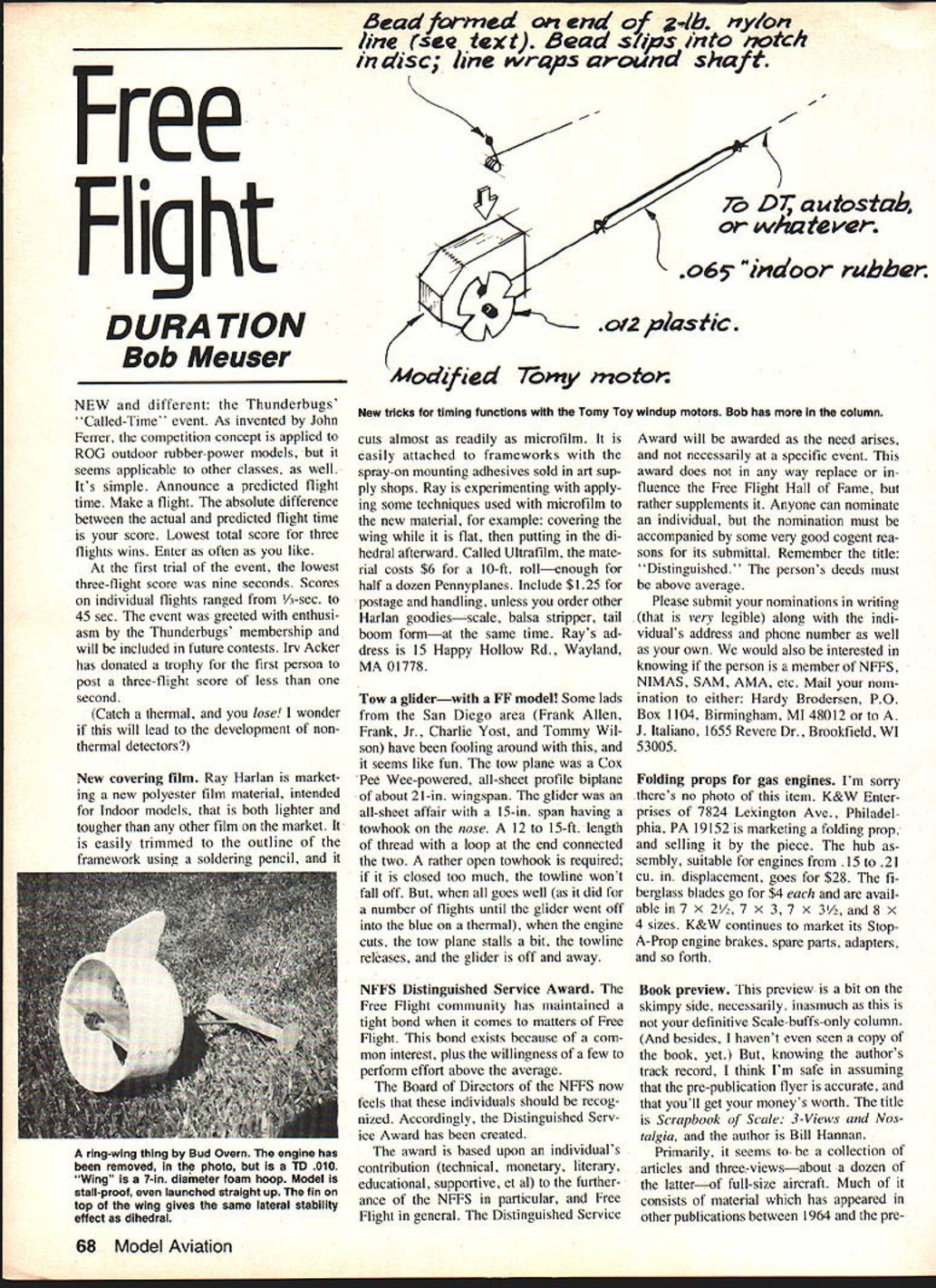
Bill has turned his Tomy into a multi-function timer. The heart of the system is a disc having a diameter of about 4 in. cut from .012-in. plastic sheet with scissors and notched at one or more places—one notch for each function. The monofilament timer line terminates, not in a loop, as in the Lindley-Stoy system, but rather in a "bead." The bead is made by tying an overhand knot in the line, applying a drop of CyA adhesive, and dipping it into baking soda. Bill uses 2-lb. monofilament for the lines, so there is little buildup on the shaft, and the use of the beads prevents the several lines from interfering with each other. The extra pull from the additional lines gets the timer started in a positive fashion and speeds up the operation at the start, making for greater accuracy of the short-time functions.
Bill has used the system on his hand-launched gliders to supply an auto-stab function—the trailing edge of the tail pops up a little after about one second—in addition to the dethermalizer function and sees no problem in adding as many additional functions as one might want.
Are you as confused as I am, about now? I thought I had it all sorted out in my head—honest—until I read what I wrote and realized I'd simply have to make a sketch (which follows).
Business opportunity: Che Hobbies
Che Hobbies is up for grabs: Hugo Sandroni is going home to Argentina and is selling out his mail-order Free Flight business for a song, plus the wholesale value of his inventory. For half the price of a new car, you could put yourself in business and get tax writeoffs that would make the entire initial expense evaporate.
But Che Hobbies is still in business, and Sandroni won't be leaving for a while yet. In addition, he has just finished printing a new catalog which includes all the Free Flight goods from various manufacturers, large and small, plus a bunch of his own. The 23-page catalog sells for $2, which might seem a bit steep. However, you can't stay in business giving away catalogs that cost close to that amount just for printing and mailing without jacking up your prices, which Che has chosen not to do. The address for Che Hobbies is 10900 Eastwood Ave., Inglewood, CA 90304, or phone (213) 674-1756.
Bob Meuser, 4200 Gregory St., Oakland, CA 94619.
Transcribed from original scans by AI. Minor OCR errors may remain.

