
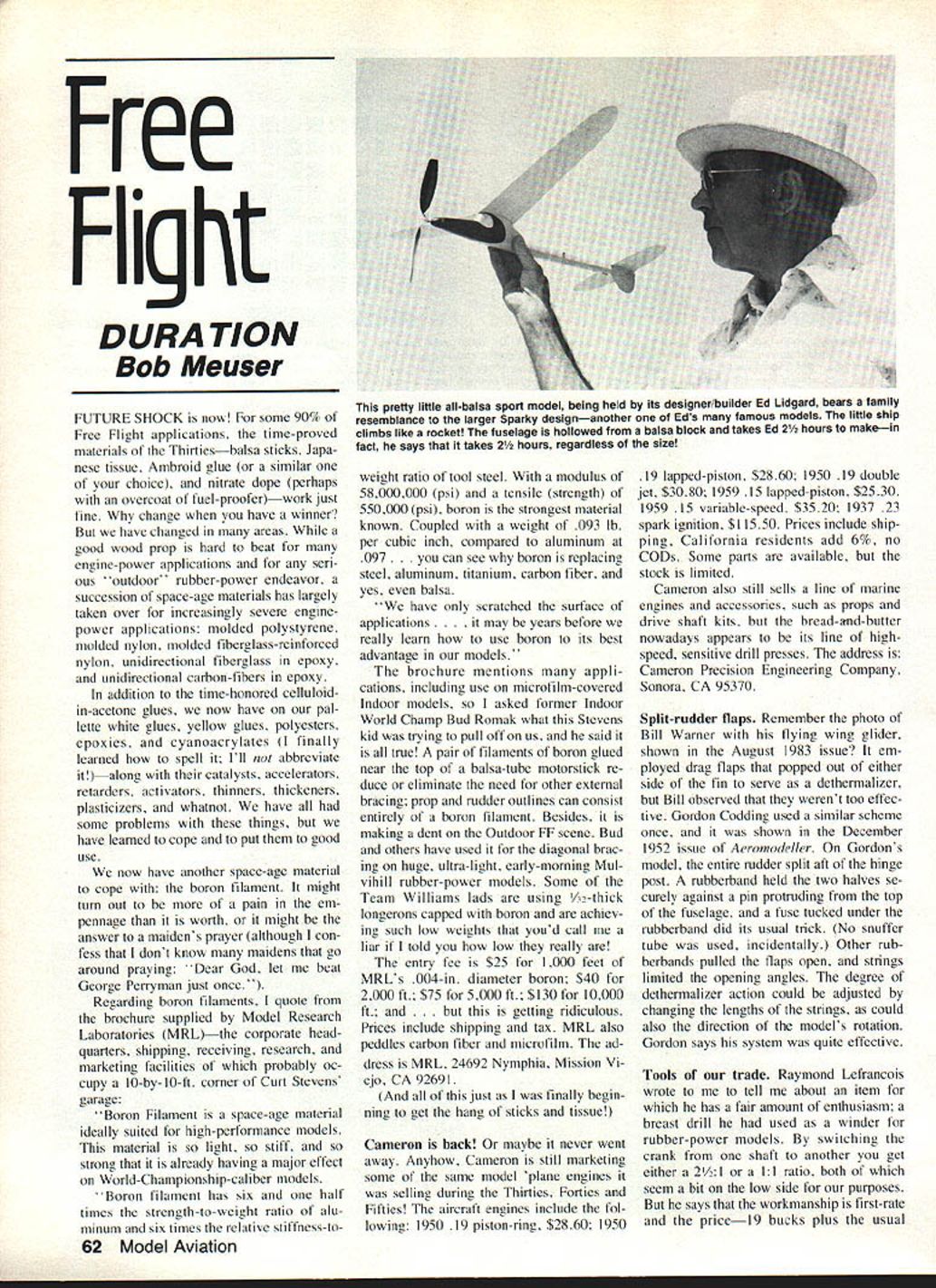
Free Flight: DURATION
Bob Meuser
FUTURE SHOCK is now! For some 90% of Free Flight applications, the time‑proved materials of the Thirties—balsa sticks, Japanese tissue, Ambroid glue (or a similar one of your choice), and nitrate dope (perhaps with an overcoat of fuel‑proofer)—work just fine. Why change when you have a winner? But we have changed in many areas. While a good wood prop is hard to beat for many engine‑power applications and for any serious "outdoor" rubber‑power endeavor, a succession of space‑age materials has largely taken over for increasingly severe engine‑power applications: molded polystyrene, molded nylon, molded fiberglass‑reinforced nylon, unidirectional fiberglass in epoxy, and unidirectional carbon‑fibers in epoxy.
In addition to the time‑honored celluloidin‑acetone glues, we now have on our palette white glues, yellow glues, polyesters, epoxies, and cyanoacrylates — along with their catalysts, accelerators, retarders, activators, thinners, thickeners, plasticizers, and whatnot. We have all had some problems with these things, but we have learned to cope and to put them to good use.
We now have another space‑age material to cope with: the boron filament. It might turn out to be more of a pain in the empennage than it is worth, or it might be the answer to a maiden's prayer (although I confess that I don't know many maidens that go around praying, "Dear God, let me beat George Perryman just once.").
Regarding boron filaments, I quote from the brochure supplied by Model Research Laboratories (MRL)—the corporate headquarters, shipping, receiving, research, and marketing facilities of which probably occupy a 10‑by‑10‑ft. corner of Curt Stevens' garage:
"Boron filament is a space‑age material ideally suited for high‑performance models. This material is so light, so stiff, and so strong that it is already having a major effect on World‑Championship‑caliber models.
"Boron filament has six and one half times the strength‑to‑weight ratio of aluminum and six times the relative stiffness‑to‑weight ratio of tool steel. With a modulus of 58,000,000 psi and a tensile (strength) of 550,000 psi, boron is the strongest material known. Coupled with a weight of 0.093 lb per cubic inch, compared to aluminum at 0.097 ... you can see why boron is replacing steel, aluminum, titanium, carbon fiber, and yes, even balsa.
"We have only scratched the surface of its applications ... it may be years before we really learn how to use boron to its best advantage in our models."
The brochure mentions many applications, including use on microfilm‑covered Indoor models, so I asked former Indoor World Champ Bud Romak what this Stevens kid was trying to pull off on us, and he said it is all true! A pair of filaments of boron glued near the top of a balsa‑tube motorstick reduce or eliminate the need for other external bracing; prop and rudder outlines can consist entirely of a boron filament. Besides, it is making a dent on the Outdoor FF scene. Bud and others have used it for the diagonal bracing on huge, ultra‑light, early‑morning Mulvihill rubber‑power models. Some of the Team Williams lads are using 1/32‑inch‑thick longerons capped with boron and are achieving such low weights that you'd call me a liar if I told you how low they really are!
The entry fee is $25 for 1,000 feet of MRL's .004‑in. diameter boron; $40 for 2,000 ft.; $75 for 5,000 ft.; $130 for 10,000 ft., and — but this is getting ridiculous. Prices include shipping and tax. MRL also peddles carbon fiber and microfilm. The address is MRL, 24692 Nymphia, Mission Viejo, CA 92691.
(And all of this just as I was finally beginning to get the hang of sticks and tissue!)
Cameron is back
Cameron is back! Or maybe it never went away. Anyhow, Cameron is still marketing some of the same model plane engines it was selling during the Thirties, Forties and Fifties! The aircraft engines include the following: 1950 .19 piston‑ring, $28.60; 1950 .19 double jet, $30.80; 1959 .15 lapped‑piston, $25.30; 1959 .15 variable‑speed, $35.20; 1937 .23 spark ignition, $115.50. Prices include shipping. California residents add 6%, no CODs. Some parts are available, but the stock is limited.
Cameron also still sells a line of marine engines and accessories, such as props and drive shaft kits, but the bread‑and‑butter nowadays appears to be its line of high‑speed, sensitive drill presses. The address is: Cameron Precision Engineering Company, Sonora, CA 95370.
Split‑rudder flaps
Remember the photo of Bill Warner with his flying wing glider, shown in the August 1983 issue? It employed drag flaps that popped out of either side of the fin to serve as a dethermalizer, but Bill observed that they weren't too effective. Gordon Codding used a similar scheme once, and it was shown in the December 1952 issue of Aeromodeller. On Gordon's model, the entire rudder split aft at the hinge post. A rubber band held the two halves securely against a pin protruding from the top of the fuselage, and a fuse tucked under the rubber band did its usual trick. (No snuffer tube was used, incidentally.) Other rubber bands pulled the flaps open, and strings limited the opening angles. The degree of dethermalizer action could be adjusted by changing the lengths of the strings, as could also the direction of the model's rotation. Gordon says his system was quite effective.
Tools of our trade
Raymond Lefrancois wrote to tell me about an item for which he has a fair amount of enthusiasm: a breast drill he had used as a winder for rubber‑power models. By switching the crank from one shaft to another you get either a 2:1 or a 1:1 ratio, both of which seem a bit on the low side for our purposes. But he says that the workmanship is first‑rate and the price — $19 plus the usual extras — is "right." (That's the "sale" price, which went off on June 30, worse luck.) The "regular" price is $38; at that price, I'd be inclined to do a bit of shopping first. The vendor is Mason and Sullivan (address later).
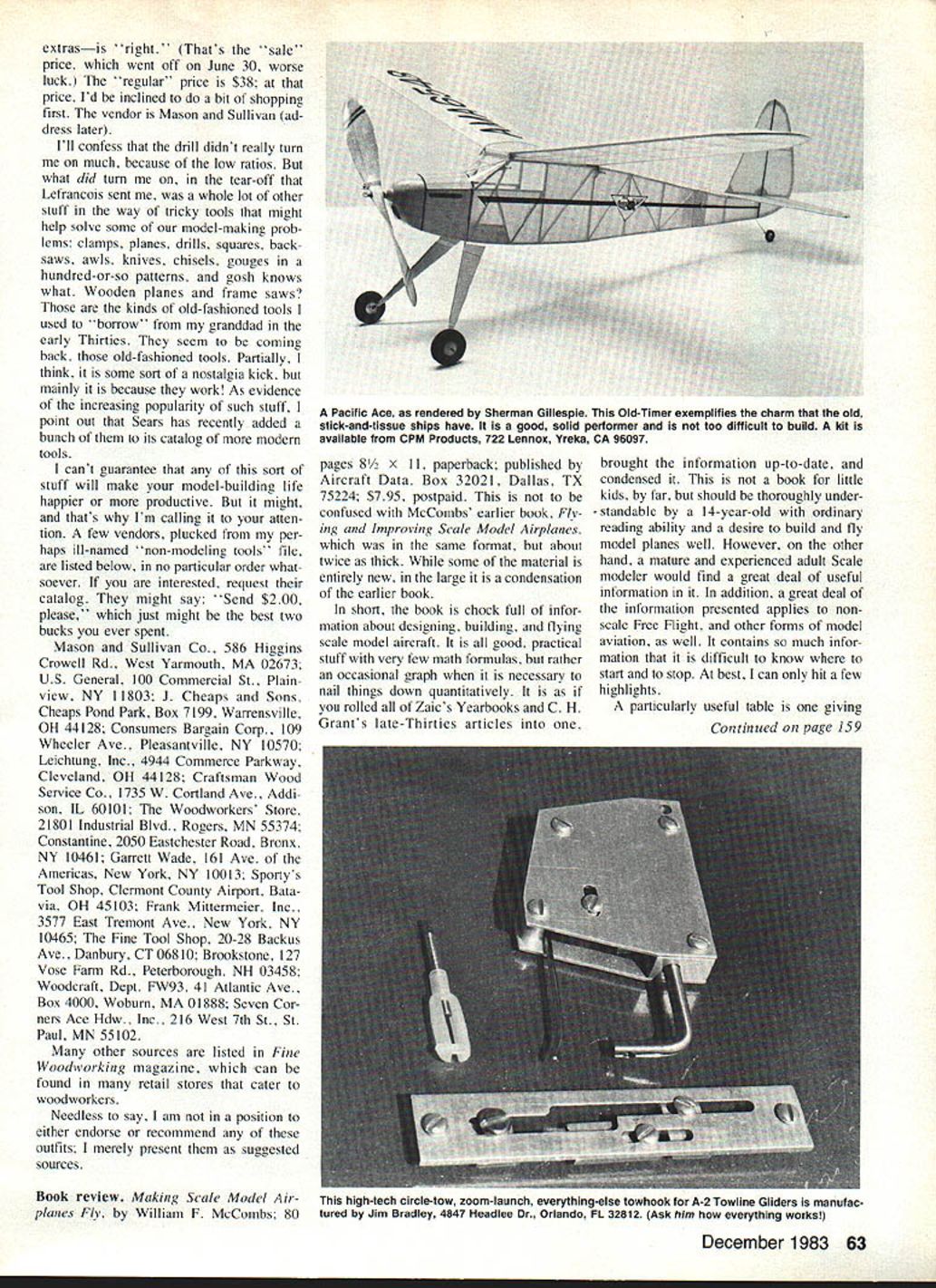
I'll confess that the drill didn't really turn me on much, because of the low ratios. But what did turn me on, in the tear‑off that Lefrancois sent me, was a whole lot of other stuff in the way of tricky tools that might help solve some of our model‑making problems: clamps, planes, drills, squares, backsaws, awls, knives, chisels, gouges in a hundred‑or‑so patterns, and gosh knows what. Wooden planes and frame saws? Those are the kinds of old‑fashioned tools I used to "borrow" from my granddad in the early Thirties. They seem to be coming back, those old‑fashioned tools. Partially, I think, it is some sort of a nostalgia kick, but mainly it is because they work! As evidence of the increasing popularity of such stuff, I point out that Sears has recently added a bunch of them to its catalog of more modern tools.
I can't guarantee that any of this sort of stuff will make your model‑building life happier or more productive. But it might, and that's why I'm calling it to your attention. A few vendors, plucked from my perhaps ill‑named "non‑modeling tools" file, are listed below, in no particular order whatsoever. If you are interested, request their catalog. They might say, "Send $2.00, please," which just might be the best two bucks you ever spent.
- Mason and Sullivan Co., 586 Higgins Crowell Rd., West Yarmouth, MA 02673
- U.S. General, 100 Commercial St., Plainview, NY 11803
- J. Cheaps and Sons, Cheaps Pond Park, Box 7199, Warrensville, OH 44128
- Consumers Bargain Corp., 109 Wheeler Ave., Pleasantville, NY 10570
- Leichtung, Inc., 4944 Commerce Parkway, Cleveland, OH 44128
- Craftsman Wood Service Co., 1735 W. Cortland Ave., Addison, IL 60101
- The Woodworkers' Store, 21801 Industrial Blvd., Rogers, MN 55374
- Constantine, 2050 Eastchester Road, Bronx, NY 10461
- Garrett Wade, 161 Ave. of the Americas, New York, NY 10013
- Sporty's Tool Shop, Clermont County Airport, Batavia, OH 45103
- Frank Mittenmeier, Inc., 3577 East Tremont Ave., New York, NY 10465
- The Fine Tool Shop, 20‑28 Backus Ave., Danbury, CT 06810
- Brookstone, 127 Vose Farm Rd., Peterborough, NH 03458
- Woodcraft, Dept. FW93, 41 Atlantic Ave., Box 4000, Woburn, MA 01888
- Seven Corners Ace Hdw., Inc., 216 West 7th St., St. Paul, MN 55102
Many other sources are listed in Fine Woodworking magazine, which can be found in many retail stores that cater to woodworkers.
Needless to say, I am not in a position to either endorse or recommend any of these outfits. I merely present them as suggested sources.
Book review
Making Scale Model Airplanes Fly, by William F. McCombs; 80 pages, 8-1/2 x 11, paperback; published by Aircraft Data, Box 32021, Dallas, TX 75224; $7.95, postpaid. This is not to be confused with McCombs' earlier book, Flying and Improving Scale Model Airplanes, which was in the same format but about twice as thick. While some of the material is entirely new, in the large it is a condensation of the earlier book.
In short, the book is chock full of information about designing, building, and flying scale model aircraft. It is all good, practical stuff with very few math formulas, but rather an occasional graph when it is necessary to nail things down quantitatively. It is as if you rolled all of Zaci's Yearbooks and C. H. Grant's late‑Thirties articles into one, brought the information up‑to‑date, and condensed it. This is not a book for little kids, by far, but should be thoroughly understandable by a 14‑year‑old with ordinary reading ability and a desire to build and fly model planes well. However, on the other hand, a mature and experienced adult Scale modeler would find a great deal of useful information in it. In addition, a great deal of the information presented applies to non‑scale Free Flight, and other forms of model aviation, as well. It contains so much information that it is difficult to know where to start and to stop. At best, I can only hit a few highlights.
A particularly useful table is one giving key data on the proportions of 126 aircraft built between 1910 and 1971. The quantities listed are those most important to the flying characteristics of scale models: ratio of horizontal tail area to wing area; ratio of tail moment arm to average chord (tail "volume"); ratio of nose length to average chord; and wing aspect ratio. The book includes an extensive list of magazine articles and books covering subjects of interest to Scale modelers. And there is a list of hundreds of plans for Flying Scale models, and another for three‑view drawings and other information about full‑size aircraft. Another nifty item is a one‑page, small‑print trouble‑shooting chart with 24 flying problems listed, together with their causes and cures. Another table (which I nearly missed) gives various data—but especially the predicted flight duration for rubber‑power models of 93 aircraft. The predictions are not guaranteed to be 100% accurate of course, but they should serve as a good guide for relative performance potential. I don't mean to imply that the book is entirely made up of tables—probably less than 10% is tables—but a table is a darned good way to cram a lot of information in a small space, and it is indicative of the time spent by the author in putting the book together.
I could carry on for my entire column about the book and still merely scratch the surface.
Continued on page 159
Wrist watch / stopwatch / alarm clock / calculator / calendar
Many years ago, I wrote an item about an Armitron watch/stopwatch that turned out to be a turkey, and so I'm a little gun‑shy about this one. It is certainly crammed full of features: day, date, time; a beeper that can be set to go off every hour; an alarm that can be set to beep‑beep‑beep its fool head off at 6:30 a.m. every Monday, Wednesday, and Friday, for example; a full‑featured, 1/100‑sec. stopwatch with split and time‑out function; and a four‑function, eight‑digit calculator with constant and memory features which can be set to beep every time you push a button. As far as longevity is concerned, you pay your money and you take your chances. But the price is right—$15 postpaid from Indoor Modeler Bob Randolph, 25145 Lawton Ave., Loma Linda, CA 92354. (If you find yourself in dire straits, food‑wise, you can always eat the thing for the case is obviously made of licorice.)
I'm not sure I could stand all that beep‑beep stuff, but fortunately my high‑frequency hearing is completely shot. One of these days I'm going to have to get one of those neat, compact (and very expensive) new hearing aids. And the first thing I'm going to do when I get one is to turn it off.
Bob Meuser 4200 Gregory St., Oakland, CA 94619.
Transcribed from original scans by AI. Minor OCR errors may remain.

