
Free Flight: Duration
Bob Meuser
Strange configuration
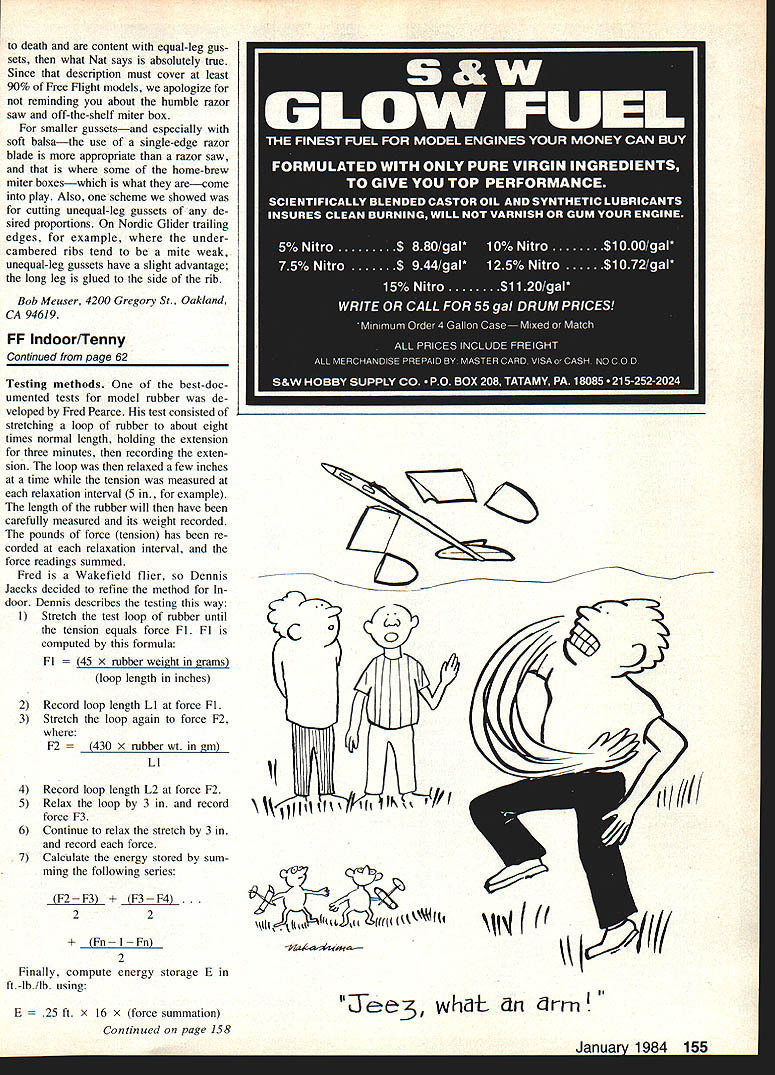
I saw a photo of a wind-tunnel model, similar to the one shown in the sketch, being tested at Langley Research Center. Thinking it might have some conceivable relation to Free Flight modeling, I checked it out with my chief technical consultant, W. Hewitt Phillips.
As the configuration was originally envisioned by Julian Walkowitz, an engineer at Wright-Patterson AFB, the wing and tail joined at the tips of the high-aspect-ratio surfaces. The idea was that the wing and tail would brace each other, giving a stiffer structure and hence a higher flutter speed. However, the stiffness increase is not nearly so great as its truss-like front-view appearance would lead one to believe. Raise the nose a bit and the whole thing suddenly becomes a lot thinner.
The idea was applied, in somewhat modified form, by Burt Rutan to a proposed agricultural aircraft that looked somewhat like the sketch. The wind-tunnel tests were done primarily to obtain stability data rather than lift-drag data. It seems obvious that the induced drag would be less than that of a monoplane of the same span because of the biplane effect.
Marginal longitudinal stability required reducing the sweep of the horizontal tail so that the outboard end of the tail was attached to the wing by means of a pod extending behind the wing. Directional stability suffered because of the tunnel effect of the wing–tail combination on the airflow acting on the fin; putting some fin area above the point where the horizontal tail attaches to it would be the cure.
Hewitt thinks the idea is worth some experimentation—Pennyplane, perhaps—but that it will not replace the long-tail-boom conventional configuration for most competition Free Flight applications.
Hot engines
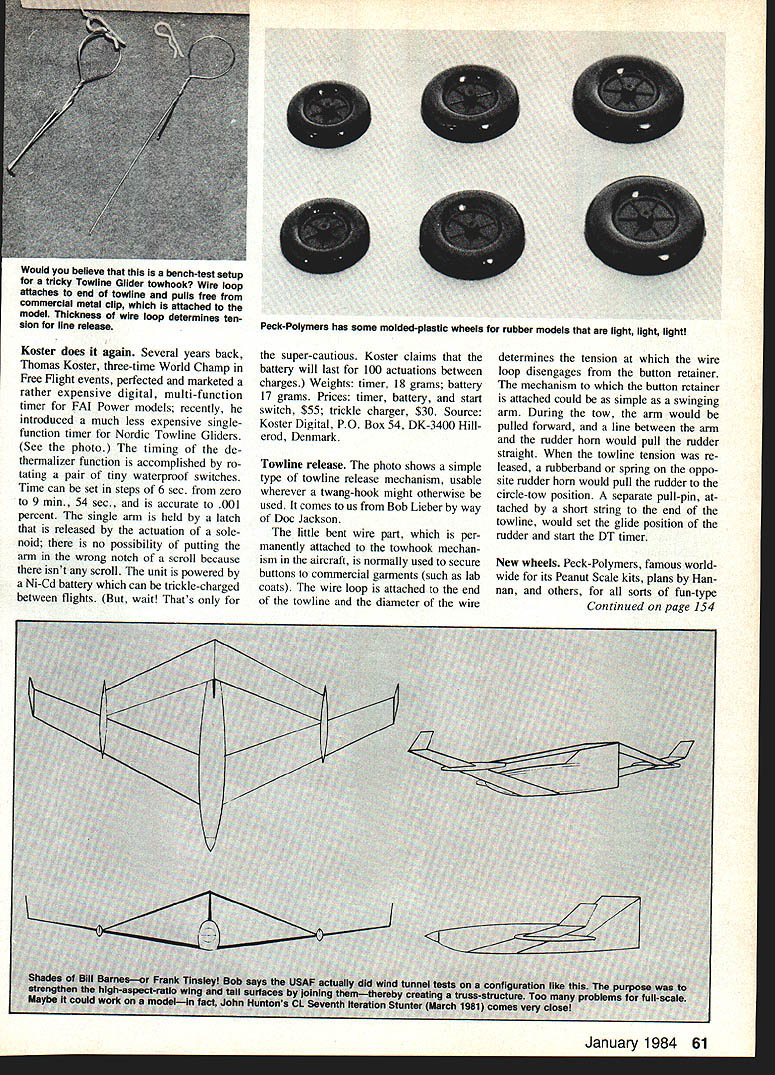
Nat Comfort (Richmond, VA) suggests that Free Flighters might do well to pay more attention to the Control Line Combat lads. Nat's engine started out as an OS .25 FSR of the ABC and RC persuasion. It was reworked, Combat-style, by Dick Tyndall, who is well known in Eastern Combat circles.
Aside from the obvious custom venturi and remote needle valve mount, many little things were done to the engine's innards. It powered Nat's Shocer to first place at the Eastern U.S. Free Flight Champs and to second place at the Nats. Tyndall does business under the name Virginia Craftsman, 348 Argyll Circle, Highland Springs, VA 23075.
Digital DT timer
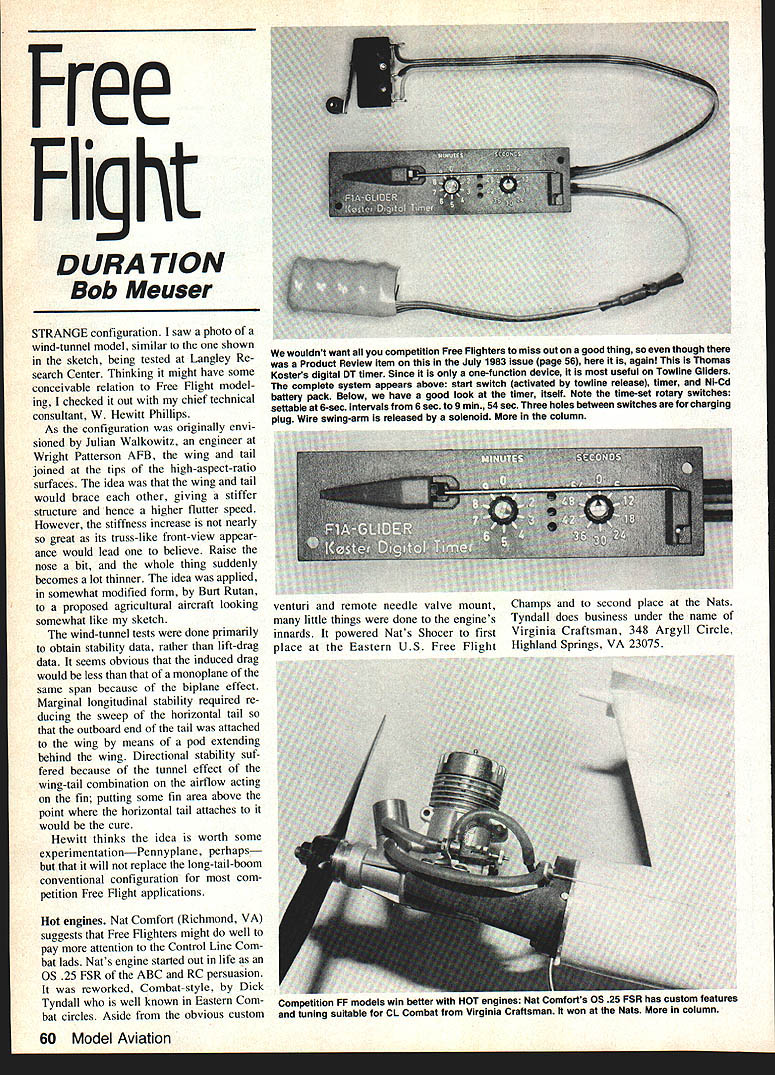
We wouldn't want competition Free Flighters to miss out on a good thing, so even though there was a Product Review item on this in the July 1983 issue (page 56), here it is again: Thomas Koster's digital DT timer. Since it is only a one-function device, it is most useful on Towline Gliders.
The complete system includes:
- Start switch (activated by towline release)
- Timer
- Ni-Cd battery pack
Timer details:
- Time-set rotary switches, settable in 6-second intervals from 6 sec to 9 min 54 sec
- Three holes between the switches are for the charging plug
- Wire swing-arm is released by a solenoid
- Time can be set in 6-sec steps, accurate to 0.01%
- Single arm is held by a latch and released by a solenoid—no scroll unit
- Ni-Cd battery can be trickle-charged between flights (Koster claims ~100 actuations between charges)
- Weights: timer 18 g, battery 17 g
Prices:
- Timer, battery, start switch: $55
- Trickle charger: $30
Source: Koster Digital, PO Box 54, DK-3400 Hillerød, Denmark.
Several years back Thomas Koster, three-time World Champion (Free Flight events), perfected and marketed a rather expensive digital multi-function timer. FAT Power Models recently introduced a much less expensive single-function timer for towline gliders that provides the timing/de-thermalizer capability via tiny waterproof switches.
Towline release
The photo shows a simple towline release mechanism usable wherever a twang-hook might otherwise be used. Bob Lieber (via Doe Jackson) uses a little bent-wire part permanently attached to the hook mechanism normally used to secure buttons on commercial garments such as lab coats.
How it works:
- A wire loop is attached to the end of the towline; the wire diameter determines the release tension.
- The wire loop disengages the button-retainer mechanism (the retainer can be a simple swinging arm).
- During tow, the arm is pulled forward; the line between the arm and the rudder horn pulls the rudder straight.
- When towline tension is released, a rubber-band spring opposite the rudder horn pulls the rudder into the circle-tow position.
- A separate pull-pin, attached by a short string to the end of the towline, sets the glide position of the rudder and starts the DT timer.
New wheels
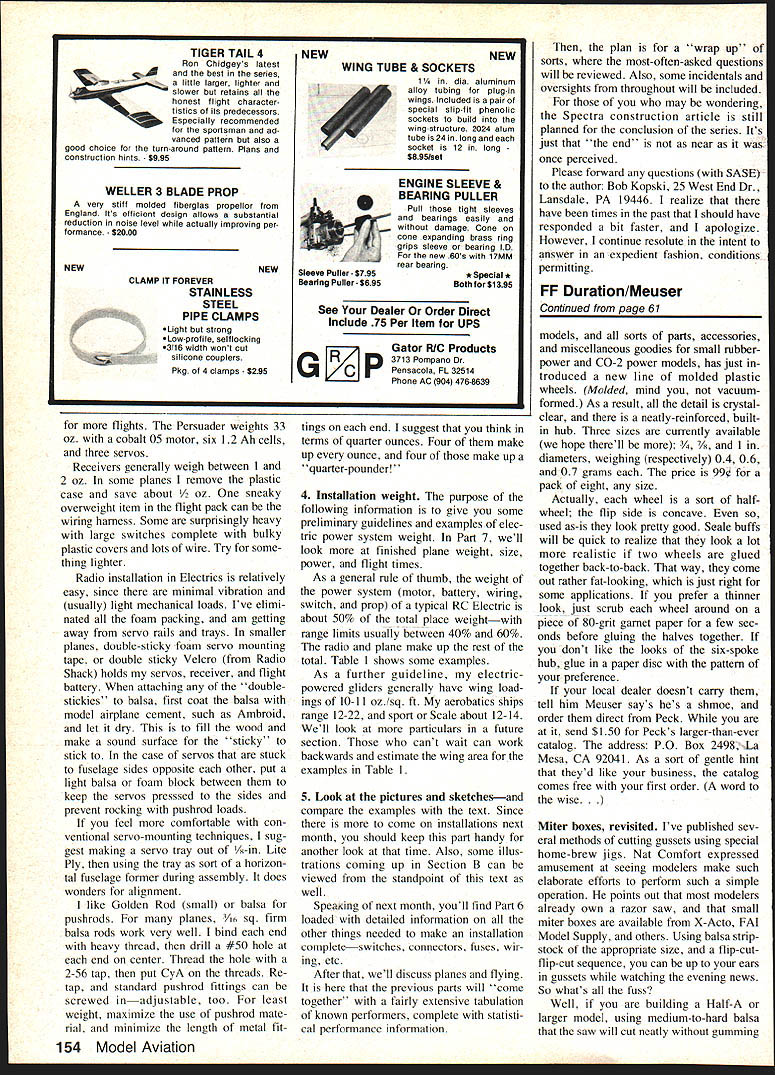
Peck-Polymers, famous for its Peanut Scale kits, plans by Hannan, and many accessories for rubber- and CO2-powered models, has introduced a new line of molded plastic wheels (molded, not vacuum-formed). Because they are molded, the detail is crystal-clear and there is a nearly reinforced, built-in hub.
Current sizes:
- 3/4" diameter — 0.4 g
- 7/8" diameter — 0.6 g
- 1 1/16" diameter — 0.7 g
Price: 99¢ for a pack of eight, any size.
Notes on use:
- Each wheel is a sort of half-wheel; the lip side is concave. Used as-is they look pretty good.
- For a more realistic, flat look, glue two wheels back-to-back.
- For a thinner look, spin each wheel on 80-grit garnet paper for a few seconds before gluing the halves together.
- If you don't like the six-spoke hub, glue in a paper disc with your preferred pattern.
Ordering: If your local dealer doesn't carry them, order direct from Peck. Send $1.50 for Peck's larger-than-ever catalog. Address: P.O. Box 2498, La Mesa, CA 92041. The catalog comes free with your first order.
Miter boxes, revisited
I've published several methods of cutting gussets using special home-brew jigs. Nat Comfort expressed amusement at seeing modelers make such elaborate efforts to perform a simple operation. He points out that most gussets can be made with a razor saw, and that small miter boxes are available from X-Acto, FAI Model Supply, and others.
Guidance:
- If you are building a Half-A or larger model and using medium-to-hard balsa that the saw will cut neatly without gumming, a small miter box is worth having.
- For very small pieces, the razor-saw and simple jig approach works very well.
- Using balsa strip stock of the appropriate size and a flip-cut jig, you can produce many gussets quickly while watching the evening news.
Series wrap-up and questions
Plans include a "wrap up" where the most-often-asked questions will be reviewed, along with incidental errors and oversights from throughout the series. The Spectra construction article is still planned for the conclusion of the series; the "end" is not as near as once perceived.
Please forward any questions (with SASE) to the author: Bob Kopski 25 West End Dr. Lansdale, PA 19446
I realize there have been times I should have responded faster, and I apologize. I remain resolute in the intent to answer expediently, conditions permitting.
Transcribed from original scans by AI. Minor OCR errors may remain.

