
Free Flight: DURATION
Bob Meuser
Foam Fame
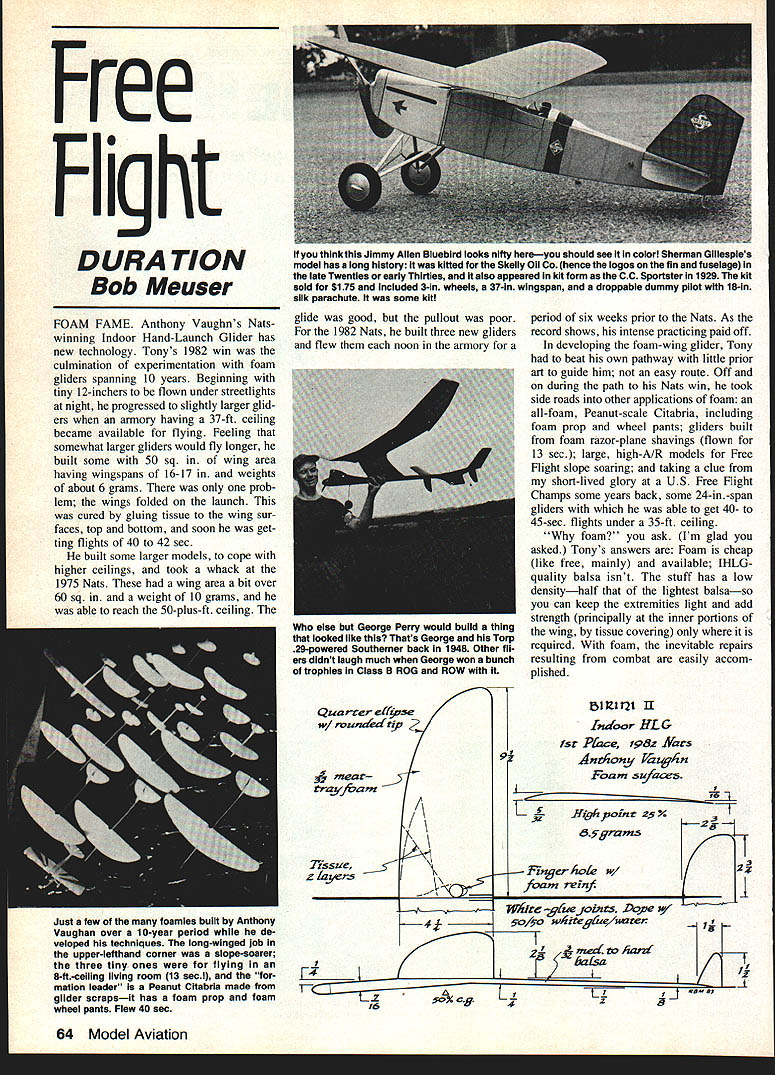
Anthony Vaughn's Nats-winning Indoor Hand-Launch Glider has new technology. Tony's 1982 win was the culmination of experimentation with foam gliders spanning 10 years. Beginning with tiny 12‑inch models to be flown under streetlights at night, he progressed to slightly larger gliders when an armory with a 37‑ft ceiling became available for flying. Feeling that somewhat larger gliders would fly longer, he built some with 50 sq. in. of wing area, wingspans of 16–17 in., and weights of about 6 grams. There was only one problem: the wings folded on the launch. This was cured by gluing tissue to the wing surfaces (top and bottom), and soon he was getting flights of 40 to 42 seconds.
He built some larger models to cope with higher ceilings and made a run at the 1975 Nats. These had a wing area a bit over 60 sq. in. and a weight of 10 grams, and he was able to reach the 50‑plus‑ft ceiling. The glide was good, but the pullout was poor.
For the 1982 Nats he built three new gliders and flew each one at noon in the armory for six weeks prior to the Nats. As the record shows, his intense practicing paid off. In developing the foam‑wing glider, Tony had to beat his own pathway with little prior art to guide him; not an easy route. Off and on during the path to his Nats win, he took side roads into other applications of foam: an all‑foam Peanut‑scale Citabria (including foam prop and wheel pants); gliders built from foam razor‑plane shavings (flown for 13 sec.); large, high‑A/R models for free flight slope soaring; and, taking a clue from my short‑lived glory at a U.S. Free Flight Champs some years back, some 24‑in. span gliders with which he was able to get 40–45 sec. flights under a 35‑ft ceiling.
"Why foam?" you ask. Tony's answers are:
- Foam is cheap (virtually free) and widely available; IHLG‑quality balsa isn't.
- Foam has low density—about half that of the lightest balsa—so you can keep the extremities light and add strength where required (principally at the inner portions of the wing, by tissue covering).
- With foam, the inevitable repairs resulting from combat are easily accomplished.
Tony, in typical free flier fashion, passed on a whole bunch of hints and tips you can use to your advantage next time you meet mortal combat. I'm sure you can use them—I'm bound to screw up a couple anyhow.
Foam comes in trays (meat trays) packaged at supermarkets and similar sources. You'll have to develop your own sources. It should be a lot easier finding an RC model shop that peddles contest‑grade IHLG wing wood. Please don't ask Tony to send some meat trays from the supermarket.
Rough shaping, to the nearest .005–.010 in. (approx.), is done with a razor plane and/or 120‑grit garnet paper. Final shaping is done with finer grits, ending up with 400‑grit, perhaps better still 600‑grit wet‑or‑dry. Tony also uses foam egg crates for smaller parts; that wouldn't hurt. Wear a dust mask when sanding foam and make sure the area is well ventilated. See John Preston's "Safety Comes First" column for a few words of wisdom on the subject.
Use white glue — Elmer's will stick things together. Tissue covering is done using water‑thinned 50/50 white glue; final overall doping is also done with diluted white glue, followed by 600‑grit sanding. The tissue used for reinforcing is not the expensive Japanese model tissue, but inexpensive throwaway tissue you find in shoe boxes and such.
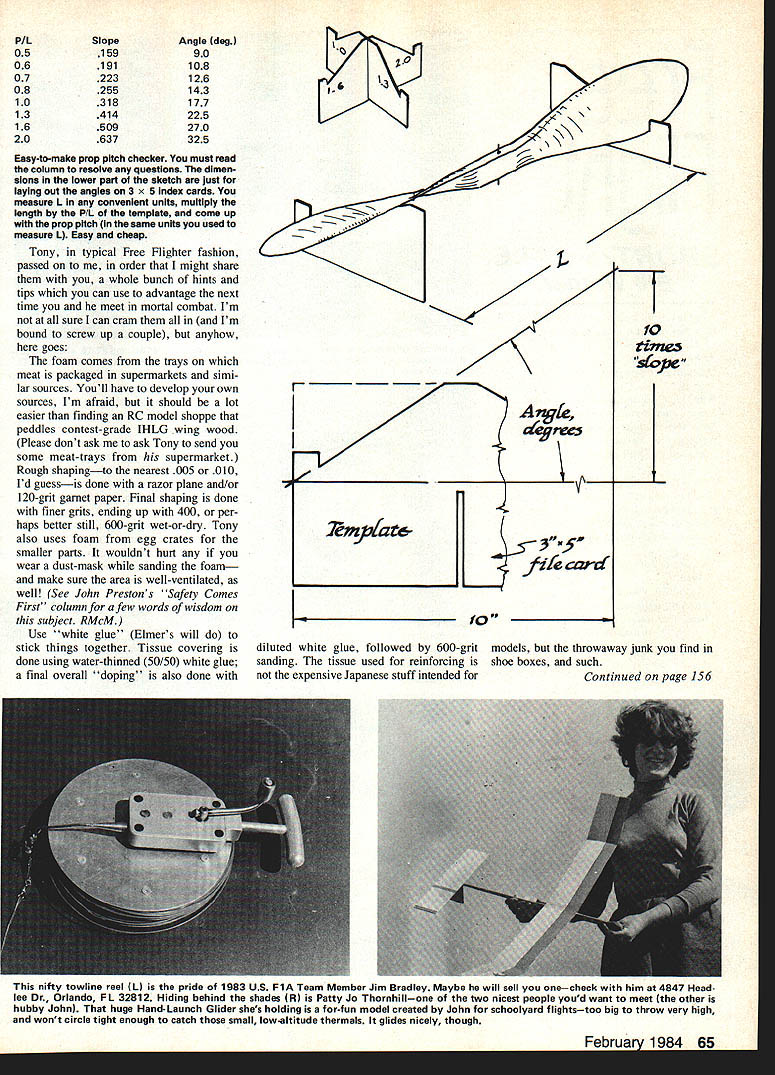
Propeller Pitch Templates
FF Duration / Meuser (Continued from page 156)
The template method came to me from Walter Getsla, an old‑time Wakefield flier, and is credited to Walter Brock (now deceased) of the Illinois Model Airplane Club. The basic idea goes back to about 1927. I've changed the template angles to give what I believe to be a more convenient set.
The sketch and table (not included here) tell most of the story. Two templates for each P/L value are required. For convenience, make the templates from 3 × 5 file cards with two different P/L values on each card: 0.5 and 0.6 on one pair of cards, 0.7 and 0.8 on another pair, and so forth. The cards are notched and assembled in egg‑crate fashion so as to be self‑standing.
If you are concerned only with gas‑power props, make templates for only the four smaller P/L values; for rubber‑power props, make the ones for the four higher values.
The template angles are expressed both as slopes and as degrees in the table; use whichever format suits you best.
Using the templates:
- Select a pair of templates for the desired P/L value.
- Plop the prop onto the templates and slide the templates back and forth along the blades, keeping the prop centerline roughly midway between the templates, until the blade angles match those of the templates.
- Measure the distance between the templates, multiply it by the P/L value printed on the template, and that product is the pitch (in whatever units you used to measure the distance between the templates).
Notes:
- Usually, the pitch will vary somewhat along the blade. It is customary to measure nominal pitch at a point 3/4 of the way from the center to the tip.
- If the templates you selected give a distance, L, substantially less than 3/4 of the proper diameter, try ones with a smaller P/L value (and vice versa).
- The pitch is usually pretty uniform in the neighborhood of the 3/4 point, so it doesn't matter much if you are not exactly on it. The P/L values in the table have been selected to give the proper overlap so that there is a pair that will get you pretty close to the 3/4 point for pitch‑to‑diameter ratios between 0.35 and 1.7.
Plans Book Available
The 1983 Free Flight Plans Handbook, published by the New South Wales Free Flight Society and covering models flown at the 1983 World Champs, is available from NFFS Publications:
- NFFS Publications, 4858 Moorpark Avenue, San Jose, CA 95129.
This publication follows the lead set by the NFFS when it published the 1981 World Champs Planbook. The book is nicely done and contains 162 pages of three‑views plus additional technical information, summaries of the models and their designers, and the designers' addresses. Price: $12, plus $2 shipping worldwide. Initial stock is small; they are being offered on a first‑come, first‑served basis.
Bob Meuser 4200 Gregory St., Oakland, CA 94619.
Transcribed from original scans by AI. Minor OCR errors may remain.

