
Free Flight: Duration
Bob Meuser
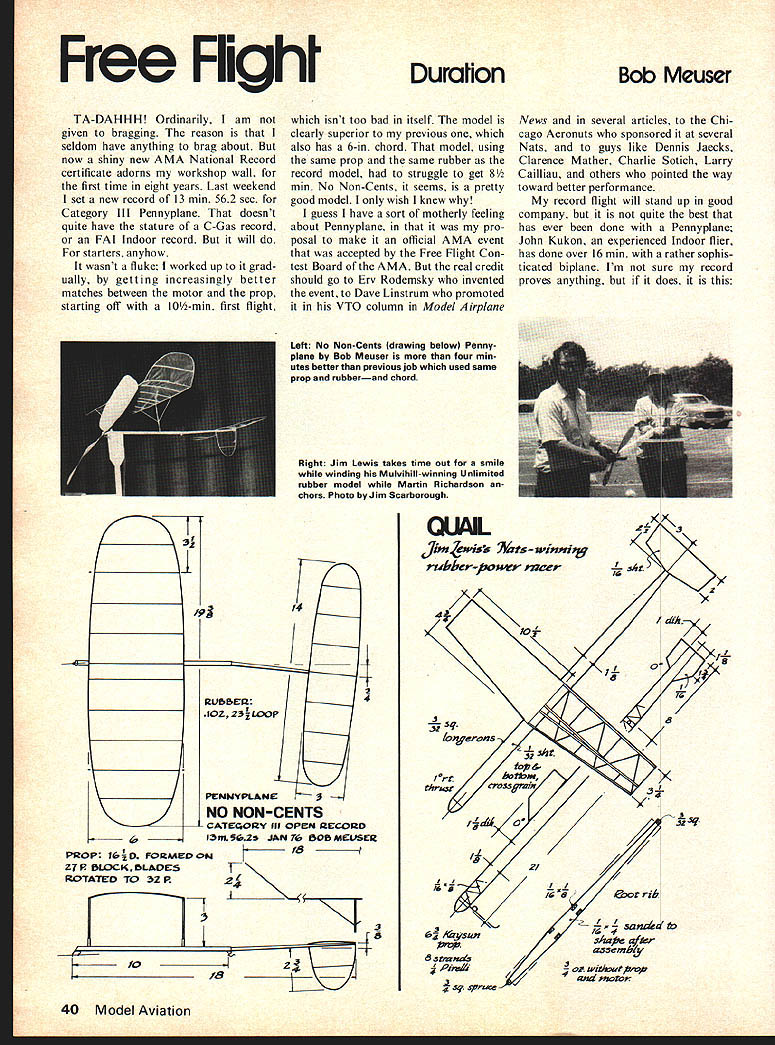
TA-DAHHH! Ordinarily, I am not given to bragging. The reason is that I seldom have anything to brag about. But now a shiny new AMA National Record certificate adorns my workshop wall for the first time in eight years. Last weekend I set a new record of 13 min. 56.2 sec. for Category III Pennyplane. That doesn't quite have the stature of a C-Gas record, or an FAI Indoor record. But it will do. For starters, anyhow.
It wasn't a fluke: I worked up to it gradually, by getting increasingly better matches between the motor and the prop, starting off with a 10½-min. first flight, which isn't too bad in itself. The model is clearly superior to my previous one, which also has a 6-in. chord. That model, using the same prop and the same rubber as the record model, had to struggle to get 8½ min. No Non-Cents, it seems, is a pretty good model. I only wish I knew why!
I guess I have a sort of motherly feeling about Pennyplane, in that it was my proposal to make it an official AMA event that was accepted by the Free Flight Contest Board of the AMA. But the real credit should go to Erv Rodemsky who invented the event, to Dave Linstrum who promoted it in his VTO column in Model Airplane News and in several articles, to the Chicago Aeronuts who sponsored it at several Nats, and to guys like Dennis Jaecks, Clarence Mather, Charlie Sotich, Larry Cailliau, and others who pointed the way toward better performance.
My record flight will stand up in good company, but it is not quite the best that has ever been done with a Pennyplane; John Kukon, an experienced indoor flier, has done over 16 min. with a rather sophisticated biplane. I'm not sure my record proves anything, but if it does, it is this: Any bumble-thumbed, outdoor-style free fighter can achieve a modicum of success, and have a whale of a lot of fun to boot, in indoor modeling via the Pennyplane route, without having to go to ultra-light micro-film models in one giant leap.
For an encore, I think I might try that FAI stuff. Tremble in fear, Jim Richmond!
The Jim Lewis Story:
So, who is Jim Lewis, you ask? Until recently that might have been a legitimate question, for Jim has been out of modeling for a decade, and only recently made his comeback, and what a comeback it was: First place in two of the top rubber-power events at the 1974 Nats, Unlimited Rubber and Coupe d'Hiver; first places in Hand-Launch Glider, Rubber-Power Speed, Rubber Power Helicopter, and third in A/2 Towline glider for a chaser. Jim was privileged to own the Mulvihill and Dick Black Memorial Trophies for a year, in addition to the new Donald Lockwood Trophy for Rubber Speed.
Jim got a lot of help from George Perryman, who has been within spittin' distance of the Mulvihill Trophy more times than he or anyone else would care to count. Mike Bailey, another of George's proteges, won the Mulvihill at the 1969 Willow Grove Nats. Here is a run-down on some of Jim's hardware:
Unlimited Rubber: George Perryman's "Little Daddy" design. Sixteen strands of Pirelli from Old-Timer Models. Jim's model won the four contests in which it was entered up to the 1975 Nats.
Coupe d'Hiver: Frank Perkins' "Checkmate" design, with minor modifications to the wing pylon. An aluminum motor tube and rolled sheet-balsa boom were used.
Hand-Launch Glider: Mathis' "Flash", from an M and P kit (now manufactured by American Balsa Corp.), with the tips installed backwards to give sweepback.
Rubber-Power Helicopter: Essentially an over-grown Jim Walker "Ceiling Walker" with a 30-in. motor tube and a pair of 18-inch counter-rotating props, one at each end. Power was four strands of 1/8 Pirelli.
A/2 Towline Glider: Don Chancey's "Poacher" design, the same Don used to earn a spot on the U.S. Nordic team. Circle tow was not used.
Rubber Power Speed: Jim put together all of the information published about the models that entered the 1973 Nats, mixed it well, and distilled it into an 18-in. model using a 5¾" Kaysun plastic prop. Jim's speed, standing start, over the 200-ft. course, was a shade over 50 mph. For a bit of tissue, rubber, and balsa, that's moving!
Hank Cole's Prop Stop:
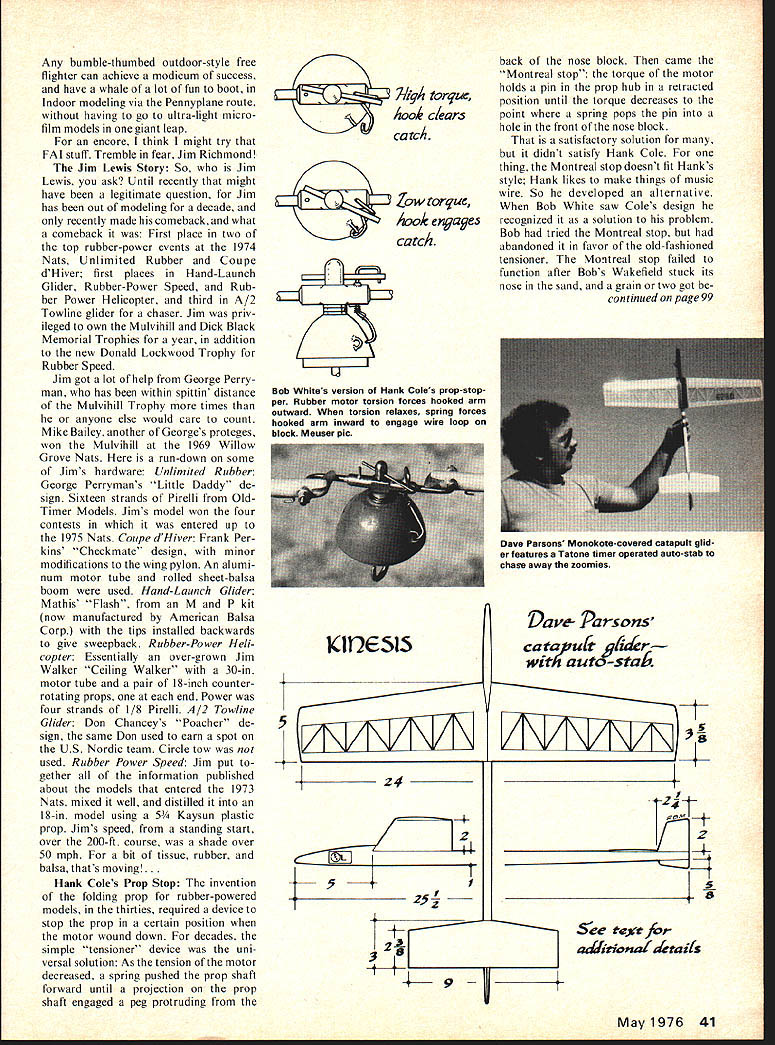
The invention of the folding prop for rubber-powered models, in the thirties, required a device to stop the prop in a certain position when the motor wound down. For decades, the simple "tensioner" device was the universal solution: As the tension of the motor decreased, a spring pushed the prop shaft forward until a projection on the prop shaft engaged a peg protruding from the back of the nose block. Then came the "Montreal stop": the torque of the motor holds a pin in the prop hub in a retracted position until the torque decreases to the point where a spring pops the pin into a hole in the front of the nose block.
That is a satisfactory solution for many, but it didn't satisfy Hank Cole. For one thing, the Montreal stop doesn't fit Hank's style; Hank likes to make things of music wire. So he developed an alternative.
When Bob White saw Cole's design he recognized it as a solution to his problem. Bob had tried the Montreal stop, but had abandoned it in favor of the old-fashioned tensioner. The Montreal stop failed to function after Bob's Wakefield stuck its nose in the sand, and a grain or two got between. some of the closely fitting sliding parts.
The clearances can be generous, in Hank's design, and as the parts rotate rather than slide, jamming is unlikely. The photos show how it works. Note that there is a torsion spring tending to draw the stop arm inward. The torque of that spring must be adjusted so that the arm is released when the rubber motor has expended most of its energy, but has not gone completely slack . . .
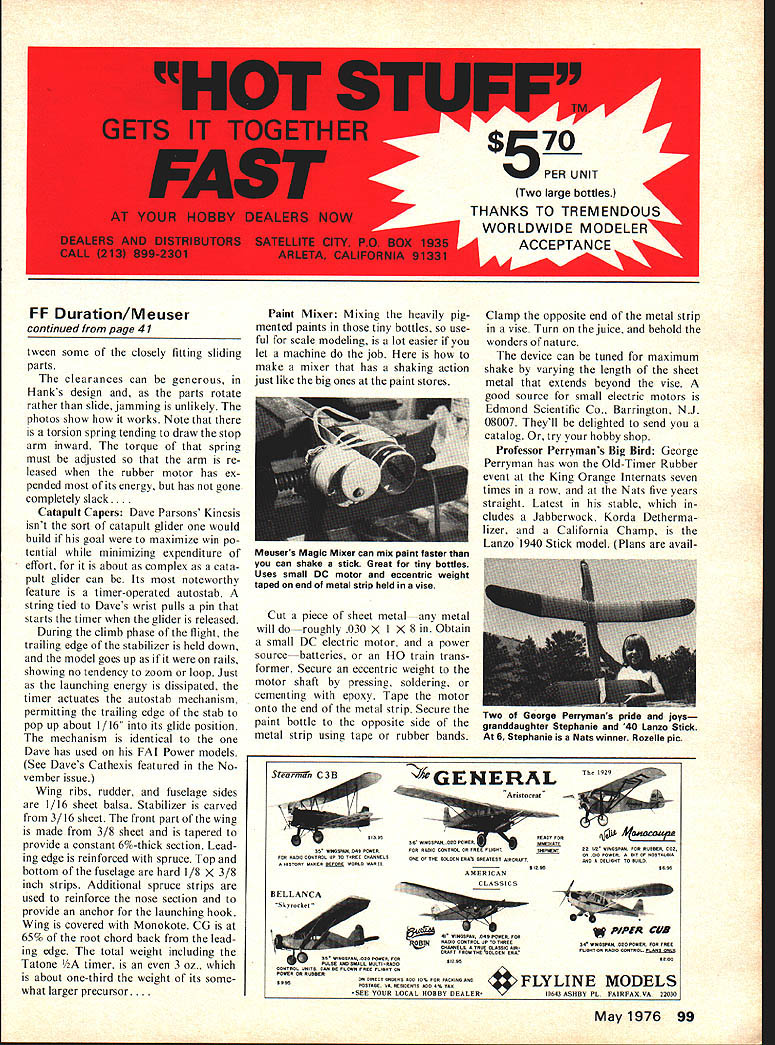
Catapult Capers: Dave Parsons' Kinesis isn't the sort of catapult glider one would build if his goal were to maximize win potential while minimizing expenditure of effort, for it is about as complex as a catapult glider can be. Its most noteworthy feature is a timer-operated autostab. A string tied to Dave's wrist pulls a pin that starts the timer when the glider is released.
During the climb phase of the flight, the trailing edge of the stabilizer is held down, and the model goes up as if it were on rails, showing no tendency to zoom or loop. Just as the launch energy is dissipated, the timer actuates the autostab mechanism, permitting the trailing edge of the stab to pop up about 1/16" into its glide position. The mechanism is identical to the one Dave has used on his FAI Power models. (See Dave's Cathexis featured in the November issue.)
Wing ribs, rudder, and fuselage sides are 1/16" sheet balsa. Stabilizer is carved from 3/16" sheet. The front part of the wing is made from 3/8" sheet and is tapered to provide a constant 6%-thick section. Leading edge is reinforced with spruce. Top and bottom of the fuselage are hard 1/8" x 3/8" strips. Additional spruce strips are used to reinforce the nose section and to provide an anchor for the launching hook. Wing is covered with Monokote. C.G. is at 65% of the root chord back from the leading edge. The total weight including the Tatone 1/2A timer is an even 3 oz., which is about one-third the weight of its somewhat larger precursor . . . .
Paint Mixer: Mixing the heavily pigmented paints in those tiny bottles, so useful for scale modeling, is a lot easier if you let a machine do the job. Here is how to make a mixer that has a shaking action just like the big ones at the paint stores.
Meuser's Magic Mixer can mix paint faster than you can shake a stick. Great for tiny bottles. Uses small DC motor and eccentric weight taped on end of metal strip held in a vise.
Cut a piece of sheet metal — any metal will do — roughly .030 x 1 x 8 in. Obtain a small DC electric motor, and a power source — batteries, or an HO train transformer. Secure an eccentric weight to the motor shaft by pressing, soldering, or cementing with epoxy. Tape the motor onto the end of the metal strip. Secure the paint bottle to the opposite side of the metal strip using tape or rubber bands.
Clamp the opposite end of the metal strip in a vise. Turn on the juice, and behold the wonders of nature.
The device can be tuned for maximum shake by varying the length of the sheet metal that extends beyond the vise. A good source for small electric motors is Edmond Scientific Co., Barrington, N.J. 08007. They'll be delighted to send you a catalog. Or, try your hobby shop.
Professor Perryman's Big Bird: George Perryman has won the Old-Timer Rubber event at the King Orange Internats seven times in a row, and at the Nats five years straight. Latest in his stable, which includes a Jabberwock, Korda Determalizer, and a California Champ, is the Lanzo 1940 Stick model. (Plans are available.)
FF Duration (continued)
Available from Model Builder magazine, plan no. 1174-OT, for $3.50. "Stick 'Em" patterns cost an additional $1.95. Address is Box 4336, Santa Ana, Ca. 92702.
I had a hunch there might be a story behind the big Lanzo machine, so I asked George about it. I wasn't wrong.
"Of all the Old-Timer Rubber models I have built, the Lanzo is the most competitive. With over 3 sq. ft. of wing and stab area and a weight of only 7 1/2 oz. it flies almost as well as our modern birds.
"I first met Chet Lanzo at the 1941 Nats in Chicago, when I was a 21-year-old. Chet was my boyhood idol, and one of modeling's all-time greats. Chet took an interest in me and showed me how he adjusted the model you asked about. I chased his model for him on test flights with great enthusiasm, and I can remember my wonder at his long motor runs. I often helped Chet Lanzo as a fine gentleman who helped a little country boy from Georgia learn some of the finer points of modeling."
Wilder's Winder
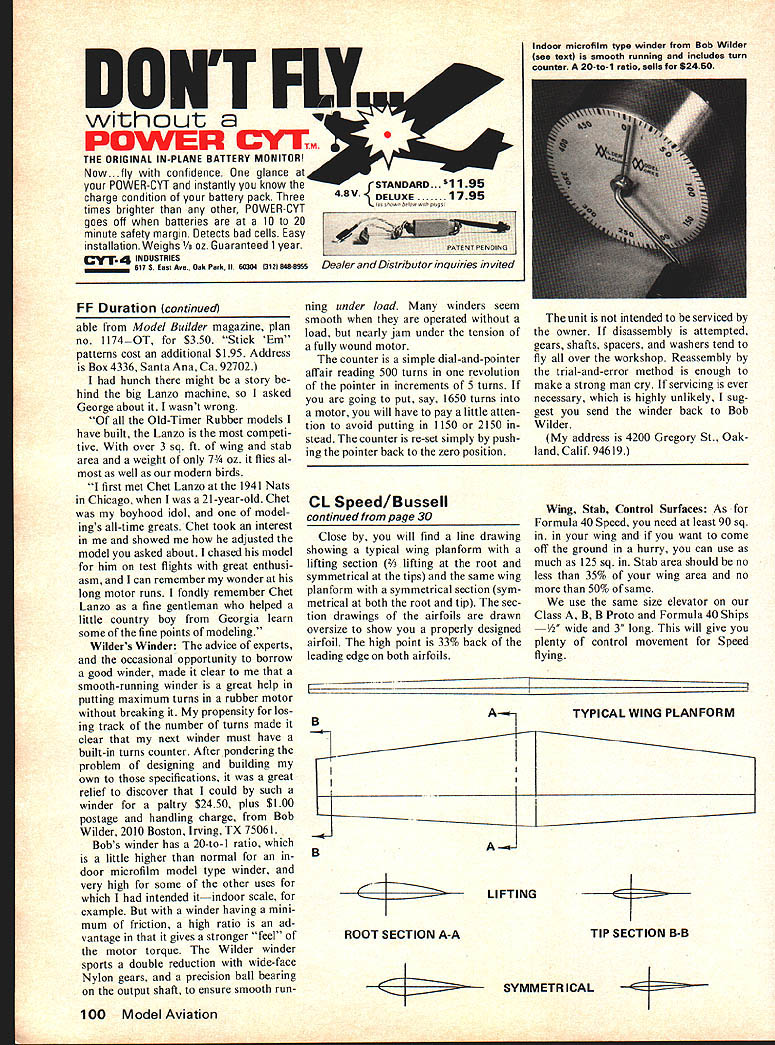
The advice of experts, and the occasional opportunity to borrow a good winder, made it clear to me that a smooth-running winder is a great help in putting maximum turns in a rubber motor without breaking it. My propensity for losing track of the number of turns made it clear that my next winder must have a built-in turns counter. After pondering the problem of designing and building my own to those specifications, it was a great relief to discover that I could buy such a winder for a paltry $24.50, plus $1.00 postage and handling charge, from Bob Wilder, 2010 Boston, Irving, TX 75061.
Bob's winder has a 20-to-1 ratio, which is a little higher than normal for an indoor microfilm model type winder, and very high for some of the other uses for which I had intended it — indoor scale, for example. But with a winder having a minimum of friction, a high ratio is an advantage in that it gives a stronger "feel" of the motor torque. The Wilder winder sports a double reduction with wide-face Nylon gears, and a precision ball bearing on the output shaft, to ensure smooth running under load. Many winders seem smooth when they are operated without a load, but nearly jam under the tension of a fully wound motor.
The counter is a simple dial-and-pointer affair reading 500 turns in one revolution of the pointer in increments of 5 turns. If you are going to put, say, 1650 turns into a motor, you will have to pay a little attention to avoid putting in 1150 or 2150 instead. The counter is reset simply by pushing the pointer back to the zero position.
The unit is not intended to be serviced by the owner. If disassembly is attempted, gears, shafts, spacers, and washers tend to fly all over the workshop. Reassembly by the trial-and-error method is enough to make a strong man cry. If servicing is ever necessary, which is highly unlikely, I suggest you send the winder back to Bob Wilder. Wilder's address is 4200 Gregory St., Oakland, Calif. 94619.
Transcribed from original scans by AI. Minor OCR errors may remain.

