
Free Flight: Duration
Bob Meuser
Model Aviation's regular Free Flight Duration Contributing Editor, Bob Meuser, is taking a well-deserved rest from his writing chores. We have asked freelance writer and publisher Bill Hartill to fill in for him this month. Bill is an internationally known Free Flight competitor of long standing.
After a dry spell of 22 years, the U.S.A. at long last has a Free Flight World Champion. Matt Gewain of Florida brought home the Swedish Glider Cup from Australia. Matt now heads the list of 11 U.S. champions and joins Gerry Ritz as the only U.S.A. A-2 Nordic Glider champion.
Jim Wilson has flown with Matt as much as anyone. Here are Jim's impressions of the new champion.
I first met Matt at the 1977 Free Flight Champs. Here was this pale skinny kid just arrived from Oklahoma with a cowboy hat and a Happy Hooker glider with "Laura Scudder" wings. I knew he was OK when I saw that his wife, Gail, flew V-dihedral gliders. Before 1977 he flew Power, Scale, RC, CL, and even messed with RC cars.
Settling in California for a few years, he decided to concentrate on F1A, and that's the operative word. He's super-motivated and has built 16 F1As in six years while going through two Air Force transfers, two house remodelings, computer work, and lots of "honey-dos." He does this by building for two hours before work and four to five hours after.
His original Pacer F1A has been a practical contest machine. It has undergone a number of modifications to fine-tune it and try out other ideas. Thin airfoils were tried and rejected. A taller pod didn't make any difference. Increased span was used for calm-air rounds. Lighter stabs have helped—and most importantly, the wings are very stiff. The wing has gotten the most attention and uses his version of the 7456 airfoil. A huge 3/4 x 3/4 spruce upper spar is used, and there is lots of carbon in the leading and trailing edges. There are many diagonals, and wood choice favors small, high-density sections. He admits the workmanship is not perfect—but it gets the job done!
Matt is a quiet guy, to the point of being shy even with close friends. However, he is competitive with a "killer" intensity and flies all the contests in all weather. Wife Gail helps out a lot on the field. He is famous for patience on the line and has suffered very few dropped flights. In the past six years of concentration on F1A, he has avoided boredom with intense concentration and mental adjustment.
To stay in good physical shape, Matt runs and bikes regularly, and he has developed a good balance of speed and endurance. But it is the flying training that he really works at—which means two, sometimes three, sessions per week and as many as four during heavy competition. He loves to fly, and he has the stable personality that helps put that motivation and concentration to work right out of the box.
FAI Paris meeting
Word from the December meeting of the CIAM Free Flight Subcommittee in Paris is that Yugoslavia has offered to host the 1985 World Champs. A record 36 countries attended this meeting, and the Yugoslavian offer was received with much enthusiasm. The proposed site is located near Livno and is judged by many to be the best Free Flight site in the world.
Impressions of Yugoslavia
Last summer (1983), this old Free Flight gypsy had the opportunity to check out Livno by competing in the Izet Kurtalic Memorial Competition held there on August 28. Events were F1A, F1B, and F1C. In fact, the Yugoslavs put on another open international meet at Mostar (Soko Cup) the weekend before Livno and then also held their National Championships on August 27 at Livno. The Mostar site is similar to Livno and was the site of the 1980 European Free Flight Championships.
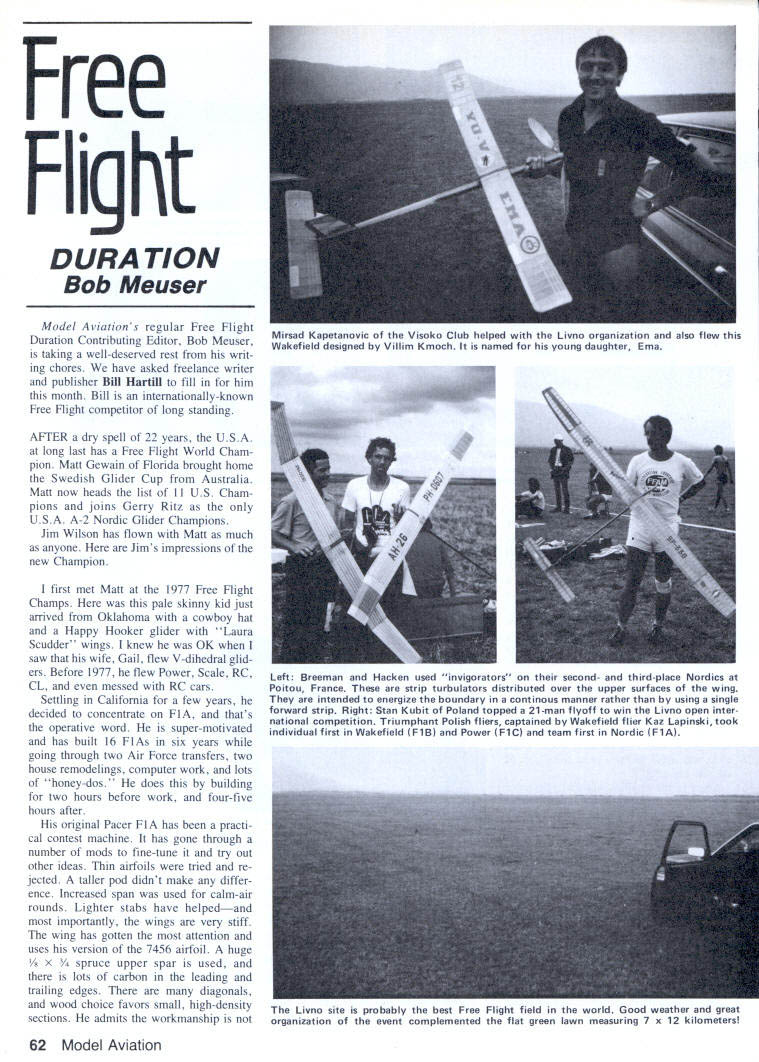
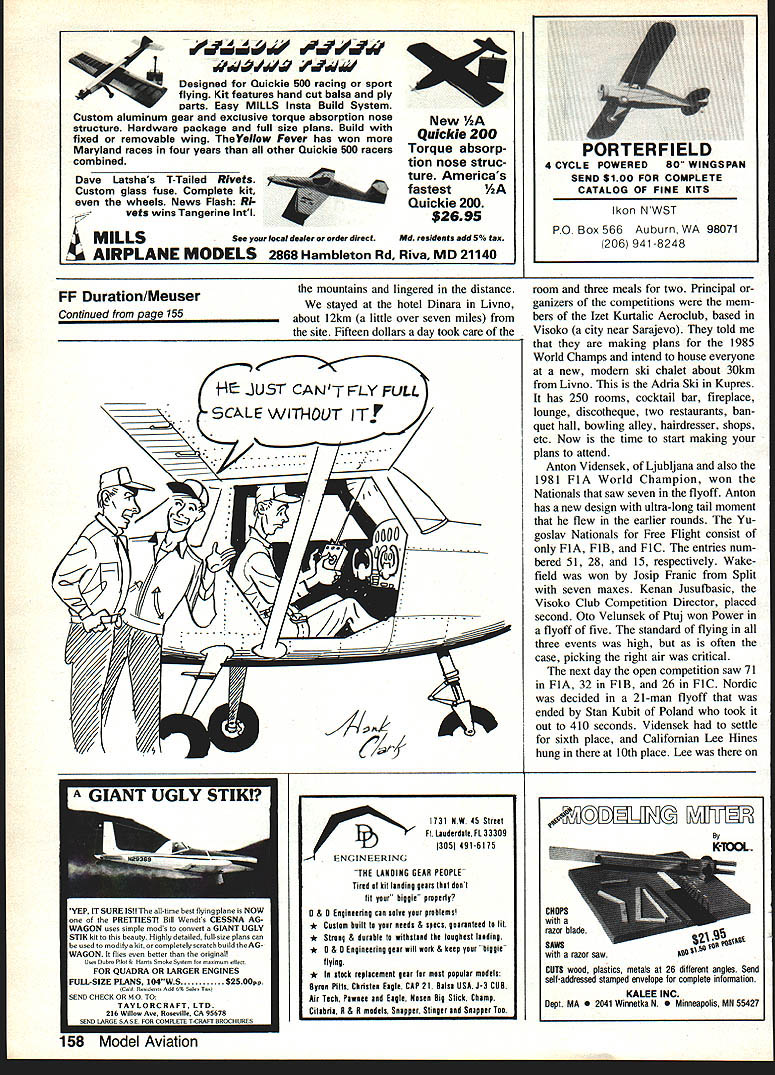
The Livno site is a flat plain measuring 7 by 12 kilometers (about 4.2 by 7.2 miles). There are mountains in the distance to the west and eastern flanks. Livno lies about 100 km east of Split in Bosnia. That flat plain is truly flat—no hills, trees, or bushes—just absolutely nothing in the 7 x 12 km area. The surface is covered with green grass several inches deep. About a foot beneath the topsoil there is a layer of soft limestone, which is probably why there are no trees or other vegetation. We were also told that the plain floods in the winter months. The place is so vast and featureless that you can actually get lost if you lose sight of the landmark point. The plain is not used for any commercial or agricultural purpose except for the grazing of a handful of sheep and cows tended by herders. There are no fences, and you can drive anywhere in the area, although retrieving on foot is the simplest procedure.
We were there about a week, and in that time the wind was never stronger than a mild breeze. Most of the time it would have to be called calm. Several of the days were overcast and a slight rain fell—but not for long. Threatening clouds appeared but hung near the mountains and soon passed.
We stayed at the Hotel Dinara in Livno, about 12 km (a little over seven miles) from the site. Fifteen dollars a day took care of the room and three meals for two. Principal organizers of the competitions were the members of the Izet Kurtalic Aeroclub, based in Visoko (a city near Sarajevo). They told me that they are making plans for the 1985 World Champs and intend to house everyone at a new, modern ski chalet about 30 km from Livno. This is the Adria Ski in Kupres. It has 250 rooms, a cocktail bar, fireplace, lounge, discotheque, two restaurants, a banquet hall, bowling alley, hairdresser, shops, etc. Now is the time to start making your plans to attend.
Anton Vidensek, of Ljubljana and also the 1981 F1A World Champion, won the Nationals that saw seven in the flyoff. Anton has a new design with ultra-long tail moment that he flew in the earlier rounds. The Yugoslav Nationals for Free Flight consist of only F1A, F1B, and F1C. Entries were:
- F1A: 51
- F1B: 28
- F1C: 15
Wakefield was won by Josip Francic from Split with seven maxes. Kenan Jusufbasic, the Visoko Club Competition Director, placed second. Oto Velunsek of Ptuj won Power in a flyoff of five. The standard of flying in all three events was high, but as is often the case, picking the right air was critical.
The next day the open competition saw 71 in F1A, 32 in F1B, and 26 in F1C. Nordic was decided in a 21-man flyoff that was ended by Stan Kubit of Poland, who took it out to 410 seconds. Vidensek had to settle for sixth place and Californian Lee Hines hung in there at 10th place. Lee was there on a competition vacation, having a grand time. He had flown at Mostar also and had made that flyoff as well. The British contingent of Mike Farnham, Dave Oldfield, Peter Williams, and Martin Dilly placed Mike in the flyoff where he picked up 8th place.
In Wakefield, an all-Yugoslav flyoff of four was settled by Djuro Grabescak with a score that took him beyond the five-minute round.
Werner Klaus of Austria won Power, having bested a strong effort by the Polish team in a four-man flyoff.
The competition was run smoothly and the hosts laid on an excellent banquet and awards presentation. The hospitality was sincere, and it looks like the 1985 Champs should be a well-run affair.
Antique model museum
Phillipe Lepage, of Paris, is a very good Wakefield flier. He also is a dealer in antique toys. As a sideline to his business, he has been collecting antique model aircraft and memorabilia. His collection covers the period 1880 to about 1940 and is believed to be unique. It is certainly most unusual. Many of these models are in relatively good condition, with the original boxes, plans, and even rubber strands. Lepage does not repair the models but shows them in their original condition and completeness, where possible.
French competition
The annual Poitou international meet held August 20–21 was a great success with an awesome 143 entries in F1A, 69 entries in F1B, and 24 in F1C. A dozen countries were represented. Dave Rounsvalle, John Lenderman, and Bill Hartill carried the flag for the U.S.A.
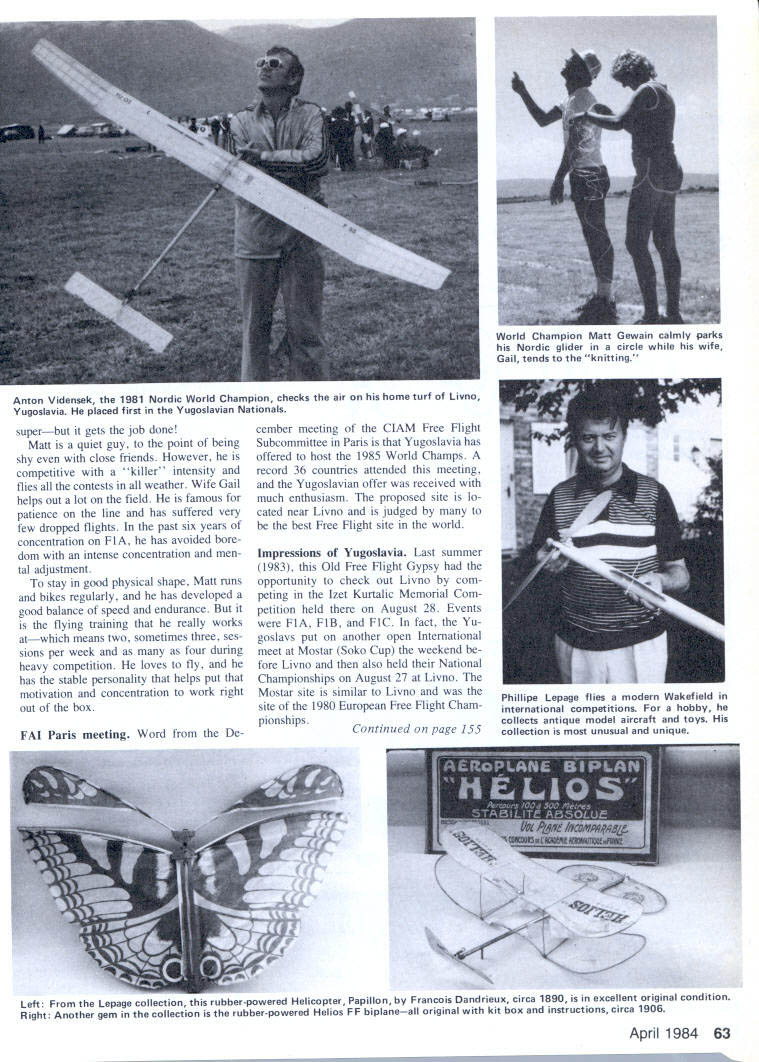
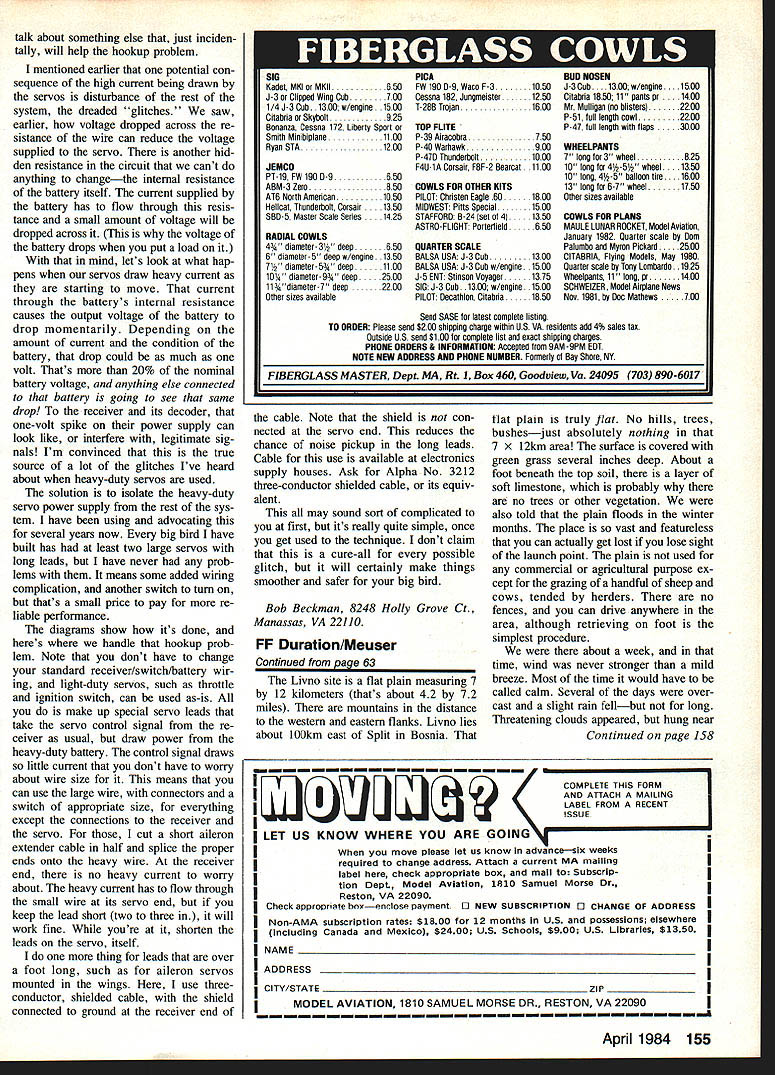
P. Jornaien of France took F1A with two Dutchmen, Cenny Breeman and Arno Hacken, in second and third. As a footnote here, Breeman and Pieter de Boer fought out a fantastic six-round flyoff, finishing at nine minutes in a competition this spring in Holland. Vol Libre asks: "Has that ever been bettered, anywhere?" Well, try this one: at the Jim Patterson FAI Challenge held at Taft this last November 27, in F1A, Martyn Cowley, Hector Diez, and Randy Weiler all flew 10 maxes. Then they flew off another five rounds, all making eight minutes. Diez and Weiler then both did nine minutes. Going for 10 minutes, Weiler eased ahead of Diez 175 sec. to 166 sec.
Back to Poitou: Anselmo Zeri (Italy) topped the Wakefield list. He is good. Note that Anselmo placed second at the World Champs this fall.
Power was a tough battle with a strong breeze giving us plenty of exercise. Ken Faux of England did it once again in his relaxed way, slipping five seconds ahead of Denkin (Bulgaria) in the flyoff. Thomas Koster just wasn't on form, but he was having a great time anyway, training his young son in that Koster launch style. That is, he was doing it whenever he could get Thomas, Jr. away from Grandma and Grandpa "Denmark." How time flies when you're having fun.
Many thanks to Bill Hartill for this fascinating report. Letters and photos for this column should continue to be sent to Bob Meuser, 4200 Gregory St., Oakland, CA 94619.
Transcribed from original scans by AI. Minor OCR errors may remain.

