
Free Flight: Duration
Bob Meuser
NFFS LIVES! Hard times come, hard times go — we survive. Free Flight made a terrific splurge in 1981–82, then fell way behind toward the end of 1983. No excuses — it is getting back on stream, and we hope it will stay that way for a while.
Meanwhile, the mainstream of the National Free Flight Society's activities — which keeps the tip of the iceberg afloat — continues: NFFS Supplies, Plans, and Publications services; management of the Indoor Champs; administration of what might turn out to be the cutting edge of Free Flight competition (the Nats unofficial events); interaction with World Champs activities; and more.
NFFS contacts and management changes
Recently there have been quite a few changes in the management of various NFFS activities. If you have questions, contact the appropriate person below. If in doubt, send material to the Editor.
- NFFS Plans and NFFS Supplies: Joe Wagner, 12 Cook St., Rowayton, CT 06853
- NFFS Publications (except the NFFS Digest): Fred Terzian, 4858 Moorpark Ave., San Jose, CA 95129
- NFFS Memberships and Subscriptions: Don Hughes, 8383 Zancanaro Ct., Citrus Heights, CA 95610
- Free Flight / NFFS Digest material: send to the appropriate Contributing Editor; if in doubt, send to the Editor — Bob Meuser, 4200 Gregory St., Oakland, CA 94619
An SASE to the appropriate person will get you a complete list of what is available from NFFS Plans, Supplies, and Publications.
Membership and subscription rates
- U.S. residents 19 years of age and over (or residents of other countries): $15 for one year, $27 for two years.
- U.S. residents under 19: $7.50 for one year, $13.50 for two years.
Membership includes subscription to the NFFS Digest.
Terrific glue and dope
Several sources, including Ed Lidgard, report that a goop known as "seam cement," sometimes available at airports, is "the best glue and dope ever." It's the stuff used to hold down pinked tape over ribs on full-scale planes. Thin it to suit your model and application.
At the risk of possibly confusing you beyond repair, I must also mention that Terry Rimert has discovered another excellent glue: Franklin Home, Shop & Craft Glue (HSC). Many of us are familiar with Franklin Titebond (the yellow glue); HSC is not merely Titebond under a different label — it is a white glue with different properties. Use it straight from the bottle as a glue; dilute it about 50% with water to use as an adhesive for high-wet-strength tissues or as a sealer around the engine area. It appears compatible with most materials used on model airplanes, including foam. Clean-up with water is easy unless you wait too long. Try both seam cement and HSC to see which you prefer.
Humble George does it again!
We are privileged to announce that the Second Annual Meuser Memorial Modeler of the Year Award goes to George Perryman (who also received this prestigious award last year). In fact, George is the only person who has ever won this award — and the only person who has applied!
George's record for the 1983 season included 32 first places (29 in 1982) in 16 events (11 in 1982). At the Nats he flew in 14 events, taking nine firsts (same as 1982), three seconds, and one third. Not too shabby.
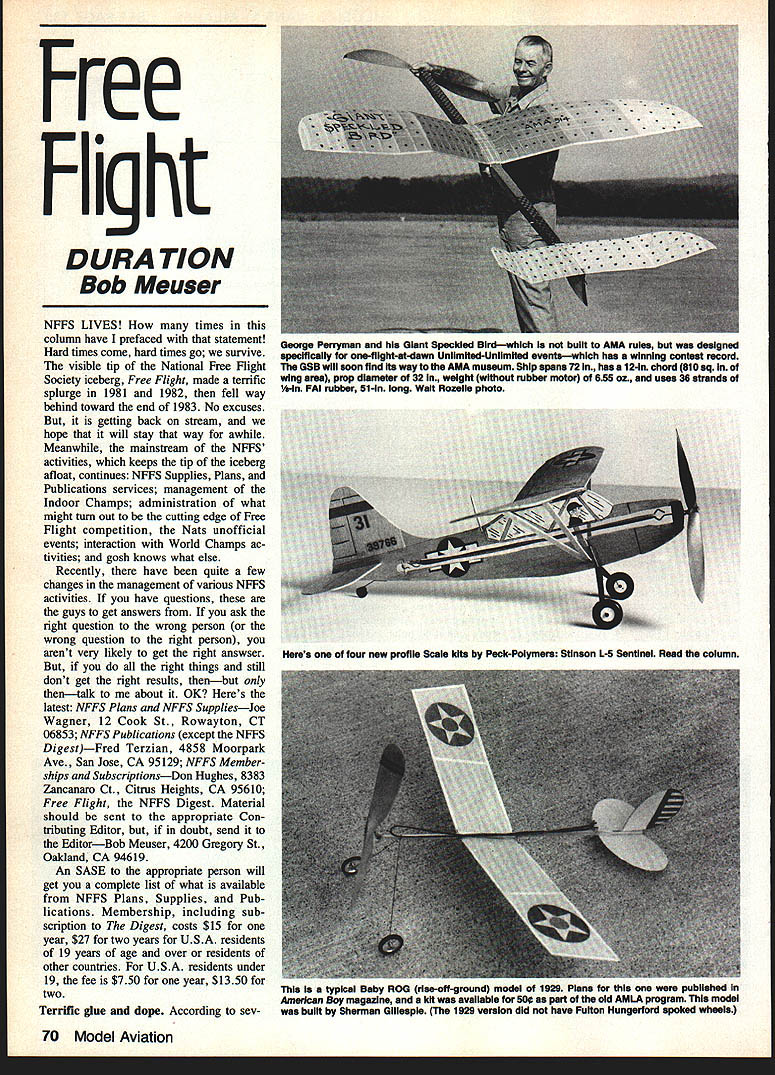
George's "Giant Speckled Bird," a no-holds-barred outdoor rubber-power model, will soon make its way to the AMA Museum after a relatively short but glorious career. In real life, George is a wind-tunnel/model design engineer for Lockheed; his job has taken so much of his time that he only managed to build two new models in 1983, both of which were lost.
Cameron engines: in the December 1983 issue I mentioned Cameron engines being available but neglected to give the complete address. Here it is: Cameron Precision Engineering Co., 19401 Rawhide Rd., Sonora, CA 95370. Phone: (209) 532-7201.
Peck does it, again.
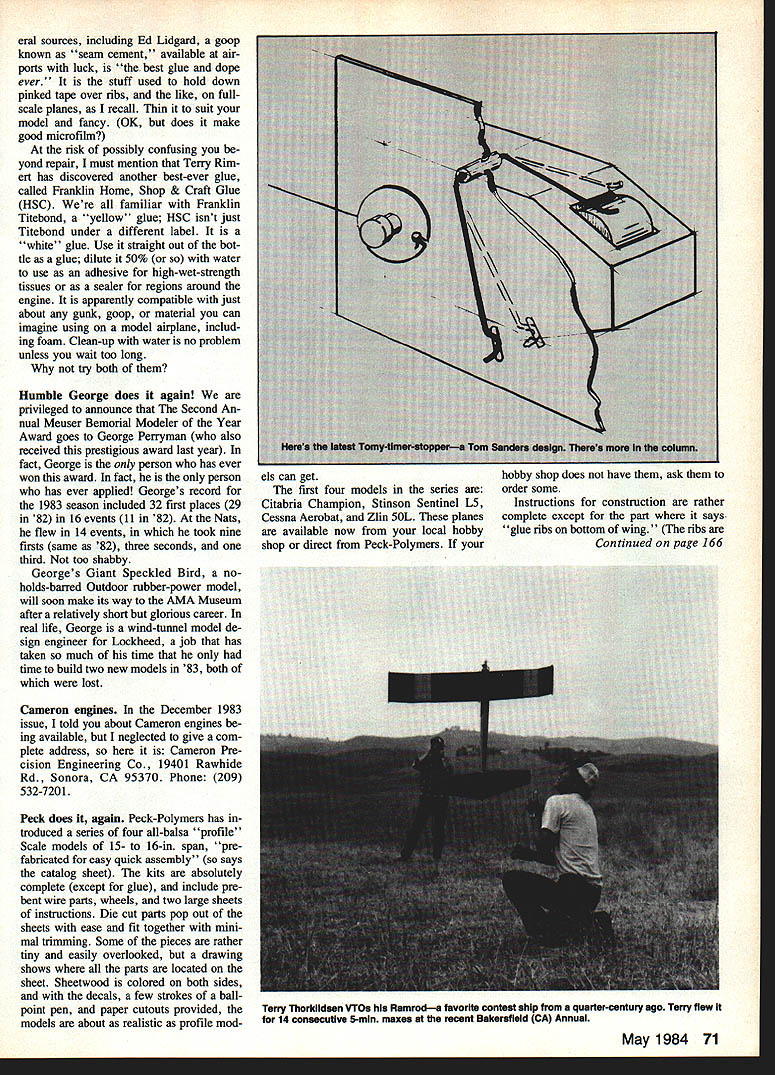
Peck-Polymers has introduced a series of four all-balsa profile scale models (15–16 in. span), "pre-fabricated for easy, quick assembly," according to the catalog. The kits are essentially complete (except for glue) and include pre-bent wire parts, wheels, two large sheets of instructions, and decals. Die-cut parts pop out easily and fit together with minimal trimming. Some pieces are rather tiny and easily overlooked, but a parts layout drawing shows where everything is located on the sheet. The sheetwood is covered on both sides; with the decals, a few strokes of a ball-point pen, and the provided paper cutouts, the models are about as realistic as profile models can get.
The first four models in the series are:
- Citabria Champion
- Stinson L-5 Sentinel
- Cessna Aerobat
- Zlin 50L
Instructions are generally complete except for one point: the ribs for the wing are curved (to give undercamber), while the sheetwood provided is flat, stiff, C-grain material. If you are unsure how to join them, one practical method is to dampen the sheetwood, strap it to a tin can or similarly curved form of the correct radius, and let it air-dry for a couple of days. After that, the wing assembly goes together acceptably.
Final notes and contributions
Keep those care packages (news items, opinions, photos, etc.) coming in — they keep life interesting for all of us. Remember, we pay $5 for all photos published in Model Aviation.
A small personal note: half a century ago my public-speaking instructor told me I sounded as if I started in the middle of a sentence and mumbled toward both ends simultaneously. I never quite overcame that, so I became a mechanical engineer and invented a special attachment for my typewriter — I just start typing and the typewriter types away, first in one direction, then the other.
Send contributions and correspondence to: Bob Meuser, 4200 Gregory St., Oakland, CA 94619
Transcribed from original scans by AI. Minor OCR errors may remain.

