
Free Flight: Duration
Bob Meuser
The Hobby Shop versus the Free Flighter
The main problem is getting the local hobby shops to carry lines of merchandise we care about. If they would, it would reduce the necessity we presently have of buying many things by mail order—a practice local business people detest. We say that if the merchandise were stocked, it would sell. The hobby shop owners are more interested in items that turn over fast and/or have a high markup, and they say they'll special-order what we want—but they won't stock it. We reply that we can special-order it ourselves and get it quicker, besides.
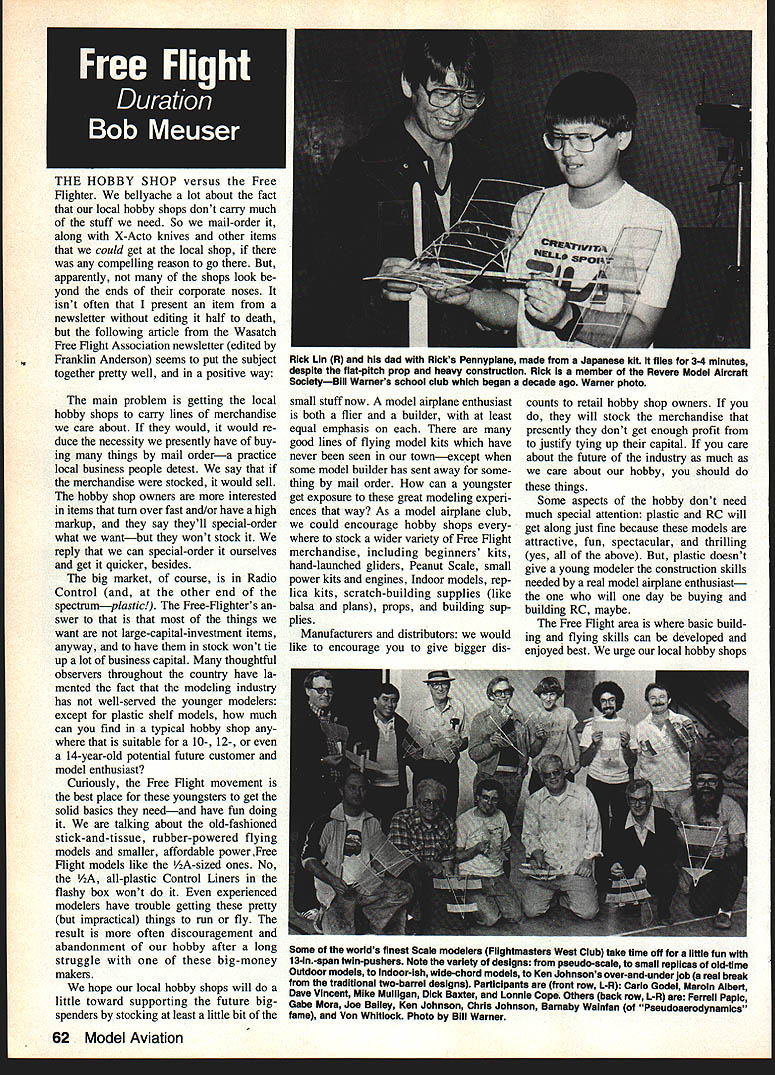
The big market, of course, is in Radio Control (and, at the other end of the spectrum—plastic!). The Free-Flighter's answer to that is that most of the things we want are not large-capital-investment items, anyway, and to have them in stock won't tie up a lot of business capital. Many thoughtful observers throughout the country have lamented the fact that the modeling industry has not well-served the younger modelers: except for plastic shelf models, how much can you find in a typical hobby shop anywhere that is suitable for a 10-, 12-, or even a 14-year-old potential future customer and model enthusiast?
Curiously, the Free Flight movement is the best place for these youngsters to get the solid basics they need—and have fun doing it. We are talking about the old-fashioned stick-and-tissue, rubber-powered flying models and smaller, affordable power Free Flight models like the 1/2A-sized ones. No, the 1/2A, all-plastic control liners in the flashy box won't do it. Even experienced modelers have trouble getting these pretty (but impractical) things to run or fly. The result is more often discouragement and abandonment of our hobby after a long struggle with one of these big-money makers.
We hope our local hobby shops will do a little toward supporting the future big-spenders by stocking at least a little bit of the small stuff now. A model airplane enthusiast is both a flier and a builder, with at least equal emphasis on each. There are many good lines of flying model kits which have never been seen in our town—except when some model builder has sent away for something by mail order. How can a youngster get exposure to these great modeling experiences that way? As a model airplane club, we could encourage hobby shops everywhere to stock a wider variety of Free Flight merchandise, including:
- Beginners' kits
- Hand-launched gliders
- Peanut Scale
- Small power kits and engines
- Indoor models
- Replica kits
- Scratch-building supplies (like balsa and plans)
- Props and building supplies
Manufacturers and distributors: we would like to encourage you to give bigger discounts to retail hobby shop owners. If you do, they will stock the merchandise that presently they don't get enough profit from to justify tying up their capital. If you care about the future of the industry as much as we care about our hobby, you should do these things.
Some aspects of the hobby don't need much special attention: plastic and RC will get along just fine because these models are attractive, fun, spectacular, and thrilling (yes, all of the above). But plastic doesn't give a young modeler the construction skills needed by a real model airplane enthusiast—the one who will one day be buying and building RC, maybe.
The Free Flight area is where basic building and flying skills can be developed and enjoyed best. We urge our local hobby shops to stock at least a little bit of Free Flight merchandise. We also urge national manufacturers and distributors to support Free Flight merchandise—both Scale and endurance, both rubber-powered and glow, and both new and nostalgic movements. Yes, we want to see these lines represented on local dealers' shelves to make possible local hobby shops:
- Comet
- Peck-Polymer
- Golden Age
- Fly-Line
- Keil Craft
- Veron
- Guillow
- Scientific
- And others
Ron Williams' book to be republished!
According to the Wasatch Free Flight Association, Ron Williams' outstanding book, Building and Flying Indoor Model Airplanes, will be republished later this year. The first edition of 8,000 copies was published by Simon & Schuster in 1981. Despite being a sellout, S & S elected not to republish the book, as was noted in the January issue of MA in Ed Whitten's "Junior Flight" page.
Picking up on that, Franklin Anderson took a copy of the book and his rendition of Ron's Yelose Manhattan Formula model to a publisher friend, and one thing led to another. The publisher-to-be is Gibbs Smith of Peregrine Smith Books and Falcon Books in Layton, UT.
It is good news—this excellent book becoming available again. I hear that some copies have been remaindered and are being peddled off by one of the major mail-order book outfits. Don't expect that source to be viable for long. We'll try to keep you posted.
Rubber motor make-up jig
Making motors to a desired length is no sweat. But making them to a specified weight, for Wakefield and Coupe d'Hiver models, is another story, since every batch of rubber strip has a different weight per unit length—and frequently even that varies from one end of a one-pound spool to the other. The jig shown in the sketch (attributed to Bob White) makes the problem a little easier.
The usual procedure is to weigh out a little more than the desired weight of rubber, then snip it down to exactly what you want: 39.5 grams, perhaps, for a 40-gram Wake motor (allowing a bit for the lube). Trimming off the ends of the knot after it's tied will lose a tenth of a gram or so, too. Then, using the jig, wrap it up. If it doesn't come out even at the end, with a few inches for the knot, unwind, readjust the jig, and try again. Tedious, but it beats pounding nails into the dining-room table—which often leads to getting blood on the carpet. (From an Orbiters' newsletter item by Fudo Takagi.)
Notch-maker
This is an oldie-but-goodie item that keeps popping up in various forms. This version comes from Tom Winter, via the Nebraska FF newsletter.
What follows is the slickest, most useful hint you've seen anywhere, so pay attention! Want to make 1,000 notches exactly alike and never destroy a former? You will need garnet paper, a balsa sheet about 2 in. wide and 12 in. long and of the same thickness as the desired notches, a steel straightedge, and a good razor blade.
- Take the 2 x 12 block and set its edge flush against one edge of the sheet of garnet paper.
- Move the straightedge up against the side of the 2 x 12 which overlaps the garnet paper.
- Let the 2 x 12 drop so it bears on the garnet paper, press the straightedge down firmly, and draw the razor blade along the straightedge to cut the notches.
- Repeat the operation as needed to produce identical notches quickly and accurately.
(End of Wasatch Free Flight Association item.)
Free Flight: Duration
There are a few classes which are sometimes flown under Old-Timers rules, but they are at a disadvantage when flown in competition with larger models that are also eligible. That's why the idea of an event specifically for the smaller models cropped up in Southern California and was soon picked up by the Central Indiana Aeromodelers (CIA). Competition events for such models will be held at the June 10 meet of the CIA at Wright-Patterson AFB, and at the SAM Champs to be held during the last week of June at Bong Field, WI.
Condensed rules follow, but these are not official rules:
- Designs published or kitted before 1943.
- Maximum wingspan: 36 in. (projected).
- Fixed, two-wheel landing gear as on the original design.
- Models will ROG (Rise-Off-Ground).
- Construction must follow that of the original; no added turbulator spars or geodetic construction. A few diagonals and sheet-balsa fill-in may be added to the fuselage.
- No limit on rubber or model weight.
- Prop must be two-blade, balsa, free-wheeling, regardless of prop on the original.
- Prop diameter may be increased to 16 in., and must be similar to props of the era.
- Landing gear may be extended to allow ground clearance for the propeller.
For a complete set of rules, send a SASE to the author at the address at the end of the column. For lists of available plans, send a SASE to:
- Plans, RR No. 1, Box 450, New Palestine, IN 46163
- Oldtimer Models, P.O. Box 913, Westminster, CA 92683
- John Pond (send $1), P.O. Box 3215, San Jose, CA 95156
- Bert Pond, 128 Warren Terrace, Longmeadow, MA 01106
Designs of the era include:
- Gordon Light's 1934 Wakefield, Ranger, and High-Climber
- De La Mater's One-and-One-Half
- Stoner's 1937 Stout Trophy winner
- Comet AYA 5 and Pepper
- Berkeley Buccaneer
- Zaci's 1937 Diamond Contestant
- Jim Cahill's winner from the 1934 Ziac yearbook
Nostalgia Gas events
Invented some five years ago by the nimble mind of Ralph Prey, Nostalgia bridges the gap between Old-Timer events and the modern stuff. Eligible models are those that meet the period January 1, 1943 through December 31, 1956. Eligible engines include those of that period plus a few others that are in the spirit of that period (primarily loop-scavenged, plain-bearing engines). As the event developed, regional differences in the rules for the event cropped up, which is normal. Within the past few months, these differences have been ironed out, and we now have a unified set of rules put together under the aegis of the National Free Flight Society (NFFS). John Pond is putting together a list of eligible model designs—and he'll probably be able to furnish plans for them—and Bob Larsen has a mailing list of eligible engines; these will be available soon.
The rules occupy a full page of small type; too much to present here. But, if you will send a SASE, I'll send a copy to you. (NFFS members needn't bother; they are in the January issue of Free Flight, the NFFS Digest, which is in the hands of the printer as of this writing.)
And while I'm at it— a new quasi-Nostalgia event is going to be tried out by the C.I.A. Tentatively, engines up to .025 cu. in. will be permitted, and any legal Nostalgia model may be scaled down to cope with the small engine size. Presumably, other features of the rules will follow those of .020-Old-Timer. We'll keep you posted.
Department of Philosophy
If I were the owner of a multi-megabuck-per-year athletic team, or the sponsor of an Indy racer, I sure wouldn't go around telling the competition what I was up to. But in Free Flight competition, that is what happens all the time. Curiously, perhaps, it seems that Free Flight types are always willing to share their "secrets" with anyone who cares enough to ask—or without even asking via the various underground club newsletters and magazine articles.
Why? Perhaps it is because we all do our own things; if it doesn't work, well, back to the old drawing board. We've been there a hundred times before, take another whack at it. If it does work, we're justifiably damned proud of it, and inclined to crow about it a bit. Or is it that if our winning is the result of our withholding of information that may be of benefit to our adversaries, then the significance of such a win is lessened thereby? Cripes, I don't know. You think I'm some kind of a philosopher or something? All I know is that competition-oriented Free Flight is a nice environment to live in.
Bob Messer 4200 Gregory St., Oakland, CA 94619.
Transcribed from original scans by AI. Minor OCR errors may remain.

