
Free Flight: Duration
Bob Meuser
Model weight data request
Roger Schroeder, 4111 West 98th St., Shawnee Mission, KS 66207, has been compiling data on airframe weights and would like more submissions than he can obtain from weighing his own models and those of friends.
Basically he needs:
- Model name and class; indicate whether Gas, Glider, Rubber-powered, etc.
- Projected wing area.
- Weight (without rubber if rubber-powered).
- Rubber weight (if rubber-powered).
Additional, less essential information:
- Weight breakdown by component (wing, stab, fuselage assembly, etc.).
- Be specific about what is included in each component (e.g., does "fuselage" include the rudder, prop assembly, or engine? Are DT or engine-run timers included?).
Also indicate your judgment of whether the model or its components are average, moderately over/underweight, or grossly so. The more information Roger gets, the better; results will be presented (probably as graphs) when he’s done. Send data to Roger, not to me.
Nats unofficial Free Flight events
A couple dozen unofficial events will be held at the Reno Nats in August, most under NFFS sponsorship. The list below gives the events and enough rule pointers to allow you to build models; detailed flying and scoring procedures are omitted.
Indoor events: August 6. Outdoor events: August 8.
AMA-rule events (examples):
- Rubber-power Autogiro, Ornithopter, and Helicopter — run according to AMA rules.
- ROW Gas and Rubber — probably August 9.
- Cargo — August 7.
- Rubber-power Speed — August 8.
- Team Hand-Launched (HL) Glider — August 9.
- Team Mulvihill — August 11.
Rules for selected other events
- Dick Korda Open Rubber: Rubber-power, no size restriction. One flight at 6:30 a.m., August 9.
- Unlimited Rubber-Powered Biplane: No restrictions on size or weight. The smaller wing must have 50% or more of the area of the larger wing. ROG required. August 7.
- Embryo Endurance:
- Wing areas: Monoplanes 50 sq. in. max; Biplanes 70 sq. in. total max; 45 sq. in. max for largest wing.
- Stab area: max 50% of wing area.
- Fuselage enclosed space: 1 1/4 x 1 1/2 x 3 in.
- Wing and tail built-up, covered both sides with tissue. No folding props. Rubber power.
- ROG from tabletop from three-point rest. Wheels 3/8-in. diameter min.
- Bonuses for raised cabin or open cockpit with windscreen and headrest; for 3-dimensional exhaust pipes; and for 3-D wheel pants.
- Event date: August 7.
- 7-11 Rubber Distance:
- Single rubber motor having free length of 11 in. max.
- One fixed two-blade prop, 7-in. diameter max, direct drive.
- Launch method optional.
- Scored for maximum straight-line distance; no score if model points back toward takeoff point.
- Event date: August 8.
- Sig Mini-Maxer: Model to be built from kit; same-size wood substitution allowed. August 9.
- 1/4 Payload:
- No span or area limit.
- Engine displacement greater than .025, .050 cu. in. max.
- Dummy: head 3/4-in. cube; body 3/4 x 2-1/4 in. high x 1 in. wide. 4 oz min.
- Clear windows 1/16 sq. in. ahead and to side of head.
- Total weight including dummy: 9 oz min.
- Engine run: 15 sec for Category 1 & 2; 10 sec for Category 3.
- Other flight rules same as AMA Payload.
- Event date: August 7.
- Nostalgia events (1/4A, 1/2A, A-B, C-D): flown to NFFS rules; dates unknown.
John Pond will conduct a usual array of Old-Timer events on August 10.
We have not heard about Indoor Peanut or Unlimited Rubber-power Speed events (closed course around poles 20 ft. apart) beyond earlier mentions.
Orbiters Forty-Niner event (unofficial)
The Orbiters of San Diego will host an unofficial Forty-Niner event at the Nats. Rules differ somewhat from previous mentions; brief summary:
- Max span or length: 49 in.
- Min fuselage cross-section: 49 sq. cm (7.65 sq. in.).
- Engine: .049 reed-valve direct drive only (no gears).
- Min weight: 349 grams (12.3 oz.).
- No variable-geometry surfaces (i.e., no automatic variable-geometry).
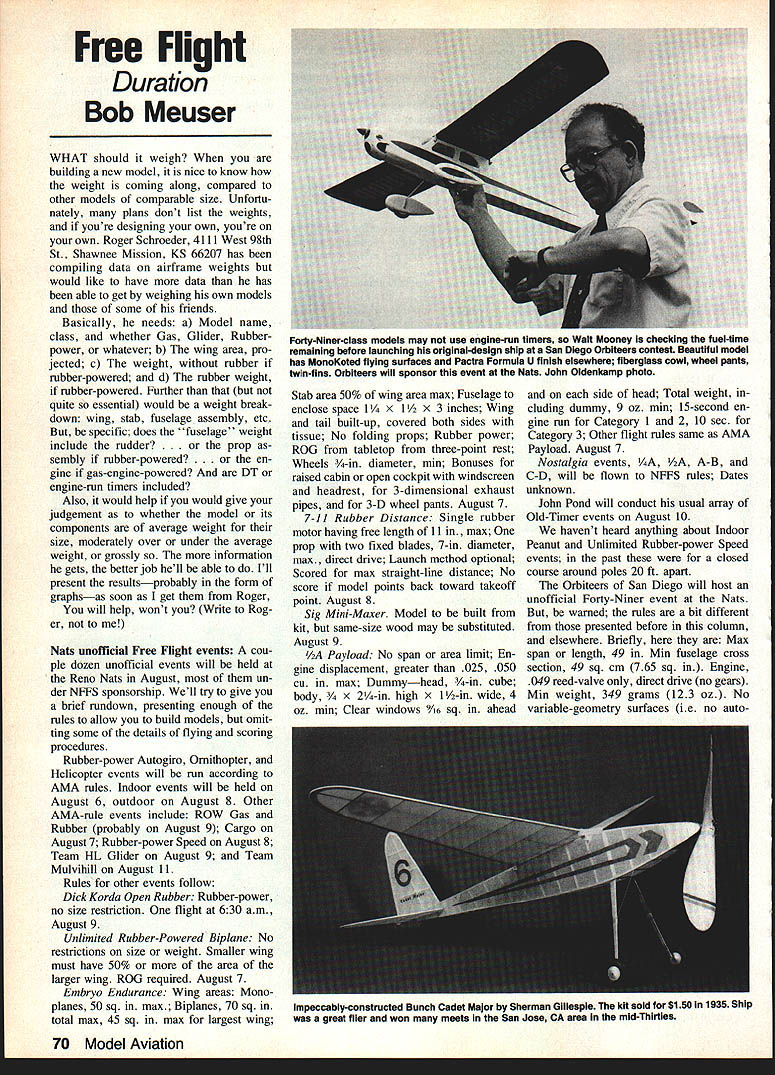
- Model Aviation Forty-Niner-class models may use engine-run timers.
- Fuel: 15% nitro (furnished at the meet).
- Engine-run timing by fuel-volume control only — no clockwork timers. (Eye-droppers, open fuel tanks stuffed with glass beads, calibrated lengths of fuel tubing, etc., are OK.)
- Main landing gear must have two wheels.
- 25% time bonus for ROG.
- Max flight time: 120 seconds; seven attempts; best three count.
- Flight time under 49 seconds is unofficial.
- Fractions of seconds dropped.
- Engine run is taken as the greater of 15 sec or actual run.
- Scoring: flight duration divided by engine run, then multiplied by 1.25 if it was an ROG.
Date: August 11. For more info contact John Oldenkamp, 3331 Adams Ave., San Diego, CA 92116.
Also note: mark Thursday, August 9 on your calendar for the NFFS Symposium and awards presentation.
World-record kite
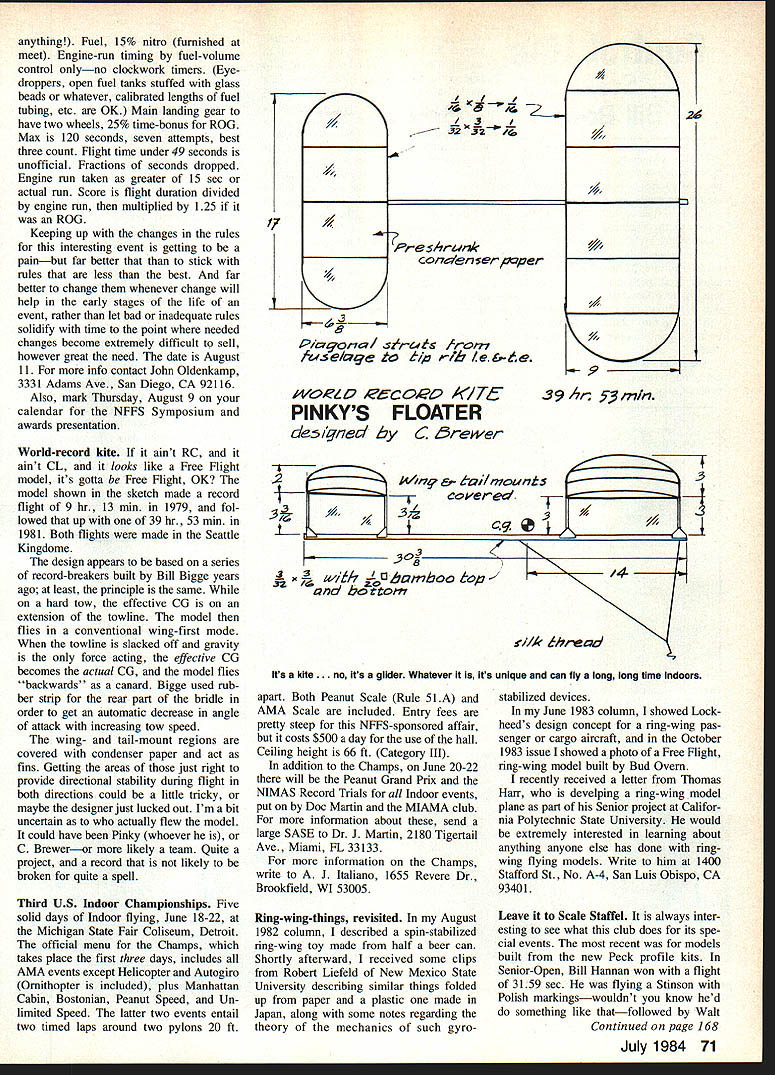
If it ain't RC, and it ain't CL, and it looks like a Free Flight model, it's gotta be Free Flight. The model shown in the sketch made a record flight of 9 hr. 13 min. in 1979 and followed that with 39 hr. 53 min. in 1981, both flown in the Seattle Kingdome.
Design notes:
- The design appears based on record-breakers built up by Bill Bigge; the principle is similar.
- While on a hard tow, the effective CG is an extension of the towline and the model flies wing-first conventionally.
- When the towline is slacked and gravity is the only force, the effective CG becomes the actual CG and the model flies "backwards" as a canard.
- Bigge used rubber strip for the rear part of the bridle to get an automatic decrease in angle of attack with increasing tow speed.
- Wing- and tail-mount regions are covered with condenser paper and act as fins. Getting the areas right for directional stability in both directions can be tricky.
- The flyer(s) may have been Pinky, C. Brewer, or more likely a team.
Quite a project and a record not likely to be broken soon.
Third U.S. Indoor Championships
Five days of Indoor flying, June 18–22, at the Michigan State Fair Coliseum, Detroit. The official Champs (first three days) include all AMA events except Helicopter and Autogiro (Omnihelicopter is included), plus Manhattan Cabin, Bostonian, Peanut Speed, and Unlimited Speed. Peanut Speed and Unlimited Speed involve two timed laps around two pylons 20 ft. apart. Both Peanut Scale (Rule 51.A) and AMA Scale are included.
Notes:
- Entry fees are steep — the hall costs $500 per day. Ceiling height is 66 ft. (Category III).
- On June 20–22 there will be the Peanut Grand Prix and the NIMAS Record Trials for all Indoor events, run by Doc Martin and the MIAMAS club.
- For Peanut Grand Prix/NIMAS Record Trials info send a large SASE to Dr. J. Martin, 2180 Tigertail Ave., Miami, FL 33133.
- For Champs information write to A. J. Italiano, 1655 Revere Dr., Brookfield, WI 53005.
Ring-wing things, revisited
- August 1982: described a spin-stabilized ring-wing toy made from half a beer can.
- Shortly afterward: Robert Liefeld of New Mexico State University sent clips describing similar paper and a Japanese plastic ring-wing, plus notes on the mechanics.
- June 1983: showed Lockheed's ring-wing passenger/cargo concept.
- October 1983: photo of a Free Flight ring-wing model built by Bud Overn.
Recent development: Thomas Harr is developing a ring-wing model as his Senior project at California Polytechnic State University and is interested in hearing about other ring-wing flying-model work. Contact: 1400 Stafford St., No. A-4, San Luis Obispo, CA 93401.
Scale Staffel and contest notes
Scale Staffel continues to put on interesting special events. Recent results for models built from the new Peck profile kits, Senior-Open:
- Bill Hannon won with a flight of 31.59 sec flying a Stinson with Polish markings.
- Walt Mooney's Citrabla and Len Piddle's Zlin placed behind.
- Best flight was Terry Allen's winning Junior flight of 45.38 sec posted by his Cessna — an impressive performance for that type of model.
Conclusion: Peck's profiles fly well; score often depends more on the pilot than on the model.
Scale model (junior indoor HLG note)
John has twice set the Junior Indoor Hand-Launched Glider record at the Boys' Ranch and is moving into other kinds of Indoor flying as well.
Trophies, anyone?
Attractive trophies and plaques can be inexpensive if you can generate the necessary artwork. Don Chancey reports:
- The plaque shown uses a stained-wood base with a black-and-silver plate produced using Scotchcal by 3-M (cat. No. 8005).
- Scotchcal is printed from negative or positive artwork (for light or dark lines). Printing is on photosensitive material exposed under ultraviolet light and developed with a single-step developer, then rinsed.
- Approximate cost of a 3 in. x 6 in. plate: $1.
- Plates can be aluminum-based or sensitized plastic; both are available in several colors.
- Suitable artwork can include halftoned photos (65-line screen).
Contact: Bud Tenny, P.O. Box 545, Richardson, TX 75080.
TV ornithopter segment
Ken Johnson builds ornithopters in quantity (around 120). He appeared on "Eye on Hollywood" with several of his birds, including:
- A biplane with upper and lower wings flapping out of phase that flew smoothly.
- Exotic models such as one that flaps everything, including the tail.
The segment could have shown more slow-motion close-ups of mechanisms and more exotic models. They did include scenes of trophies crashing when Ken attempted outdoor flights in wind — entertaining, if not ideal coverage.
NFFS awards for 1984 and Symposium
The National Free Flight Society (NFFS) annually awards Model of the Year and has a Free Flight Hall of Fame. Distinguished Service Awards have been reinstated but details were unavailable at press time.
Model of the Year Awards for 1984:
- International Classes:
- F1A (Nordic): Walt G.?
- F1B (Wakefield): Angelo Sen.?
- F1C (Power): Silvano Lustrati, S-120-A.
- AMA Power:
- Small: Ron St. Jean (structureless foam-composite concept).
- Large: Sal Taibi, Starduster 900.
- Hand-Launched Glider: Martyn Conroy, Goldrush.
- Indoor: Bernard Hunt, Tandy Two EVB.
- Unlimited Rubber: Mik Maszkiewicz, Unlimiter.
- Scale: Bill Norman, Armstrong-Whitworth Ape.
- Special: George Xeniakos and Lothar Döring (recording thermal detectors).
Free Flight Hall of Fame awards for 1984:
- Ed Lidgard — creator and lifer of championship-quality models.
- Paul Plecan — prolific designer with special attention to scale details.
- Ken Willard — creator of significant model designs and early author of creative articles.
Presentation: The awards will be presented at the Reno Nats during the NFFS Symposium, Thursday, August 9, 7:30 p.m., Reno Coliseum. Some awardees will have their models on display and will be present to answer questions. Drawings, photos, and stories about them will appear in the NFFS Symposium Report, available at the Nats or by mail order.
Hedge your bets (tips to avoid losses)
Murphy’s Law applies: if anything can go wrong, it will. To reduce losses, hedge your bets with:
- Spare parts and a minimum of complex gadgetry.
- Checklists and winding tubes.
- Fail-safe procedures and hardware.
Timers and DTs:
- I forget to light fuses, so I use timers — but timers can fail or be forgotten.
- Some fliers remove start-stop levers from DT timers so they run on and are reset before launch; if forgotten, a short DT is better than none.
- Simple reminder rig: a wire or heavy nylon monofilament through a hole in the timer mount prevents the escapement from running. Tie a big red flag to the end as a reminder to pull it out before launch.
- For Eaton-type mechanical timers with a start-stop lever: loosen the lever so it flops freely, attach a spring or rubber band to pull to the "on" position, and arrange a pull-pin to hold it in "off" until ready.
If you consider losing models or contests part of the sport and think these fixes are excessive, skip these suggestions — but be aware of the risks.
Bob Meuser 4200 Gregory St., Oakland, CA 94619
Transcribed from original scans by AI. Minor OCR errors may remain.

