
Free Flight Duration
Bob Meuser
Bob Meuser is on vacation, so we've asked veteran Free Flight fanatic Larry Kruse to take the reins for this month. To all veteran Free Flight modelers, Larry needs no introduction; however, for the newcomers, we'll just suggest that you read on, and let Larry introduce himself.
Being a guest columnist has many of the same attributes as being a grandparent. First of all, no one expects you to be an authority figure. While your comments are noted in sort of a bemused fashion by the patient reader, no one expects you to strike fire with each word.
Similarly, a certain amount of doddering misdirection is tolerated. If you fumble, stumble, and bumble a bit, allowances are generally made for the effects of longevity and absent-mindedness.
Third, and most importantly, you don't have to bear any of the consequences for audacious behavior! After a one-shot performance, your charges have all gone back to their regular columnist and you are four weeks down the road, leaving the poor editor and his staff to sort out the shambles you've created.
Given all of the above, I was very pleased to be asked to fill in for Bob Meuser and allow him a well-deserved break. In that same vein, the next bit of information comes under the heading of "fools rushing in."
Joined-wing reprise
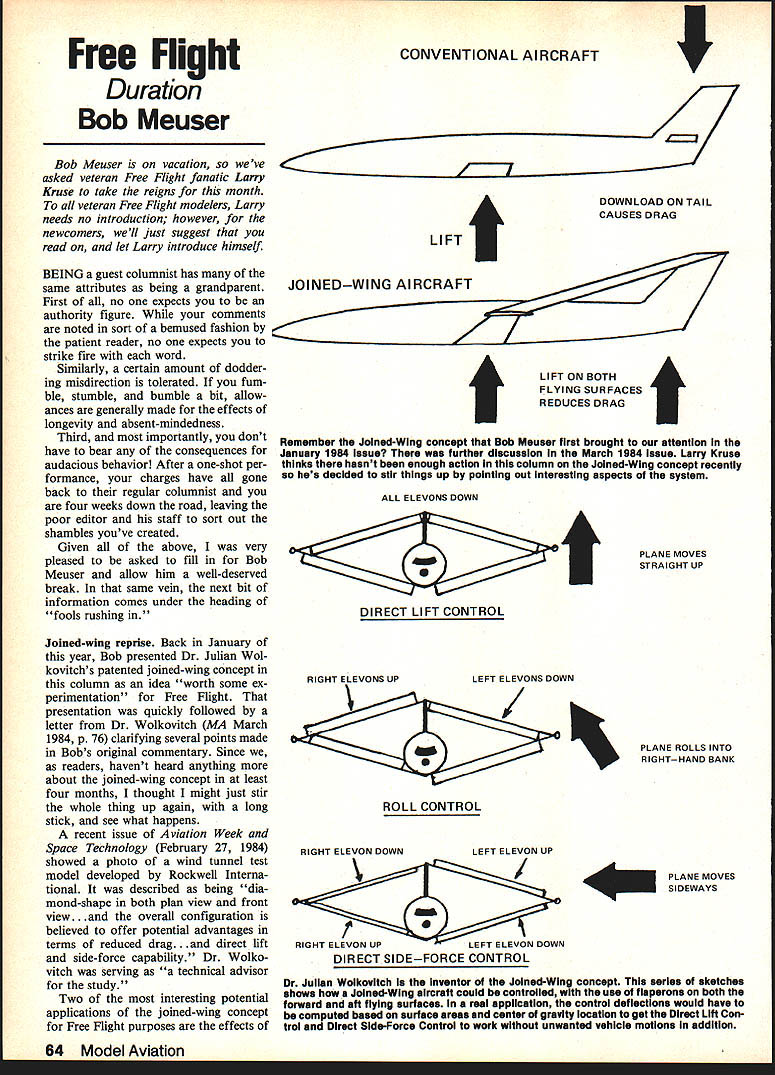
Back in January of this year, Bob presented Dr. Julian Wolkovitch's patented joined-wing concept in this column as an idea "worth some experimentation" for Free Flight. That presentation was quickly followed by a letter from Dr. Wolkovitch (MA March 1984, p. 76) clarifying several points made in Bob's original commentary. Since we, as readers, haven't heard anything more about the joined-wing concept in at least four months, I thought I might just stir the whole thing up again, with a long stick, and see what happens.
A recent issue of Aviation Week and Space Technology (February 27, 1984) showed a photo of a wind tunnel test model developed by Rockwell International. It was described as being "diamond-shape in both plan view and front view... and the overall configuration is believed to offer potential advantages in terms of reduced drag... and direct lift and side-force capability." Dr. Wolkovitch was serving as a technical advisor for the study.
Two of the most interesting potential applications of the joined-wing concept for Free Flight purposes are the effects of direct lift control and direct side-force control.
Dr. Julian Wolkovitch is the inventor of the joined-wing concept. The accompanying sketches show how a joined-wing aircraft could be controlled with the use of flaperons on both the forward and aft flying surfaces. In a real application, the control deflections would have to be computed based on surface areas and center-of-gravity location to get the direct lift control and direct side-force control to work without unwanted vehicle motions. The control surfaces and the lift potential, as illustrated by the sketches, suggest that results of these applications on Free Flight models could certainly be worth exploring. Anyone out there working with the joined-wing concept?
CO-2 Duration
Curiously enough, as popular as CO-2 motors have become in the last few years, no Duration events for them have risen to any discernible popularity in this country. As early as 1979, our British cousins brought CO-2 Duration into prominence and have included it as a British Nats event since 1980. Why the event was popularized there and not here is not exactly clear, but it would seem that it is an idea whose time has come in this country.
As an advocate of CO-2 power and a devotee of both sport and Scale CO-2 aircraft, I'd like to present one set of CO-2 Duration rules employed in Great Britain. These rules were originally developed by the British SMAE (Society of Model Aircraft Engineers) and published in Aeromodeller. Notice that, in an attempt to encourage design development, there are no restrictions on wing area, model weight, or type of propeller used.
SMAE Rules for CO-2 events
- The maximum capacity of the carbon dioxide (CO-2) tank and piping system shall be less than 3.25 cubic centimetres (0.1983 in.^3). Note: Brown, Humbrol, Shark, and Telco standard, single-cylinder tanks and motors meet the requirements of these rules.
- Outdoor contests: the competitor is allowed six flights with a maximum of two minutes for each flight. The best three flights will count toward the final score.
- Indoor contests: the competitor is allowed six flights with a maximum of six minutes for each flight. The best three flights will count toward the final score.
- For contest flights, the CO-2 system must be filled from a bulb type of filler.
- Non-standard motors, tanks, piping, or filling systems may be used if the Contest Director is satisfied that all reasonable precautions have been taken to ensure that the equipment is safe.
British outdoor CO-2 models tend to be about the same size as a Coupe d'Hiver rubber-power and use 1/16-in.-square open structures.
Indoor ships tend to be somewhat larger and lighter, as one might expect. Typical wingspans range in the neighborhood of 40–48 inches and often use mylar covering in an attempt to minimize weight.
In light of the many events the Free Flight community has attempted to retain, develop, and/or perpetuate in the last few years, CO-2 Duration should be given due consideration.
For example, it's evident to most of us that Rocket power (Jeter) has largely faded, except at the Nationals level. Electric power, too, is a bit slow to catch on, although the potential is certainly there. CO-2 Duration is my personal favorite to become a viable event in the next few years and has the potential to replace Rocket and to forge ahead of Electric in popularity due, simply, to its lower initial cost.
Although I am not aware of any nationally published domestic designs for the event, plans have been presented in Aeromodeller from time to time and should give excellent reference points for domestic development of CO-2 Duration models. A new, small-field Power event could make Category III contests a whole lot more fun.
Embryo and 7-11 for beginners
Jim Kostecky's excellent Tutor (MA, June 1984) design, intended to introduce beginners to the wonders of Free Flight, presents a very good springboard for young modelers. Likewise, the NFFS (National Free Flight Society) Embryo and 7-11 events can do the same thing—or, depending on the skill level of the builder, serve as the next step up from the Tutor.
Two Embryo kit designs, in particular, stand out as appropriate choices for beginners to the realm of Free Flight:
- Peck-Polymers' Prairie Bird — a long-established design.
- Micro-X's Hornet — a newer design.
Structures are simple, straightforward, strong, and functional. Both are readily available from most hobby dealers or can be ordered from Peck-Polymers, Box 2498-MA, La Mesa, CA 92041 and Micro-X Products, Box 1063, Lorain, OH 44055.
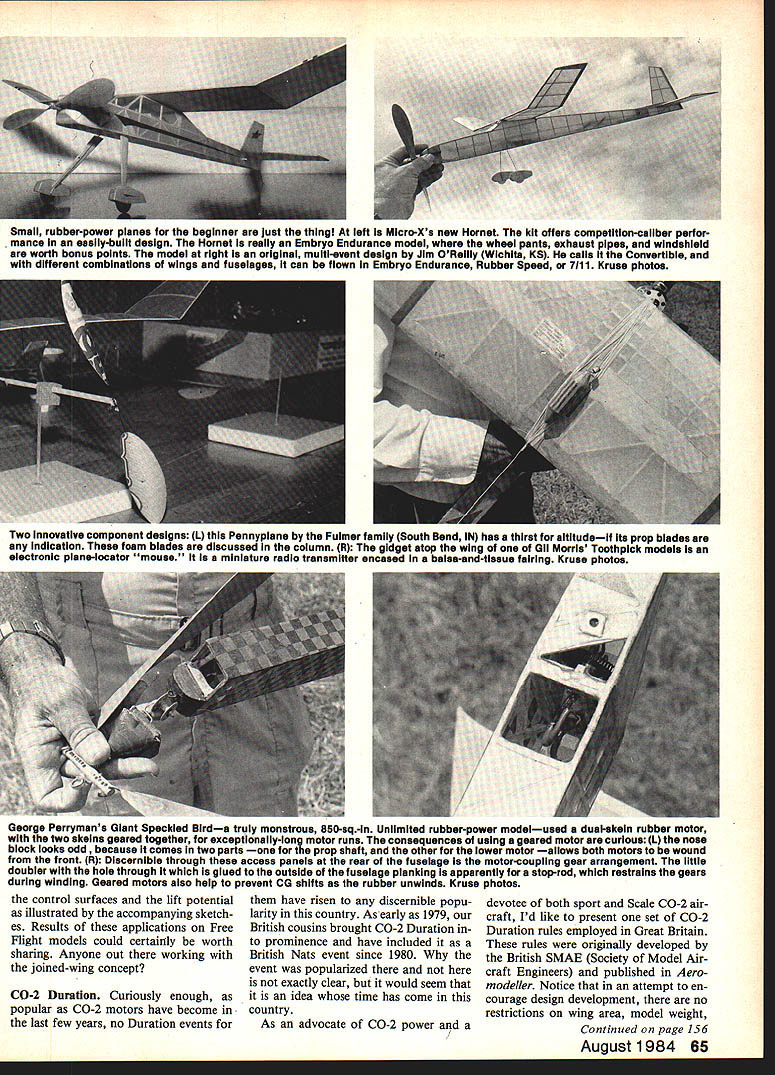
I've also included a photo of Jim O'Reilly's "convertible" 7-11/Embryo design, shown in its Embryo configuration. By manipulating combinations of wings, fuselages and rubber, the design is also convertible to Rubber Speed as a triple-threat entry in NFFS events. It, too, typifies models which could qualify as beginners' ships while maintaining competition potential.
Foam blades
Props for Pennyplanes and EZBs typically are pretty standard-sized items as far as construction goes. Typically, blade blanks are cut from thin sheet balsa, soaked in some sort of wetting solution, and then wrapped on a cylindrical form and either baked to maintain shape or allowed to air-dry. A variation of that theme has been provided for us by Keith Fulmer and his sons, Brad and Bryan, of South Bend, IN, who have been campaigning models fitted with wire and sheet-foam blades.
The printed foam shells on A&W Root Beer containers have been the choice sources of these props. The curvature of the container itself provides the camber, so it is a simple matter to vary the chamber by cutting new blades along a different tangential line of the container. The wire "frame" to which the blades are attached is wrapped and glued to the prop hook. Props made in this fashion are extremely long-lived and damage-resistant.
Gearing up for rubber power
Those who are enamored of large rubber-powered planes are constantly faced with the problem of CG (center of gravity) shifts as the motor unwinds. The longer the fuselage and the further the motor peg is from the CG, the greater the chance of a stall while under power, or a stall in the glide portion of the flight. If you shorten the motor length by either moving the motor peg forward or actually chopping off a hank of rubber, then you've defeated the purpose of having a long fuselage in the first place.
George Perryman was obviously faced with the same cascading set of problems when he designed his gigantic Great Speckled Bird for the NFFS Dick Korda Open Rubber event. George's solution was to go with a gearing system, which is no great shakes, except that George gave it a little unique Perryman twist. The gear mechanism is at the rear of the plane—not at the front.
As the photos show, there are two motor hooks facing forward, and the gearing mechanism is immediately behind what appears to be a ply plate with metal bushings. The small circular hole is apparently for a stop-rod to keep everything from unraveling while winding and to relieve undue pressure on the gears themselves. The double noseblock allows winding both motors from the front of the plane. The motor run with all that gearing in place is unbelievably long, and there is no problem whatsoever with the unwound motors upsetting the CG. Very ingenious—which is what we have come to expect from George Perryman.
Radio Controlled Free Flight
I knew that would get your attention! Actually this has nothing to do with radio-controlled Free Flight. What it does have to do with is Gil Morris' (The Toothpicks designer) use of a small radio transmitter mounted in a streamlined pod atop the wing of his plane. Gil's "mouse," as he calls it, emits electronic "beeps" which help him locate and retrieve the plane in the midst of the jungle-like growth we sometimes have to fly into. Gil reports good success with the device. I'm sure he'd be happy to supply more details about the exact components if you sent a SASE (self-addressed, stamped envelope) to Gilbert Morris, 2810 Brackey Rd., Columbus, OH 43220.
Nickels roll 'cause they're round
One of the niftiest hints I've encountered in a while comes from Jerry Skrivanc, the Micro-X man. I've always had trouble making small wheels of sheet balsa, or laminations of the same. It just never seems that I can get them to finish up round! Regardless of how carefully I cut them out, somehow I lose it in the sanding process, and then the wheel takes on its own whopper-jawed characteristics later in the game.
The next time you're faced with the wheel-making task, sandwich each wheel blank between two coins of the appropriate size and sand right down to the metal. Neat, huh! If you pinch the coins tightly enough (an easy task for most Free Flighters), there's just no way you can be wrong.
Speaking of wheels, it's time that I "wheel" on out of here and let Bob Meuser return to his accustomed and revered place next month. I hope that I'll get to meet many of you along the contest trail this season. Free Flight is forever.
Try address: Larry Kruse, Box 1177, Liberal, KS 67901.
Photos, drawings, and correspondence dealing with any and all Free Flight subjects should continue to be sent to our regular Contributing Editor, Bob Meuser, at 4200 Gregory St., Oakland, CA 94619.
Transcribed from original scans by AI. Minor OCR errors may remain.

