
Free Flight: Duration
Bob Meuser
Computer
A computer in every bathroom? Maybe not, but there is no question that computers are becoming commonplace. You don't have to live in an affluent neighborhood to find that every third kid either has a computer or at least access to one—or at least a programmable calculator. The computer age will (or might well) have an impact on Free Flight. Why count squares on graph paper when you can punch in the coordinates of a wing outline and have a computer do the cookie-labor of calculating the wing area? The computer age is bigger than merely Free Flight, and I wouldn't be surprised to see a computer page as a regular feature in the major modeling magazines in the near future.
I've received requests for computer programs and have asked other modelers for copies of their programs. One teacher asked for programs to use in a model-airplane-building class. If youngsters who have computers could use them to solve real-life problems rather than as sophisticated pinball machines, they'd get a better feel for what computers are all about. I've used computers myself to solve model-aviation problems.
There should be some way for people who have programs, or who can write them, to communicate with those who would like the programs but lack the facility to write their own. I could offer to be a go-between, but that might be more work than I can handle, and without structure and some formality it could turn into chaos.
One big problem is that, at this stage, programs are not very portable. A BASIC program written for an HP9845 won't run on an Apple II, nor on an HP85. The version of BASIC used on some machines won't even calculate an arc-tangent. We'd need a sort of universal language, close to English, with standard mathematical notation—phrases like "Evaluate a = sin(b/c)" or "Store result in register 21." If a person submitted: (a) the equations used, (b) a blow-by-blow description in modified English as outlined above, and (c) a printout of the program in the native language of his computer, then another person could conceivably make use of it even if his computer spoke a different language.
I'm open to suggestions—particularly ones likely to gain me fame, glory, the admiration (envy will do in a pinch) of my peers, and oodles of coin of the realm with no effort whatsoever on my part.
High-strength solder
I gave up ordinary lead-tin solder years ago when I discovered Sta-Brite, a 4% silver, 96% tin alloy that is much stronger. Similar solders, melting at around 440°F, are marketed by the major manufacturers; Allstate makes one, too. My 20-year-old supply of Sta-Brite finally got used up, so I ordered some Kester "silver" solder sight unseen by mail. When it arrived my first reaction was, "Dang—no flux!" I discovered the solder has a flux core. Will the flux work on music wire? I tried it on uncleaned music wire and, by golly, it worked, though it was necessary to apply heat for some time to give the flux ample opportunity to chew through the crud. On wire cleaned with 400-grit sandpaper, the solder tinned the surface immediately. The stock number is 82-5000-0005. Any decent hardware store should stock it if your hobby store does not.
Kester will also send a free booklet called Soldering Simplified; send 50¢ postage and handling to Kester Solder, 4201 Wrightwood, Chicago, IL 60639. Fifty cents—funny kind of free anyhow. The booklet is pretty good; if you already know much about soldering it won't tell you much you don't already know.
Fly Max (brief note)
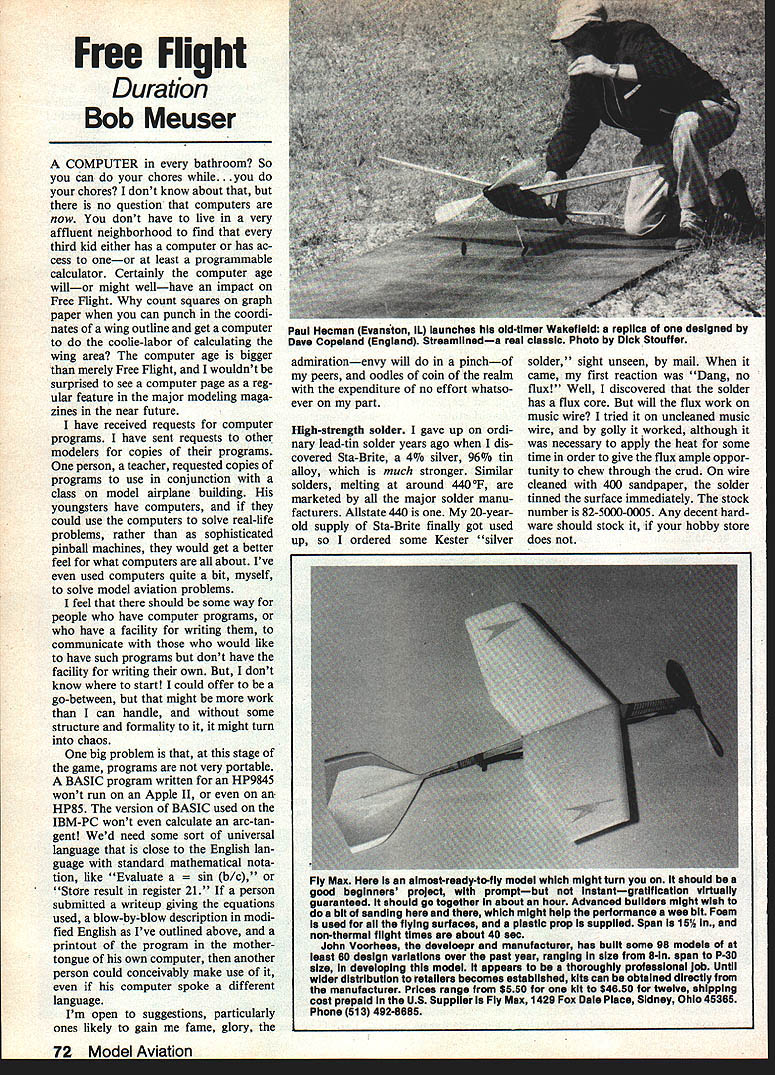
Paul Hechman, Evanston, IL, developed an old-timer Wakefield replica assigned to Dave Copeland, England—streamlined and a real classic. Fly Max produces an almost-ready-to-fly model that might be a good beginner's project. It should go together in about an hour; advanced builders may wish to do some sanding to improve performance. Foam is used for flying surfaces; a plastic prop is supplied. Span 15"; non-thermal flight times about 40 seconds.
John Voorhees, developer/manufacturer, has produced about 98 models with at least 60 design variations over the past year, ranging in size from 8-inch span to P-30 size. Until wider distribution channels are established, kits can be obtained directly from the manufacturer. Prices: $5.50 kit, $4.65 ready-to-fly, plus shipping prepaid. US supplier: Fly Max, 1429 Fox Dale Place, Sidney, Ohio 45365. Phone: 513-492-8685.
Polyhedral parameters
John Ferrer, a tech-sort guy, innovative model designer, and president of the Thunderbugs, has come up with some neat notions about polyhedral.
Ferrer's First Notion
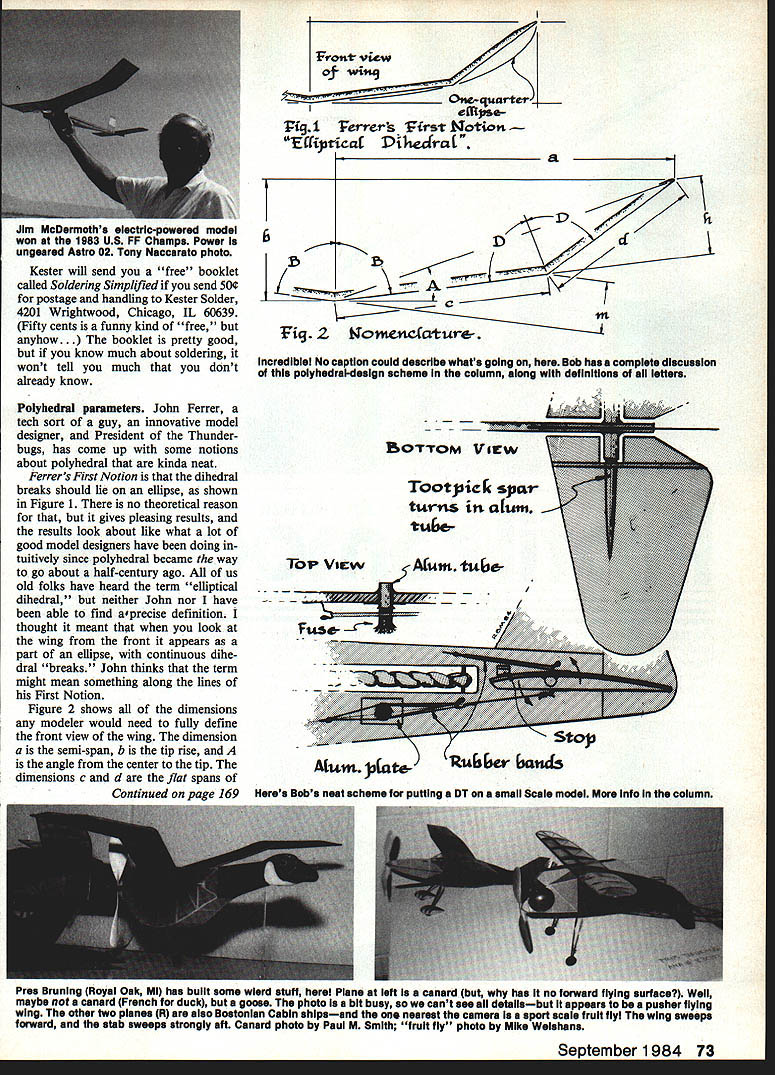
- The dihedral breaks should lie on an ellipse (as shown in Figure 1). There is no theoretical reason for this, but it gives pleasing results that resemble what many good model designers have been doing intuitively since polyhedral became common.
Figure 2 (not included here) shows all the dimensions needed to fully define the front view of the wing. The dimension a is the semi-span, b is the tip rise, and A is the angle from the center to the tip. The dimensions c and d are the flat spans of the inner and tip wing panels. The angles B and D are the angles you need to know when setting ribs adjacent to the dihedral breaks (or when sanding them to the proper angle); the dimensions m and n are the amounts by which you prop up the end of one panel when gluing it to the end of another.
There are many scenarios, involving considerable trial-and-error, by which modelers arrive at final wing dimensions.
Ferrer's Second Notion
- A designer would ideally: (a) establish the semi-span a and the tip angle A; (b) establish the ratio c:d; and (c) invoke Ferrer's First Notion about the ellipse. All other numbers of interest should then follow.
Why the ratio c:d? Suppose rib spacing is to be uniform throughout the wing. From experience (or a wild guess) you decide the tip panel should have six rib spaces and the inner panel four. Then c:d, which John calls R, is simply 10/6 = 1.667. Given that scenario and constraints, a skilled draftsman could produce all the answers quickly; considering the model will take about 20 hours to build, that’s a small price to pay.
Ferrer's Third Notions
- Ferrer's Third Notion (of the First Kind) is that a trial-and-error program could be put into a programmable calculator to make short work of the calculations; he has done that.
- Ferrer's Third Notion (of the Second Kind) is that a more sophisticated programmable calculator (capable of looping and branching), or even a basic computer, could perform the trial-and-error and make even shorter work of it.
Meuser's First Notion
- I thought Ferrer's complete notions could be packaged as tables or graphs I could present in this column so that someone lacking drafting or calculation skills could simply pluck the desired numbers from the graphs or tables. I dusted off my trusty computer, programmed John's formulas, and produced a bunch of numbers. Unfortunately, the results can't be compressed to fit this column while remaining readable. Perhaps they will appear in the NFFS Digest or an NFFS Sympo Report; perhaps not. Meanwhile, if you send a self-addressed envelope (at least "legal" size and preferably 6 × 9 in. or larger) with 54¢ worth of stamps on it (enough for three ounces), I'll send you three ounces worth of whatever I happen to have on hand at the time.
Where else can you get 54¢ worth of material for 54¢ these days?
Boron filament—dangers and precautions
Boron filament is terrific stuff, but there are dangers associated with it. It is the latest high-technology material to be used by modelers, and while most of us will never use much of it, those who do must be careful.
- Boron filaments come in long pieces and are most efficiently cut by snapping off a piece with pliers. Because the material is brittle, other methods may leave tiny, glass-sharp shards.
- These shards can penetrate the skin and will not work their way back to the surface. If left in place they are annoying; worse, they can enter the bloodstream and cause serious problems if they reach the brain, heart, or lungs.
Precautions:
- Do not leave broken ends lying around. Have a jar or other sealable container on the workbench and drop broken ends directly into it from the pliers.
- A tab of masking tape attached to the end to be broken off may help retain the small piece, which should then be put into the wastebasket or other suitable container.
(Howard Haupt’s article on this subject has appeared in several FF newsletters, including El Torbellino and Bugs Buzz.)
Reconstituted "goofer" feathers (Artcor) as a potential balsa substitute
John Oldenkamp sent a sample of a material called Artcor that might have potential as a Free Flight construction material. It consists of a foam core faced on both sides with a tough, water-resistant material. The name and the advertising (which calls it "pH neutral") indicate it's intended for art applications. It is also advertised as "scorable, die cuttable, printable" and "capable of withstanding numerous tortures."
Availability and sizes
- Smallest sheet: 40 × 60 in.
- Smallest pack: 50 sheets per carton (so the wholesale route is impractical for average hobbyists).
- Thicknesses: 1/8, 1/16, and 1/32 in.
- Density (sample of 1/8 material): about 15 lb./cu. ft.
Properties and suggested uses
- Compared to balsa of similar density, the foam is likely far weaker than balsa along the grain and perhaps a bit stronger across the grain.
- For 1/32 ribs I would consider using the 1/16 material but beef it up with a strip of 1/16 × 1/4 hard balsa toward the trailing edge.
- The material tends to fail by folding rather than crushing like balsa, so it behaves differently and is more suited to some uses than others.
Primary source: Amoco Foam Products Co., Atlanta, GA 30339.
A commercial-minded person might cut the sheets into more usable sizes (for example 12 × 24) and repackage them under a house brand (perhaps "Goofer-board") for retail sale.
A side note on terminology: "goofer-feathers" (from an old Amos and Andy record) was defined jokingly as the fuzz from peaches. I'm not implying Artcor is made from goofer feathers, but the name stuck in my head.
Fus ODT for small scale and sport models
A model worth building is worth a little effort to get back after a flight. Rigging a dethermalizer on a small-scale model can be a chore. Here is a rather simple lash-up I've used on a small "profile" model; the principle could be applied to "fuselage" models as well, with negligible...
Transcribed from original scans by AI. Minor OCR errors may remain.

