
Free Flight: Duration
Harry Murphy
Here it is — time to submit my second attempt at pounding out this column. My first effort has yet to hit the streets, so I haven't had the opportunity to respond to initial mistakes before it's time to jump in and make some more.
In contrast to issuing a newsletter, where it's not uncommon to receive reader responses by return mail, this delayed-action situation of rushing to meet deadlines and then having nothing happen for a couple of months feels rather strange. It's like the suspense of knowing you'll be handed the bar bill for 20 people after a big night on the town — while everyone else is enjoying themselves, all you can think about is how badly you're going to get stung.
I know one can get a more immediate, in-depth feel for what's going on at the grass-roots level as a newsletter editor than in the seemingly displaced, delayed role of a magazine columnist. For that reason I'm attempting to maintain my status as editor of the CIA Informer, in hopes that voices and contacts from those pages might eventually be relayed into this column.
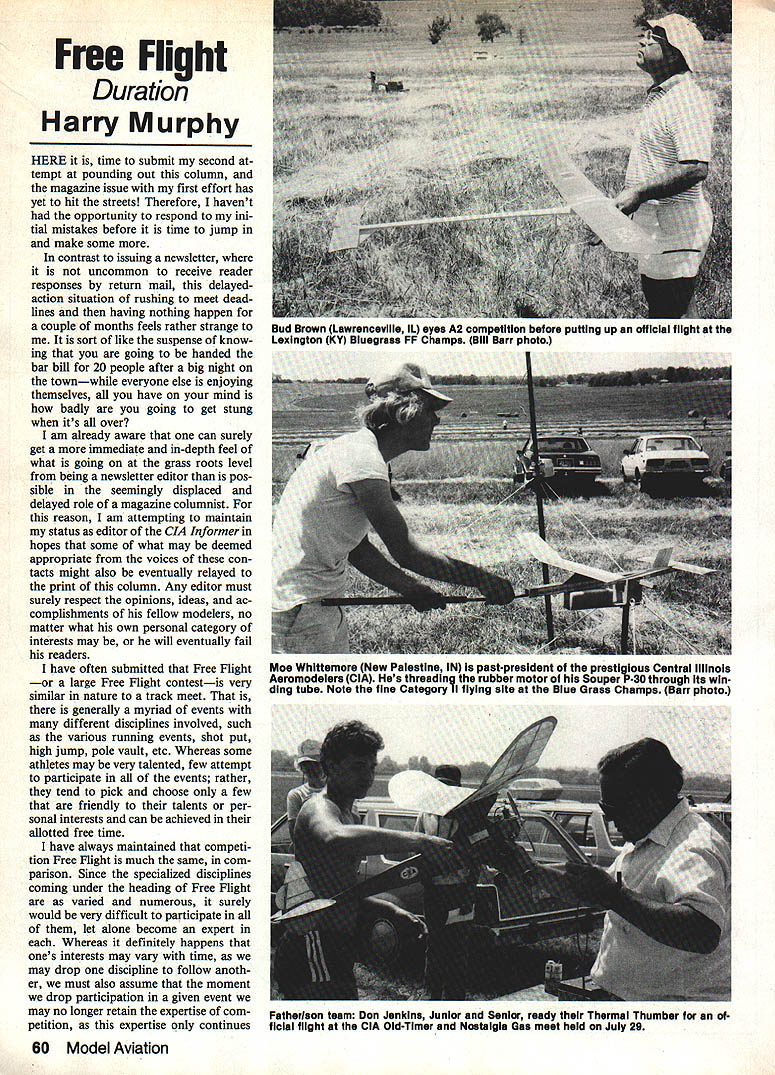
Any editor must respect the opinions, ideas, and accomplishments of fellow modelers no matter what his own personal category of interest may be — otherwise he will eventually fail his readers. I've often compared Free Flight (and a large Free Flight contest) to a track meet: a myriad of events and many different disciplines, like the various running events, shot put, high jump, pole vault, etc. Some athletes may be talented across events, but most pick and choose the few that suit their talents and available time.
Competition in Free Flight is much the same. The disciplines are varied and numerous; it's difficult to participate in, let alone become an expert at, all of them. Interests change with time — we may drop one discipline to follow another — and once we drop participation we may no longer retain the competitive expertise. That always irks me when someone who no longer participates claims to be a qualified expert: once you stop participating, you disqualify yourself as an expert in my book.
If I eventually contribute anything useful in this column, I hope readers will know that any expertise I claim is based on personal experience and participation in those disciplines I actively pursue. My primary interest in Free Flight involves anything with an engine hanging on the front. That isn't to say I have little interest in Rubber, Glider, or Indoor disciplines — simply that time doesn't stretch far enough to permit concentrated active participation in every event. I would feel more secure passing along information about other disciplines if that information came from those who actively participate in them.
Should the foregoing sound like a call for assistance in contributing information on Free Flight subjects, take it to mean just that — it feels a bit lonesome out here on this tree limb at the moment. Keep those cards and letters a-comin', guys — in other words, help!
1985 U.S. FAI Team Finals
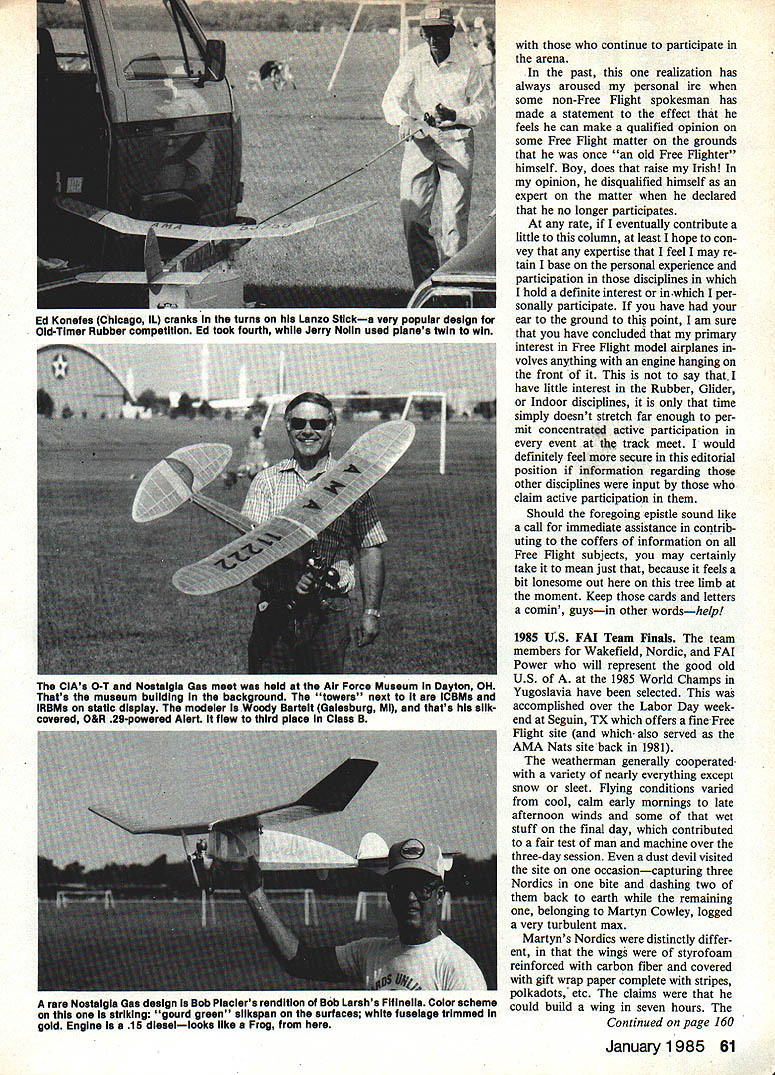
The team members for Wakefield, Nordic, and FAI Power who will represent the U.S. at the 1985 World Championships in Yugoslavia have been selected. The selection took place over Labor Day weekend at Seguin, TX — a fine Free Flight site that also served as the AMA Nats location in 1981.
Weather cooperated with nearly everything except snow or sleet. Conditions ranged from cool, calm early mornings to late-afternoon winds and some wet weather on the final day, making for a fair test of man and machine. A dust devil even visited the site once — it grabbed three Nordics, sending two back to earth and leaving Martyn Cowley's to log a very turbulent max.
Notable items:
- Martyn Cowley's Nordics used styrofoam wings reinforced with carbon fiber and covered with gift-wrap paper (stripes, polka dots, etc.). He claimed he could build a wing in seven hours. The paper was applied with wallpaper paste and looked very appealing.
- In Power, folding props were used more often than before. One team member, Bob Gutai, used a folding prop made by Tom Kerr.
- Engines seemed to run faster each year and competition grew more intense.
Team members (three-day, five rounds per day results):
- Power: Bob Gutai (PA) — 2,700 sec.; Ken Happersett (CA) — 2,700 sec.; Ken Phair (CO) — 2,700 sec.
- Nordic: Jim Bradley (FL) — 2,687 sec.; Lee Hines (CA) — 2,656 sec.; Randy Weiler (CA) — 2,625 sec.
- Wakefield: Walt Ghio (CA) — 2,520 sec.; Bob White (CA) — 2,520 sec.; Jack Brown (CA) — 2,486 sec.
Notes:
- The only perfect-max tallies after three days occurred in Power, so no flyoff was necessary; the three tied competitors were selected for the team.
- The Power event was tightly bunched at the top: being 21 seconds off the 2,700-second perfect mark placed Gil Morris (Columbus, OH) seventh. Last year's team member Rod Anderson was 20 seconds short. Doug Galbreath and Bob Stiefel were seven and five seconds off, respectively.
- The final rosters contain a fair balance of experienced team participants and some first-time members seeking their initial challenges. We wish our newest FAI Free Flight teams good fortune in 1985.
1985 and '86 SAM Champs
To help with vacation planning and preparing models, it's useful to have early, finalized sites for major events. The Society of Antique Modelers (SAM) runs an iron-clad rotation program for its annual championship: the country is divided into four geographical sections from east to west, and each year the Champ is held in a different section so attendees know well in advance which years the event will come to their area.
- 1984: Bond Field, Wisconsin (Midwest district)
- 1985: Western district — Madera, CA. Contest Manager: Jack Jellas. Dates: June 17–20. RC-Assist events will be flown all four days; Free Flight events on the latter three. The site reportedly offers extremely good chase conditions. The area was originally planned as a housing development years ago; development stalled after the streets were connected, leaving a fine flying site.
- 1986: Back to the East Coast — Chicopee, MA has submitted a bid with George Armstead as Contest Manager.
This advance notice should help interested parties make plans. Personally, I'm making short-term plans for Madera — the balsa chips are already flying in my workshop.
Taking it off
David Jones (Pittsburgh, PA) asked if anyone has an "easy" method of removing old silkspan from model structures. At the time I received his inquiry I was in the midst of recovering a Comet Zipper, so I was tempted to answer categorically "no." However, editors should not assume they're the last word in the knowledge department. This is certainly an often-asked question; if you have a tried-and-true method, please write in and share it.
Marathon flyoffs
Although marathon flyoffs are often interesting, they are a headache for the contest director and the scorer's bench. They require double the number of flight timers (one on the engine run and one on the flight), who are usually in short supply, and they limit the number of events in which a contestant can participate on a given day.
Most modelers come prepared to compete in several events, but a long marathon can reduce participation: what might be eight or ten events on a Sunday contest can shrink to only a few. Increasing participation in more events would also make contest sponsors happier through higher registration and event counts.
Because marathons are often decided by an engine overrun, I have never felt they are a true test for determining the better model; close calls are always subject to debate. Conversely, all controversy is avoided should a model touch the ground before the expiration of a maximum flight.
I strongly feel the cure for marathon flyoffs is not another reduction in engine-run time (say to three seconds) but rather an increase in the maximum flight limit as the engine run becomes shorter. The logic: a given Power model on a four-second engine run will drift downwind no further in 2½ minutes than the same model will when given a seven-second engine run and a two-minute maximum flight time. It generally takes a pretty good model to log 2½ minutes on a four-second engine run without buoyant support from favorable air.
I believe this proposal has merit, but it's up to the Contest Board to decide. Note: the formal Cross-Proposal procedure has recently been eliminated from the Contest Board Procedures by the AMA Executive Council and Contest Board Chairmen, so anyone with opinions pro or con should pass them on to their respective Contest Board members as soon as possible. Meanwhile, let's keep those marathons running.
Tape solder
How many times has your day's flying ended because of a loose solder joint on a needle valve body, a broken ignition wire, or a loose piece of tubing in a fuel tank? Quite a few, if you think about it.
I own a 12-volt DC soldering iron but usually leave it at home because it clutters my flight box — of course, the only time I need it is when it's at home. While browsing in a Radio Shack store I found an interesting alternative: "tape solder." The package claimed a melting point low enough to melt with a match. I bought a small pack (Archer brand, Catalog No. 64-010) containing 100 thin flat pieces, each about 1/2 x 1/4 inch, for $1.39.
My tests:
- Folded half a strip over an unsoldered terminal on a scrap piece of No. 20 wire, applied flux, and held it over a match. The solder tape melted almost instantly and flowed evenly to produce a perfect solder joint.
- Wrapped a strip around a vent tube on an old metal fuel tank, dabbed on flux, and used matches to melt the solder. It took three matches to completely melt all the solder, but the joint held.
Take proper safety precautions when using an open flame near fuel tanks and the model. A few strips of solder tape in the flight box might come in handy for temporary field fixes.
NFFS Nostalgia Gas rules feedback
As most Nostalgia Gas buffs know, Ralph Prey and his reporter were initially enlisted by NFFS President Tony Italiano to help draft universal rules for vintage glow-engine-design competition (pre-1957 era). The timetable was short because NFFS intended to sponsor the events at the Reno Nats.
When work began there were pockets of activity around the country, but no two areas were standardized on the same rules. Ralph and I felt our primary goals should be:
- To provide regulations that would prevent immediate obsolescence of models already built — thus "scaling" had to be permitted.
- To encourage the use of large, early glow engines and the contemporary designs supported by the nostalgic stature of the era — thus increased restriction on the use of modern glow engines.
- To attempt to make everyone happy.
Well, as you might expect, that was a challenging task. If you have comments or experience with vintage-glow competition rules, please send them along.
Transcribed from original scans by AI. Minor OCR errors may remain.

