
Free Flight: Duration
Bob Meuser
NFFS doings
REPORTS of my death (as a columnist) have been greatly exaggerated. I've received a number of letters that start off with "Now that you're no longer writing your column..." and such. Not true! If we told you once, we told you a thousand times, I'm still writing this column — but only once every two months. My alternate, Harry Murphy, leans more toward the gas-engined stuff; I lean more toward rubber-power and sport-type stuff. Both of us have a keen interest in all aspects of Free Flight but have insufficient time to pursue many avenues that we would like to. So, don't send all of your good material to Harry; I need input from you, too!
The item of business is to announce the Call for Papers for Sympo '85. If you think you might wish to submit a paper, Hank Cole is the guy to talk to. Papers can cover just about any sort of topic you can think of, from the down-home practical aspects of competition strategy and tactics to the far-out theoretical aspects of the hobby/sport. The deadline for papers in final form is usually April Fools' Day (no comment), but if you have something in mind, Hank would like to know about it much earlier than that. Coping with last-minute stuff is a pain.
Papers will be published in the 1985 Sympo Report. Some of them will be presented at the Sympo, which will be held during the 1985 Nats; you do not have to attend the Nats in order to have a paper published.
Write to Hank Cole at 84 Alvarado Avenue, Los Altos, CA 94022.
Rules-of-Play for competition in 1986 and 1987
It seems like only yesterday that the rulebook for 1984–85 popped out of my mailbox, and we are now already well into the cycle for the 1986–87 rule book! It is already far too late to submit new proposals; that deadline was September 1, 1984. But there is still a little time left for you to affect whether, or in what form, these proposals find their way into the rule book. Tell your Contest Board representatives what you think about the proposals. Their addresses are in the "Competition Newsletter" section of almost every issue of this magazine. Postage stamps are a lot cheaper than poor rules.
You can affect what will finally appear in the 1986–87 rule book in two ways:
- Suggesting, to your Contest Board representative, modifications to a proposal that you feel will improve it while retaining its original intent.
- Telling him how you think he should vote, and why.
If you tell him too late, it won't do any good. Various dates concerning the rules-making procedure have appeared in the "Competition Newsletter." Unfortunately, however, the ones you really need have not. Accordingly, I have manufactured a few dates of my own, working backwards from the published dates.
By the time you read this (which was written immediately after the last of the new rules proposals was published in the December 1984 issue), it will already be too late for you to have any effect on the Initial Vote. It will also be too late for you to affect the "final" versions of the proposals that survive the Initial Vote, due for publication in the April 1985 issue. But, don't be intimidated by the word "final," that's AMA's wording, not mine. You can still suggest changes in the proposals up to about March 7 (with luck) which can affect the details of the proposals as they will appear in the 1986–87 rule book.
The big event, however, is the Final Vote. The deadline for voting by CB members is May 15, 1985. If we assume that the ballots will be distributed about three weeks earlier and that some CB members will vote soon after that, then you had better tell him now how you would like to see him vote by no later than April 7, 1985. These dates might be optimistic. Play safe: talk to him much earlier, if possible.
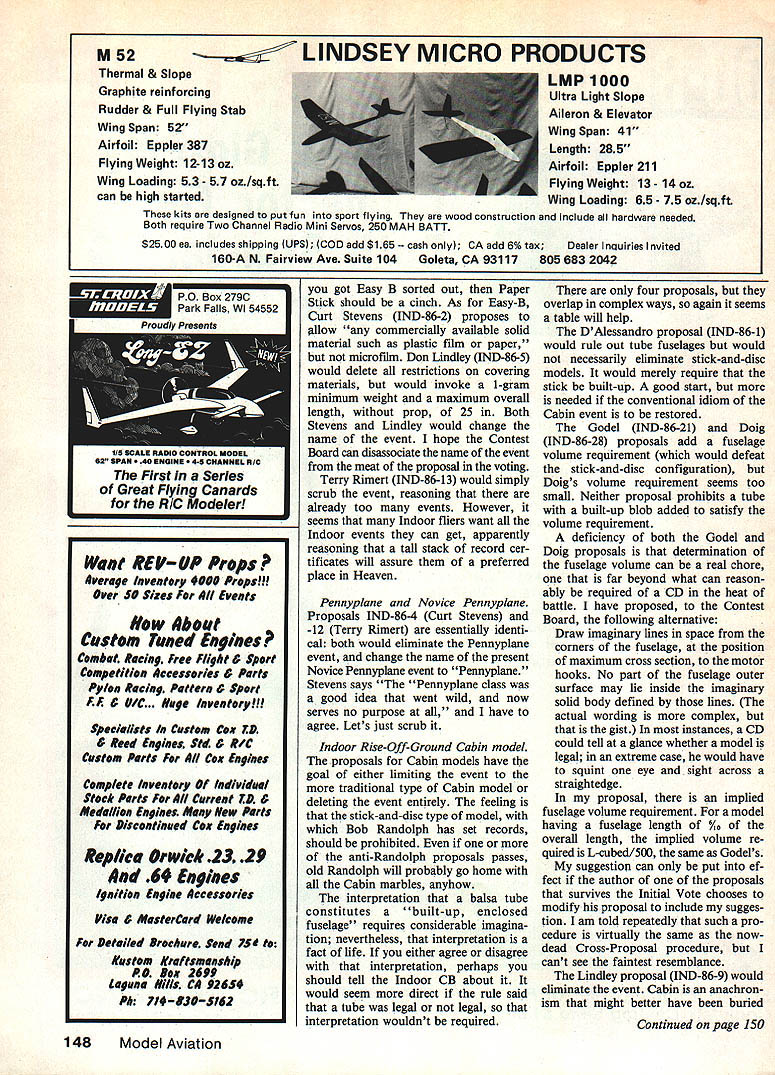
I have gone over the proposals rather carefully. Many of them are rather straightforward; you can either be for them or against them without my help. Some of them get pretty involved, however. When half a dozen proposals attempt to accomplish the same thing by affecting various features of the same section of the rule book in slightly different ways, then things get sticky. I've tried to sort some of those things out, and I present what I've come up with in the two charts.
When I comment on proposals I will mention those I consider worthy of note; others you can read and decide upon yourselves. Read the summaries of the proposals presented in the October, November and December 1984 issues of the Competition Newsletter. As Free Flighter readers will be interested in the Free Flight rules (and possibly Indoor rules), don't forget the General rules — they may be important. The comments I present are strictly my own and do not represent the position of the magazine or anyone else. Accept them, give a big ho-hum, or reject them — the choice is yours. Please, at least read the General proposals; some real earth-shaking wave-makers deserve attention.
General proposals
There are some real earth-shaking wave-makers here; pay attention or you might get some real surprises in 1986. Shaking the earth and making waves is OK, but it must be done very carefully.
Proposals by Ray Roberts (GEN-86-1) and John Thompson (GEN-86-2) would restructure our time-honored (but perhaps obsolete?) age-classification system for contestants.
Roland Boucher (GEN-86-5) proposes to establish four "displacement" classes for electric propulsion, and the CN synopsis of the proposal says these classes would "find application in AMA Power Events," which would seem to include Free Flight events. That doesn't compute. The classification of electric propulsion event sizes for Free Flight Electric Power events is spelled out under FF Electric Power, not under the General rules. So, the effect of the proposal on Free Flight Electric events seems unclear.
Free Flight proposals
I have 10 subsections here.
A-1 Towline Glider, FAI Power, and Old-Timer
A-1 Towline and FAI Power are FAI events, and we are bound by the rules established by the FAI. While the SAM Old-Timer rules appear in the AMA rule book, they do not fall within the jurisdiction of the AMA Contest Boards. Proposals relating to these events are therefore invalid and will probably be scrubbed.
New events for Juniors
Proposal FF-86-3 would replace the existing menu of events applicable to Juniors—identical to those for Senior and Open fliers—with a set of events specifically for Juniors. Look it over carefully.
Ornithopter
Recently, as a result of the burgeoning interest in Indoor Ornithopters, I asked a number of people who have been involved in the event for suggestions regarding the rules. Most of those who answered thought the present rules were far too complex and suggested a reversion to something like the old rules.
But, those old rules got us into trouble! It wasn't a fault of the rules themselves, but rather the way they were interpreted by the Contest Board. There is no way a model having a flapping propeller, which could not possibly have provided any appreciable lift, could satisfy either the intent or the letter of the old rules; nevertheless, official AMA records were set with such models. I protested at the time, but my protest fell on deaf ears.
The present rules (which I wrote) were designed to be less subject to misinterpretation. I now see a loophole in those rules, and one item of inadvertent overkill. My proposals FF-86-9 and -10, and the corresponding Indoor proposals IND-86-22 and -23, are intended to correct the situation.
Scale proposals
Proposals SC-86-22, -23, -24 and -25 apply to Indoor or Outdoor Scale; Scale buffs take note.
Indoor, General
This is the first rules-proposed cycle where we have an Indoor Contest Board; previously, Indoor proposals were handled by the Free Flight Contest Board.
Present rules for Indoor Rubber state that timing ends "when the model comes to rest on the floor," essentially, although there are things about hang-ups, delayed flights, etc., too. Two proposals address a potential and very real problem with this rule: wheels could be mounted on any class of hand-launched model, and timing would not cease until the model quit rolling along the floor, which could be a half-hour after the model "landed." The problem exists for models required to ROG, too; timing starts when the model is released, and there is no requirement for the model ever to become airborne!
Three proposals address this problem. Richard Doig (IND-86-26) proposes that "any model equipped with wheels or other landing gear... shall not be allowed to compete in events requiring hand launching." A second proposal by Doig (IND-86-27) would require an ROG model to become airborne within 15 seconds of release. Clarence Mather (IND-86-20) proposes that "Time of flight starts the instant the model is launched by hand or takes off from the floor and ends when the model touches the floor or the building or its contents."
There is a serious flaw in Doig's first proposal; there is nothing in the rules that requires a model in any class to be hand launched. Even a Hand-Launched Paper Stick model is permitted to ROG.
It seems to me that the Mather proposal takes care of the whole problem rather directly, except that "or its contents" bothers me a little. I would assume that "contents" does not include the walls, ceiling, or structural members of the building's interior. But what about drapes, flags, loudspeakers, lamps, scoreboards, banners, and the like, hanging from the ceiling? That should be clarified so that the wording requires less interpretation.
Indoor Easy B
There is no way I could keep the seven, subtly-related proposals straight in my head, so I made a table. The table presents only those features of the rules which are affected by one or more of the proposals. Sorting all of the items revealed by the table so that the voting will truly represent the feelings of the Contest Board members—Chairman Bud Tenney's job—will not be easy. Let's hope that some of the proposals will be split into sub-proposals that can be voted on separately.
Lindley (IND-86-6), Barber (IND-86-14), and Van Gorder (IND-86-24) propose minimum-weight restrictions. The Van Gorder proposal is a little unclear to me, as the addition of the minimum weight rule applies to a "provisional class." Apparently, he proposes to add a provisional Easy B class, while at the same time retaining the present Easy B event, but that isn't clear. The logic behind the other two is that modelers using light balsa and covering materials—condenser paper at their disposal—have a built-in advantage in competition. The weight rule would put everyone on a more equal footing and encourage participation.
The covering material is the subject of three proposals. Proposal IND-86-14 (Barber) would substitute "any material except microfilm" for "paper" in the present rules; IND-86-3 (Curt Stevens) would substitute "any commercially-available solid material such as paper or plastic film. Microfilm is not allowed." (Do the words "commercially-available" and "solid" make Stevens' proposal better or the same as Barber's?) There is further discussion of coverings in the proposals for Paper-Covered Hand-Launched Stick. The reasons for the proposals is that condenser paper is no longer produced; plastic films are light, easy to work with, and inexpensive.
Lindley (IND-86-6) proposes to remove all restrictions on covering materials, but if—and only if—a minimum-weight rule is passed. He reasons that if there is a weight rule, then microfilm would be of no advantage.
Paper-Covered Hand-Launched Stick
If you got Easy B sorted out, then Paper Stick should be a cinch. As for Easy-B, Curt Stevens (IND-86-2) proposes to allow "any commercially available solid material such as plastic film or paper," but not microfilm. Don Lindley (IND-86-5) would delete all restrictions on covering materials, but would invoke a 1-gram minimum weight and a maximum overall length, without prop, of 25 in. Both Stevens and Lindley would change the name of the event. I hope the Contest Board can disassociate the name of the event from the meat of the proposal in the voting.
Terry Rimert (IND-86-13) would simply scrub the event, reasoning that there are already too many events. However, it seems that many Indoor fliers want all the Indoor events they can get, apparently reasoning that a tall stack of record certificates will assure them of a preferred place in Heaven.
Pennylane and Novice Pennylane
Proposals IND-86-4 (Curt Stevens) and -12 (Terry Rimert) are essentially identical: both would eliminate the Pennylane event, and change the name of the present Novice Pennylane event. Stevens says "the 'Pennypalne' class was a good idea that went wild, and now serves no purpose at all," and I have to agree. Let's just scrub it.
Indoor Rise-Off-Ground Cabin model
The proposals for Cabin models have the goal of either limiting the event to the more traditional type of Cabin model or deleting the event entirely. The feeling is that the stick-and-disc type of model, with which Bob Randolph has set records, should be prohibited. Even if one or more of the anti-Randolph proposals passes, old Randolph will probably go home with all the Cabin medals, anyhow.
The interpretation that a balsa tube constitutes a "built-up, enclosed fuselage" requires considerable imagination; nevertheless, that interpretation is a fact of life. If you either agree or disagree with that interpretation, perhaps you should tell the Indoor CB about it. It seems more direct if the rule said that a tube was legal or not legal, so that interpretation wouldn't be required.
There are only four proposals, but they overlap in complex ways, so again it seems a table will help.
The D'Alessandro proposal (IND-86-1) would rule out tube fuselages but would not necessarily eliminate stick-and-disc models. It would merely require that the stick be built-up. The Godel (IND-86-21) and Doig (IND-86-28) proposals add a fuselage volume requirement (which would defeat the stick-and-disc configuration), but Doig's volume requirement seems too small. Neither proposal prohibits a tube with a built-up bulb added to satisfy the volume requirement.
A deficiency of both the Godel and Doig proposals is that determination of the fuselage volume can be a real chore, as far beyond what can reasonably be required of a CD in the heat of battle. I have proposed, to the Contest Board, the following alternative:
Draw imaginary lines in space from the tips of the fuselage, at the position of maximum cross section, to the motor hooks. No part of the fuselage outer surface may lie inside the imaginary solid body defined by those lines. (The actual wording is more complex, but that is the gist.) In most instances, a CD could tell at a glance whether a model is legal; in an extreme case, he would have to squint one eye and sight across a straightedge.
In my proposal, there is an implied fuselage volume requirement. For a model having a fuselage length of 1/8 of the overall length, the implied volume required is L^3/500, the same as Godel's. My suggestion can only be put into effect if the author of one of the proposals that survives the Initial Vote chooses to modify his proposal to include my suggestion. I am told repeatedly that such a procedure is virtually the same as the now-dead Cross-Proposal procedure, but I can't see the faintest resemblance.
The Lindley proposal (IND-86-9) would eliminate the event. Cabin is an anachronism that might better have been buried.
Transcribed from original scans by AI. Minor OCR errors may remain.

