
Free Flight Gypsy
A first-hand account of the competitions at the Bohemia Cup, Tabor, Czechoslovakia, and the Journée Internationale de Vol Libre (Poitou), France, from a well-traveled free-flight flier. — Bill Hartill
Overview
Free flight has long been an international sport. World Championships feature dozens of countries but limit national team spots; however, many world-class international competitions are unrestricted and attract a large following, providing spirited competition and transcendent camaraderie.
This account describes two European free-flight competitions I participated in during the past summer: the Bohemia Cup in Tabor, Czechoslovakia (held August 13–15) and the Journée Internationale de Vol Libre (commonly called "Poitou") in the Poitou region of France, held the following week.
Travel and logistics
- I began in Los Angeles and flew Air Canada to London; this was the least expensive routing I found. My model box, containing two F1C power models, was accepted as baggage after I explained its contents.
- In London I was met by my friend Roy Collins. We packed the car with batteries, starters, tools, models, food, etc. Packing was interrupted pleasantly by free-flight friends dropping by, and we stopped at Henry Nicholls' shop and the Aviation Bookshop.
- We took the Dover–Calais car ferry (about two hours). A lively group of Italian tourists made the crossing memorable.
- From Calais we drove through France and Belgium east into Germany, following the Rhine from Remagen to Frankfurt (one overnight stop), then through Nürnberg to the Czech border. The border crossing took about two hours for visas, baggage, and car papers; we made the obligatory purchase of Czech currency.
- We stayed in Pilsen and spent a few hours wandering Prague the next day before heading south to Tabor.
Bohemia Cup
Sezimovo Ústí and the site
- The competition was headquartered in Sezimovo Ústí, a planned "new town" combining industry, housing, shopping, schools, recreation, hotels, and restaurants.
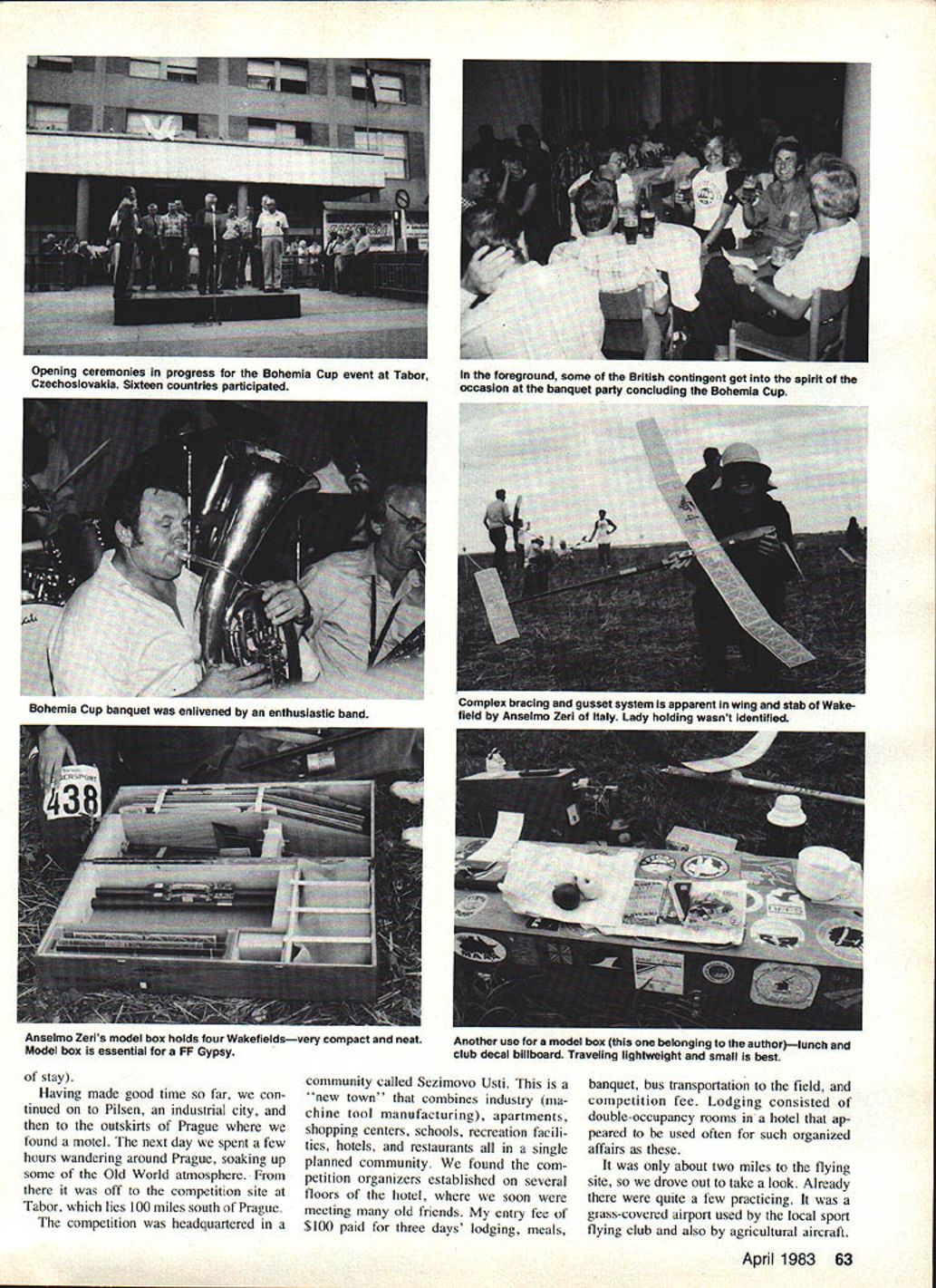
- Organizers used several floors of a hotel for meeting and lodging. The entry fee ($100) covered three days' lodging (double occupancy), meals, the banquet, bus transportation to the field, and the competition fee.
- The flying site was a grass-covered airport about two miles from the hotel, used by the local sport-flying club and agricultural aircraft. Surrounding the airfield were farm fields (corn, wheat, plowed sections) and, about a mile away, forested areas. The grass at the site was soft, dense, and about six inches deep.
Practice
- The next two days were spent practicing. Weather was generally good, though the breeze could carry models across the field in a couple of minutes.
- Retrieval could be demanding because of the long downwind walks and crops that slowed recovery. Cars or bikes were not permitted for retrieval. Several Czech "helpers" assisted competitors by finding models in wheat and forest and returning them to the flight line.
Competition format
- Events: F1A (Nordic glider), F1B (Wakefield), and F1C (Power).
- Rounds: 1 hour 10 minutes per round, with 5-minute breaks between rounds and a 50-minute lunch break.
- Pole positions were set up; seven competitors shared one set of timers.
Entrants and conditions
- Competitors came from 16 countries: Czechoslovakia, Poland, Sweden, East Germany, West Germany, Holland, Canada, U.S.A., Italy, France, North Korea, England, Austria, New Zealand, Romania, and the Soviet Union.
- North Korea fielded a full, disciplined team, drawing attention.
- Saturday dawned dull and overcast with light rain early on; the rain passed but conditions remained gray and breezy. Lift was often hard to find and sink could come unexpectedly.
F1A (Nordic) — 90 entrants
- Lift was difficult in the first round; only about one-third of fliers recorded a max. Many flights were 160–177 seconds, with some that started well ending in sink near the ground.
- Two Czech fliers recorded a string of seven maxes.
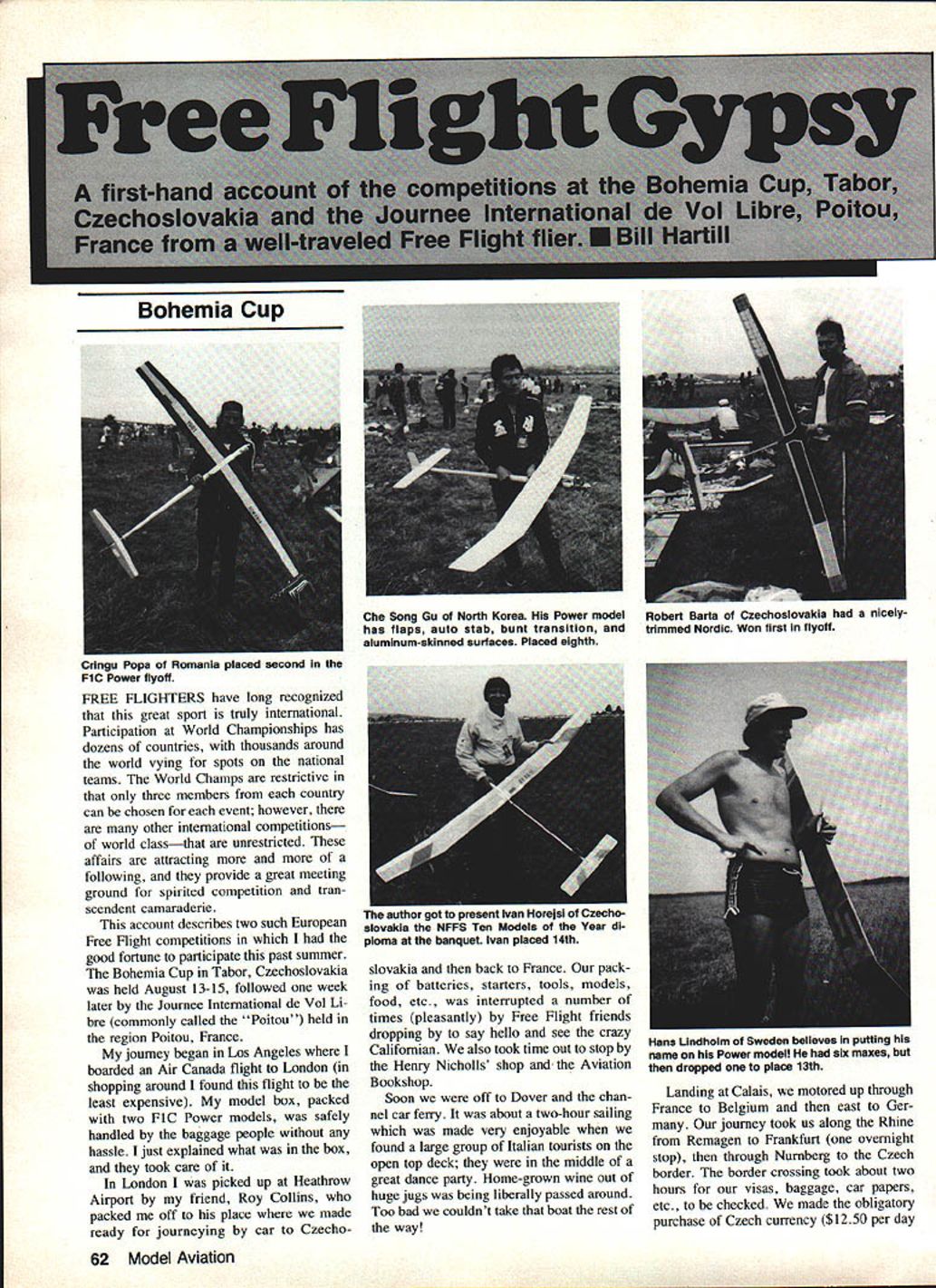
- Flyoff: Robert Barta won with 125 seconds; Zdenek Jancar was second with 77 seconds; Pavel Dvorak placed third, having dropped 3 seconds in both flyoff rounds.
- Notable: Ivan Horejsi (recipient of the NFFS/FIA Model of the Year Award for 1982) placed 14th. England's Mike Fantham, a star entrant, dropped 111 seconds in the fifth round and finished 16th.
F1B (Wakefield) — 39 entries from 10 countries
- Air picking was not easy with three categories flown together, but the North Koreans had some successful technique. Their team manager was Paik Chang Sun, Wakefield champion of 1975.
- The Korean models resembled previous designs and had characteristics similar to Russian Wakefields, though they were not using feathering props.
- Results: Winner Kim Jeng Sok (all maxes); second Kim Dong Sik (dropped 51 seconds in round three; Wakefield World Champ 1977). Czech Jiri Libra placed third. North Korean Li Zun Ban placed 13th.
F1C (Power) — 36 entries, 12 countries
- I flew this event and can provide more detail on conditions. The first two rounds were relatively poor: thermals weak, turbulence upsetting glide trim, though some fliers (including North Koreans and Swedes) maxed out.
- Thermals and breeze strengthened starting with round three, making retrieval more difficult and walks downwind long.
- I had a notable retrieval: in the fifth round I hooked a good thermal and watched my model DT from good height at 3:18. From a distance it looked like it went into bushes; after walking downwind I found it lodged in a tall pine tree in a deep ravine, about 75 feet up with no limbs to climb on. Several Czech helpers and I waited; a miniature whirlwind shook the tree and the model flipped out, crashing to earth. It sustained a broken wing, stab, and tail boom but was salvageable, so I returned to the flight line with a reserve model.
- Final rounds often presented poor air. In the last rounds I hooked a good boomer but followed it down into trees; retrieval was again difficult.
- Flyoff: Five made the flyoff. Only Ken Faux (Great Britain) managed a 4-minute mark in the flyoff using a new American-built Nelson .15 glow. Cringu Popa (Romania) placed second; Vladimir Hájek (Czechoslovakia) third. Kang Zung Sik (North Korea) flew an aluminum-covered model with full-span deep-chord flaps on a polyhedral wing and finished fifth after a poor climb pattern in the flyoff.
- Prize-giving and banquet: Held at the hotel with a brass band and three singers. I presented the NFFS "Ten Models" diploma to Ivan Horejsi. Storytelling in many languages continued into the night.
Aftermath and departure
- The next day I retraced my route through the forest looking for my lost model; others were finding treed models and even sawed down some trees to recover models. Pilot members of the Tabor Flying Club conducted an aerial search and spotted several models but dense cover prevented immediate recovery.
- We packed and headed for the Czech border amid rain, thunder, and lightning. Border guards were young soldiers who proved friendly after checks and a look through the model boxes.
- We found lodging in a small German town; though the restaurant was closed, the owner served cold meats, cheese, potato salad, and pickles — complemented by great beer.
- Our route west took us through Munich, Ulm, Stuttgart, and the Black Forest (another night stop). Hotel rooms in small European towns averaged about $25 (double occupancy); dinner was $5–$7 each.
Poitou (Journée Internationale de Vol Libre)
Arrival and accommodations
- We crossed into France at Strasbourg and stopped at the Hotel Cheval Gris at Pleurs, a familiar spot from the Pierre Trébod contest (last held 1981).
- We met English competitors Martin Dilly, Mike Fantham, Martin Gregory, and Ken Faux. I repaired my tree-broken model at Cheval Gris to have something for Poitou.
- The Poitou contest was organized from a campsite in the village of Moncontour. Swimming and boating were available; the village provided a banquet hall.
- We stayed at the Hotel Swan in Airvault (a few miles away). My bill for four days (room, breakfast, dinner, and wine) was $53. The food and hospitality were excellent.
The site
- The flying area is the Plaine de Noizé, a great plain said to be part of an ancient sea bed, with many fossilized trochoids visible in stone. The field was grassy with short stubble; the chase area was plentiful with few trees and only occasional crops.
F1A Nordic Glider — Friday (104 entries)
- Round schedules and timer allocations were similar to the Czech contest. Weather was generally good with some breeze, but the ample site minimized its effect.
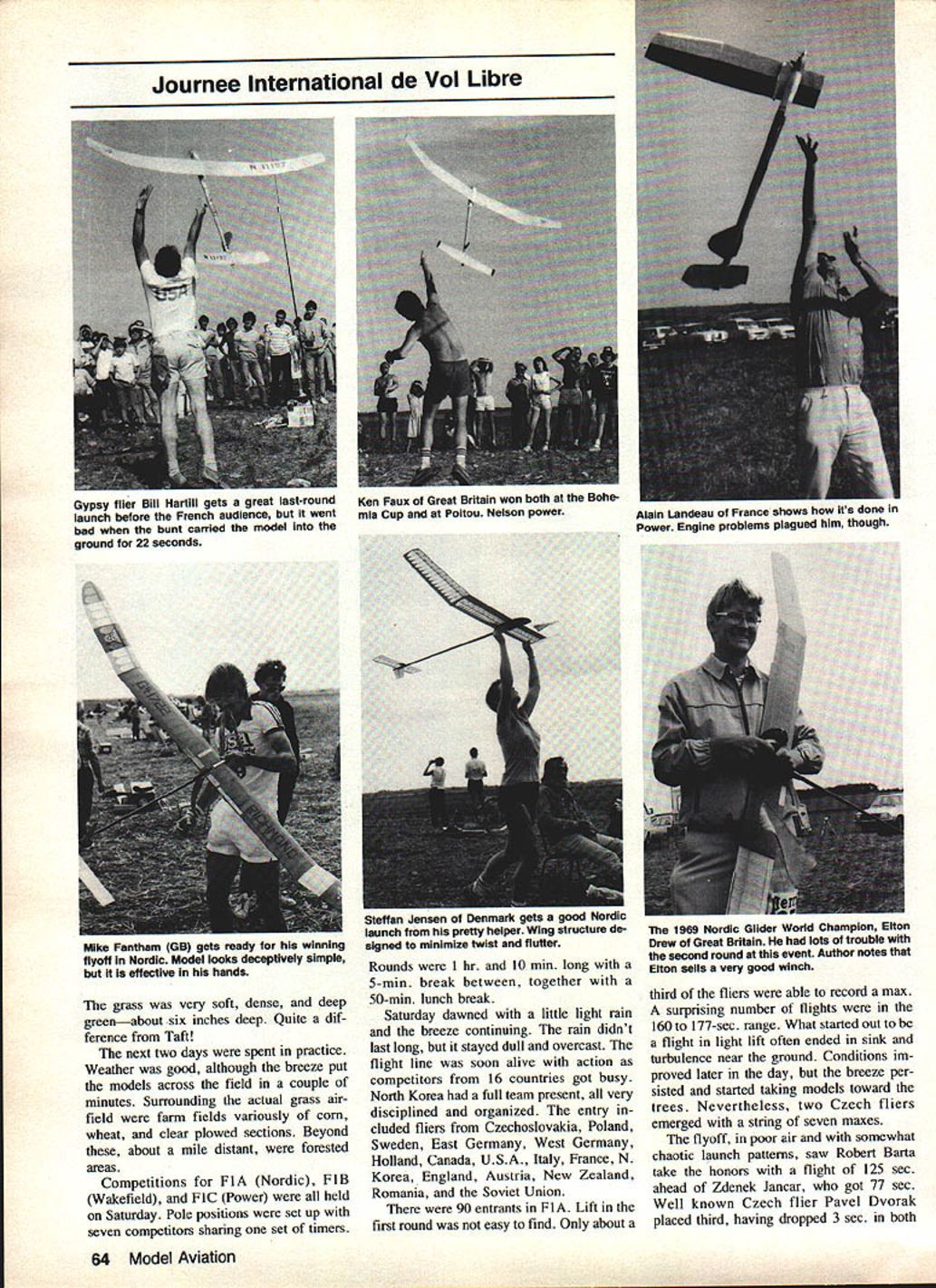
- The first round was the most troublesome. Only two fliers maxed all seven rounds: Mike Fantham (Great Britain) and Martin Gregory (New Zealand, now living in England).
- In the 4-minute round both went off in strong lift. In round five Mike found another boomer while Martin suffered terrible air and a 72-second flight.
- Results: 1st Mike Fantham; 2nd Martin Gregory; 3rd J. Lareau (France); 4th Willi Kamp (Austria); 5th Finn Bjerre (Denmark).
- Top Nordic designs tended to be relatively simple, without elaborate tricks.
F1B Wakefield — 52 entries from eight countries
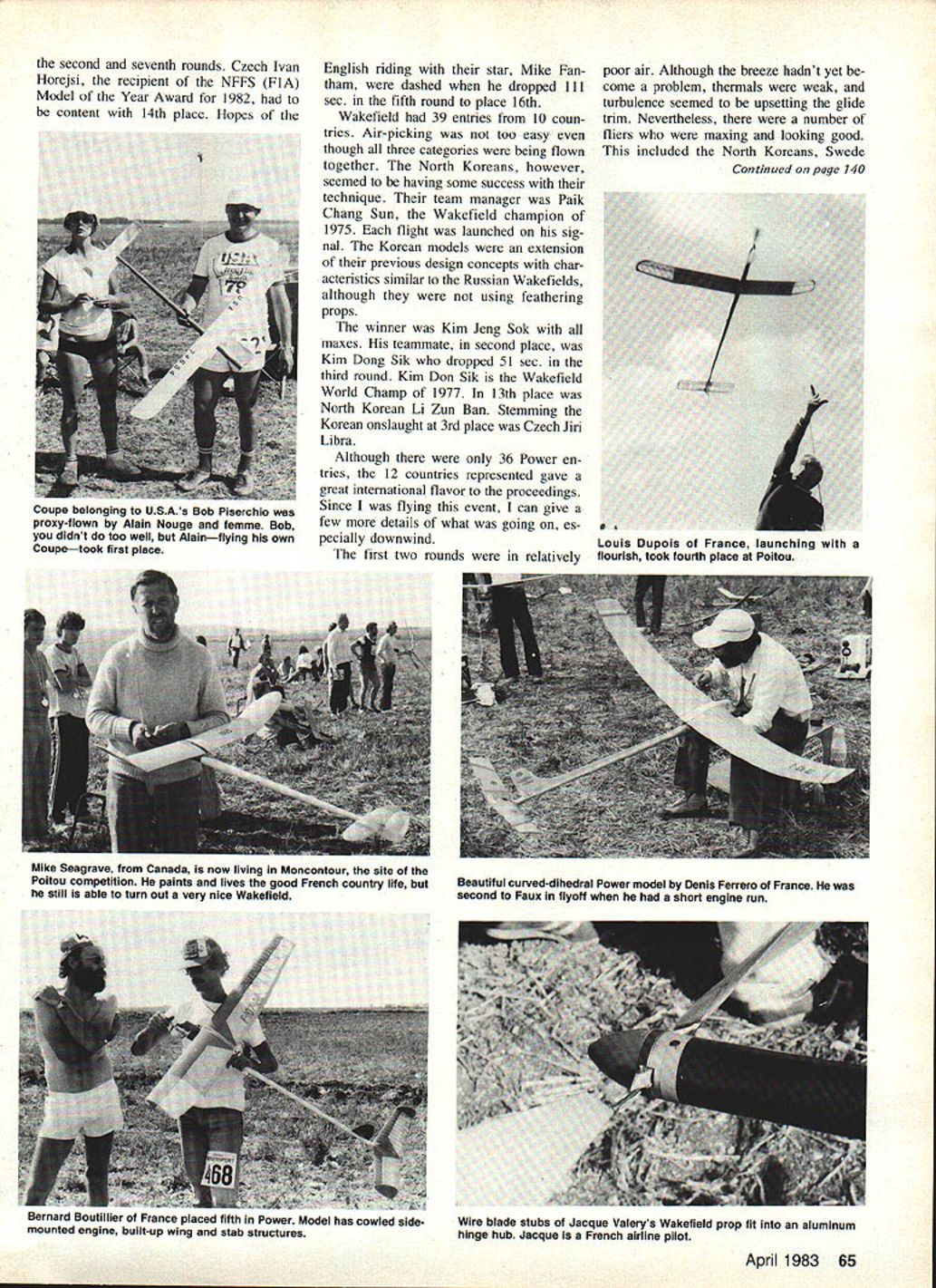
- Mike Seagrave (Canada), who had bicycled from England to Spain for the World Champs the year before, was present and staying in Moncontour as an artist.
- The Wakefield competition tightened late: only one flier, Gérald Nogue (France), had all maxes. Joe Barnes (Great Britain) dropped 1 second in round one but maxed in the last round, pressuring Nogue. Anselmo Zeri (Italy, working in Holland) had been the 1981 Wakefield winner at Poitou but dropped 16 seconds in round six. Louis Dupuis (France) also dropped time in round six.
- Finals: Gérald Nogue took first (all maxes); Joe Barnes finished strongly but was behind; Dupuis and Zeri placed among the top.
F1G Coupe d'Hiver and F1C Power — Sunday
- Coupe (F1G): 32 entrants versus 13 Power fliers. The French domination of Coupe continued; Alain Nogue flew Bob Piserchio's Coupe by proxy and maxed out. Alain then bested Louis Dupuis (2nd) and G. Ambrogo (3rd) in an all-French flyoff.
- Power (F1C): My repaired model initially performed very well. Carelessness in round four cost me 29 seconds by picking poor air. Denis Ferrero (France) and Ken Faux both maxed and entered the flyoff.
- Flyoff: Denis and Ken launched together in the first flyoff round and both hit the 4-minute mark. In the next round Ken launched quickly; Denis launched minutes later but suffered a very short run (about 60 seconds). Ken Faux won his second consecutive Nelson-engined power event at Poitou.
- In the final round with French spectators watching, my model climbed nicely but the bunt stayed on after the engine stopped and the ship hit the ground in 22 seconds — a disappointing finish but part of the sport.
Banquet and return
- The banquet and general festivities that night matched the great traditions of the sport.
- A few days later I returned to California for team selection finals. The Free Flight Gypsy was off to the next round.
Transcribed from original scans by AI. Minor OCR errors may remain.

