
Free Flight: Indoor
Bud Tenny
THIS IS A NEW column in a new magazine, so if we team up, we can make it something to benefit us all. My name is Bud Tenny, and my address is P.O. Box 545, Richardson, TX 75080. The topic is Indoor modeling; with your help and feedback, we can cover the whole field. Indoor modeling covers many different types of models—almost literally, there is something for everyone.
The "classic" Indoor model is the superlight endurance design, which is described by the AMA Rule Book under the heading Hand-Launched Stick Model. The wing area must not exceed 300 sq. in. There is no limit on how light the model may be built except the skill and perseverance of the builder. The flight of a maximum-area Indoor job is perhaps the most graceful and beautiful of any kind of model flight.
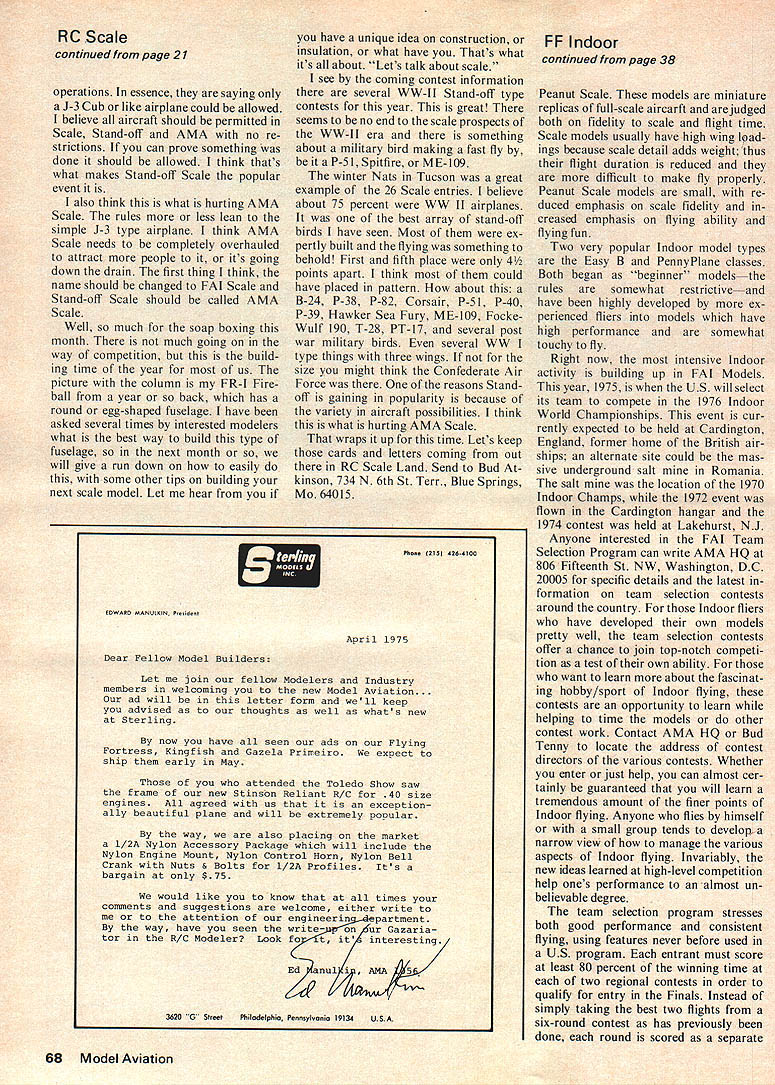
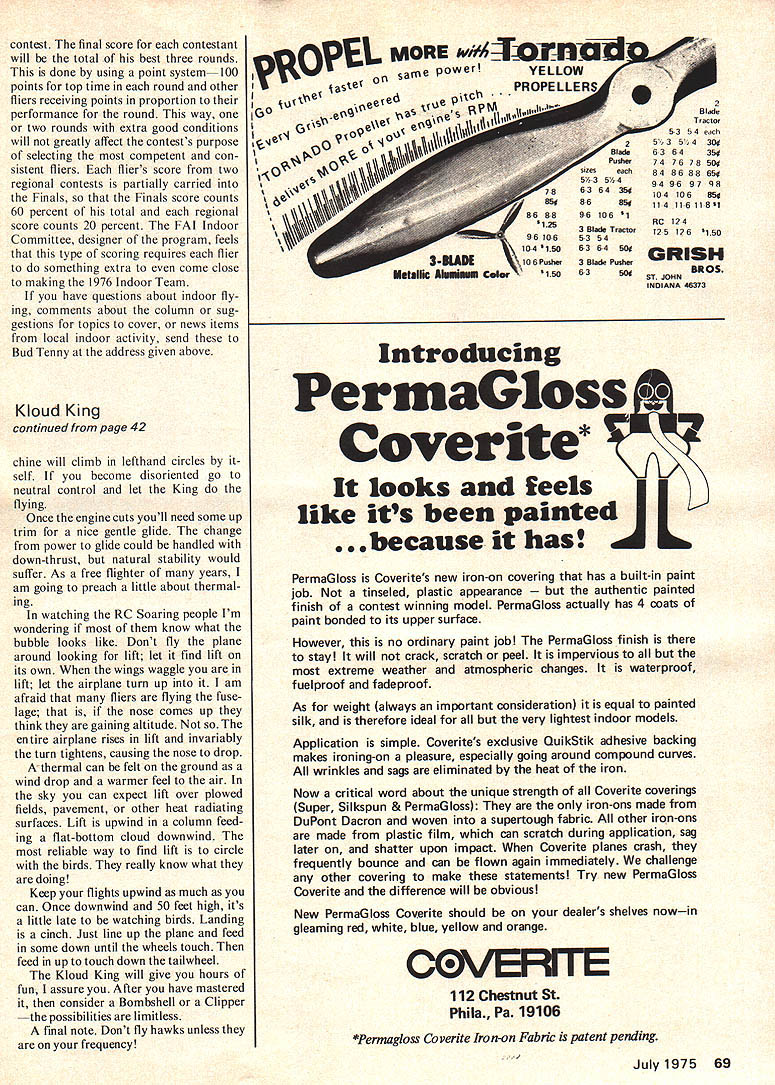
Other classes of Indoor Stick models are specified in the Rule Book. The Rise-Off-Ground Stick model is limited to 30 sq. in. of wing area and must have functional take-off gear. The Paper-Covered Stick Model is hand-launched like the Indoor Stick model, but must be covered with paper. The international class model, FAI Indoor Model, greatly resembles the Indoor Stick model except that the FAI model is limited to 65-cm wing span, and it must weigh at least one gram. Because the weight requirement and span limit tend to create a model with higher wing loading and (theoretically) lower performance, designers make wider wings to get more wing area.
The Rise-Off-Ground Cabin Model is supposed to have a built-up fuselage which encloses the rubber motor and simulates a man-carrying aircraft. The addition of a built-up fuselage and take-off gear adds weight and drag so that the Cabin model performance suffers in comparison to Stick models. The Cabin model is one of the original indoor classes, and unlike Stick models is dying out. The reason is probably related to both the difficulty of building a light model that is strong enough, and to the fact that almost no contests except the Nats offer a chance to fly Cabin models in competition. With no competition to stimulate development, most indoor fliers just don't bother with Cabin models.
Three other classes of indoor models are also scarce: Helicopter, Ornithopter and Autogyro. Few chances for competition exist for these models, and they hang on by virtue of their unique characteristics. The Helicopter and Autogyro present special problems in aerodynamics and dynamic stability; the Ornithopter poses tremendous problems in creating lightweight and strong mechanisms to make the flapping wings functional and efficient. Only persistent fliers who enjoy a challenge fly these classes, competing against National Records.
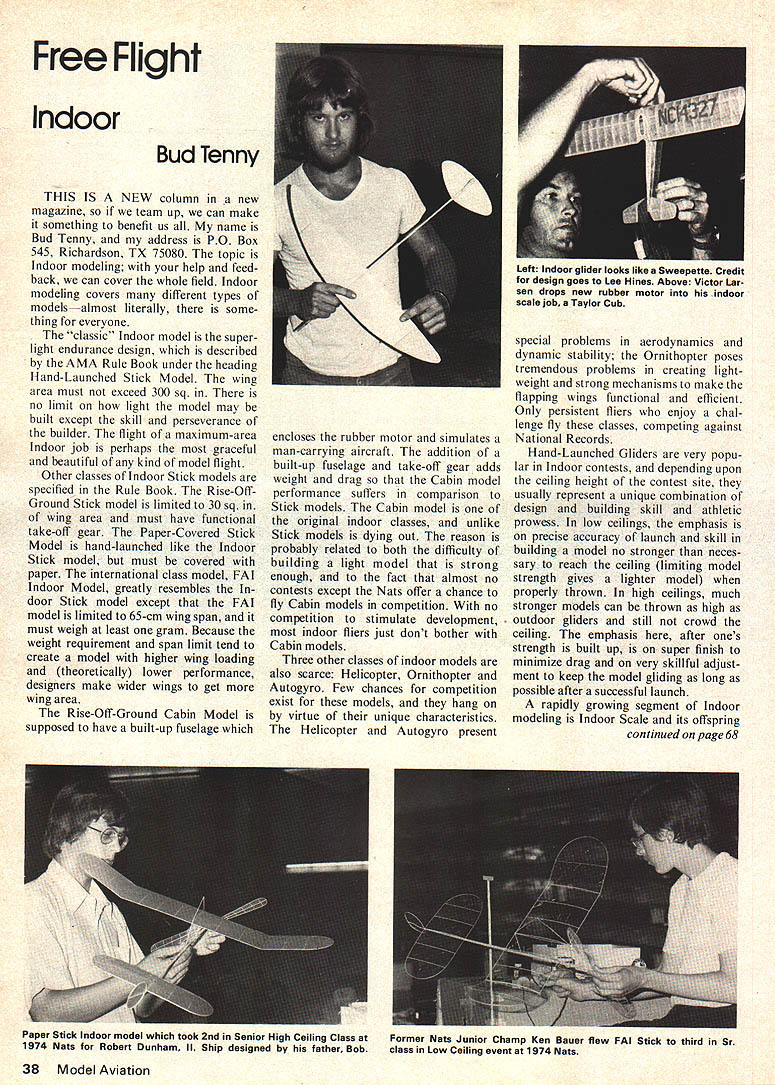
Hand-Launched Gliders are very popular in Indoor contests, and depending upon the ceiling height of the contest site, they usually represent a unique combination of design, building skill and athletic prowess. In low ceilings the emphasis is on precise accuracy of launch and skill in building a model no stronger than necessary to reach a ceiling (limiting model strength gives a lighter model) when properly thrown. In high ceilings, much stronger models can be thrown as high as outdoor gliders and still not crowd the ceiling. The emphasis here, after one's strength is built up, is on super finish to minimize drag and on very skillful adjustment to keep the model gliding as long as possible after a successful launch.
A rapidly growing segment of Indoor modeling is Indoor Scale and its offspring Peanut Scale: These models are miniature replicas of full-scale aircraft and are judged both on fidelity to scale and flight time. Scale models usually have high wing loadings because scale detail adds weight; thus their flight duration is reduced and they are more difficult to make fly properly. Peanut Scale models are small, with reduced emphasis on scale fidelity and increased emphasis on flying ability and flying fun.
Two very popular Indoor model types are the Easy B and PennyPlane classes. Right now, the most intensive Indoor activity is building up in FAI Models. This year, 1975, is when the U.S. will select its team to compete in the 1976 Indoor World Championships. This event is currently expected to be held at Cardington, England, former home of the British airships; an alternate site could be the massive underground salt mine in Romania. The last time the Indoor Champs were flown in the Cardington hangar was the 1972 event and the 1974 contest was held at Lakehurst, N.J.
Anyone interested in the FAI Team Selection Program can write AMA HQ at 806 Fifteenth St. NW, Washington, D.C. 20005 for specific details and the latest information on team selection contests around the country. For those Indoor fliers who have developed their own models pretty well, the team selection contests offer a chance to join top-notch competition as a test of their own ability. For those who want to learn more about the fascinating hobby/sport of Indoor flying, these contests are an opportunity to learn while helping to time the models or do other contest work. Contact AMA HQ or Bud Tenny to locate the address of contest directors of the various contests. Whether you enter or just help, you can almost certainly be guaranteed that you will learn a tremendous amount of the finer points of Indoor flying. Anyone who flies by himself or with a small group gains the added experience of how to manage the various aspects of Indoor flying. Invariably the new ideas learned at high-level competition help one's performance to an almost unbelievable degree.
The team selection program stresses both good performance and consistent flying, using features never before used in a U.S. program. Each entrant must score at least 80 percent of the winning time at each of two regional contests in order to qualify for entry in the Finals. Instead of simply taking the best two flights from a six-round contest as has previously been done, each round is scored as a separate contest. The final score for each contestant will be the total of his best three rounds. This is done by using a point system—100 points for top time in each round and other fliers receiving points in proportion to their performance for the round. This way, one or two rounds with extra good conditions will not greatly affect the contest's purpose of selecting the most competent and consistent fliers. Each flier's score from two regional contests is partially carried into the Finals, so that the Finals score counts 60 percent of his total and each regional score counts 20 percent. The FAI Indoor Committee, designer of the program, feels that this type of scoring requires each flier to do something extra to even come close to making the 1976 Indoor Team.
If you have questions about indoor flying, comments about the column or suggestions for topics to cover, or news items from local indoor activity, send these to Bud Tenny at the address given above.
Transcribed from original scans by AI. Minor OCR errors may remain.

