
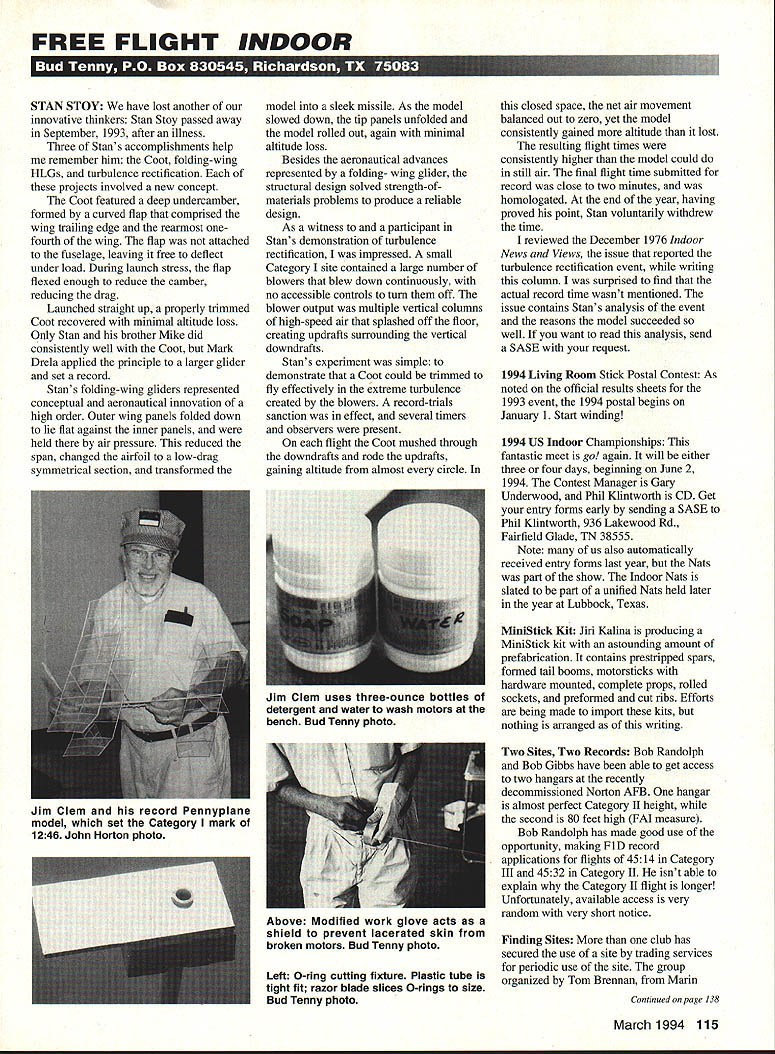

FREE FLIGHT INDOOR
Bud Tenny, P.O. Box 830545, Richardson, TX 75083
STAN STOY
We have lost another of our innovative thinkers: Stan Stoy passed away in September 1993 after an illness.
Three of Stan's accomplishments help remember him: the Coot, folding-wing HLGs, and turbulence rectification. Each of these projects involved a new concept.
The Coot featured a deep undercamber formed by a curved flap that comprised the wing trailing edge and the rearmost one-fourth of the wing. The flap was not attached to the fuselage, leaving it free to deflect under load. During launch stress the flap flexed enough to reduce the camber, reducing the drag.
Launched straight up, a properly trimmed Coot recovered with minimal altitude loss. Only Stan and his brother Mike did consistently well with the Coot, but Mark Drela applied the principle to a larger glider and set a record.
Stan's folding-wing gliders represented conceptual and aeronautical innovation of a high order. Outer wing panels folded down to lie flat against the inner panels and were held there by air pressure. This reduced the span, changed the airfoil to a low-drag symmetrical section, and transformed the model into a sleek missile. As the model slowed down, the tip panels unfolded and the model rolled out, again with minimal altitude loss.
Besides the aeronautical advances represented by a folding-wing glider, the structural design solved strength-of-materials problems to produce a reliable design.
As a witness to and a participant in Stan's demonstration of turbulence rectification, I was impressed. A small Category I site contained a large number of blowers that blew down continuously, with no accessible controls to turn them off. The blower output was multiple vertical columns of high-speed air that splashed off the floor, creating updrafts surrounding the vertical downdrafts.
Stan's experiment was simple: to demonstrate that a Coot could be trimmed to fly effectively in the extreme turbulence created by the blowers. A record-trials sanction was in effect, and several timers and observers were present.
On each flight the Coot mushed through the downdrafts and rode the updrafts, gaining altitude from almost every circle. In this closed space, the net air movement balanced out to zero, yet the model consistently gained more altitude than it lost. The resulting flight times were consistently higher than the model could do in still air. The final flight time submitted for record was close to two minutes and was homologated. At the end of the year, having proved his point, Stan voluntarily withdrew the time.
I reviewed the December 1976 Indoor News and Views, the issue that reported the turbulence rectification event, while writing this column. I was surprised to find that the actual record time wasn't mentioned. The issue contains Stan's analysis of the event and the reasons the model succeeded so well. If you want to read this analysis, send a SASE with your request.
1994 Living Room Stick Postal Contest
As noted on the official results sheets for the 1993 event, the 1994 postal begins January 1. Start winding!
1994 US Indoor Championships
This fantastic meet is go! again. It will be either three or four days, beginning on June 2, 1994. The Contest Manager is Gary Underwood, and Phil Klintworth is CD. Get entry forms early by sending a SASE to Phil Klintworth, 936 Lakewood Rd., Fairfield Glade, TN 38555.
Note: many of us also automatically received entry forms last year, but the Nats was part of the show. The Indoor Nats is slated to be part of a unified Nats held later in the year at Lubbock, Texas.
MiniStick Kit
Jiri Kalina is producing a MiniStick kit with an astounding amount of prefabrication. It contains pre-stripped spars, formed tail booms, motor sticks with hardware mounted, complete props, rolled sockets, and preformed and cut ribs. Efforts are being made to import these kits, but nothing is arranged as of this writing.
Two Sites, Two Records
Bob Randolph and Bob Gibbs have been able to get access to two hangars at the recently decommissioned Norton AFB. One hangar is almost perfect (Category II height), while the second is 80 feet high (FAI measure). Bob Randolph has made good use of the opportunity, making F1D record applications for flights of 45:14 in Category III and 45:32 in Category II. He isn't able to explain why the Category II flight is longer! Unfortunately, available access is very random with very short notice.
Finding Sites
More than one club has secured the use of a site by trading services for periodic use of the site. The group organized by Tom Brennan, from Marin County, California, organized classes for students in exchange for monthly use.
Free Flight Indoor
Flying opportunities: The session series listed below are carried over from the listing in the previous column. CDs with events beginning in April 1994 send schedules ASAP! Refer to previous columns for listings of site contact-persons.
- California — Burbank. The Black Sheep Exhibition Squadron (VMF-214) has monthly sessions on second Fridays; flying in Category I site at Luther Burbank Middle School; 7–10 p.m. Tony Naccarato, 2121 N. Hollywood Way, Burbank CA 91507; Tel.: (818) 842-5062.
- California — Los Angeles area. Monthly sessions at the Naval & Marine Corps Armory, next to Dodger Stadium. Paul Avery, 6360 Germania Ct., Agoura Hills CA 91301; Tel.: (818) 707-0282.
- California — Marin County (20 miles north of San Francisco). Year-round mini-contests, 8 a.m.–2 p.m., fourth Sunday each month. The site is a standard basketball court with 28 feet clear. Contact Tom Brennan, 21326 Via Colombard, Sonoma CA 95476; Tel.: (707) 938-2893.
- California — San Diego. Fun-Fly and Scale sessions 2nd Friday each month; monthly sessions on fourth Friday, all in Colina Del Sol Community Center (Category I), 5316 Orange Ave., San Diego. Howard Haupt, 3860 Ecochee Ave., San Diego CA 92117; Tel.: (619) 272-5656.
- Canada — Ontario area. Dan O'Grady, 50 Largo Crescent, Nepean, Ontario, Canada K2G 3C7. Indoor flying at Woodroffe High School in Ottawa on Mondays, 7 p.m. to 10 p.m.: January 31; February 7, 14, 21, and 28; April 11, 18, and 25; May 2, 9, 16, and 30, 1994.
- Colorado — Denver. Several 1994 sessions planned. Contact Les Shaw, 995 McIntire St., Boulder CO 80303; Tel.: (303) 499-0946.
- Connecticut — Glastonbury. Sunday sessions: January 9, February 6, March 13, April 3, May 1, 1994. Contact George Armstead, 89 Harvest Lane, Glastonbury CT 06033; Tel.: (203) 633-7836 for details.
- Florida — Miami. Monthly meets sponsored by Miami Indoor Airplane Modelers Association. Delta Airlines Maintenance Hangar, Tampa, Florida: February 12–13; March 19–20; April 16–17; May 14–15, 1994. Contact Dr. John Martin, 2180 Tiger Tail Ave., Miami FL 33133; Tel.: (305) 858-6363.
- Iowa — Cedar Rapids. Regularly scheduled unsanctioned flying sessions through March 1994; 28-foot ceiling. Paul Millcrath, 1524 48th St. NE, Cedar Rapids IA 52402; Tel.: (319) 393-4677.
- Kansas — Wichita. Session at Friends University (28-foot site), 12–6 p.m. Planned for the first weekend each month, subject to approval, January 1994 through March 1994. Normal schedule: heavy events 12–2 p.m.; lightweight events 2–6 p.m. Contact Stan Chilton, 725 E. Lincoln, Wichita KS 67211-3302; Tel.: (316) 686-9634.
- Kentucky — Louisville. Flying sessions every Tuesday at the Sawyer Park site, 11 a.m.–1 p.m. Also, one Saturday each month (subject to military schedules) at the Kentucky Air National Guard site 10 a.m.–2 p.m. Contact Mason Plank, 3207 Oriole Dr., Louisville KY 40213; Tel.: (502) 634-8191.
- New York — Brooklyn. Indoor contests in March and April 1994 at the "Blue Nose" Hangar at Floyd Bennett Field, Brooklyn. Site has 150 x 450-foot floor and 45 feet to rafters (field uses beam, easy retrieval). Contact Don Ross, 38 Churchill Rd., Cresskill NJ 07626; Tel.: (201) 568-5272.
- Ohio — Cleveland area. Weekly sessions year-round in Category I sites. One site is in Willoughby at the Andrews School and has a 20-foot flat ceiling with 60 x 80-foot floor area. The other site is at Meridian Euclid Hospital in Euclid and has a 19.5-foot ceiling and 45 x 70-foot floor area. Contact Vern Hacker, 25599 Breckinridge Dr., Euclid OH 44117-1807; Tel.: (216) 486-4990.
- Oklahoma — Oklahoma City. 1994 mini-contests at the National Guard Armory: January 9 (Easy B and No-Cal); February 6 (MiniStick and No-Cal); Annual contest March 6, 1994. Jim Belson, 4933 NW 29th, Oklahoma City OK 73129; Tel.: (405) 946-1093.
- Oklahoma — Tulsa. Indoor sessions January 14, February 12, and contest March 12, 1994. Roy O'Mara, 9120 E. 7th St., Tulsa OK 74112; Tel.: (918) 815-1424.
- Pennsylvania — Philadelphia. Flying at Bryn Athyn and Fairmont Park. Joe Kunsh, 409 Warner Rd., Wayne PA 19087; Tel.: (215) 688-3027.
- Washington — Seattle area. Flying sessions at the Boeing Everett Recreation Center, January 22, March 19, and May 21, 1994. Sessions at the Naval Air Reserve Center February 26 and April 16, 1994. For Everett Rec Center events, contact Keith Varnau at (206) 342-9218. For Reserve Center, contact Gene Stubbs, (206) 237-6419.
- Wisconsin — Racine. Bong Eagles contest March 13, 1994 at the Memorial Hall in Racine, Wisconsin. Tony Italiano, 1655 Revere Dr., Brookfield WI 53005; Tel.: (414) 782-6256.
Variable-Geometry Props
Many low-ceiling records are much higher than they used to be. One reason is that variable-geometry props are much more common, and not just on F1D models.
One photo shows Jim Clem and his Pennyplane model that holds the Category I record at 12:46. Jim's model uses a variable-pitch prop; other variable-geometry props vary diameter instead of pitch. How do they work? Variable-geometry props operate on the concept of stowing the climb rate until the burst is gone, then changing geometry to a higher thrust that increases enough to start a new climb. The concept is illustrated in this discourse (part of the dossier required as part of FAI documentation for Bob Randolph's 45:32 Cat. II record):
"The model was released inches from the floor. It climbed very slowly but steadily to about 40 feet of altitude. 18 minutes into the flight it was down to 35 feet with the prop moved to lower pitch. It started another slow climb, peaking at about 44 feet. The model finally settled to the floor at 45:32. The turns remaining were counted, and average rpm was 45.7."
This narrative is starkly different from the normal flight pattern of an indoor model. Regardless of the initial rate of climb, models with fixed props gain all their altitude at the start of the flight. Typical high-duration low-ceiling flights by models with fixed props consist of a long period of ceiling scrubbing or a rotary-banging. The last part of the flight is the descent, with a sink rate slightly higher than with a variable prop.
The difference is that the fixed prop requires a certain level of torque to maintain a steady descent. At the same stage of flight, the variable prop is running with lower pitch (variable pitch) or reduced diameter and pitch (variable diameter). The smaller prop requires much less torque for the same rate of sink, which allows much more total energy to be used from the motor. That is the most compelling reason for using variable-geometry propellers—to extract the maximum amount of energy from the motor.
Tracking Pitch Variations
Refer to the chart and Figure 3 in the January 1994 column to gain perspective on exactly how the pitch varies along the length of a prop blade as the prop changes geometry. From the chart of blade pitch you can see that an unmodified prop approaches 90° at zero radius. When the blade is rotated to a higher angle, the resulting angle at the prop centerline will become greater than 90°—clearly undesirable.
The implication is that blades for a variable-pitch prop should be built on a block with pitch equal to the highest pitch the prop will assume. Then, when the prop rotates to low pitch, the blade hub and tip are washed out (lower angle than equivalent helical pitch). This pitch distribution can probably reduce the required blade angle change needed for effective energy extraction. A similar analysis can be made for variable-diameter props. The major difference is that, from the mathematical analysis in the chart, the retracted blade reduces in pitch from the tip all the way to the hub. Instead of the center of the blade doing most of the pulling, the tips are the most heavily loaded on the variable-diameter prop.
Keep Motors Clean!
A photo shows Jim Clem's solution to keeping motors clean under difficult conditions: two three-ounce bottles, one filled with a mild detergent solution and the other with water. After wiping a motor down to remove some lube and dirt, Jim puts the motor into the detergent and shakes the bottle vigorously. After similar treatment in the bottle of water, the motor is ready to be lubricated and used again.
No Ouch!
Like anyone who winds motors (if you don't break motors, you aren't winding them enough!), one of the photos shows how he modifies a heavy work glove into a shield to save his skin.
Making O-rings
Another photo shows my fixture that eases O-ring cutting. It consists of a wooden block with an aluminum faceplate. The block and faceplate are drilled to a snug fit for the plastic tube used as source material. The strongest O-rings I've tried are cut from plastic push-up handles or similar tubing found in convenience stores.
The fixture is used this way: I push the tubing through the faceplate just enough to allow a thin ring to be cut. Next, enough tube is pushed through to make an O-ring of the desired thickness. Single-edge razor blades, pressed flat against the faceplate, are used to make the cut. I cut partway through from opposite sides to form O-rings with parallel sides.
Transcribed from original scans by AI. Minor OCR errors may remain.

