
FREE FLIGHT: INDOOR
INDOOR NATS SITE — Abram Van Dover, Category Manager
If you plan to fly Indoor at the 1994 Nats in Lubbock, here's an overview of the site: Lubbock Municipal Coliseum. Available floor space is 105 x 210 feet in an oval shape. From the middle of the floor you look up at a scoreboard directly overhead. The scoreboard is cube-shaped, about 10 feet high and 12 feet square; it will be covered with polyfilm to make it as model-proof as possible. The scoreboard is too large to remove from the building without dismantling it.
On the north side of the scoreboard is a cluster of speakers that is not removable. These will also be covered with polyfilm to help models bounce off them.
The top of the Coliseum is an inverted bowl. This configuration can cause high drift, but drift will be kept to about zero because we will have control of the air conditioning and lighting. Chairs and tables will be available at no cost.
Coliseum management does not want participants climbing on the catwalks or up the walls. Maintenance personnel will retrieve hung-up models on the catwalk or in areas close to it. Long poles and/or balloons should retrieve most models stuck along the walls.
Check the pros and cons, make your choice, and we hope to see you in Lubbock in 1994.
---
Randolph's Rampage
Following up on his record flights in Cat. II and Cat. III hangars at Norton AFB (March 1994 column), Bob gained access to the hangar at Santa Ana USMHAS. In flights two weeks apart, Bob logged 53:48 and 55:06 with world-record sanctions in force.
Obviously, his next target has to be Cat. I. (Editor's note: After this column was written, word was received that Bob also broke the Cat. I record with a flight of 36:40 on January 9, 1994.)
All flights were made with VP props despite the conventional wisdom that VP props are useful only for low-ceiling sites.
---
Gibbs' Models
Bob Gibbs placed fourth at the Team Selection Finals using English-style unbraced models. Details of wood sizes he used and additional comments:
- Wing spars — 65# wood, .095 x .034 tapered to .032 x .034.
- Stab spars — 50# wood, .075 x .031 tapered to .025 x .031.
- Tailboom — rolled fishing-rod section tapered .225" diameter to .125" diameter, 15.5 inches long.
- Motor stick — rolled .25" diameter form, 16 inches long.
Stick construction is conventional but wing posts are part of the stick. 0.2-inch wing sockets are glued to the wing leading edge and trailing edge at the center rib. Wing posts also hold tungsten braces — one .0015" diameter wire or two .001" diameter wires. Motor sticks can be lighter because Bob never uses over 30 inch-ounces of torque.
Part of Bob's reason for working with unbraced models is storage and transportation. Bob credits articles by Bernard Hunt for his interest and subsequent success with the models.
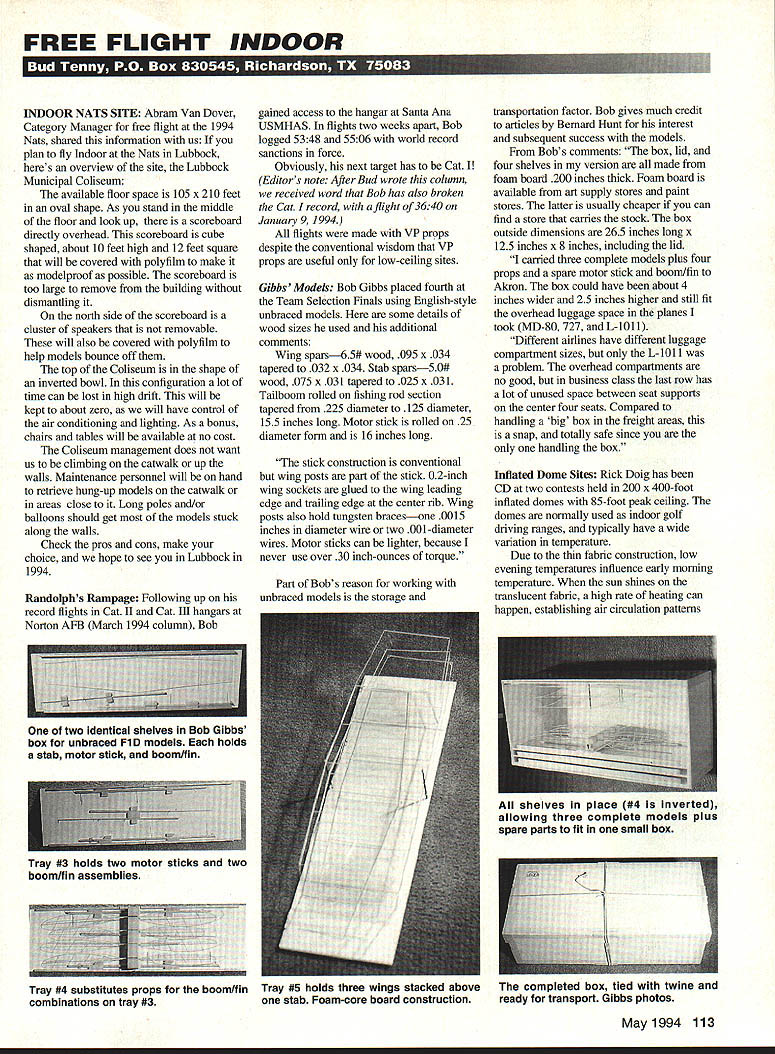
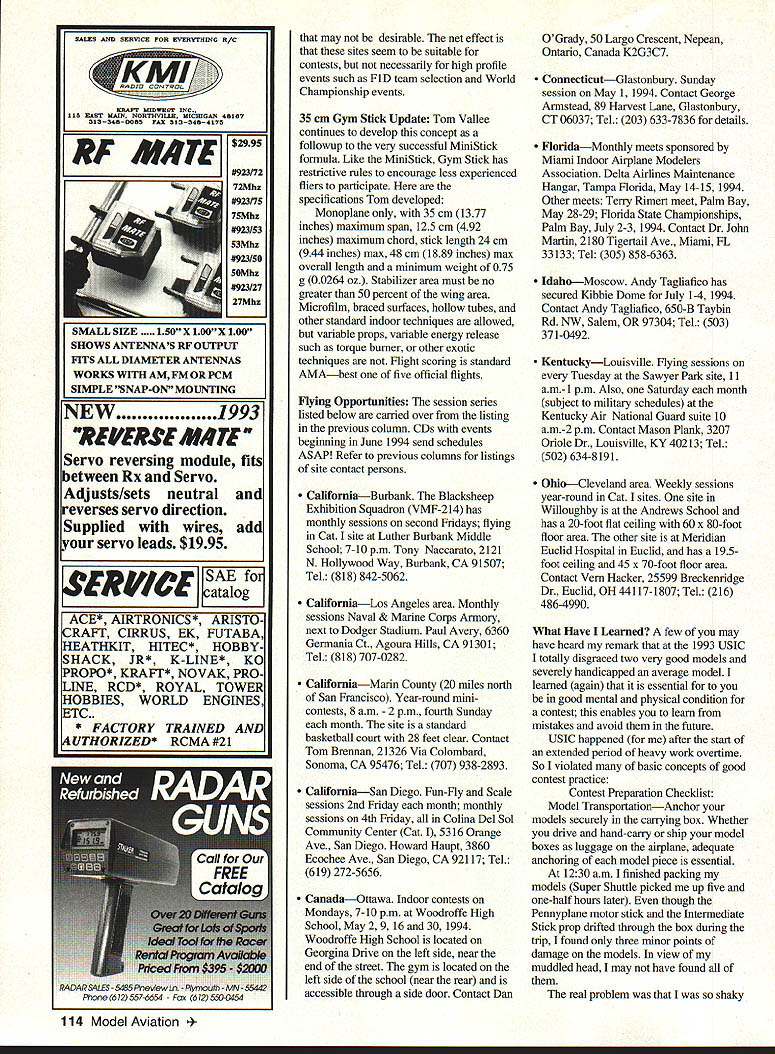
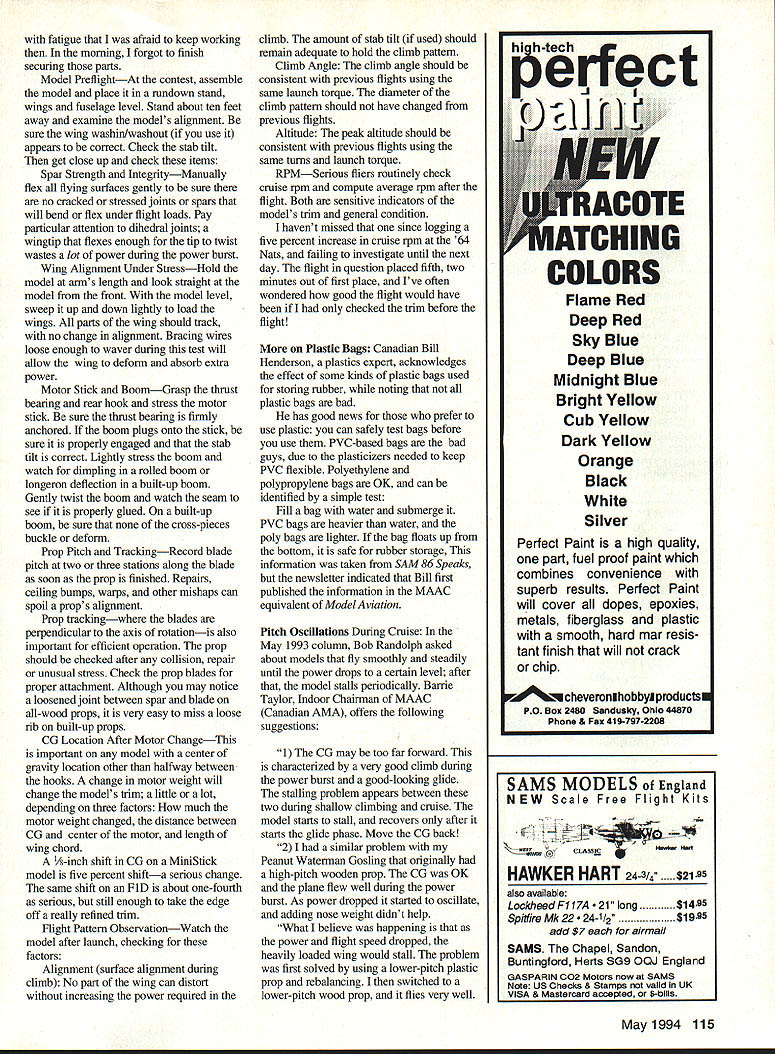
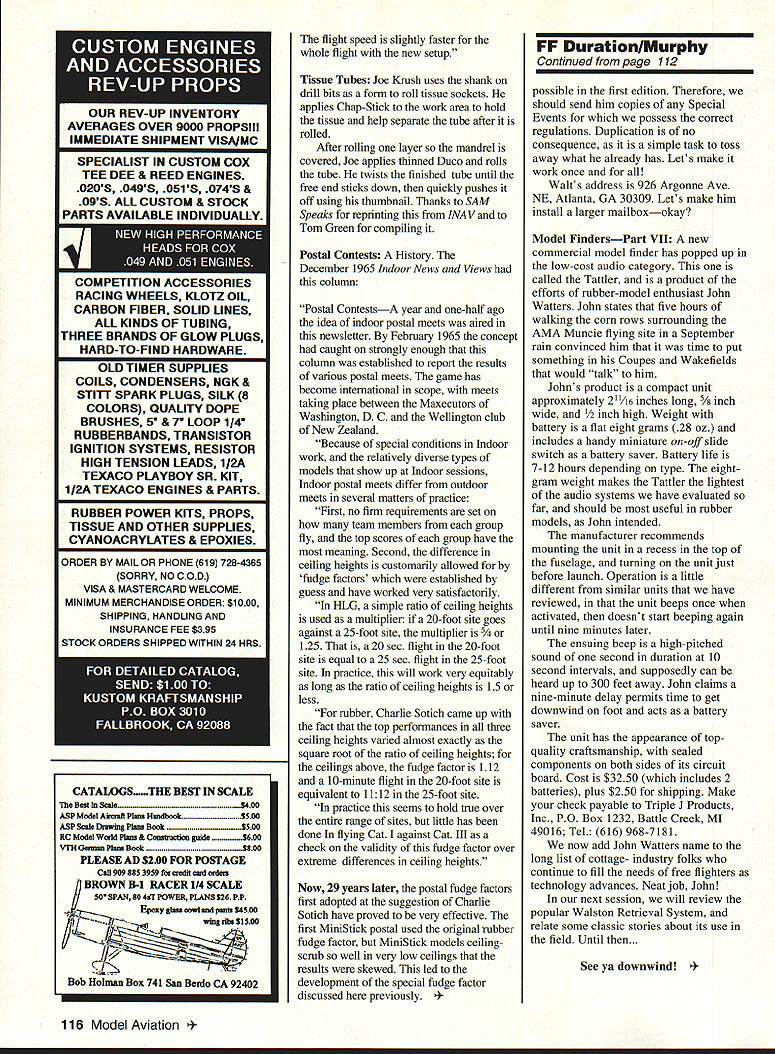
From Bob's comments on transportation and the model box: the box, lid, and four shelves in his version are all made from foam board 0.200 inches thick. Foam board is available from art supply stores and paint stores (the latter usually cheaper if you can find a store that carries the stock). Box outside dimensions: 26.5 inches long x 12.5 inches x 8 inches, including the lid. He carried three complete models plus four props and a spare motor stick and boom/fin to Akron. The box could have been about 4 inches wider or 2.5 inches higher and still fit the overhead luggage space in the planes he took (MD-80, 727, and L-1011). Different airlines have different luggage compartment sizes; only the L-1011 was a problem. The overhead compartments are no good, but in business class the last row has a lot of unused space between seat supports in the center four seats. Compared to handling a big box in the freight area, this is a snap, and totally safe since you are the only one handling the box.
---
Tissue Tubes (Joe Krush method)
Joe Krush uses the shank on drill bits as a form to roll tissue sockets. He applies Chap‑Stick to the work area to hold the tissue and help separate the tube after it is rolled. After rolling one layer so the mandrel is covered, Joe applies thinned Duco and rolls the tube. He twists the finished tube until the free end sticks down, then quickly pushes it off using his thumbnail. Thanks to SAM Speaks for reprinting this from INAV and to Tom Green for compiling it.
---
Inflated Dome Sites
Rick Doig has been CD at two contests held in 200 x 400-foot inflated domes with 85-foot peak ceilings. Domes are normally used as indoor golf driving ranges and typically have wide variation in temperature. Due to thin fabric construction, low evening temperatures influence early morning conditions. When the sun shines on the translucent fabric, rapid heating can occur and establish air circulation patterns. The net effect is that these sites seem suitable for contests, but not necessarily for high-profile events such as F1D team selection and World Championship events.
---
35 cm Gym Stick Update
Tom Vallee continues to develop this concept as a follow-up to the very successful MiniStick formula. Like the MiniStick, Gym Stick has restrictive rules to encourage less experienced fliers to participate. Specifications Tom developed:
- Monoplane only, with 35 cm (13.77 inches) maximum span.
- Maximum chord 12.5 cm (4.92 inches).
- Stick length 24 cm (9.44 inches) max.
- 48 cm (18.89 inches) max overall length.
- Minimum weight 0.75 g (0.0264 oz).
- Stabilizer area must be no greater than 50 percent of the wing area.
- Microfilm, braced surfaces, hollow tubes, and other standard indoor techniques are allowed.
- Variable props, variable energy release such as torque burners, or other exotic techniques are not allowed.
- Flight scoring is standard AMA — best one of five official flights.
---
Flying Opportunities
(The session series below are carried over from the previous listing. CDs with events beginning in June 1994 should send schedules ASAP. Refer to previous columns for site contact persons.)
- California — Burbank: The Blacksheep Exhibition Squadron (VMF-214) has monthly sessions on second Fridays, flying in a Cat. I site at Luther Burbank Middle School, 7–10 p.m. Contact: Tony Naccarato, 2121 N. Hollywood Way, Burbank, CA 91507; Tel.: (818) 842-5062.
- California — Los Angeles area: Monthly sessions at the Naval & Marine Corps Armory next to Dodger Stadium. Contact: Paul Avery, 6360 Germania Ct., Agoura Hills, CA 91301; Tel.: (818) 707-0282.
- California — Marin County (20 miles north of San Francisco): Year-round mini-contests, 8 a.m.–2 p.m., fourth Sunday each month. Site: standard basketball court with 28 feet clear. Contact: Tom Brennan, 21326 Via Colombard, Sonoma, CA 95476; Tel.: (707) 938-2893.
- California — San Diego: Fun-Fly and Scale sessions 2nd Friday each month; monthly sessions on 4th Friday; all in Colina Del Sol Community Center (Cat. I), 5316 Orange Ave., San Diego. Contact: Howard Haupt, 3860 Echolake Ave., San Diego, CA 92117; Tel.: (619) 272-5656.
- Canada — Ottawa: Indoor contests on Mondays, 7–10 p.m. at Woodroffe High School (May 2, 9, 16 and 30, 1994). Woodroffe High School is located on Georgina Drive; the gym is on the left side of the school (near the rear) and is accessible through a side door. Contact: Dan O'Grady, 50 Largo Crescent, Nepean, Ontario, Canada K2G 3C7.
- Connecticut — Glastonbury: Sunday session on May 1, 1994. Contact: George Armstead, 89 Harvest Lane, Glastonbury, CT 06037; Tel.: (203) 633-7836.
- Florida — Various: Monthly meets sponsored by Miami Indoor Airplane Modelers Association. Delta Airlines Maintenance Hangar, Tampa, FL, May 14–15, 1994. Other meets: Terry Rimer meet, Palm Bay, May 28–29; Florida State Championships, Palm Bay, June 2–3, 1994. Contact: Dr. John Martin, 2810 Tigertail Ave., Miami, FL 33133; Tel.: (305) 858-6363.
- Idaho — Moscow: Andy Tagliafico has secured Kibbie Dome for July 1–4, 1994. Contact: Andy Tagliafico, 650-B Taybin Rd. NW, Salem, OR 97304; Tel.: (503) 371-0492.
- Kentucky — Louisville: Flying sessions every Tuesday at the Sawyer Park site, 11 a.m.–1 p.m. Also one Saturday each month (subject to activity schedules) at the Kentucky Air National Guard site, 10 a.m.–2 p.m. Contact: Mason Plank, 3207 Oriole Dr., Louisville, KY 40213; Tel.: (502) 634-8191.
- Ohio — Cleveland area: Weekly sessions year-round in Cat. I sites. One site in Willoughby is at Andrews School and has a 20-foot half ceiling with 60 x 80-foot floor area. The other site is at Meridian Euclid Hospital in Euclid and has a 19.5-foot ceiling and 45 x 70-foot floor area. Contact: Vern Hacker, 25599 Breckenridge Dr., Euclid, OH 44117-1807; Tel.: (216) 486-4990.
---
What Have I Learned?
A few of you may have heard my remark that at the 1993 USIC I totally disagreed with two very good models and severely handicapped an average model. I learned (again) that it is essential to be in good mental and physical condition for a contest; this enables you to learn from mistakes and avoid them in the future. USIC happened for me after the start of an extended period of heavy overtime work, so I violated many basic concepts of good contest practice.
#### Contest Preparation Checklist
- Model Transportation — Anchor your models securely in the carry box. Whether you drive and hand-carry or ship your model as baggage on the airplane, adequate anchoring of each model piece is essential.
I finished packing my models at 12:30 a.m. (Super Shuttle picked me up five and one-half hours later). Even though the Pennsylvania motor stick in the International Stick prop drifted through the box during the trip, I found only three minor points of damage on the models. In view of my muddled head, I may not have found all of the damage.
The real problem was that I was so shaky.
Transcribed from original scans by AI. Minor OCR errors may remain.

