
Free Flight: Indoor
Bud Tenny, P.O. Box 830545, Richardson, TX 75083
From the Tulsa Glue Dobbers' newsletter:
"The other day at one of our Thursday flying sessions, I met a beautiful little girl. I happened to look up while I was winding my Embryo, and discovered her watching me intently. I asked her name and doll's name, and I told her my name.
"She followed me out to the middle of the floor and watched as I launched the plane, and it circled up toward the ceiling. The little girl was entranced, and walked under the ship as it circled up and then back down to the floor.
"As I put it back into the stooge, she asked, 'Can I wind it?' I replied, 'Sure.' I held the winder as she cranked in the turns.
"When it was ready, I walked out to the floor and she followed. I had a brainstorm. I asked, 'Do you want to fly it?' She replied, 'Do you think I could?' 'Sure,' I said.
"I showed her how to hold the prop and release it, and then give the Embryo a gentle push to launch it. She did a very good launch, and the plane circled up for its best flight of the day. She retrieved the plane, and when she brought it back, she said, 'I didn't think I could do that.' I answered, 'You did an excellent job.'
"A little girl went away enthralled by our stick-and-tissue flying works of art, and a grandfather learned something about this granddaughter.
"What's my point? Let's not forget to give our daughters and granddaughters the same opportunity we had to experience what we love dearly. You never know what might happen."
George Calvert
Medical tools still available (from Vern Hacker)
Two years ago, Ray Harlan started a program to make medical instruments available to fliers in exchange for donations. The first year's effort generated more than $3,000 that was transferred to the Academy Indoor fund at the end of 1992. The 1993 program generated more than $2,600 that will be transferred to the AMA's Junior Free Flight Fund and the museum at Muncie.
This year I plan to continue both the laparoscopic instrument and the eye scalpel and cautery programs. For a $10 donation the donor will receive one of the laparoscopic tools that have been donated to this effort by Kevin Smith and Chuck Slater of the Symbiosis Company of Miami, Florida.
There are two different tools available: a grasper and a pair of scissors. These instruments are twelve inches in length and are very useful for removing broken motors from inside fuselages.
Another offer is for three eye scalpels for a $5 donation, or a battery-operated variable-temperature hot-wire cautery. Because we now have to buy these cauteries, the donation must be $12 (so the donation is significant enough to be worth the bother). This year's contributions will again go to the Indoor fund.
Contact Vern Hacker, 25599 Breckenridge Dr., Euclid OH 44117-1807; Tel.: (216) 486-4990.
New lighter boron
Model Research Labs (Curt Stevens), 25108 Marguerite #160, Mission Viejo CA 92692; Fax (714) 248-1074 announced they have a new supply of boron fiber. The new boron is .003 inch diameter, 30% stronger, 40% lighter, 50% tougher and less brittle than the original .004 boron previously available. The .004 boron was grown on .001 inch wire; the new supply was grown on a core wire .000375 in diameter.
Curt is selling the boron (US and Canada) at $15 for 150 feet, plus 7.75% tax ($1.16) for California orders. The price includes surface shipping. Overseas orders are $21, including next-day air shipment.
Boron safety
Part of the MRL announcement above noted that the new boron is "still user-friendly." The following piece came from the Boeing Hawks newsletter 1293, Gene Stubbs, editor, by way of the NFFS Digest.
Gil Coughlin described some useful tips for using boron fiber. For those like me who have not experienced it, the material Gil uses is a .004-inch fiber consisting of a tungsten core with a vapor-deposited coating of boron. It comes on a roll and has tensile strength and stiffness similar to .020 piano wire. The typical use is to add stiffness to, say, a motor stick or stabilizer framework by cementing a fiber to the structure.
To cement the fiber, Gil first coats it with Duco by drawing it through a drop of cement between his fingers. Then with the coated fiber positioned on the structure, he activates the cement with a swipe of acetone.
Anyone using boron fiber should be aware of its danger and appropriate disposal methods. The chief danger with boron fiber is that if a small piece punctures the skin like a splinter, it tends to migrate through the body, causing discomfort and damage. Therefore, extreme care must be used to contain any scraps or fragments of the fiber.
A good way to keep track of the material is to handle it attached to masking tape until it is ready for installation. For disposal, Gil collects any scraps in a plastic bowl and casts them in epoxy or embeds them in a block of Portland cement.
Flying opportunities
The session series listed below are carried over from the listing in the previous column. Clubs with events beginning in August 1994, send schedules ASAP! Refer to previous columns for listings of site contact persons. Caution: Call and verify all dates before leaving home!
- California — Burbank. The Blacksheep Exhibition Squadron (VMF-214) has monthly sessions on second Fridays, flying in Cat. I at Luther Burbank Middle School; 7–10 p.m. Tony Naccarato, 2121 N. Hollywood Way, Burbank CA 91507; Tel.: (818) 842-5062.
- California — Los Angeles area. Monthly sessions at the Naval & Marine Corps Armory, next to Dodger Stadium. Paul Avery, 6360 Germania Ct., Agoura Hills CA 91301; Tel.: (818) 707-0282.
- California — Marin County (20 miles north of San Francisco). Year-round minicons, 8 a.m.–2 p.m., fourth Sunday each month. The site is a standard basketball court with 28 feet clear. Contact Tom Brennan, 21326 Via Colombard, Sonoma CA 95476; Tel.: (707) 938-2893.
- California — San Diego. Fun Fly and scale sessions 2nd Friday each month; monthly sessions on 4th Friday, all in Colina Del Sol Community Center (Cat. I), 5316 Orange Ave., San Diego. Howard Haupt, 3860 Eccleston Ave., San Diego CA 92117; Tel.: (619) 272-5656.
- Kentucky — Louisville. Flying sessions every Tuesday at the Sawyer Park site, 11 a.m.–1 p.m. Also, one Saturday each month (subject to military schedules) at the Kentucky Air National Guard site, 10 a.m.–2 p.m. Contact Mason Plank, 3207 Oriole Dr., Louisville KY 40213; Tel.: (502) 634-8191.
- Ohio — Cleveland area. Weekly sessions year-round in Cat. I sites. One site in Willoughby is at the Andrews School and has a 20-foot flat ceiling with 60 x 80-foot floor area. The other site, at Meridian Euclid Hospital in Euclid, has a 19.5-foot ceiling and a 45 x 70-foot floor area. Contact Vern Hacker, 25599 Breckenridge Dr., Euclid OH 44117-1807; Tel.: (216) 486-4990.
Tan II — hot or cold?
Everyone seems to agree that the Tan II "fettucini" is some of the best rubber to come down the pike in a while. Meanwhile, some early reports seemed to indicate the rubber was more sensitive to low temperatures than earlier batches. Later reports by several users refute that.
A week ago, I was flying in temperatures ranging from 61°F down to 59°F as we packed up. It seemed obvious to me that there was no change in performance in comparison to previous versions. When you build the shorter loop of thicker rubber and wind to the same turns as with earlier batches of Tan, there is some increase in performance. Good stuff!
New Materials!
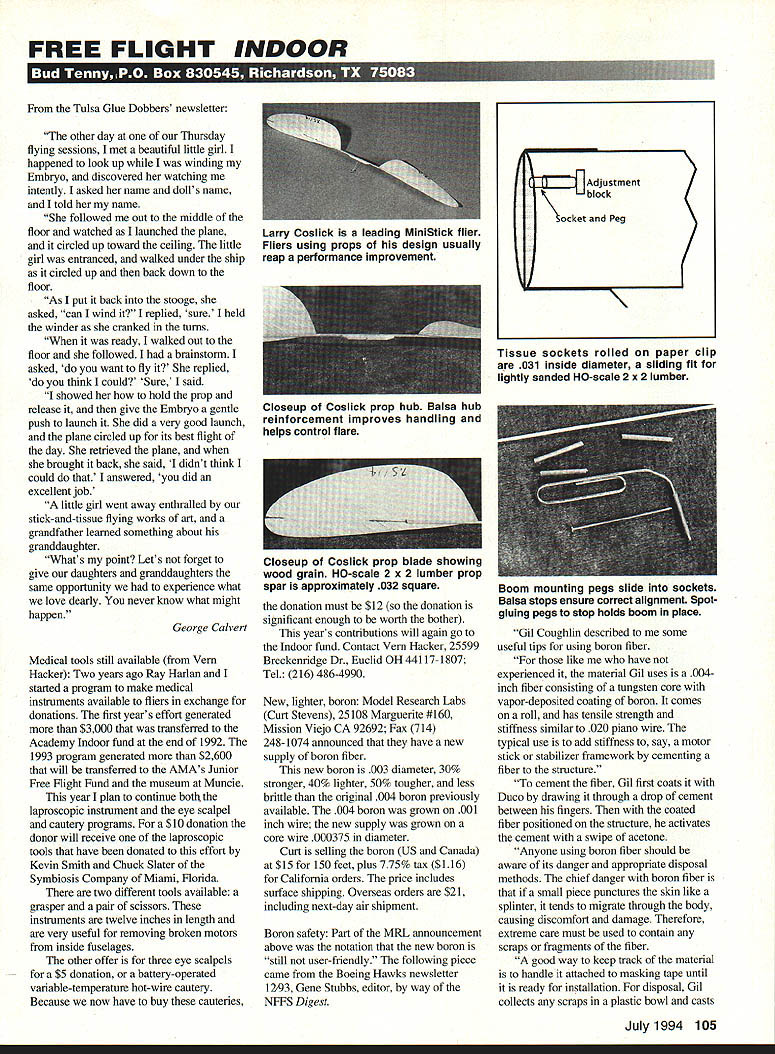
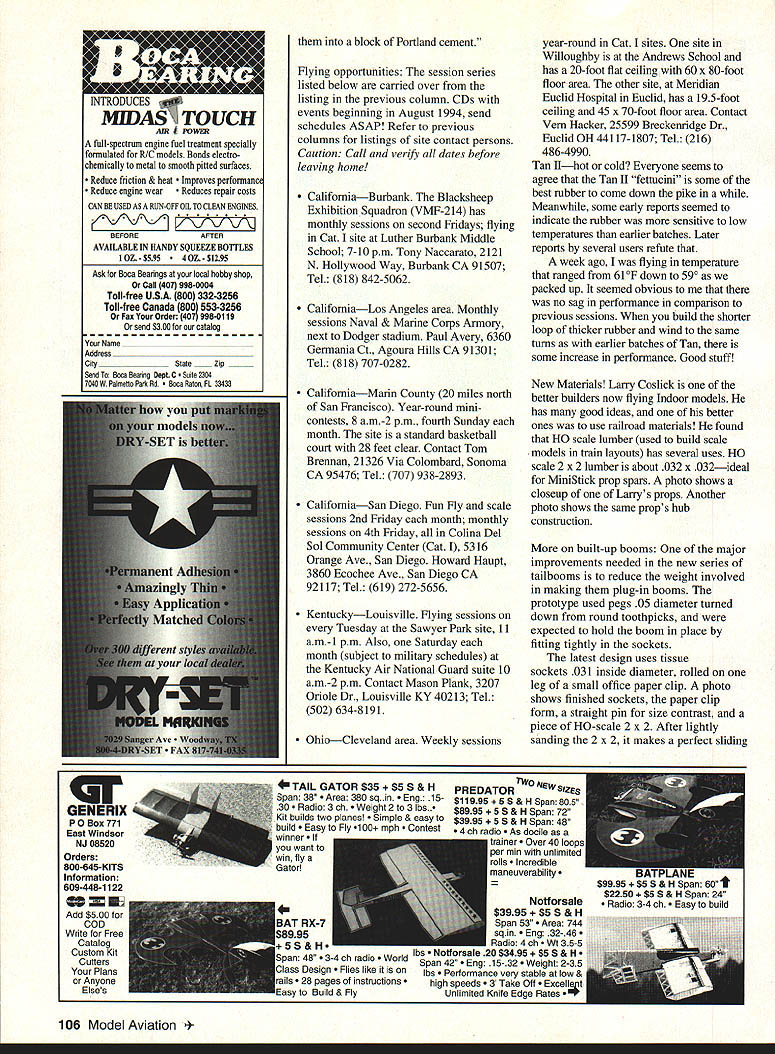
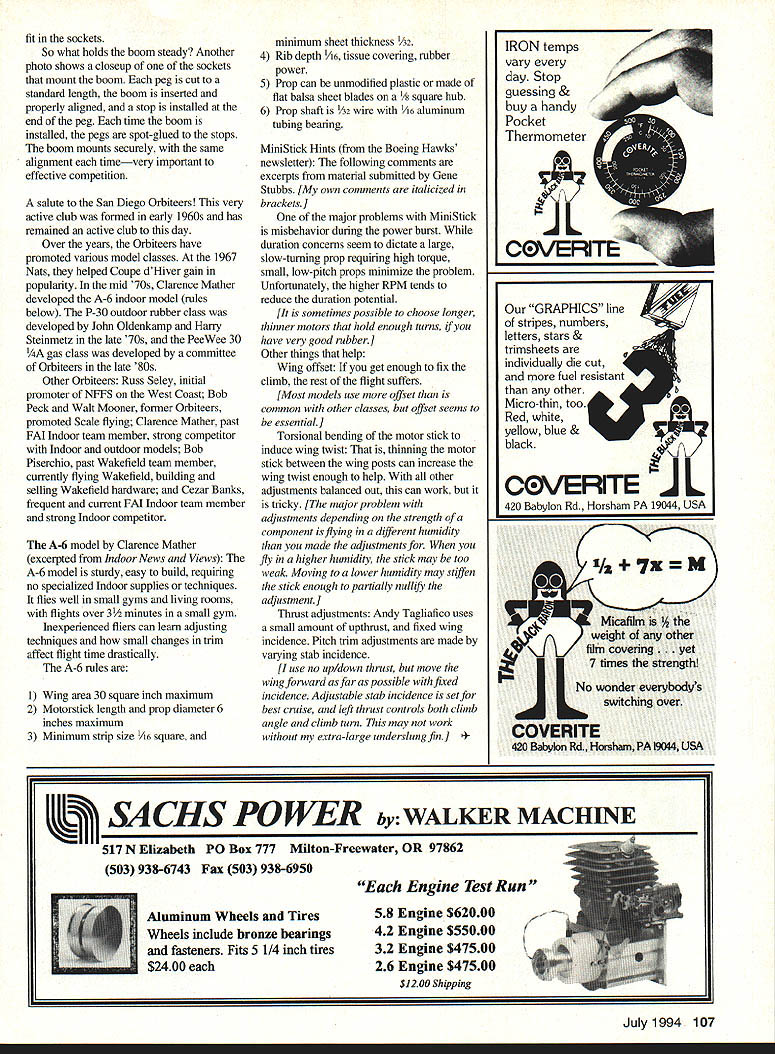
Larry Coslick is one of the better builders now flying Indoor models. He has many good ideas, and one of his better ones was to use railroad materials. He found that HO scale lumber (used to build scale models in train layouts) has several uses. HO scale 2 x 2 lumber is about .032 x .032 — ideal for MiniStick prop spars. A photo shows a closeup of one of Larry's props. Another photo shows the same prop's hub construction.
More on built-up booms
One of the major improvements needed in the new series of tailless is to reduce the weight involved in making them plug-in booms. The prototype used pegs .045 diameter turned down from round toothpicks, and were expected to hold the boom in place by fitting tightly in the sockets.
The latest design uses tissue sockets .031 inside diameter, rolled on one leg of a small office paper clip. A photo shows finished sockets, the paper-clip form, a straight pin for size contrast, and a piece of HO-scale 2 x 2. After lightly sanding the 2 x 2, it makes a perfect sliding fit.
So what holds the boom steady? Each peg is cut to a standard length, the boom is inserted and properly aligned, and a stop is installed at the end of the peg. Each time the boom is installed, the pegs are spot-glued to the stops. The boom mounts securely, with the same alignment each time — very important to effective competition.
A salute to the San Diego Orbiters!
This very active club was formed in the early 1960s and has remained an active club to this day.
Over the years, the Orbiters have promoted various model classes. At the 1967 Nats, they helped Coupe d'Hiver gain in popularity. In the mid '70s, Clarence Mather developed the A-6 indoor model (rules below). The P-30 outdoor rubber class was developed by John Oldenkamp and Harry Steinmetz in the late '70s, and the PeeWee .30 1/4A gas class was developed by a committee of Orbiters in the late '80s.
Other Orbiters: Russ Seely, initial promoter of NFFS on the West Coast; Bob Peck and Walt Mooneer, former Orbiters, promoted Scale flying; Clarence Mather, past FAI Indoor team member, strong competitor with Indoor and outdoor models; Bob Pieschino, past Wakefield team member, currently flying Wakefield, building and selling Wakefield hardware; and Cezar Banks, frequent and current FAI Indoor team member and strong Indoor competitor.
The A-6 model (excerpted from Indoor News and Views)
The A-6 model is sturdy, easy to build, requiring no specialized Indoor supplies or techniques. It flies well in small gyms and living rooms, with flights over 3 1/2 minutes in a small gym. Inexperienced fliers can learn adjusting techniques and how small changes in trim affect flight time drastically.
The A-6 rules are:
- Wing area 30 square inch maximum.
- Motorstick length and prop diameter 6 inches maximum.
- Minimum strip size 1/16 square, and minimum sheet thickness 1/32.
- Rib depth 1/16, tissue covering, rubber power.
- Prop can be unmodified plastic or made of flat balsa sheet blades on a 7/8 square hub.
- Prop shaft is 1/32 wire with 1/16 aluminum tubing bearing.
MiniStick Hints (from the Boeing Hawks' newsletter)
The following comments are excerpts from material submitted by Gene Stubbs. (My own comments are in brackets.)
One of the major problems with MiniStick is misbehavior during the power burst. While duration concerns seem to dictate a large, slow-turning prop requiring high torque, small, low-pitch props minimize the problem. Unfortunately, the higher RPM tends to reduce the duration potential.
[It is sometimes possible to choose longer, thinner motors that hold enough turns, if you have very good rubber.]
Other things that help:
- Wing offset: If you get enough to fix the climb, the rest of the flight suffers. [Most models use more offset than is common with other classes, but offset seems to be essential.]
- Torsional bending of the motor stick to induce wing twist: That is, thinning the motor stick between the wing posts can increase the wing twist enough to help. With all other adjustments balanced out, this can work, but it is tricky. [The major problem with adjustments depending on the strength of a component is flying in a different humidity than you made the adjustments for. When you fly in a higher humidity, the stick may be too weak. Moving to a lower humidity may stiffen the stick enough to partially nullify the adjustment.]
- Thrust adjustments: Andy Tagliafico uses a small amount of upthrust, and fixed wing incidence. Pitch trim adjustments are made by varying stab incidence.
[I use no up/down thrust, but move the wing forward as far as possible with fixed incidence. Adjustable stab incidence is set for best cruise, and left thrust controls both climb angle and climb turn. This may not work without my extra-large underslung fin.]
Transcribed from original scans by AI. Minor OCR errors may remain.

