
FREE FLIGHT: INDOOR
Bud Tenny, P.O. Box 830545, Richardson, TX 75083
NEW SERVICE! From the newsletter of the Boeing Hawks:
"Are you one of the many unfortunate individuals who like to build free flight models but can't seem to get them to fly worth a damn? Do you feel like the other modelers are snickering at you behind your back? Perhaps you are suffering from congenital tail heaviness, warposis, chruncho-phobia, tall grass allergy, or one of the many other modelers' afflictions. Do not despair! Help is on the way.
"During the summer outdoor flying season these problems can be overcome by simply stumbling back from the weeds, smiling with model held high, and pretending to be retrimming after a spectacular flight. With the advent of the indoor flying season, however, no such compensation is possible. Your frustration and suffering are apparent to everyone present as you try in vain to tame your model's errant behavior."
Announcing a new service: Trimmers Anonymous. For a nominal fee our expert staff will analyze and correct your airplane's trim problems in complete confidence. When you arrive at the next contest you can proudly launch your model for a perfect flight, right out of the box, to the amazement of all your fellow modelers. Put an end to snickering; call (800) ADD-CLAY today!
Type It, Please
A few of you know that I now have an OCR scanner. This enables me to read most typed/printed materials electronically, so I only have to edit your submissions before using them. If at all possible, send me printed material — it saves me a lot of time!
Site Searches
The following item appeared in TOPMAC Topics, Jack Koehler, editor. The TOPMAC club has its share of site problems, so Jack's remarks are right to the point!
"Have you ever bought anything over the phone, sight unseen, from a stranger, particularly a stranger from out-of-town? Me neither! So why am I, a stranger, and sometimes an out-of-town stranger, trying to 'sell' folks I don't know on permitting other people they've never met to fly something they've never seen in a precious building (or on land) that they own, or manage — over the phone? Stupid, ain't it? But that's what I've been trying to do; sell TOPMAC over a phone.
"What I should do is: ask for a face-to-face meeting with the site owner or manager, preferably on the site. Second, I should attend such meetings with models I can demo on site. Third, I should offer references from owners of other sites we use. Fourth, I should have a TV/VCR and suitable tapes to show. Fifth, I should have TOPMAC, AMA and AMA Member and Site Insurance info to give to the site owners/managers. Sixth, etc., etc.
"But, honestly, I'd rather beat a big stick than do all this. How 'bout you? See our site problem?"
Flying Opportunities
The list below contains both flying session listings carried over from the listing in the previous column and the latest update of the contact-persons list.
Clubs with events beginning in October 1994 — send schedules ASAP!
Caution: Call and verify all dates before leaving home!
- California — Burbank. The Black Sheep Exhibition Squadron (VMF-214) has monthly sessions on second Fridays; flying in Cat. I site at Luther Burbank Middle School, 7–10 p.m. Tony Naccarato, 2121 N. Hollywood Way, Burbank, CA 91507; Tel.: (818) 842-5062.
- California — Los Angeles area. Monthly sessions at Naval & Marine Corps Armory next to Dodger Stadium. Paul Avery, 6360 Germania Ct., Agoura Hills, CA 91301; Tel.: (818) 707-0282.
- California — Marin County (20 miles north of San Francisco). Year-round minicontests, 8 a.m.–2 p.m., fourth Sunday each month. Site is standard basketball court, 28 feet clear. Contact Tom Brennan, 21326 Via Colombard, Sonoma, CA 95476; Tel.: (707) 938-2893.
- California — San Diego. Fun-Fly and Scale sessions 2nd Friday each month; monthly sessions 4th Friday; Colina Del Sol Community Center (Cat. I), 5316 Orange Ave., San Diego. Howard Haupt, 3860 Ecochee Ave., San Diego, CA 92117; Tel.: (619) 272-5656.
- Canada — Ontario area. Dan O'Grady, 50 Largo Crescent, Nepean, Ontario K2G 3C7, Canada.
- Colorado — Denver. Les Shaw; Tel.: (303) 499-0946.
- Connecticut — Glastonbury. George Armstead, 89 Harvest Lane, Glastonbury, CT 06037; Tel.: (203) 633-7836.
- Connecticut — Norwich. Jerry Bockius, 48 Division St., Norwich, CT 06360; Tel.: (203) 887-5879.
- Connecticut — Wilton. Roger Kleinert, 17 Gardiner St., Darien, CT 06820; Tel.: (203) 655-1585.
- Florida. Contact Dr. John Martin, 2180 Tigertail Ave., Miami, FL 33133; Tel.: (305) 858-6363.
- Georgia — Atlanta area. Contact John Barker; Tel.: (404) 436-9912.
- Idaho — Kibbie Dome. Andy Tagliafico, (addresses): 650-B Taybin Road NW, Salem, OR 97304; Tel.: (503) 371-0492. Also listed at 10039 SW Quail Post Rd., Portland, OR 97219; Tel.: (503) 452-0546.
- Iowa — Cedar Rapids. [Contact information not provided in OCR.]
- Illinois — Chicago area. Year-round weekly sessions in a 25-foot gym at College of DuPage in Glen Ellyn, Illinois. Currently held 6–11 p.m. on Monday evenings. Bob Warmann, 245 N. Oaklawn, Elmhurst, IL 60126; Tel.: (708) 834-9075.
- Kansas — Topeka. Jack Koehler, 3425 SW Arrowhead Rd., Topeka, KS 66614-3485; Tel.: (913) 272-8439.
- Kansas — Wichita. Contact Stan Chilton, 725 E. Lincoln, Wichita, KS 67211-3302; Tel.: (316) 686-9634.
- Kentucky — Louisville. Flying sessions every Tuesday at the Sawyer Park site, 11 a.m.–1 p.m. Also, one Saturday each month (subject to military schedules) at the Kentucky Air National Guard site 10 a.m.–2 p.m. Contact Mason Plank, 3207 Oriole Dr., Louisville, KY 40213; Tel.: (502) 634-8191.
- Maryland — Goddard NAS. Goddard NAS Record Trials and flying sessions scheduled in the auditorium of Building 8 at Goddard NAS on Saturdays, 11 a.m.–10:30 p.m., July 16, August 6, August 20, September 17, October 1*, October 15*, October 29*, 1994. (* = Sanctioned national and FAI record trials.) NASA security requires attendees to be US citizens and AMA members with licenses available for inspection at the gate, and be listed on a roster by Tom Vallee. You must notify Tom of your intent to attend in advance of each meet.
Changes in NASA launch schedules and other possible events can preempt the auditorium without much warning; be sure to verify the date with Tom before leaving home! Tom Vallee, 444 Henryton So., Laurel, MD 20707; Tel.: (301) 498-0790.
- Massachusetts — Cambridge (M.I.T.). Ray Harlan, 15 Happy Hollow Rd., Wayland, MA 01778; Tel.: (617) 358-4013.
- Minnesota — Burnsville. John O'Leary, 11425 Kell Circle, Bloomington, MN 55437; Tel.: (612) 888-0638. Dell Marchant, 17110 24th Ave. N., Plymouth, MN 55447; Tel.: (612) 473-5971.
- Nebraska — Beatrice. John Pakiz, 4523 Poppleton Ave., Omaha, NE 68106; Tel.: (402) 551-2964.
- New Jersey — Lakehurst. Flying sessions/contests/record trials at Hangar #1, almost every weekend between July and the end of October. (Friday through Monday on Labor Day weekend.) Contact Gary Underwood at the address shown below to make the necessary arrangements for access to Lakehurst NAS.
Attendance at Lakehurst meets require strict adherence to these rules:
- You must furnish your name, driver's license number, make and model of vehicle, license plate number and state of registration to Gary Underwood not later than the Wednesday before the meet you plan to attend.
- Obey all military regulations, especially speed limits, no-smoking areas and restricted parking, all of which are clearly posted.
- Certain base personnel give access to lavatories and other facilities. Please route requests for assistance through the CD.
- You absolutely must leave your flying area at least as clean as you find it; check with the CD about where to locate your equipment.
- No photos allowed except in the hangar.
Out of town participants who fly in and rent a car must make special arrangements regarding auto identification. Contact Gary Underwood, 97 Treelawn Terrace, Mercerville, NJ 08619; Tel.: (609) 586-3202 for more information.
- New Jersey — Northern Area. Don Ross, 38 Churchill Rd., Cresskill, NJ 07626; Tel.: (201) 568-5272.
- New Jersey — Union area. Fergus Collins, 48 East Hazlewood Ave., Rahway, NJ 07067; Tel.: (201) 568-5272.
- New York — Brooklyn. Contact Don Ross, 38 Churchill Rd., Cresskill, NJ 07626; Tel.: (201) 568-5272.
- New York — Levittown (Cantiague). Richard Fiore, 531 Secor Ave., Farmingdale, LI, NY 11735; Tel.: (516) 249-4358.
- New York — Locust Valley. Fred Dippel, 2 David Court, Glen Cove, LI NY 11542; Tel.: (516) 671-2858.
- New York — NYC. Dan Marek, 210 West 101st St. #10F, NYC 10025; Tel.: (212) 222-1546.
- New York — Queens. Bob Bender, 159 Raff Ave., Mineola, NY 11501; Tel.: (516) 248-5118.
- Ohio — Cleveland area. Weekly sessions year-round in Cat. I sites. One site in Willoughby is at the Andrews School and has a 20-foot flat ceiling with 60 x 80-foot floor area. The other site is at Meridian Euclid Hospital in Euclid, and has a 19.5-foot ceiling and 45 x 70-foot floor area. Contact Vern Hacker, 25599 Breckenridge Dr., Euclid, OH 44117-1807; Tel.: (216) 486-4990.
- Oklahoma — Oklahoma City. Jim Belson, 4933 NW 29th, Oklahoma City, OK 73129; Tel.: (405) 946-1093.
- Oklahoma — Tulsa. Roy O'Mara, 9120 E. 7th St., Tulsa, OK 74112; Tel.: (918) 835-6880.
- Oregon — Albany. Bob Stalick, 5066 NW Picadilly Cir., Albany, OR 97321; Tel.: (503) 928-8101.
- Pennsylvania — Eastern. Walt Eggert Jr., 26 Moredon Rd., Huntington Valley, PA 19006; Tel.: (215) 947-4387.
- Pennsylvania — Philadelphia. Joe Krush, 409 Warner Rd., Wayne, PA 19087; Tel.: (215) 688-3927.
- Virginia — Newport News. Abram Van Dover, 112 Tillerson Drive, Newport News, VA 23602.
- Washington State — Seattle area. Ed Lamb, 15911 SE 42nd Place, Bellevue, WA 98006; Tel.: (206) 747-7806.
- Wisconsin — Racine. Tony Italiano, 1655 Revere Dr., Brookfield, WI 53005; Tel.: (414) 782-6256.
Rubber Aging
The following comments by Ted Ballin appeared in Bat Sheet, the newsletter of the Strat-O-Bats club:
How long will rubber last? Almost indefinitely, it seems. I have some Champion rubber that I purchased in 1981 that is still in excellent condition. It has never been in the refrigerator. The trick seems to be to keep it in a chemically inert and airtight container. Light and oxygen are the major causes of rubber deterioration.
In other areas of the country, where summer temperatures in excess of 90°F are common, refrigeration may be required. I keep it in its original one-pound-size cardboard box, sealed with masking tape, with the box in turn placed in two heavy-weight plastic grocery bags (QFC supplies the heaviest in the Seattle area). The plastic bags are then twisted tightly shut and tied with the standard grocery store metal twist-tie. I do not recommend storage in empty coffee cans, as metal is a heat conductor.
"Rubber definitely improves with age, but exactly when the improvement stops—and deterioration starts—has not, to my knowledge, been tested. Competitive bicycle racers use special racing tires called 'tubulars' (or 'sew-ups') that have a pure rubber inner tube. They do not immediately use their tires, but age them by placing them on old rims and storing them in a cool place for one to two years."
Editorial comment: While it is true that most rubber improved with age, this is not always true. These comments apply only to Pirelli and the earlier batches of Tan. I have insufficient experience with Tan II to comment, but the same concepts should still apply:
- If rubber is over-vulcanized during manufacture, aging can only make it worse. Even if it doesn't break from stress, such rubber normally won't accept as many turns as properly cured rubber.
- A measure of rubber hardness is the rate of recovery from stress. This is quite apparent with Tan; acceptable Tan returns to break-in length in half an hour. If recovery takes more than an hour, save the motor for the next day.
I firmly believe that keeping good records of recovery time for rubber is a key concept in judging rubber vulcanization. Note that I doubt there is a close correlation between absolute quality (energy storage capability) and the level of vulcanization.
It does seem likely that under-vulcanized rubber can't return as much total energy as properly cured rubber, but this also is only supposition. Similarly, the very hard rubber may return a high level of energy, but in a form not likely to be useful.
Laminated Outlines
From the Tulsa Glue Dobbers' newsletter:
Laminating tips (Double entendre intended): I have used several materials as formers for laminated tips and have just found one I like. If I run across the original article again I will give credit. I had used thin cardboard before (as in the packaging for 5 packs of sandpaper at Wal-Mart) but did not like the way the pattern edges finished or the tendency for glue to stick to the pattern. I tried wax and Saran Wrap to shield the edges, getting mixed results.
Here is the tip: Seal the edge of the cardboard former with a thin coat of white glue. When that has dried, apply a thin coat of wax to the edge (car or beeswax OK). The edge of the pattern is tough, and the sealed/waxed edge prevents the lamination glue from adhering to the former. Your laminated surfaces will not stick. I soak the balsa strips in water with a wetting agent, apply Titebond to one face of the lamination, pin the strips in place, and wait overnight for it to dry. If you use strips of masking tape to hold the strips on the pattern you may nuke it in the Radarange. (Ed. note: don't cake; wax rubbed on the forms works very well.)
Technical Stuff
(from the Boeing Hawks' newsletter):
"Have you ever heard of 'lead wool'? I ran across this strange material in the plumbing section at McLendon's hardware store. It looks just like steel wool. Plumbers use it to jam into cracks and joints in drain pipes—so the man there explained.
"It seemed like it might be useful to modelers in situations where you need to pack a lot of nose weight into a small space. You could pack this stuff into an odd-shaped cavity more conveniently and to higher density than by using lead sheet or shot. It could probably also be used as filler, with epoxy to make molded ballast forms, such as a spinner."
Quarter-Motors
I have never heard who started using half- or quarter-motors, but Clarence Maher used the technique in preparing for the 1968 World Championships in Rome. He had one motor for test flying. The WC site was more than 100 feet high.
The fractional motor concept works this way:
- Make a motor of the presumed correct cross-section, except one-fourth as long as the final motor will be.
- Make a spacer bar with hooks on each end. The spacer must be three-quarters the distance between the prop hook and rear hook on the model.
- Add enough weight to the spacer to make it exactly three times as heavy as the short motor.
- Fly the model with this combination. Altitude reached and flight time will be almost exactly one-fourth as great as flights with the full motor.
- Adjust loop length and cross-section of the short motor as needed to zero in on the correct motor size and weight. Always change the weight of the spacer to track the adjusted motor!
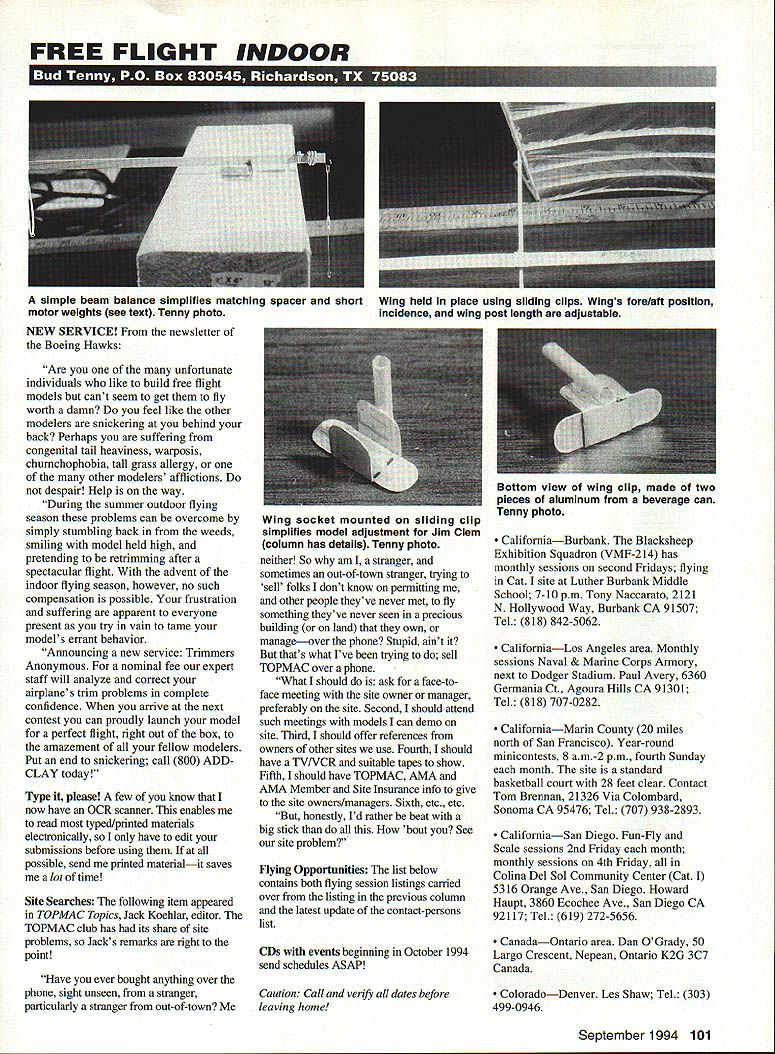
A photo shows Jim Clem's simple go/no-go scale that simplifies trimming the spacer weight to match changes in the motor weight. Most of the weight on the scale is above the pivot, so the scale will tip over-center and stay when the spacer weighs exactly three times as much as the motor.
To test this, push the high end just past center. Unless the ratio is correct, the beam will return to the original position. Test from both positions to be sure. The beam must have the center of the hook on the long end (for the rubber) exactly three times as far from the pivot as the other hook is.
Slide the Wing
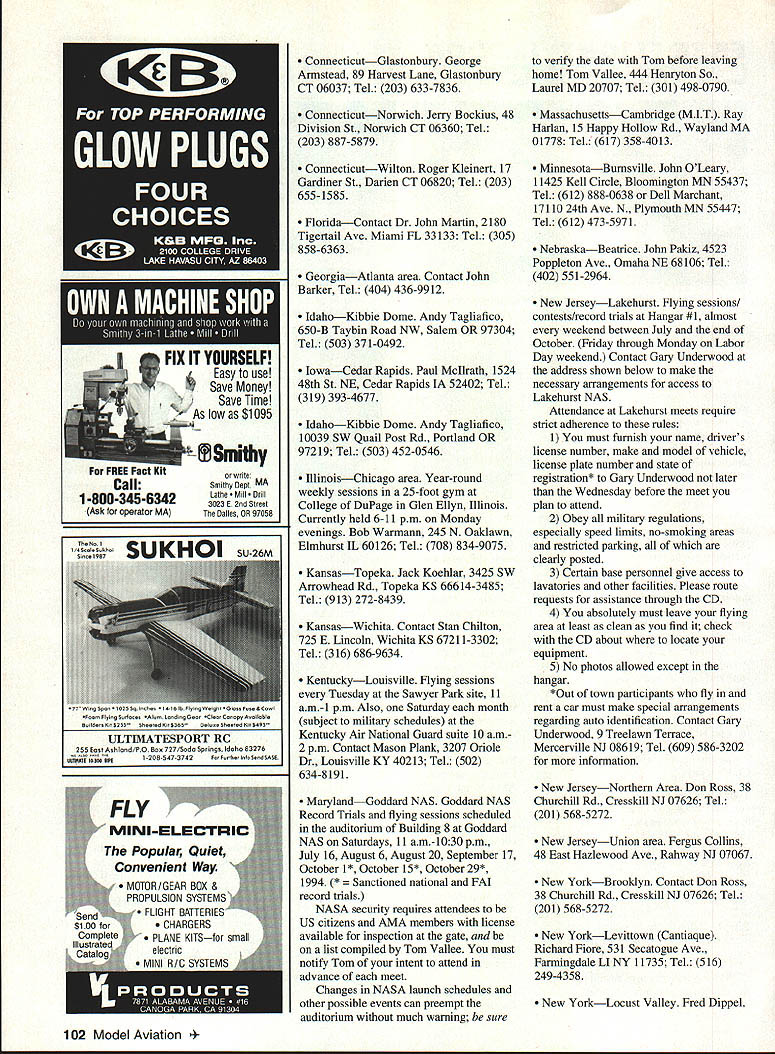
If the wings on our Pennylane, MiniSticks, and other duration models could slide for adjustment instead of plugging into sockets, final trim would be much easier.
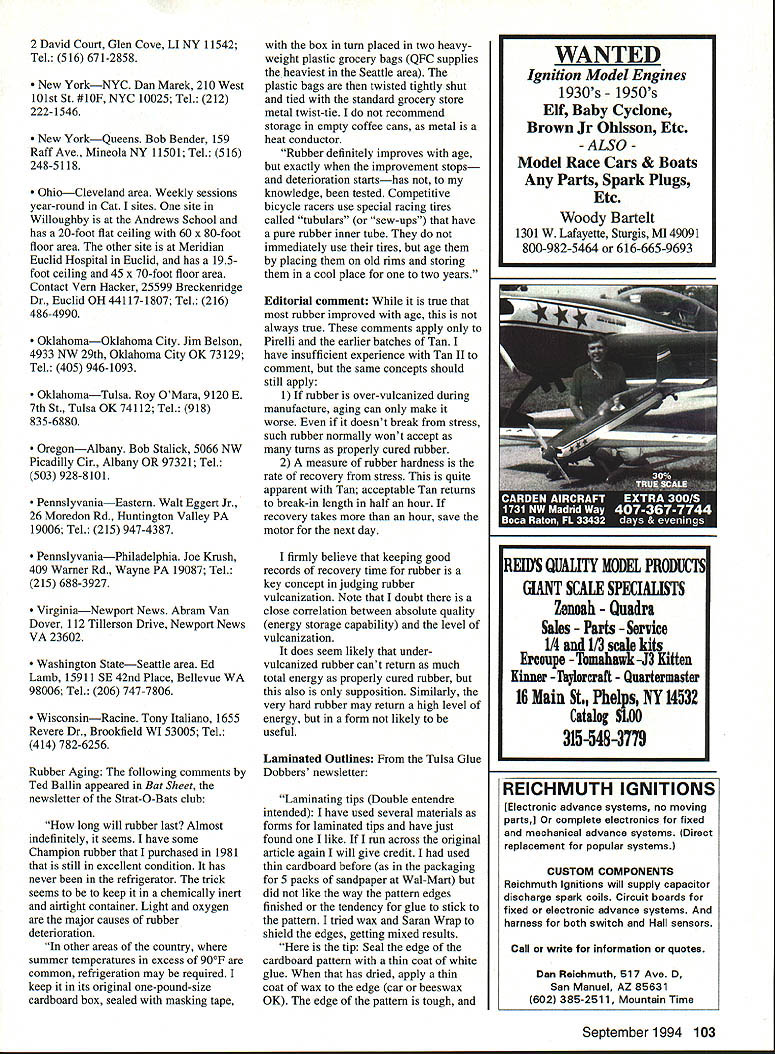
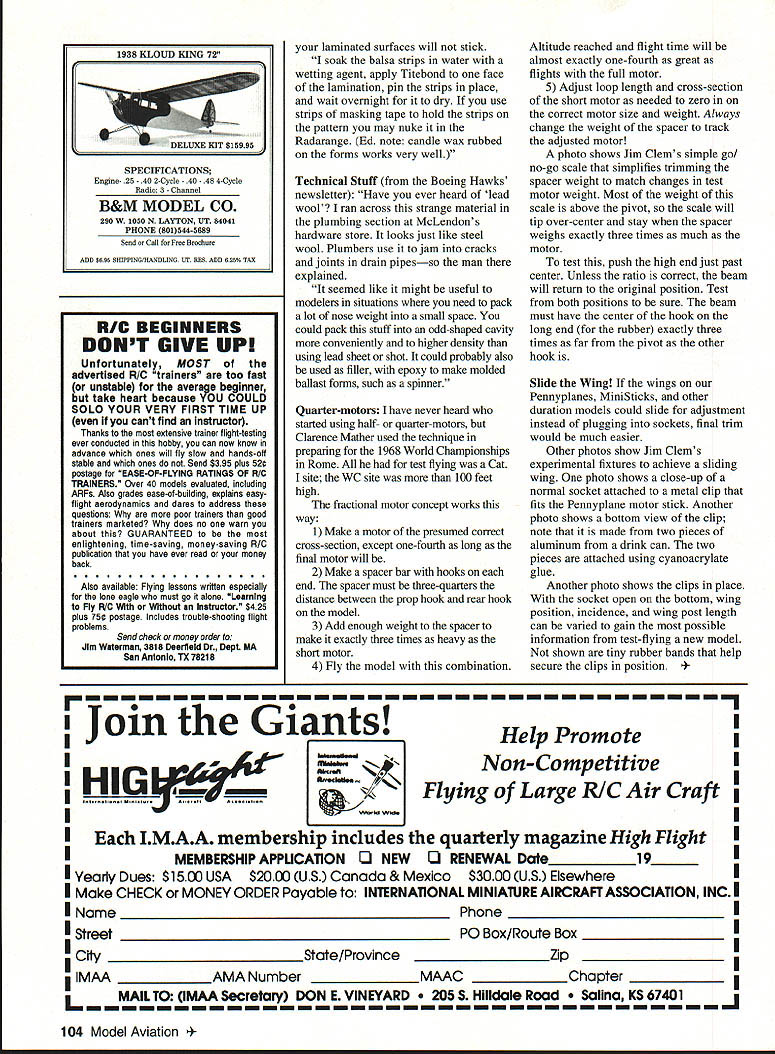
Other photos show Jim Clem's experimental fixtures to achieve a sliding wing. One photo shows a close-up of the normal socket attached to a metal clip that fits the Pennylane motor stick. Another photo shows a bottom view of the clip; the photo shows a washer made from two pieces of aluminum from a drink can. The two pieces are attached using cyanoacrylate glue.
Another photo shows the clips in place. With the socket open on the bottom, wing position, incidence, and wing post can be varied to gain the most possible information from test flying a new model. Not shown are tiny rubber bands that help secure the clips in position.
Transcribed from original scans by AI. Minor OCR errors may remain.

