
FREE FLIGHT INDOOR
Bud Tenny, P.O. Box 830545, Richardson, TX 75083
Boyd Felstead
Late in May, Boyd Felstead passed away two hours after speaking with his daughter. Boyd was an indoor pioneer in Australia and New Zealand.
When Indoor began its comeback after the AMA's adoption of ceiling categories in 1960, Boyd began corresponding with indoor fliers all over the world. Boyd was literally "way out in the boondocks: no place to fly and no one to fly with."
In 1972, Boyd made a proxy entry in the World Championships. In 1976 Boyd managed a round-the-world trip with his family. He was able to fly in the Wind Tunnel at Moffett Field, the Cow Palace in San Francisco, Santa Ana, and Cardington at the World Champs. What a grand tour! This was that rare opportunity to not only see sites you know only by correspondence, but to actually fly in them.
Boyd continued his correspondence through the years, even after his wife Betty died long ago. Besides keeping his own interest active, Boyd helped other fliers keep up with critical developments well in advance of publications dealing with indoor matters. A notable example is the warning about plastic zipper bags and paper envelopes used for storing rubber. Boyd had the news out long before publication deadlines. Boyd: thank you for years of service to the hobby/sport you loved!
Don Lindley memorials
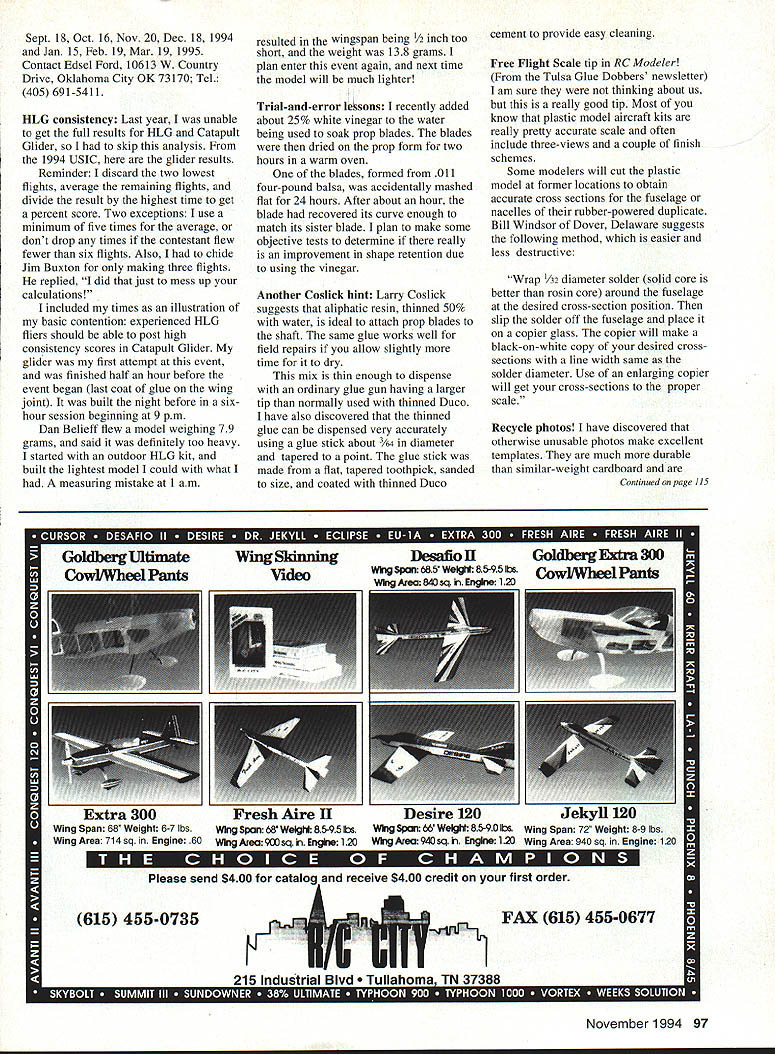
Don Lindley is remembered. A photo shows Jane Lindley with the Don Lindley Memorial Award. This perpetual trophy is sponsored by the Chicago Aeronuts and is to be awarded to the winner (regardless of age) of Bostonian Cabin at the USIC each year. Vito Garofalo, a member of the Aeronuts, designed and built the trophy. The photo was taken at the Aeronuts' annual banquet, shortly before the USIC. Jim Grant was the 1994 winner and gets to keep the trophy until the 1995 USIC.
Another photo shows a model of the Beanburner, Don Lindley's favorite and most recent Bostonian design. Tom Nied, a member of the Chicago Aeronuts, built this model, which was one of three in a field of 32 awarded maximum charisma points.
Treatise on jug props
Phil Alvirez has developed an interesting analysis of jug props. Most such papers use mathematics for the analysis and design, but Phil uses almost no mathematics—just geometry—for design and analysis.
The manual shows how to develop helical props on cylindrical forms. Phil is asking $10, postage paid, for this 24-page manual. His address is 1350 Arncliffe Pl., Windsor, Ontario, Canada N8S 4K3.
Best of "The Hangar Pilot"
John Martin has been printing "The Hangar Pilot" since 1971. This newsletter is whimsical, informative, and irreverent, but it always has one or more plans for obscure or interesting models—most of which are Peanut-sized. Dave Linstrum is compiling selections from this venerable publication into three volumes:
- Vol. 1 (1971–78)
- Vol. 2 (1979–86)
- Vol. 3 (1987–90)
These tomes are available for $7 each or 3/$20, postage paid. Dave Linstrum, 3927 Maravic Pl., Sarasota, FL 34231.
Tape those newsletters!
Not long ago, I received a newsletter with someone else's letter enclosed—the newsletter had been taped closed at the corners, leaving the sides untaped, and the letter had slipped inside. Fortunately, it still had an uncancelled stamp so it could be re-mailed.
Please tape (or staple, if you must) the newsletters on each end and in the center opposite the fold. Unless the ends are closed, the newsletter can scoop up smaller envelopes, and it is more likely to belly open on high-speed machinery and jam the flow at the entry to a scanner. The stream of mail behind it then often crushes or destroys the newsletter.
Flying Opportunities
The list below contains active flying session listings carried over from the previous column and the latest update of contact-persons. Clubs with events beginning in December 1994: send schedules ASAP. This is restricted to active listings; please refer to the previous column for a full listing of contact-persons. Caution: call and verify all dates before leaving home!
- California — Burbank
The Blacksheep Exhibition Squadron (VMF-214) has monthly sessions on second Fridays; flying in Cat. I site at Luther Burbank Middle School, 7–10 p.m. Tony Naccarato, 2121 N. Hollywood Way, Burbank, CA 91507; Tel.: (818) 842-5062.
- California — Los Angeles area
Monthly sessions at the Naval & Marine Corps Armory, next to Dodger Stadium. Paul Avery, 6360 Germania Ct., Agoura Hills, CA 91301; Tel.: (818) 707-0282.
- California — Marin County (20 miles north of San Francisco)
Year-round minicontests, 8 a.m.–2 p.m., fourth Sunday each month. The site is a standard basketball court with 28 feet clear. Tom Brennan, 21326 Via Colombard, Sonoma, CA 95476; Tel.: (707) 938-2893.
- California — San Diego
Fun Fly and Scale sessions second Friday each month; monthly sessions on fourth Friday, all in Colina Del Sol Community Center (Cat. I), 5316 Orange Ave., San Diego. Howard Haupt, 3860 Ecochee Ave., San Diego, CA 92117; Tel.: (619) 272-5656.
- Illinois — Chicago area
Year-round weekly sessions in a 25-foot gym at College of DuPage in Glen Ellyn, IL. Currently held 6 p.m. to 11 p.m. on Monday evenings. Bob Warmann, 245 N. Oaklawn, Elmhurst, IL 60126; Tel.: (708) 834-9075.
- Iowa — Cedar Rapids
Non-sanctioned indoor flying, Nov. 1994 through Feb. 1995. Paul McIlrath, 1524 48th St. NE, Cedar Rapids, IA 52402; Tel.: (319) 393-4677.
- Kentucky — Louisville
Flying sessions every Tuesday at the Sawyer Park site, 11 a.m.–1 p.m. Also, one Saturday each month (subject to military schedules) at the Kentucky Air National Guard site, 10 a.m.–2 p.m. Mason Plank, 3207 Oriole Dr., Louisville, KY 40213; Tel.: (502) 634-8191.
- Maryland — Goddard NAS
Goddard NAS Record Trials and flying sessions scheduled in the auditorium of Building 8 at Goddard NAS on Saturdays, 11:00 a.m.–10:30 p.m.: October 1*, October 15*, October 29*, 1994. (* = Sanctioned for FAI record trials.) NASA security requires attendees to be U.S. citizens and AMA members with license available for inspection at the gate and on a list compiled by Tom Vallee. You must notify Tom of your intent to attend in advance of each meet. Changes in NASA launch schedules and other events can preempt the auditorium without much warning; verify dates with Tom Vallee, 844 Henryton St., Laurel, MD 20707; Tel.: (301) 498-0790.
- New Jersey — Lakehurst
Flying sessions/contests/record trials at Hangar #1, almost every weekend between July and the end of October (Friday through Monday on Labor Day weekend). Contact Gary Underwood to make arrangements for access to Lakehurst NAS. Attendance requires strict adherence to these rules:
- You must furnish your name, driver’s license number, make and model of vehicle, license plate number and state of registration to Gary Underwood, not later than the Wednesday before the meet you plan to attend.
- Obey all military regulations, especially speed limits, no-smoking areas and restricted parking.
- Certain base personnel give access to lavatories and other facilities. Please route requests for assistance through the CD.
- You absolutely must leave your flying area at least as clean as you find it; check with the CD about where to locate your equipment.
- No photos allowed except in the hangar.
Out-of-town participants who fly in and rent a car must make special arrangements regarding auto identification. Contact Gary Underwood, 9 Treelawn Terrace, Mercerville, NJ 08619; Tel.: (609) 586-4441.
- New York — Brooklyn
Flying sessions at the Blue Nose Hangar on Floyd Bennett Field in Brooklyn, Oct. 22, 23 and Nov. 19, 1994. Contact Don Ross, 38 Churchill Rd., Cresskill, NJ 07626; Tel.: (201) 568-5272 for Brooklyn general info. Contest on Nov. 20, 1994: MiniStick, AMA HLG, Peanut Scale, FAC Scale, Bostonian, plus numerous special events. Contact Ed Whitten, Tel.: (212) 724-0282 for contest info. Verify other data before each meet with Len Seastone, Tel.: (516) 589-5706.
- North Carolina — Charlotte
Flying sessions at a 25-foot gym every Friday night, year-round. Cliff Culpepper, 1401 Ferncliffe Rd., Charlotte, NC 28211; Tel.: (704) 366-7350.
- Ohio — Cleveland area
Weekly sessions year-round in Cat. I sites. One site in Willoughby is at the Andrews School and has a 20-foot steel ceiling with 60' x 80' floor area. The other site, at Meridian Euclid Hospital in Euclid, has a 19.5-foot ceiling and 45' x 70' floor area. Gene Hacker, 25899 Breckenridge Dr., Euclid, OH 44117-1807; Tel.: (216) 486-4990.
- Oklahoma — Oklahoma City
1994–95 flying sessions/contests at the Armory: Sept. 18, Oct. 16, Nov. 20, Dec. 18, 1994 and Jan. 15, Feb. 19, Mar. 19, 1995. Edsel Ford, 10613 W. Country Drive, Oklahoma City, OK 73170; Tel.: (405) 691-5411.
HLG Consistency
Last year I was unable to get the full results for HLG and Catapult Glider, so I had to skip this analysis. From the 1994 USIC, here are the glider results. Reminder: I discard the two lowest flights, average the remaining flights, and divide the result by the highest time to get a percent score. Two exceptions: I use a minimum of five times for the average, or I don't drop any times if the contestant flew fewer than six flights. Also, I had to cull Jim Buxton for only making three flights. He replied, "I did that just to mess up your calculations!"
I included my times as an illustration of my basic contention: experienced HLG fliers should be able to post high consistency scores in Catapult Glider. My glider was my first attempt at this event, and was finished half an hour before the event began (last coat of glue on the wing joint). It was built the night before in a six-hour session beginning at 9 p.m.
Dan Belief flew a model weighing 7.9 grams, and said it was definitely too heavy. I started with an outdoor HLG kit, and built the lightest model I could with what I had. A measuring mistake at 1 a.m. resulted in the wingspan being 1/2 inch too short, and the weight was 13.8 grams. I plan to enter this event again, and next time the model will be much lighter!
Construction Tips and Hints
Prop blade forming and treatment
Trial-and-error lessons: I recently added about 25% white vinegar to the water used to soak prop blades. The blades were then dried on the prop form for two hours in a warm oven.
One of the blades, formed from .011 four-pound balsa, was accidentally mashed flat for 24 hours. After about an hour, the blade had recovered its curve enough to match its sister blade. I plan to make objective tests to determine if there really is an improvement in shape retention due to using the vinegar.
Another Coslick hint: Larry Coslick suggests that aliphatic resin, thinned 50% with water, is ideal to attach prop blades to the shaft. The same glue works well for field repairs if you allow slightly more time for it to dry.
This mix is thin enough to dispense without an ordinary glue gun, provided the gun has a larger tip than normally used with thinned Duco. I have also discovered that the thinned glue can be dispensed very accurately using a glue stick about 3/16 in. diameter, tapered to a point. The glue stick was made from a flat, tapered toothpick, sanded to size, and coated with thinned Duco cement to provide easy cleaning.
Free Flight scale tip (from the Tulsa Glue Dobbers' newsletter)
Most plastic model aircraft kits are reasonably accurate scale and often include three-views and a couple of finish schemes. Some modelers will cut the plastic model at former locations to obtain accurate cross sections for the fuselage or nacelles of their rubber-powered duplicates. Bill Windsor of Dover, Delaware suggests a method that is easier and less destructive:
- Wrap 1/32" diameter solder (solid core is better than rosin core) around the fuselage at the desired cross-section position.
- Slip the solder off the fuselage and place it on a copier glass.
- The copier will make a black-on-white copy of your desired cross-sections with a line width the same as the solder diameter.
- Use an enlarging copier to get your cross-sections to the proper scale.
Recycle photos
I have discovered that otherwise unusable photos make excellent templates. They are much more durable than similar-weight cardboard and are easier to work with than thin aluminum.
Modified foam mount
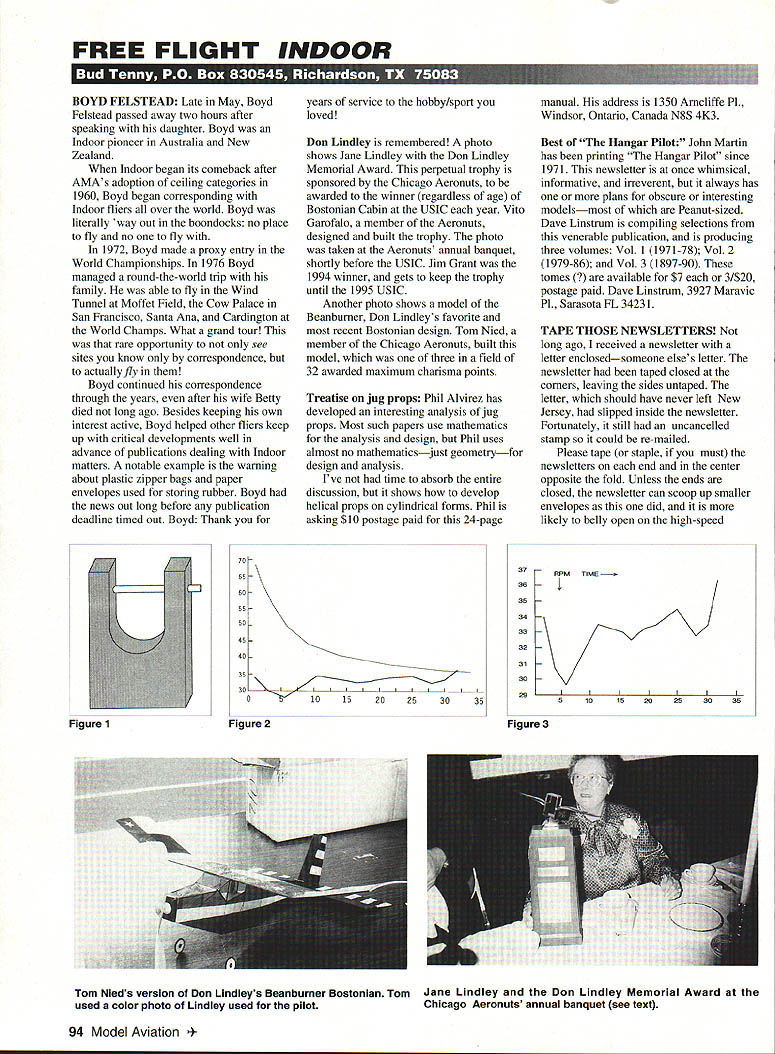
For years fliers have been using slotted plastic foam to hold motor sticks, tailbooms, and props. Effective anchoring depends on the slot being small enough to apply pressure to the part, which works in most cases. The downside is that high humidity can enlarge and soften the foam, possibly deforming the part. By making the slot just larger than the part and adding a retainer pin, there will be no pressure on the part.
- Use round toothpicks as retainer pegs.
- Drill or pierce the foam using a guide to set the location.
- If the retainer is too low, it will cause pressure; too high, and the part can move more than desired.
(The original illustration was produced on a computer by Donna Gatlin.)
RPM profiles—vital flight record
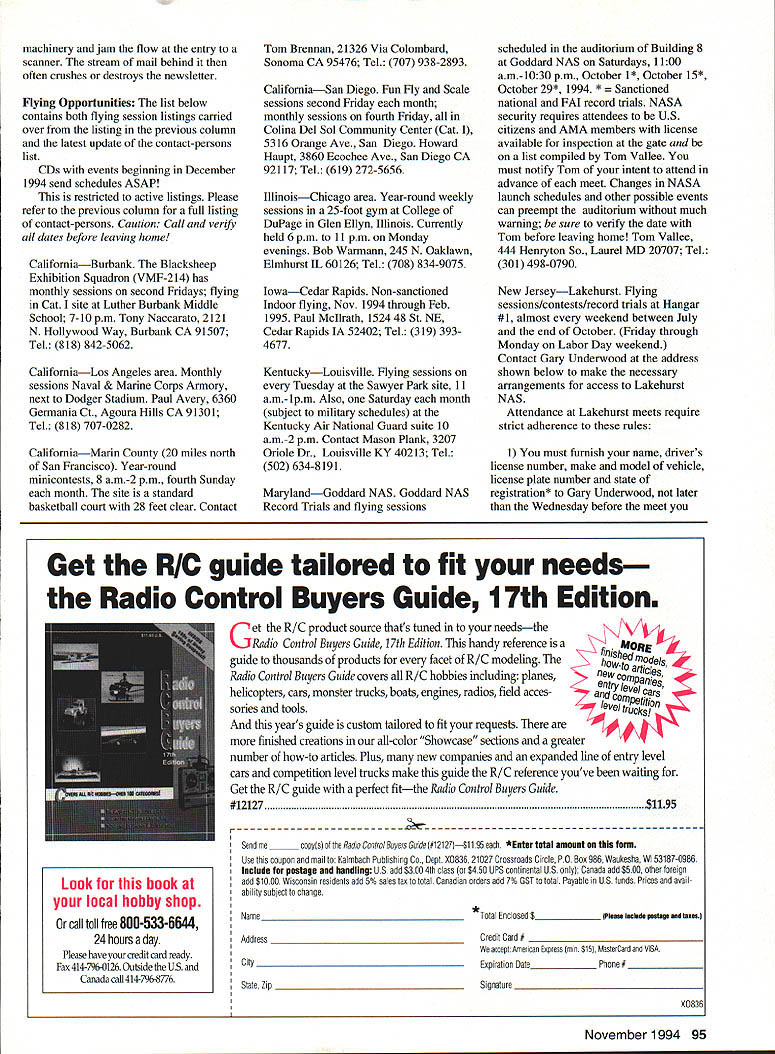
Two kinds of rpm profiles are now common, instead of the single type originally available. The familiar rpm profile of a non-variable prop shows rpm high at launch (causing gain in altitude while torque exceeds level-flight torque) then dropping slowly as the model settles into cruise. This curve is nearly identical to one recorded from Ed Stoll's best flight during the F1D Team Selection Finals in the American Airlines 747 hangar in Tulsa (mid-1970s).
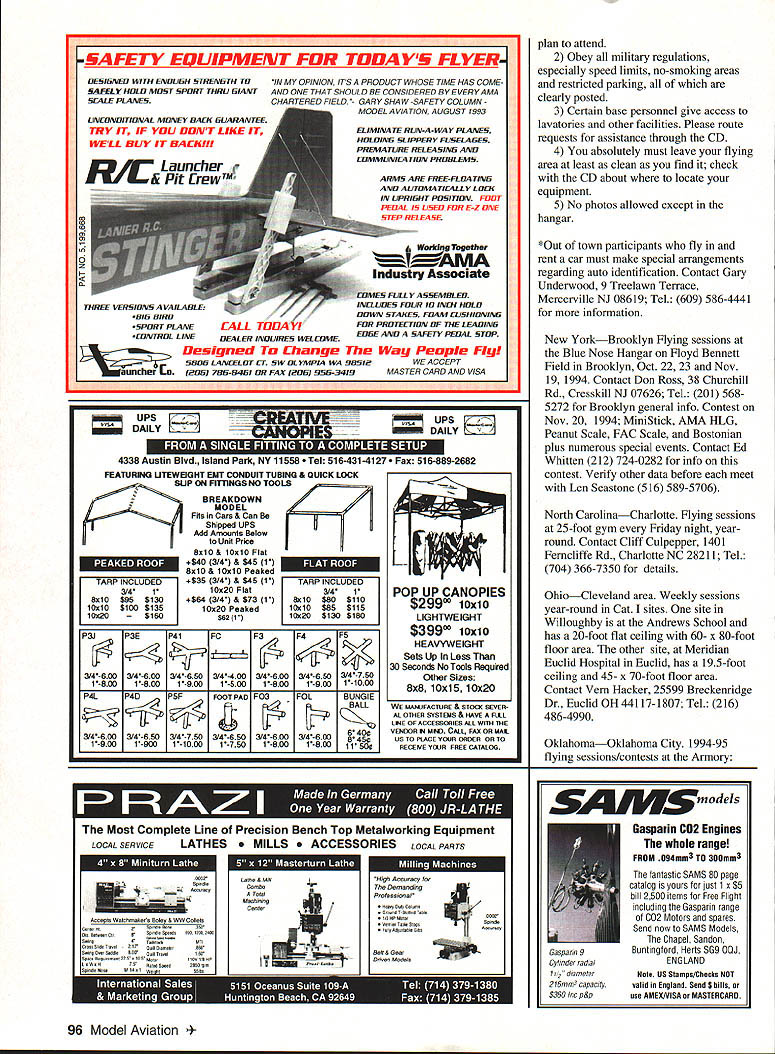
A different profile—shown in another example—rises slightly after the prop comes off the top stop, the opposite of a fixed prop. More detailed figures show this trend in Bob Randolph's 37:12 flight.
Transcribed from original scans by AI. Minor OCR errors may remain.

