
FREE FLIGHT INDOOR
Bud Tenny, P.O. Box 830545, Richardson, TX 75083
Overview
The 1994 National Aeromodeling Championships Indoor meet is over. Entry at Indoor was small, the site was one of the better ones in the country, and a few of the best indoor fliers attended. It was a really good contest, with strong and spirited competition in several events. Anyone (especially Texans) who passed up this meet missed a good event.
Site and Safety
The Coliseum at Texas Tech University in Lubbock, Texas, was rated by one flier as a 6 on a scale of 10 (from a flyability standpoint). To put that in context, he rated the Akron airdock as 10 and the ETSU MiniDome (site of the NFFS US Indoor Championships) as a 9. Another flier rated the Coliseum as the fifth-best site in the country; it is certainly by far the best site within a radius of 900 miles.
Except for a scoreboard centered in the flight area, only a speaker cluster added to the hazards common to other sports arenas. The speakers were shrouded in plastic that kept all models except one from getting caught. The scoreboard and the surrounding catwalk caught several models each day, all but one of which were returned undamaged.
The high degree of model safety was due entirely to the riggers. These young men, responsible for arranging lighting and display details for commercial events, casually roamed the catwalks like we use the sidewalk. After instruction in how to handle the models, the riggers retrieved model after model from the catwalk and scoreboard.
The one damaged model, Jim Clem’s Limited Pennyplane, had fallen out of reach inside the scoreboard into a tangle of wires. Even then, the propeller and motor stick were undamaged, and Jim had spare wings and tail surfaces. After quick repairs and a test hop, Jim made his final official flight. Probably no other indoor event flown in a coliseum has had so few damaged models.
Attendance and Public Interest
The low attendance most likely relates to timing—five weeks after the 1994 US Indoor Championships and two weeks after Andy Tagliafico’s annual event at the Kibbie Dome. Some fliers feared that contest officials might decide Indoor was a waste of time due to the low entry, but officials might not see the bigger picture. Fliers in District VIII believe this Nats greatly boosted local interest in indoor modeling.
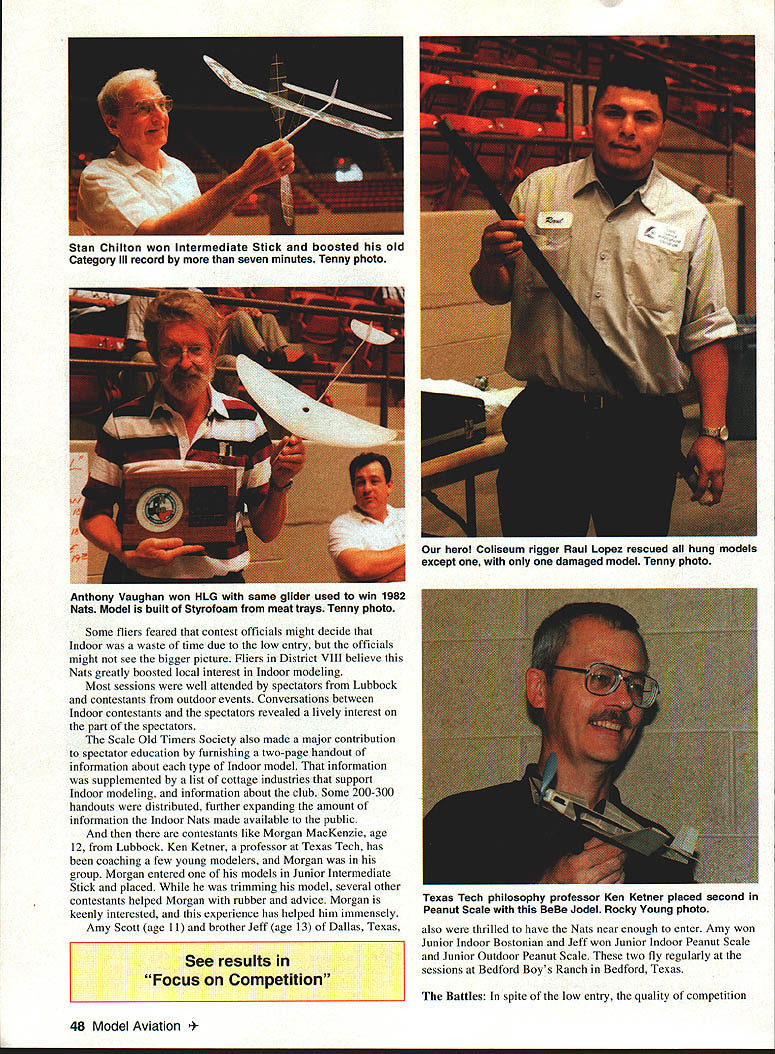
Most sessions were well attended by spectators from Lubbock and contestants from outdoor events. Conversations between indoor contestants and the spectators revealed lively interest. The Scale Old Timers Society contributed to spectator education by furnishing a two-page handout about each type of indoor model, supplemented by a list of cottage industries that support indoor modeling and information about the club. Some 200–300 handouts were distributed, expanding the information the Indoor Nats made available to the public.
Youth Participation
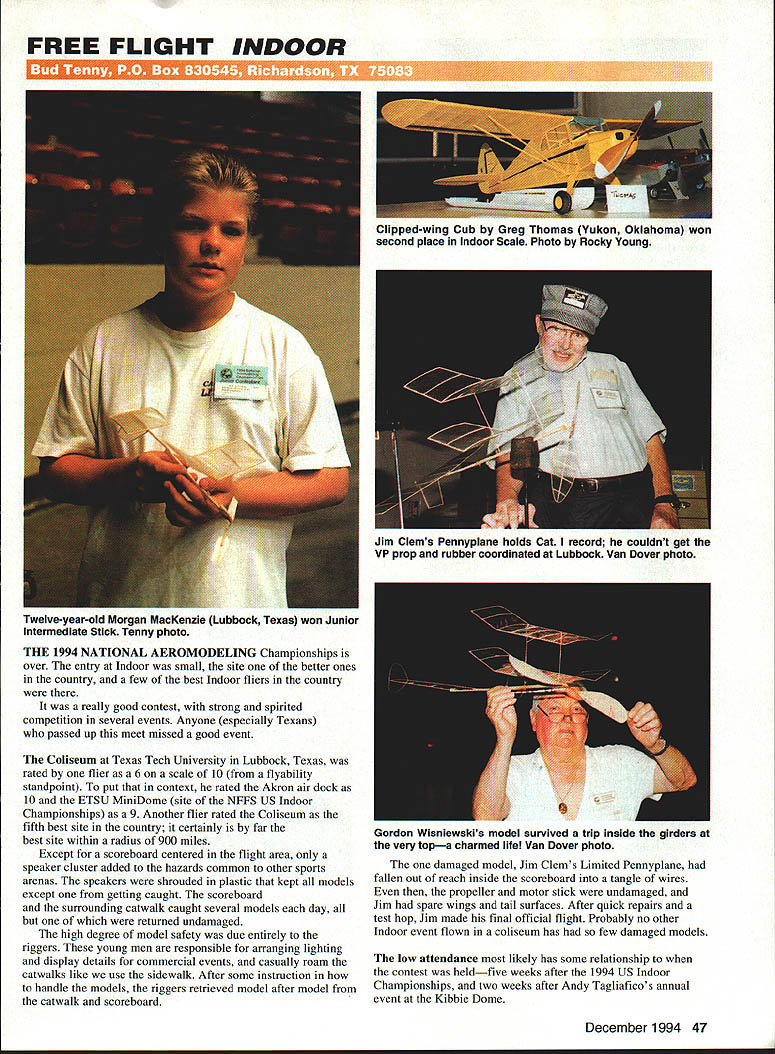
Contestants like Morgan MacKenzie, age 12, from Lubbock, illustrate the meet’s positive impact. Ken Ketner, a professor at Texas Tech, has coached a few young modelers; Morgan was in his group. Morgan entered a model in Junior Intermediate Stick and placed. While trimming his model, several other contestants helped Morgan with rubber and advice. Morgan is keenly interested, and this experience helped him immensely.
Amy Scott (age 11) and brother Jeff (age 13) of Dallas, Texas, were thrilled to have the Nats near enough to enter. Amy won Junior Indoor Bostonian, and Jeff won Junior Indoor Peanut Scale and Junior Outdoor Peanut Scale. These two fly regularly at the Bedford Boy’s Ranch in Bedford, Texas.
The Battles
In spite of the low entry, the quality of competition was high in Easy B, Limited Pennyplane, and Pennyplane. The winning fliers at this contest also win regularly at the US Indoor Championships at the MiniDome in Johnson City, Tennessee. This was the first time the Coliseum had been used for indoor flying, so everyone had a level playing field. The high times in most events show that these fliers can excel in adapting to a new site.
Entrants in Hand Launch Glider (HLG) had the toughest time adapting. No definitive ceiling-height information had been provided in contest literature, so HLG fliers had to guess what was needed. The weight and strength of HLG structure is closely related to available ceiling: overweight models climb well but come down too fast; underweight gliders simply won’t go high enough, even if they hold together during a hard launch.
Anthony Vaughan (Edmond, Oklahoma) and Jerry Chambers (Denver, Colorado), the top two HLG fliers, flew flight after flight trying to get a winning combination. Vaughan’s model was too light and Chambers’ model was too heavy.
The rubber-powered events were a different story. Three factors affected performance:
- Lubbock’s higher altitude (higher than any other active site except the Kibbie Dome).
- Temperature (similar to normal conditions at the Tennessee MiniDome).
- Humidity (much lower than at the MiniDome).
In this case, the low entry was a plus for rubber fliers, since there was room for partial-motor test flying.
Easy B times were tightly bunched, with a 69-second spread between first place and fifth until Stan Chilton (Wichita, Kansas) put up a last flight of 21:16 to move into first with a 2:32 margin. With ten fliers making official flights, Easy B had the most entrants of any Indoor Nats event this year.
Stan Chilton was primed for Intermediate Stick—his 28:29 flight in West Baden in August 1987 had not been surpassed, but he felt it would not be long before someone beat that record. His first flight at Lubbock upped the ante to 35:43 and outdistanced Dick Hardcastle’s second-place flight by more than 12 minutes.
Dick Hardcastle (St. Louis, Missouri) swept the Pennyplane events by narrow margins. His 15:19 in Pennyplane won by 21 seconds, and his 11:02 in Limited Pennyplane won by 29 seconds. Hardcastle repeated his USIC win with the same 14-year-old model he used in Johnson City. Second-place finisher Jim Clem (Plano, Texas) overcooked his model in a bid to win, and it went over the edge of the scoreboard and inside.
Gordon Wisniewski (Greendale, Wisconsin) closed with a scary flight that wound through the small girders at the very top of the site. He got away with it, but this was almost the only flight all week that got through the small girders at the very top of the site, so high without drifting into the scoreboard or catwalk.
Jim Clem wasn’t able to get his variable-pitch prop properly matched with rubber before the end of the flight period. The model currently holds the Category I Pennyplane record with a higher time than the 12:17 he posted in the Coliseum.
Catapult Glider Record Trials
At the start of the Nats, no Category III catapult glider records were listed on the record listing available at Indoor, probably because there are almost no Category III sites currently active. As Chairman of the Indoor Contest Board, I requested permission to conduct a special Record Trials for Catapult Glider. In the absence of the missing Nats event, the record trials were the only opportunity for record flights at this site.
An unofficial Catapult Glider event with cash prizes was offered if five entrants could be found. Until one hour before the end of the scheduled time slot, only four fliers were entered. Meanwhile, those four contestants had the opportunity to practice while the HLG event proceeded. At 1:10 p.m., the fifth and sixth contestants showed up, and flying began.
Nats Indoor Director Jesse Shepherd Jr. set up a flightline procedure where each flier made an official flight timed by two timers. As soon as the flight time was recorded and the watches were cleared, the next contestant in rotation launched. Forty minutes later, the flights listed below were recorded.
Record Trials results (best two flights and total):
- Dick Hardcastle — Best two: 43.9, 47.5 — Total: 91.4
- G. Wisniewski — Best two: 47.8, 41.0 — Total: 88.7
- Bud Tenny — Best two: 35.0, 36.0 — Total: 71.0
- Don Blackburn — Best two: 28.8, 32.7 — Total: 62.3
- Walter Legan — Best two: 5.0, 12.1 — Total: 17.0
- Anthony Vaughan — Best two: 2.2, 7.0 — Total: 9.0
Dick Hardcastle immediately began a new series of nine flights to satisfy the requirements for a record trials. He logged :51.6 and :51.5 for a potential national record, with about one minute left in the time slot assigned to HLG.
Other Unofficial Events
Most Nats have had unofficial events sponsored by the National Free Flight Society or the Miami Indoor Aircraft Modelers Association. Jesse Shepherd sponsored these unofficial events at Lubbock:
- MiniStick — won by Larry Calliau with 8:28.
- No-Cal Scale — won by Ken Stevens with 2:56.
- P-24 Rubber — won by Al Backstrum with 3:18.
- 14-gram Bostonian — won by Ken Stevens with 122.72 points.
Transcribed from original scans by AI. Minor OCR errors may remain.

