
FREE FLIGHT INDOOR
Bud Tenney, P.O. Box 830545, Richardson TX 75083
STEERING BAN REVISITED
The Indoor Contest Board rejected the proposed ban on steering of AMA class models in the initial vote. This decision affirms that steering will remain part of AMA contest strategy. The following passages from the Competition Regulations review an important steering parameter for contest directors and contestants: change of altitude during steering.
- Steering of Model. Steering is intended to alter the direction of flight and the general location of a model which is approaching the structure of the building. The intent of the rule is to avoid influencing either the altitude of the model or its rate of climb or descent during the period of steering.
Steering rules for AMA events shall be identical to the current rules for FAI Indoor Models (F1D).
3.4.7 Steering of Model (use of balloon and line or rod) a. Steering must only be used to avert collision with the structure of the building, its contents, or other models. Movements of the model must be primarily in the horizontal plane.
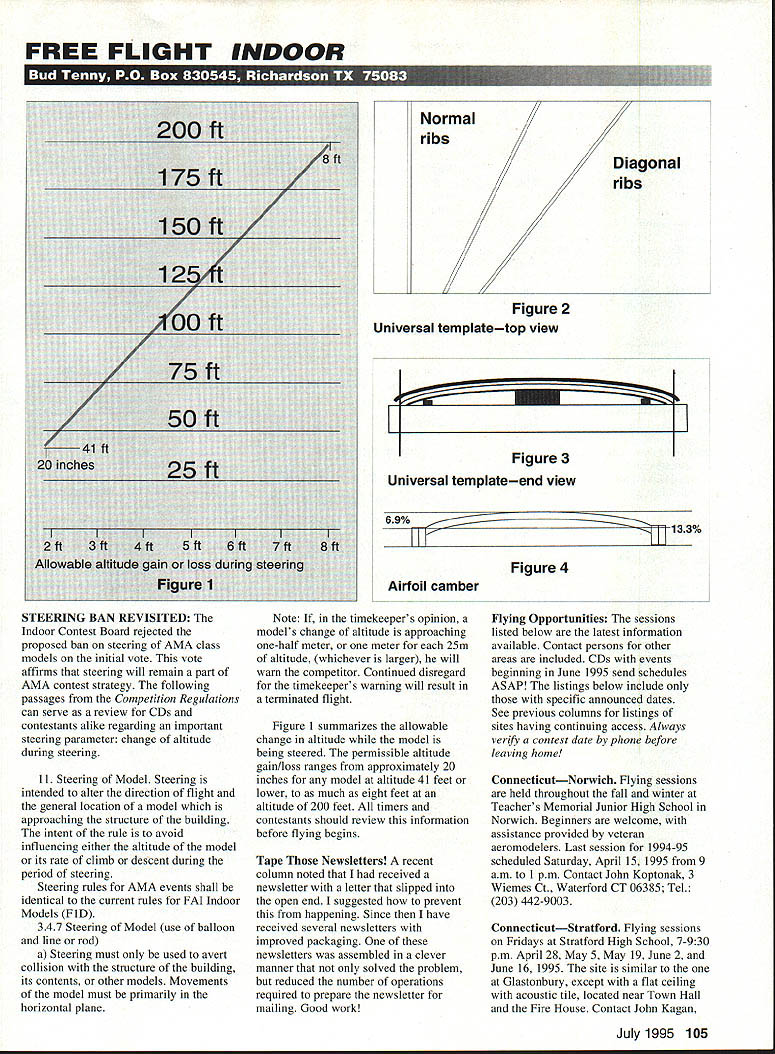
Note: If, in the timekeeper's opinion, a model's change of altitude is approaching one-half meter, or one meter for each 25 m of altitude (whichever is larger), he will warn the competitor. Continued disregard for the timekeeper's warning will result in a terminated flight.
Figure 1 (not shown) summarizes the allowable change in altitude while the model is being steered. The permissible altitude gain/loss ranges from approximately 20 inches for any model at altitude 41 feet or lower, to as much as eight feet at an altitude of 200 feet. All timers and contestants should review this information before flying begins.
Tape Those Newsletters!
A recent column noted that a newsletter had a letter slip into the open end. Suggestions were offered to prevent this. Since then several newsletters have been received with improved packaging. One newsletter was assembled cleverly in a way that solved the problem and reduced the number of operations required to prepare the mailing. Good work!
Flying Opportunities
The sessions listed below are the latest information available. Contact persons for other areas are included. Contest directors with events beginning in June 1995 should send schedules ASAP. The listings below include specific announced dates. See previous columns for sites with continuing access. Always verify a contest date by phone before leaving home.
- Connecticut — Norwich
Flying sessions held throughout the fall and winter at Teacher's Memorial Junior High School in Norwich. Beginners are welcome; assistance provided by veteran aeromodelers. Last session for 1994–95 scheduled Saturday, April 15, 1995, from 9 a.m. to 1 p.m. Contact John Koptonak, 3 Wiemes Ct, Waterford CT 06385; Tel: (203) 442-9003.
- Connecticut — Stratford
Flying sessions on Fridays at Stratford High School, 7:00–9:30 p.m.: April 28, May 5, May 19, June 2, and June 16, 1995. The site is similar to Glastonbury, except with a flat ceiling with acoustic tile, located near Town Hall and the Fire House. Contact John Kagan, 3699 Broadbridge Ave, Apt. 310, Stratford CT 06497; Tel: (203) 378-8940.
- Florida
The session at Tampa MacDill rounds out the Florida indoor season. State Indoor Meet #6 April 22–23. Armed Forces Day meet is the last state meet. MIAMA's 24th indoor season includes mass-launch biplanes May 20–21, 1995. Contact John Martin, 2180 Tigertail Ave, Miami FL 33133; Tel: (305) 858-6363.
- Idaho — Kibbie Dome
Kibbie Dome Annual will be held the week of July 12–13, 1995. Contact Andy Tagliafico, 10039 Quail Post Rd, Portland OR 97219; Tel: (503) 371-0492. Easy B International Meet: July 14, 1995. Contact Andy Tagliafico (same address/phone). Indoor Nats: July 15–18, 1995. Contact Abram Van Dover, 112 Tillerson Dr, Newport News VA 23602; Tel: (804) 877-2830.
- New Jersey — Lakehurst
1994 flying sessions/contests/record trials in Hangar #1 were scheduled almost every weekend between July and the end of October. For information on the 1995 season send SASE to Gary Underwood, 24 Kennebec Ct, Bordentown NJ 08505 or call (609) 324-9004.
- New York — Brooklyn
Indoor contest April 22–23, 1994, Blue Nose Hangar, Floyd Bennett Field, Brooklyn. Site has a 150 × 450-foot floor, 45-foot rafters, and field truss beam for easy retrieval. Contact Ed Whitten, 67 Riverside Dr #9A, New York NY 10024; Tel: (212) 724-0282.
- Pennsylvania — Reading
Reading Indoor Air Races, DKI Hangar, Reading Airport, May 6, 1995, 9 a.m.–5 p.m.
- Tennessee — Johnson City
Add to events listed in the May ’93 column: MIAMA-sponsored Grand Prix on Saturday evening. Contact John Martin, 2180 Tigertail Ave., Miami FL 33133; Tel: (305) 858-6363.
- Virginia — Hampton area
The Langley Brainbusters winter indoor contest schedule concludes with a meet on Apr. 23, 1994, 1–6 p.m. This contest is held at the SBH Gym and features EZ-13, Limited Pennyplane, Bostonian, No Cal, A-6, 8-inch hand-launch glider, and Mini Stick. All events count for scoring. Contact Abram Van Dover, 112 Tillerson Dr., Newport News VA 23602; Tel: (804) 877-2830.
Tan II Lore
Shortly after Tan II became available, various reports attributed properties, good and bad, to the new rubber. Further experience with Tan II has disproved some early reports while confirming others.
- Energy storage: Most reports now confirm better energy storage than Tan I.
- Temperature sensitivity: Early reports of energy sag at lower temperatures have not always proven out. In Cat. I flights at 60°F, no sag was detectable in some tests.
- World Championships experience: The U.S. team prepared with both Tan and Pirelli but used Tan II in the cold with no problems. Some European teams believed “cold is bad” and therefore did not bring Tan.
Some outdoor fliers have reported broken strands in Coupe motors flown in 90°F weather, but others (including Jim Clem and the author) experienced no breakage or mechanical damage in 93°F low-humidity air at the Lubbock Nats. Under the same conditions, Stan Chilton experienced a high level of breakage.
Two factors may explain these different experiences:
- Lubricants: Jim Clem and the author use Armor All or Son of a Gun (automotive vinyl/restorer products) as lubricant during break-in/winding. Dipping a finger and thumb in Armor All while massaging knots during the final winding phase may both cool and lubricate the rubber.
- Stretching: Jim Clem and the author do not stretch the rubber as far during initial winding as Stan does.
Universal Rib Template
Laminated ribs and reinforcement techniques (including boron) have been discussed previously. A common element is the need for molds, forms, or templates: each rib station needs a template to set rib length and camber. Andy Tagliafico’s method uses a male and female form to sandwich laminations until the glue dries.
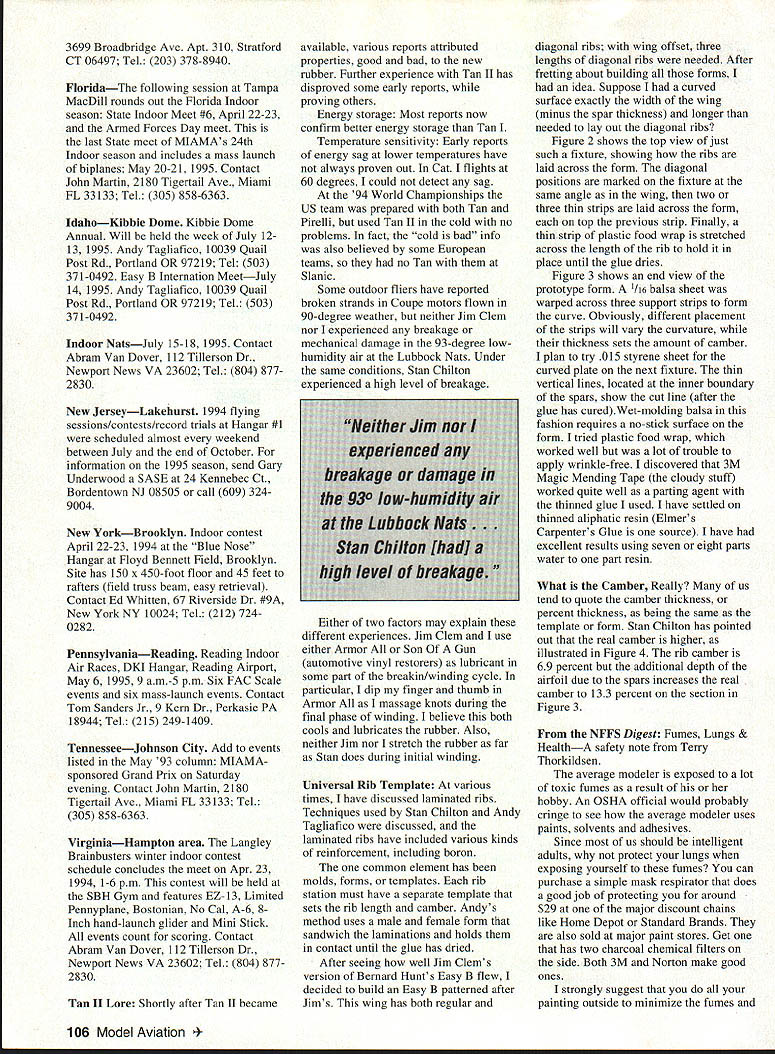
After seeing Jim Clem’s version of Bernard Hunt’s Easy B, the author patterned a similar wing with both regular and diagonal ribs; with wing offset, three lengths of diagonal ribs were needed. Rather than build many separate forms, the author made a curved surface exactly the width of the wing (minus spar thickness) and longer than needed to lay out the diagonal ribs.
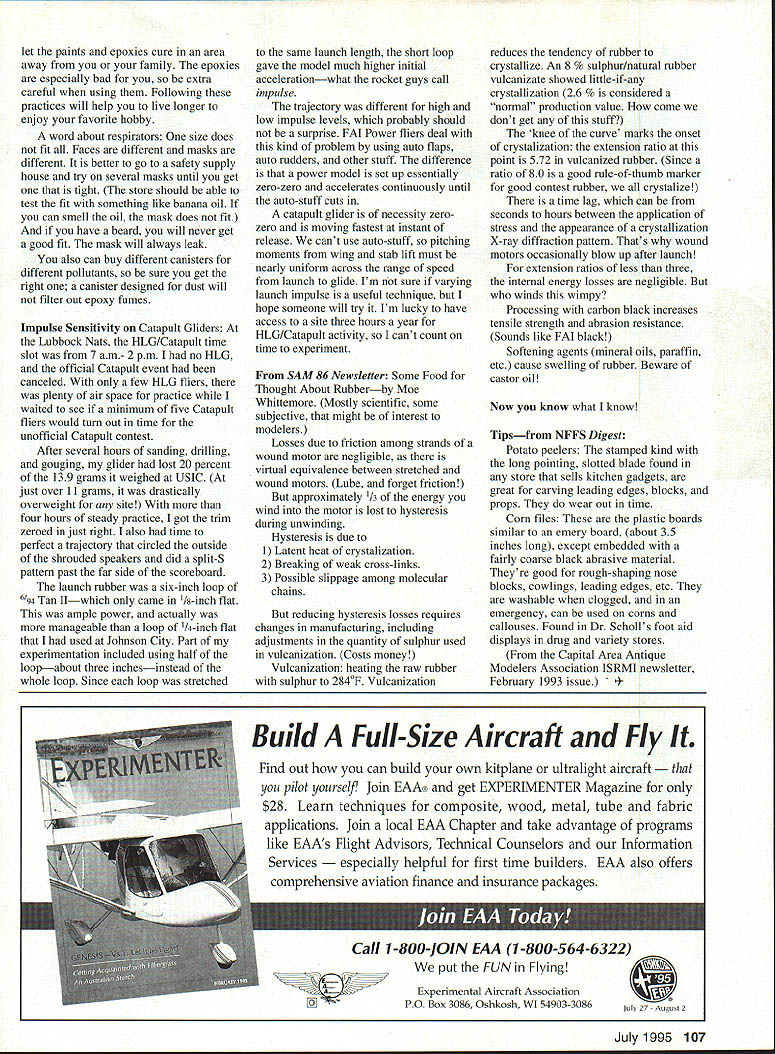
- Construction: A 1/16" balsa sheet was warped across three support strips to form the curve. Different placement of the strips varies the curvature, while their thickness sets the amount of camber. For the next fixture, trim a 1/8" styrene sheet for the curved plate.
- Assembly: Diagonal positions are marked on the fixture at the same angle as in the wing; two or three thin strips are laid across the form, each on top of the previous strip. A thin strip of plastic food wrap can be stretched across the length of the rib to hold it in place until the glue dries.
- Parting agent and glue: Wet-molding balsa requires a no-stick surface on the form. Plastic food wrap works but is hard to apply wrinkle-free. 3M Magic Mending Tape (cloudy type) works well as a parting agent with thinned glue. The author uses thinned aliphatic resin (Carpenter’s/Elmer’s glue) thinned about seven or eight parts water to one part resin.
What is the camber, really? Many tend to quote camber thickness based on the template or form. Stan Chilton pointed out that the real camber is higher because the additional depth of the airfoil due to spars increases the effective camber. For example, a rib camber of 6.9% can become 13.3% on a section when spars are included (see Figure 3 and 4 references).
From the NFFS Digest: Fumes, Lungs & Health — a safety note from Terry Thorkildsen
The average modeler is exposed to many toxic fumes from paints, solvents, and adhesives. An OSHA official would likely cringe at how many modelers work without protection. Protect your lungs:
- Use an inexpensive mask (about $29) with replaceable cartridges — available at major discount chains (Home Depot, Standard Brands) and at most paint stores. Both 3M and Norton make good masks.
- Do painting outside when possible to minimize fumes.
- Use a respirator with appropriate cartridges when spraying or working with strong solvents.
Catapult Glider Launch Impulse (notes)
Comparing launch loops of different lengths but to the same launch length, the short loop gave the model much higher initial acceleration — what rocket folks call impulse. The trajectory differed for high and low impulse levels. FAI power fliers handle such differences with auto flaps, auto rudders, and similar devices; power models accelerate continuously until the auto systems cut in.
A catapult glider is necessarily at zero airspeed at release and is moving fastest at the instant of release. Auto-control devices cannot be used, so pitching moments from wing and stab lift must be nearly uniform across the speed range from launch to glide. Varying launch impulse could be a useful technique to explore; experimentation is limited by access to suitable sites.
From SAM 86 Newsletter: Some Food for Thought About Rubber — Moe Whittemore
- Friction losses among strands in a wound motor are negligible; there is virtual equivalence between stretched and wound motors (use lubricant and forget friction).
- Approximately one-third of the energy wound into the motor is lost to hysteresis during unwinding.
- Hysteresis is due to:
- Latent heat of crystallization.
- Breaking of weak cross-links.
- Possible slippage among molecular chains.
- Reducing hysteresis losses requires manufacturing changes, including adjustments in sulphur content during vulcanization (which costs money).
- Vulcanization: heating raw rubber with sulphur to about 284°F. Vulcanization reduces tendency to crystallize. An 8% sulphur/natural rubber vulcanizate showed little or no crystallization (2.6% is typical production value).
- The “knee of the curve” marks onset of crystallization; there is a time lag (seconds to hours) between application of stress and appearance of crystallization patterns. That can explain why wound motors sometimes fail after launch.
- For extension ratios less than three, internal energy losses are negligible (but few wind so little).
- Adding carbon black increases tensile strength and abrasion resistance (typical of FAI black rubber).
- Softening agents (mineral oils, paraffin, etc.) cause swelling of rubber. Beware of castor oil.
Now you know what I know.
Tips — from NFFS Digest
- Potato peelers: The stamped kind with a long pointed, slotted blade (found in kitchen gadget sections) are great for carving leading edges, blocks, and props. They do wear out with use.
- Corn files: Plastic boards similar to an emery board (about 3.5 inches long) embedded with coarse black abrasive are good for rough-shaping nose blocks, cowlings, and leading edges. They are washable when clogged and can be found in Dr. Scholl's foot aid displays in drug and variety stores.
(From the Capital Area Antique Modelers Association ISRM newsletter, February 1993 issue.)
Transcribed from original scans by AI. Minor OCR errors may remain.

