
FREE FLIGHT INDOOR
Bud Tenny, P.O. Box 830545, Richardson TX 75083
ON LINE! Anyone wishing to contact me via electronic mail can use either CompuServe (73220,3212) or the Internet (rten@unicomp.net).
It's really difficult to lose a close friend. Earle "Foggy" Moorhead died on February 27 after a long stay at the Salem Hospital, where he had been recuperating from surgery. All of us who knew him will miss his cheerfulness and warm personality. Although he was not a competitor at the field, he was a constant companion and helper, providing many of us with untold hours of enjoyable friendship. He was a long-term member of the District XI Scale Contest Board, and was probably best known as the continuous president of the Willamette Modelers Club. His term with the club was longer than FDR's presidency. Those of us who considered him a friend, and the numbers are legion, will not soon forget him. (This news comes from the WMC Patter, edited by Bob Stalick.)
Keeping Lakehurst Alive
The following information comes from Gary Underwood, president of the East Coast Indoor Modelers. It concerns all who are interested in preserving one of the world's oldest and most valuable indoor flying sites.
The government's military base closure commission has identified Lakehurst as a closure target. New Jersey state officials are developing a defense with the "Save Lakehurst Committee" to prevent closure. You can help in several ways:
- Help fund the Save Lakehurst Committee. Contact George Gillmore at (908) 240-6000. Contributions can be made through this number.
- Participate in Congress petitions and letters of support. Contact Loretta Chabonneau at (908) 350-2300.
Our support is crucial in the defense of the base. As news develops, I'll pass it along and provide instructions on how to direct your support.
A New Book About Indoor Models
Lew Gitlow has produced a new book about indoor models. There was at least one copy at the 1994 USIC, but I hadn't seen a copy until recently. Lew has packed the book with sketches, commentary, hints—all the topics you'd expect, including first-visit indoor site guidance, flying models, schools, history, models, rubber techniques, design sketches, and a torque-actuated variable-pitch propeller. Indoor Flying Models is priced at $22. It's available from Indoor Model Supplies, Box 5311, Salem OR 97304. A very good book.
Oops! My March 1995 column showed a picture of a simple but appealing Bostonian built by Peter Van Dore. Peter wrote to say it is called the "Beginner's Bostonian," designed by Carl Hedley. The plans were published in Bill Hannan's book Stick & Tissue, Vol. 1. "The stab was supposed to be on top of the rudder," Peter noted, "but I must have had a martini before assembling it."
Another New Indoor Event (from WMC Patter)
The Legal Eagle has spread its wings. It's being sponsored as a new event at indoor sites in the U.S. The event was originally developed on the East Coast, flown by the MIAMA group. Our upcoming two-day indoor meet is no exception; we'll have Eagles at South Albany. Here, in brief, are the rules:
#### Drawing Requirements
- The drawing must fit on one side of a sheet of legal-size (8.5 x 14 inch) paper.
- No component parts on the drawing may be superimposed or overlap one another. They must clear one another and the edge of the paper by at least 1/8 inch.
- Wing(s) and stabilizer must be drawn full-span, tip-to-tip.
- Fin(s) may be drawn where space allows, not necessarily attached to the side view.
- The landing gear must be drawn full-length, in-place on the side view.
#### Design Requirements
- The smallest wood size is 1/16 square.
- The fuselage volume must contain a 1 1/2 x 3-inch cube.
- The fuselage must have a cabin (or open cockpit) with a raised windshield of at least 30°. The cockpit must be open, with a head rest or canopy.
- The leading and trailing edges of flight surfaces cannot parallel each other.
- The tip outlines cannot have any straight lines (except for a stabilizer, where twin fins are used).
- If twin fins or two wings are used in the design, duplicate parts may be built over the same drawing.
- Japanese tissue covering only — no Mylar covering. Flight surfaces may be single- or double-covered.
- The landing gear must use at least one 1-inch hardwood wheel.
- The use of motor sticks or tubes is permitted.
#### Flying
Models must take off from the ground, a tabletop, or other surface. The highest total of three flights wins.
Lighter and Lighter!
Our plastics mavens in Florida have done it again. The latest covering film is called PM2L, and is claimed to weigh 2 1/2 oz (95% as much as Mylar). This film is available in 15-ft lengths for $15 (postage paid) from Dick Obarski, 2112 N. Halcyon Dr., Sun City Center FL 33573.
Flying Opportunities
The sessions listed below are the latest information available. Clubs with events beginning in August 1995, send schedules ASAP! The listings below include only those with specific announced dates. See previous columns for listings of sites having continuing access. Always verify a contest date by phone before leaving home!
#### MARYLAND — Goddard NAS
Record trials and flying sessions in the auditorium of Building 8 at Goddard NAS have been requested on Saturdays, 11 a.m. to 11 p.m., on August 5, August 19, September 9, September 23, October 7, October 21, and November 4*, 1995. Dates marked with an asterisk (*) indicate sanctioned national and FAI record trials.
NASA security requires that attendees be U.S. citizens and AMA members, with license available for inspection at the gate. Fliers must also be on a list compiled by Tom Valle. You must notify Tom of your intention to attend in advance of each meet. Changes in NASA launch schedules and other events can pre-empt auditorium use — BE SURE to verify the date with Tom before leaving home! Contact Tom at 444 Henryton St., Laurel MD 20707; Tel.: (301) 498-0790.
#### NEW JERSEY — Lakehurst
1995 flying sessions/contests/record trials are scheduled almost every weekend between July and the end of October at Hangar #1.
Attendance at Lakehurst meets requires strict adherence to these rules:
- You must furnish your name, driver's license number, make and model of vehicle, license plate number, and state of registration to Gary Underwood not later than the Wednesday before the meet you plan to attend.
- Obey all military regulations, especially speed limits, no-smoking areas, and restricted parking — all of which are clearly posted.
- Certain base personnel must give access to lavatories and other facilities. (Please route requests for assistance through the Contest Director.)
- You must leave your flying area as clean as you found it — check with the Contest Director about where to locate your equipment.
- No photos are allowed, except in the hangar.
Out-of-town participants with rental cars must make special arrangements for auto identification. Contact Gary Underwood at 24 Kennebec Ct., Bordentown NJ 08505. Call (609) 324-9004 for more information.
MINI #3 MINICOS #2 Dia. Angle Pitch Angle Pitch 2.0 48.5 7.10 51.5 7.89 3.0 46.5 9.90 50.5 11.4 4.0 41.5 11.1 50.5 15.2 5.0 40.0 13.2 50.5 19.1 6.0 32.0 11.8 50.5 23.7
Ratio p@6/p@3 = 1.8 2.08
Prop Pitch Blues
For some time I've been concerned about how the measured pitch of can props always seems to increase (sometimes drastically) from hub to tip. I measured blade angles on some MiniStick props at one-inch increments, from the two-inch to the six-inch diameter to get the above data.
Note that the pitch on MINI #3 reduces slightly at the tip, but that MINICOS #2 has no reduction in pitch at the same diameter. The MINICOS #2 has a blade shape similar to the ones used by Larry Coslick. The ratio between the angle at the six-inch diameter and the three-inch diameter is better on the first prop. Also, if you compute the blade-angle distribution of the common can-prop form, the pitch reduction at the tip even in the first prop continues, washing out the tip even more.
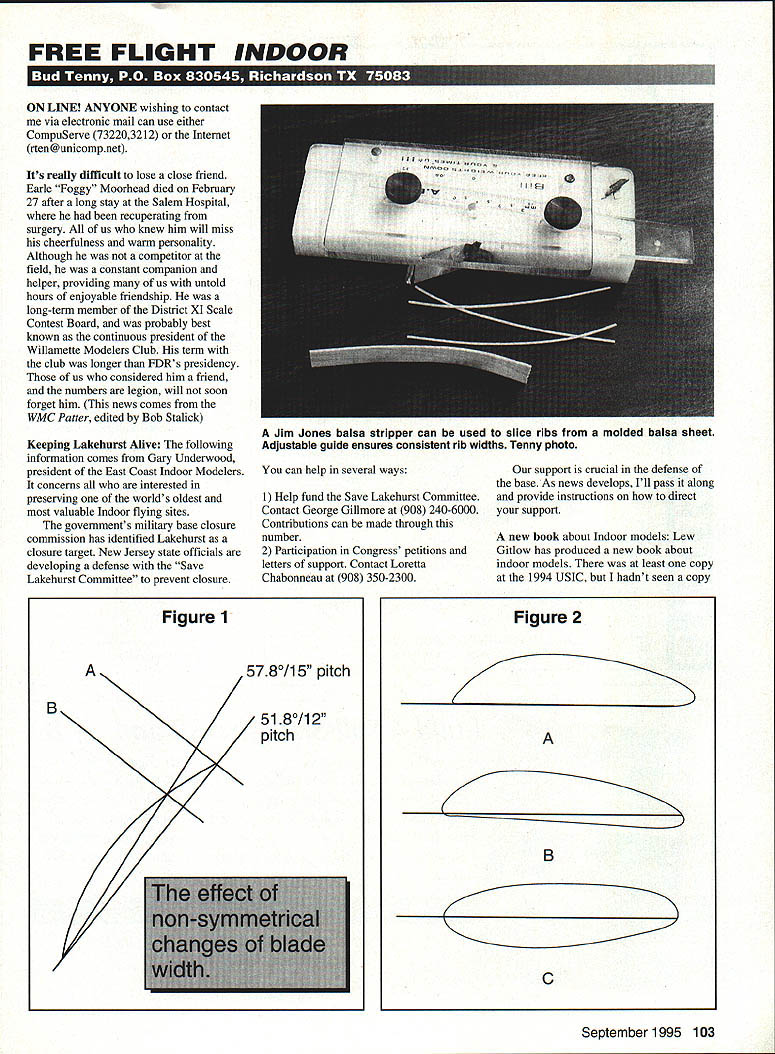
I finally figured where part of the problem lies; Figure 1 shows this concept. Larry's prop designs reduce the blade width from the leading edge only, as shown in Figures 2a and 2b. Figure 1 shows the view of a blade segment, and the effect of removing blade area ahead of the blade centroid. A blade segment with 12-inch pitch (a) increases to 15-inch pitch when the leading edge (only) is trimmed.
In Figure 2c, trimming the leading edge reduces the pitch toward the tip. If the blade is symmetrical around the centerline, the blade retains the pitch distribution of the form. More on these themes later!
Launch Impulse on Catapult Gliders
In an earlier column I speculated about using varying impulse to control the launch trajectory of catapult gliders. To vary impulse I use loops of different lengths, from the same rubber, stretched to the same length. A shorter loop applies more force to the glider in a shorter time (force/time or impulse). I've had a few chances to try this with my Category I catapult, with interesting results.
My new glider weighs in at about 3.5 g (too heavy for Category I). It can be flown up to 40 feet using a loop of .029 rubber!
Clearly, this rubber is too strong for Category I. Using a short loop stretched less (high impulse) overpowered the glider's structure. Nothing broke, but the trajectory had a hump, like a car crossing a speed bump. A longer loop length and a higher launch angle gave far more launch consistency.
Next time, I'll start with a much longer loop, and shorten it until the launch angle is the highest the glider can use, and the peak altitude is just below the ceiling. This approach reduces the number of variables in the launch, making it easier to trim for a given site.
Try catapult glider—it's a lot of fun and your arm lasts forever!
Model Trim and Troubleshooting
Larry Coslick has proven himself as an excellent builder and skilled flier of indoor models. This piece was first published in the newsletter of the Kirkwood Thelmaeleers, edited by Chris Matsuno. Follow Larry's investigation technique; maybe you can solve your tough trim problems!
#### Butterfly Blues
For the past two years I have been using a butterfly stab on my EZB. The model has experienced a spin-in problem when it would get above the ceiling, hang up, and fall free. If it did a tail slide there were no problems, but if the nose dropped too much, the model would pick up speed and spin in.
I was able to duplicate this problem at home by putting 400 turns in the motor and releasing the EZB at a 15° angle toward the floor. Each time it would spin in. As the prop speed increased, the model would go into a flat spin to the left, then into a more violent nose-down spin.
The spin was occurring so fast, it was difficult to see what was happening to the wing and stab. It didn't appear that the wing or stab was tucking under on the first flat spin, but by the third spin the wing did tuck in.
I tried bracing the wing's leading edge first. Eventually I had all the panels braced, but this didn't help. Washout on the outboard wing panel helped somewhat, but I used this primarily to control high-torque launches. I tried turning the reverse-airfoil stab around, but it still spun in.
I was running out of ideas when my eye caught a spare MiniStick slab I had on the shelf. I cut off the tip, back to the first rib, and installed it under the stab as a rudder. When I released the model with its new rudder it recovered immediately. In the final test I took EZBs with V-stabs and sub-rudders to our local flying site and they climbed to around 15 feet. I placed a steering pole in front of the model so it would stop and start sliding down the pole. When the nose dropped, I pulled the pole away and each model recovered nicely.
It appears that the increased rotation of the prop in a dive has a destabilizing effect on the model's directional and spiral stability—if the rudder area is too small. I haven't done any additional testing, but if an increase in the stab dihedral doesn't help, I'll use a conventional stab and rudder.
A Steering Drone?
Do you have a sturdy model that doesn't quite do as well as you'd like? Take off its big prop, lighten and rebalance it, and fly it "low and slow" on a smaller rubber and prop. Now you have a model you can use to practice steering. Since you're not going all-out for a record, you can use a site with an odd ceiling height, rafters, or a drift problem. You can also practice retrieval if it hangs up. Without the pressure to win, you'll be more relaxed—an excellent learning environment!
Here's a bit of humor by Grant Carson, from the Thermal Thumbers' newsletter (edited by Stan Buddenbohm).
Dihedral Measurement
In my workshop, there are four increments. From least to most, they are: the height of a small dope bottle lying flat; the height of a small dope bottle on its side; the height of a small dope bottle standing upright; and the height of a large dope bottle. Anyone who needs a more incremental system is pretentious.
Weight of Balsa
In my workshop, there are three balsa weights. One is so stiff it can't be cut with a razor knife. I use it for posts to level furniture. Another weight is so light it tears unless a new blade is used. It's the best stuff. Then there's the rest, which is most of what I have.
Transcribed from original scans by AI. Minor OCR errors may remain.

