
FREE FLIGHT INDOOR
Bud Tenny, P.O. Box 830545, Richardson TX 75083
Dick Ganslen
Many indoor fliers will remember Dick Ganslen, who was active for many years until a fall from a ladder resulted in severe injuries that required a long recuperation. He died in late May 1995.
Dick was a physiologist and a world‑renowned pole‑vault authority—an All‑American in the pole vault and the triple jump (he last competed in his mid‑ to late‑60s). He wrote articles and books on the mechanics of the pole vault, aerodynamics of pole vault/discus/javelin flight, sports psychology, sports physiology, and pharmaceutical applications in sports skills. He was a professor at several colleges, including Texas Woman's University, Denton, Texas.
Texas fliers remember his sponsorship of numerous contests and flying sessions in the TWU ballroom. Due to his long illness, newer fliers in Texas may not remember him, but the old‑timers do. Thanks for all you did, Dick!
1995 USIC
Dan O'Grady performed the incredible feat of publishing the June/July 1995 issue of SAM 86 Speaks within a week or so after the event. That issue contained full results for almost all the USIC events plus an entertaining report. Ten Canadians participated in the USIC; five Canadian records were set.
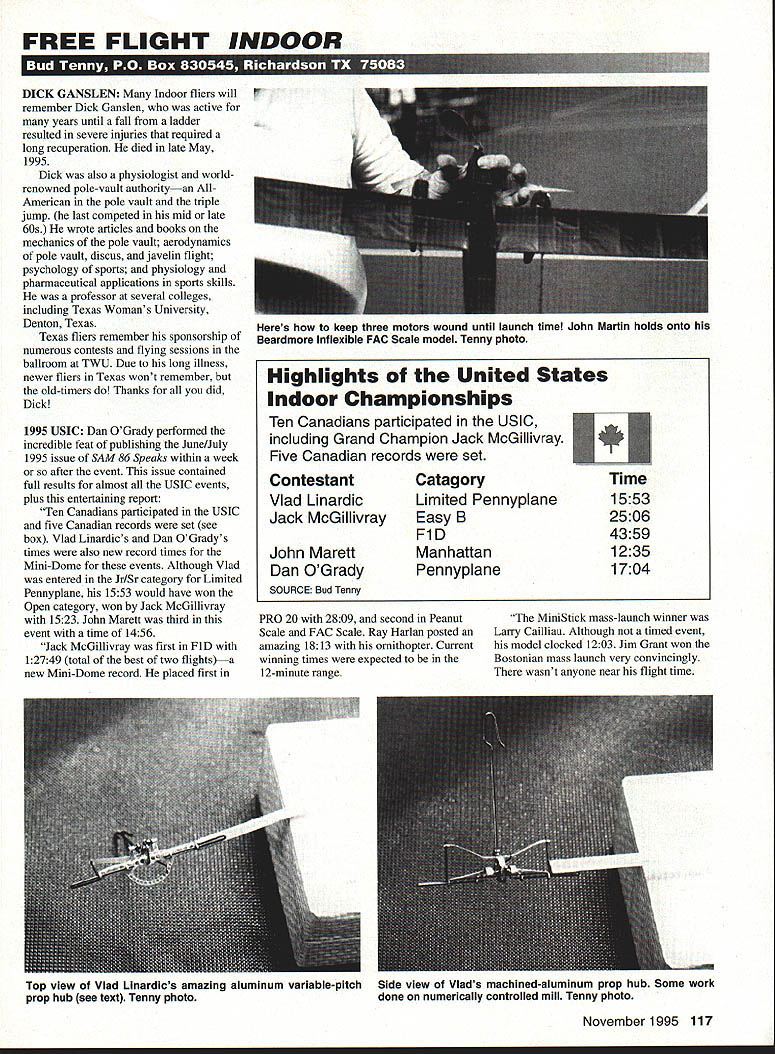
#### Highlights of the United States Indoor Championships
- Vlad Linardic — Limited Pennyplane — 15:53
- Jack McGillivray — Easy B — 25:06
- Jack McGillivray — F1D — 43:59 (best two flights total 1:27:49 — new Mini‑Dome record)
- John Marett — Manhattan — 12:35
- Dan O'Grady — Pennyplane — 17:04
Jack McGillivray placed first in F1D with a combined total of 1:27:49 (best two flights)—a new Mini‑Dome record. He also placed first in PRO 20 with 28:09, and second in Peanut Scale and FAC Scale. Ray Harlan posted an amazing 18:13 with his ornithopter. Current winning times were expected to be in the 12‑minute range for some events.
The MiniStick mass‑launch winner was Larry Cailliau; although not a timed event, his model clocked 12:03. Jim Grant won the Bostonian mass launch convincingly—no one came close to his flight time.
Indoor fliers provided many memorable flights. Pete Olshefsky posted impressive times in Easy B, Pennyplane, Limited Pennyplane, and Intermediate Stick. Jim Zufelt beat the previous high time in Easy B to loud applause from the Dome crowd.
Cohn Raymond‑Jones suffered a mishap when a 35 cm model was seriously damaged and appeared headed for the waste barrel. Cohn rebuilt the model on the spot, salvaged parts, and flew other models creditably (best 13:48). He also improved personal bests in Easy B and Pennyplane.
I’d be remiss not to mention the hard work of the Kirkwood Thermaleers in organizing and running the USIC for years. USIC results were first‑class thanks to contributors such as Larry Coslick, Roy White, Gary Underwood, Mary Jane O'Reilly, Howard Henderson, and Bill Martin.
Using Dan's listing:
- Standard Class Catapult Glider: Mike Thompson won Standard Class with 8:30, seven seconds ahead.
- Unlimited Catapult: Ralph Schlarb won with 8:31, five seconds ahead of Robert Warman.
- Open HLG: Jim Buxton won again; his total was 17 seconds less than Mike's catapult time.
- Jim Clem built two Thrushes (John Lenderman design); these tied Gordy Wisniewski’s time, finishing third, 11 seconds behind Dan O'Grady’s 17:04 winning time. Jim abandoned an aging variable‑pitch prop and used a fixed prop.
- John (last name omitted) flew a Thrush with an 80% 55‑inch wing and a 135‑inch‑diameter prop, finishing seventh with 11:12.
Other noteworthy flights:
- Larry Coslick — Easy B — 27:01 weighing one‑half gram
- Bernard Hunt — AMA Stick — 46:14 using tandem
- F1D — 38:06 in Intermediate Stick (report excerpt)
- MiniStick: Laurie Barr — 12:33; Larry Cailliau — 12:30
- Dave Aronstein (back in competition) — Bostonian best 5:34, score 7:50.95
- Senior Vlad Linardic — Easy B — 24:08 (would have been sixth in Open)
- Andy Tagliafico — Federation ROG — 9:15
- Larry Loucka — No‑Cal Scale — 8:02
New Events
P‑24 and PRO 20 were introduced this year.
- P‑24: seven‑model mass launch. Jim Clem and Bud Tenny placed first and second by a good margin even after a midair collision between their models. Jim's 5:25 suggests this event will top six minutes if held again.
- PRO 20: drew five official flights. Jack McGillivray turned 28:09—impressive for a 68‑square‑inch model.
Harmonica Concert
One afternoon, USIC Director Roy White decided to liven things up and asked Richard Miller (of Bluefin Bostonian fame) to play his harmonica over the PA system. One of the tunes was an Irish jig—and Jim Miller responded by dancing that jig!
Noteworthy Trend
It seemed more of the "touchy" models—Easy Bs and MiniSticks—were grooving out on launch. That behavior has long been a benchmark that signals correct trim. My observation is that 95% of misbehaving models (staggering, stalling, etc.) go off with reverse stall caused by stick twist. If you have a favorite trim combination that cures the staggers, please share it with us.
That’s Incredible
Two photos show a variable‑pitch prop hub designed and constructed by Vlad Linardic, the Canadian Senior who placed highly in Open events. The hub is machined aluminum with refinements visible only under magnification. It takes about ten minutes with a magnifier or eye loupe to see all the details. Not surprising that Vlad is studying to be a mechanical engineer.
Not Enough Hands? (Scale)
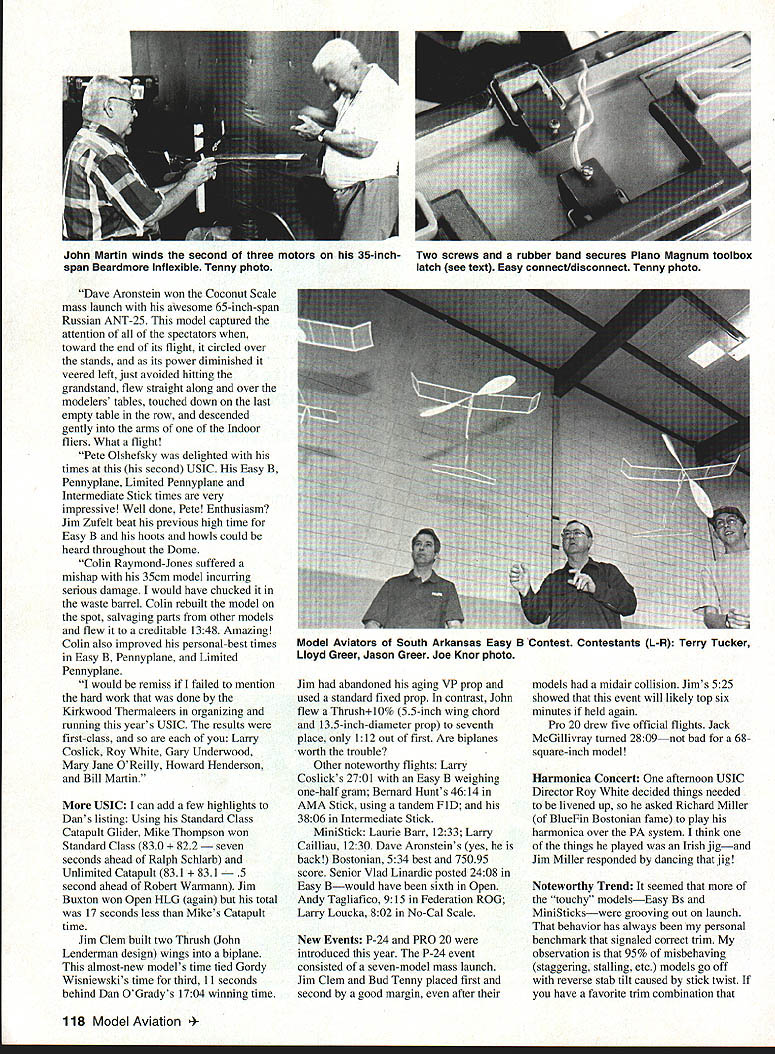
Dave Aronstein wasn't the only flier with a big scale model. John Martin entered his 35‑inch‑span Beardmore Inflexible in FAC Scale. Despite the name, the real airplane required a steel cable tension brace to keep the wingtips from flexing too high in flight.
John implemented three engines on his model: the outboard props were driven by rubber motors running from the nacelles to the stabilizer tips, and the center motor was enclosed in the fuselage. John can wind and launch single‑handed: he winds the outboard motors first, blocking each prop with a pin while the center motor is wound, then launches. The model flies "on rails" on either the center motor alone or all three together.
Just for reference:
- Longest flight: 1:06
- Scale points: 75 (highest awarded 87)
- Flight score: 63 out of 82.5
- Final score: 138 — 7th place
The winning model was Jim Miller's Voisin Hydro with 87 scale points, 1:27 flight time, 73.5 flight points, and total score of 160.5. I stand in awe of Scale builders and their creations; the models (except for No‑Cal Scale) often don't fly long enough to interest me!
USIC Wrapup
I second the accolades from Dan O'Grady about the home management. The long‑standing NFFS tradition of having handout sheets of complete results available within two hours or less of the close of each event was continued.
Behind the scenes, Howard Henderson began building the computer databases required to support "instant results" weeks before the meet. He then worked dawn‑to‑dusk every day adding late entrants, entering event results, and duplicating result sheets for distribution.
The second‑hardest worker had to be Mary Jane O'Reilly at the meet headquarters desk; she needed volunteer help early in the meet to handle late entrants, pass out contestant kits, and feed new data to Howard. No contestant has a right to complain about late‑entry fees until they have helped to run almost any contest, let alone a meet this size!
Editorial Comments
Where were the U.S. fliers? Many did show up, but if a contest like this—held in a proven world‑class site and not combined with the Indoor Nats or a World Champs—draws contestants from Canada, California and Washington State, and England, do the rest of you ever wonder what you missed?
There were entrants from Chicago, Detroit, Kentucky, Alabama, Florida, Pennsylvania, Washington, D.C., the Lakehurst area, several from Virginia, and only two from Dallas–Ft. Worth. Shame on those who didn't even plan to come! Several fliers entered and didn't make it due to illness or accidents, but this contest should draw more than 200 contestants from the 1,000‑mile radius mentioned.
"I can't compete with that crowd—my models aren't good enough!" I first learned the advantage of competing with the "big boys" at the Detroit FAI semifinals in 1962. When I returned home, my models had been upgraded simply by seeing the designs and techniques used by the experienced fliers—construction, trim, launch technique, etc. You can only learn these things by watching. Don't be shy—if you are near a major meet, go and watch. You will learn far more than you will in the backyard.
Final note: Dan O'Grady performed an incredible feat publishing the June/July 1995 issue of SAM Speaks within a week after the event; the issue contained full results of almost all USIC events plus an entertaining report. Vlad Linardic and Dan O'Grady set new record times in Mini‑Dome events. Although Vlad entered the Jr./Sr. category, his Limited Pennyplane 15:53 would have won the Open category; Open was won by Jack McGillivray 15:23, John Marett third with 14:56. Jack McGillivray's F1D total of 1:27:49 (best two flights) was a new Mini‑Dome record.
Over one year after building my first indoor model, I owe thanks to Hardy Brodersen, who devoted eight hours of encouragement and the use of his workshop between Day One and Day Two of the meet; my Day Two flights were 25 percent longer than Day One. More than 30 years later, I still learn important things at every Nats and USIC.
Was the Lubbock Nats a Waste?
A letter from Terry Tucker (403 Robin Rd., El Dorado AR 71730; Tel.: (501) 864‑1375):
"I have been building model airplanes since at least 1957, control line and RC planes in recent years. I had never seen an indoor model fly before last summer's Nats in Lubbock, Texas. I decided to stop at the Texas Tech Coliseum for an hour or two to watch more familiar events. Three days later, I was still watching indoor.
"The indoor events are the most underrated in all of modeling. After watching and asking questions, I knew I had to try indoor. Several members from our local club also watched, and we were all very impressed. We brought the technology back with us to Arkansas.
"By the end of August, I had built an Easy B and found I generally build very sturdy, heavy airplanes. After learning to use half as much glue as I thought I needed, and sanding every piece, I made some pretty decent models. Talk about fun... and competition.
"In December '94 our club scheduled two Easy B contests, thanks to tremendous support from the El Dorado Public School System; a gymnasium was available on February 25 and March 25, 1995. The first contest was for members only, to get the bugs out of the system. The second contest was open to all AMA members. We had a great time, with entrants from as far as 120 miles away.
"We owe special thanks to Jesse Sheppard and Don Mace for their assistance. If your club enjoys really competitive modeling, give indoor a try. We already plan another Easy B contest next year."
Flying Opportunities
The schedules below were the latest information available at press time. CDs with events beginning in December 1995: send schedules ASAP!
- MARYLAND — Goddard NAS
- Record trials and flying sessions in the auditorium of Building 8 at Goddard NAS have been requested on Saturdays, 11 a.m.–1 p.m.: September 9*, September 23*, October 7*, October 21*, and November 4*, 1995. (* = sanctioned national and FAI record trials.)
- NASA security requires attendees to be U.S. citizens and AMA members with license available for inspection at the gate and on a list compiled by Tom Vallee. Notify Tom in advance of each meet. Changes in NASA schedule can preempt the auditorium; verify the date with Tom before leaving home.
- Contact: Tom Vallee, 4440 Henryton So., Laurel MD 20707; Tel.: (301) 498‑0790.
- NEW JERSEY — Lakehurst
- 1995 flying sessions/contests/record trials at Hangar #1 are scheduled frequently between July and the end of October.
- Attendance requires strict adherence to rules:
- Furnish your name, driver's license number, vehicle make/model, license plate number and state of registration to Gary Underwood by the Wednesday before the meet you plan to attend.
- Obey all military regulations (speed limits, no‑smoking areas, restricted parking).
- Route requests for base assistance through the CD.
- Leave the flying area at least as clean as you find it; check with the CD about equipment location.
- No photos allowed except in the hangar.
- Out‑of‑town participants who fly in and rent a car must make special arrangements regarding auto identification. Contact Gary Underwood, 24 Kennebec Ct., Bordentown NJ 08505; Tel.: (609) 324‑9004.
- NEW YORK — Brooklyn
- Weekend indoor sessions at the Blue Nose Hangar at Floyd Bennett Field in Brooklyn: Oct. 21–22, Nov. 18, and Dec. 2, 1995, and an indoor contest on Nov. 19, 1995. The site has a 150 x 450‑foot floor and 45 feet to the rafters (field truss beam, easy retrieval).
- Contact: Ed Whitten, 67 Riverside Dr. #9A, New York NY 10024; Tel.: (212) 724‑0282.
Safety Latch
Indoor fliers will remember the versatility of the Plano Magnum tackle box. The snap catches work well but can accidentally pop open during travel. A quick solution: drill and tap the latch handles, then connect a rubber band that can be wrapped between screws. This is easy to connect and disconnect and offers almost perfect security against accidental opening.
(End of article)
Transcribed from original scans by AI. Minor OCR errors may remain.

