
FREE FLIGHT INDOOR
Bud Tenny, P.O. Box 830545, Richardson TX 75083
THE AMA RECORD APPLICATION FORM
CDs and fliers, listen up! When your model makes a record-breaking flight, many details of the flight must be entered on the AMA record application form. Some information is furnished by the Contest Director (CD), and the rest by you.
- A three-view of the model with all pertinent dimensions must accompany the record application, unless the model is a faithful replica of a published model design or the model was built from a commercial kit.
- CDs: The most important factors of the model—size, weight (if applicable), and other parameters especially defined by the rules, and the flight time—are the responsibility of the Contest Director. Practically speaking, the CD or a designated representative must satisfy themselves that the model meets all points of the rule before it is flown. The CD must also ensure that the timers of the flight are familiar with the timing requirements and that their watches are accurate.
- Contestants: Make sure your parts of the form are complete and accurate. In most cases you receive the record application form with the CD’s part filled out and signed. It is your responsibility to furnish neat and legible plans and full, complete details.
- Remember: completed files are not just filed away—other fliers can and do get copies to learn how to improve their models. A new record represents an advance in modeling practice; take as much pride in your record application as in the flight.
AMA 1995 INDOOR NATIONALS — KIBBIE DOME REPORTS
Ken Johnson reported for Model Aviation. The following comments are excerpted and edited from three club newsletters: Brainbusters (Abram Van Dover), The Bat Sheet (Chris Weinreich), and Boeing Hawks (Gene Stubbs).
- Abram Van Dover: The Kibbie Dome is great—bigger than Johnson City. Nats attendance was down: only 37 entries plus 13 modelers who entered the FAC Scale events. This was still enough to keep volunteers busy. Andrew Tagliafico handled the legwork for tables, chairs, and helium—great job. All the Scale work was done by Ed Lamb and his FAC Squadron #34; everything was set up and ready-to-go from Day One.
- Chris Weinreich: I attended part of the Kibbie Dome Annual/International Easy‑B Contest/AMA Indoor Nats. There were a lot of Strat-O-Bats—around thirty. Several Northwest stalwarts concentrated on Indoor Scale: Gene Stubbs, Dick Anderson, Clive Wienker, Ed Lamb, Len Sherman. Other familiar names included Bob Stalick, John Lenderman, Lou Gitlow, Andrew Tagliafico, Keith Varnau, Gil Couglin, and Bruce Kimball (HLG). Indoor free flight is its own form of madness: no thermals, so you must build light, trim for ceiling height, and pay close attention to rubber motor size and amount. If you’re at all interested in indoor, a trip to the Kibbie Dome is well worth the drive—excellent site, nearby motels, and the Moscow–Pullman area offers restaurants and shops. Thanks to Andrew Tagliafico for securing the Dome and scheduling it annually.
- Gene Stubbs: Turnout was light for a Nats contest. I helped judge Scale entries; Ed Lamb did a great job organizing Scale contests. Registration help from Phyllis and others was appreciated. I witnessed a 45‑minute F1D flight by Steve Brown. Canadian Orville Olin showed several elegant, good-flying Scale models.
MINISTICK POSTAL CONTEST 1995
- The International MiniStick Postal Contest is being sponsored by the Thermaleers of Kirkwood, MO. A new entry blank was published in #84 of Indoor News & Views.
- Brainbusters idea: anyone flying MiniStick in indoor winter contests is automatically entered in the International MiniStick Postal contest—just have your scores in by March 31, 1996. The highest flight time will be taken and submitted.
- Bob Eberle posted a 1,339‑second MiniStick flight at Lakehurst—a marvelous time and a record. MiniStick has accepted formal event record applications; submissions were to begin January 1, 1996.
INSECT MOUNTING PINS
Source (courtesy Stan Chilton):
- Fine Science Tools, Inc., 373 Vintage Park Dr., Foster City, CA 94404; Tel.: (800) 521-2109.
- Elefant Insect Pin, pin 26000-25: .009" diameter by about 1.6" long, tiny nylon head. Pack of 100 is $5.95; shipping $1.00. Try a group order to minimize costs.
RUBBER LUBES
Collected from club newsletters:
- Plumbers' Silicone Lubricant WG-1 (hardware stores): about $1 for 1/2 oz of gel.
- Syl‑Glyde (aerosol and gel) available from NAPA Auto Stores.
If you try either of these, please send a report of results.
RUBBER REPORTS — AUTHOR GUIDANCE
Many rubber tests and output formulas use width or strip as a factor. Although Tan II has been the most uniform product I've worked with (in strip width and thickness), I have measured strip-to-thickness variations between batches as much as ±5%. Therefore, if a formula or report uses rubber length and strip width, it is better updated to use weight/length; the results are then directly applicable to any batch of the same type of rubber, with improved accuracy.
FLYING OPPORTUNITIES
Always verify a contest date by phone before leaving home. CDs with events beginning February 1996, please send schedules ASAP.
Arkansas — Little Rock area
- Indoor sessions every month, usually the second Friday, 5:30–7:30 p.m. at North Little Rock Burns Park Tennis Center. Side walls 20 ft, center peak 40 ft. Cost $24 divided by participants.
- Contact: Ron Stanfield, 20 Oakridge Dr., Maumelle, AR 72113; Tel.: (501) 851-1697.
California — Burbank
- Blacksheep Exhibition Squadron (VMF-214) monthly sessions on second Fridays. Cat. I site at Luther Burbank Middle School; 7–10 p.m.
- Contact: Tony Naccarato, 2121 N. Hollywood Way, Burbank, CA 91507; Tel.: (818) 842-5062.
California — Garden Grove
- Gym at the Crystal Cathedral available every Tuesday, 7–10 p.m. Gym about 25 ft to lowest ceiling girder plus ~10 ft above. All indoor models welcome.
- Contact: John Wenk, 4621 Silverbell Ave., Orange, CA 92669; Tel.: (714) 633-8546.
California — San Francisco area
- Year‑round minicontests, 8 a.m.–1:30 p.m., fourth Sunday each month. Site: standard basketball court, 22 ft clear. Outdoor flying second Sunday each month May–October.
- Contact: George Benson, 204 Benson Circle, Mill Valley, CA 94941; Tel.: (415) 388-1809.
California — San Diego
- Fun-Fly and Scale sessions 2nd Friday each month; monthly sessions on 4th Friday. California Del Sol Community Center (Cat. I), 5316 Orange Ave.
- Contact: Howard Haupt, 8360 Ecochee Ave., San Diego, CA 92117; Tel.: (619) 272-5656.
Canada — Ontario (Ottawa)
- Indoor flying at Woodroffe High School on Mondays, 7–10 p.m. 1995–96 season dates included Nov. 6, 13, 20, 27; Dec. 4, 11, 18; Jan. 8, 15, 22, 29; Feb. 5, 12, 19, 26; Mar. 4, 18, 25; Apr. 1, 15, 29; May 6, 13, 27, 1996.
- Contact: Dan O'Grady, 50 Largo Crescent, Nepean, Ontario, Canada K2G 3C7.
Canada — Winnipeg, Manitoba
- Flying twice a month in a 23‑ft gym on Sundays and one session each month in an 80‑ft airline maintenance hangar (subject to work schedules). Hangar is tight with minimal drift; site of several Canadian Cat. II records.
- Contact: Barrie Taylor, 2 Thackeray, Winnipeg, Manitoba R3K 0H1; Tel.: (204) 889-4737.
Connecticut — Norwich
- Sessions through Fall and Winter at Teacher's Memorial Junior High School. Beginners welcome; assistance provided.
- Contact: John Koptonak, 3 Wiemers Ct., Waterford, CT 06385; Tel.: (203) 442-9003.
Florida
- Miami Indoor Airplane Modelers Association monthly meets. McDill AFB Meet #2 (check dates). King Orange Indoor, Delta Airlines Maintenance Hangar, Tampa, Dec. 30–31, 1995.
- Contact: Dr. John Martin, 2180 Tigertail Ave., Miami, FL 33133; Tel.: (305) 858-6363.
Illinois — Chicago area
- Year‑round weekly sessions in a 25‑ft gym at College of DuPage, Glen Ellyn. Currently Mondays, 6–11 p.m.
- Contact: Bob Warman, 245 N. Oaklawn, Elmhurst, IL 60126; Tel.: (708) 834-9075.
Kansas — Topeka
- Contact: Jack Koehler, 3310 SW Ewingside Dr., Topeka, KS 66614-3726; Tel.: (913) 273-9554.
Kansas — Wichita
- Note address change: Stan Chilton, 3010 Grail, Wichita, KS 67211; Tel.: (316) 686-9634.
Kentucky — Louisville
- Flying every Tuesday at Sawyer Park, 11 a.m.–1 p.m. Also one Saturday each month (subject to military schedules) at Kentucky Air National Guard site, 10 a.m.–2 p.m.
- Contact: Mason Plank, 3207 Oriole Dr., Louisville, KY 40213; Tel.: (502) 634-8191.
Maryland — Goddard NAS
- NASA has canceled all access to the auditorium of Building 8 at Goddard NAS until further notice. Contact for developments:
- Contact: Tom Vallee, 444 Herron St., Laurel, MD 20707; Tel.: (301) 498-0790.
Massachusetts — Merrimac Valley
- Contact: Jim Fiorello, Tel.: (508) 687-0024 for planned activity information.
THOUGHTS ON RIBS AND AIRFOILS (LAMINATED SPARS)
During investigations into laminated structures, several advantages of laminated spars became apparent:
- Acceptable strength-to-weight ratio from less-than-perfect wood (initial motivation).
- Laminating curved parts creates more permanent shapes; when laminated with thinned aliphatic resin, abrasion resistance improves.
- Some unusual or refined airfoil shapes are made easier to form.
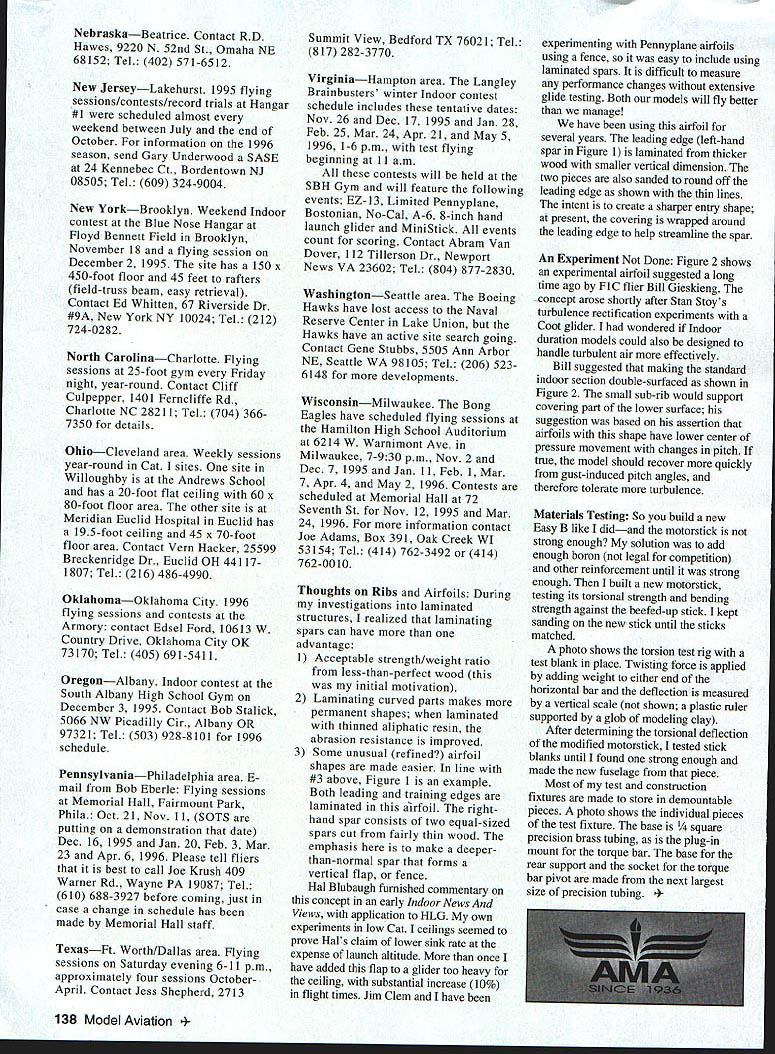
- Example concept: both leading and trailing edges laminated into the spars. One spar can be made deeper-than-normal to form a vertical flap or fence. Hal Blubaugh previously commented on this concept with applications to hand-launched gliders (HLG). My own experiments in low Cat. I ceilings indicated a lower sink rate at the expense of a small altitude penalty. Adding this flap to a glider has yielded substantial flight-time increases (about 10% in some cases).
- Jim Clem and I have experimented with small airfoils using a fence; laminated spars make including such a fence straightforward. Measuring performance changes reliably requires extensive glide testing; anecdotal results are promising.
- Construction detail: the leading edge can be laminated from thicker wood with a smaller vertical dimension, then sanded to a sharper entry shape. Covering is wrapped around the leading edge to streamline the spar.
AN EXPERIMENT NOT DONE (TURBULENCE RECOVERY)
- Bill Gieseking suggested an experimental semi-surfaced indoor airfoil with a small sub-rib supporting the lower covering so the bottom surface is partially unsupported. His assertion: such a shape has lower center-of-pressure movement with changes in pitch, allowing quicker recovery from gust-induced pitch changes and better turbulence tolerance. This remains an interesting idea worth testing for indoor duration models.
MATERIALS TESTING AND TORSION TEST FIXTURE
- Problem: a new Easy‑B motorstick was not strong enough. Temporary solution was to reinforce the stick (boron, etc.), then build a new motorstick tested to match the beefed-up stick.
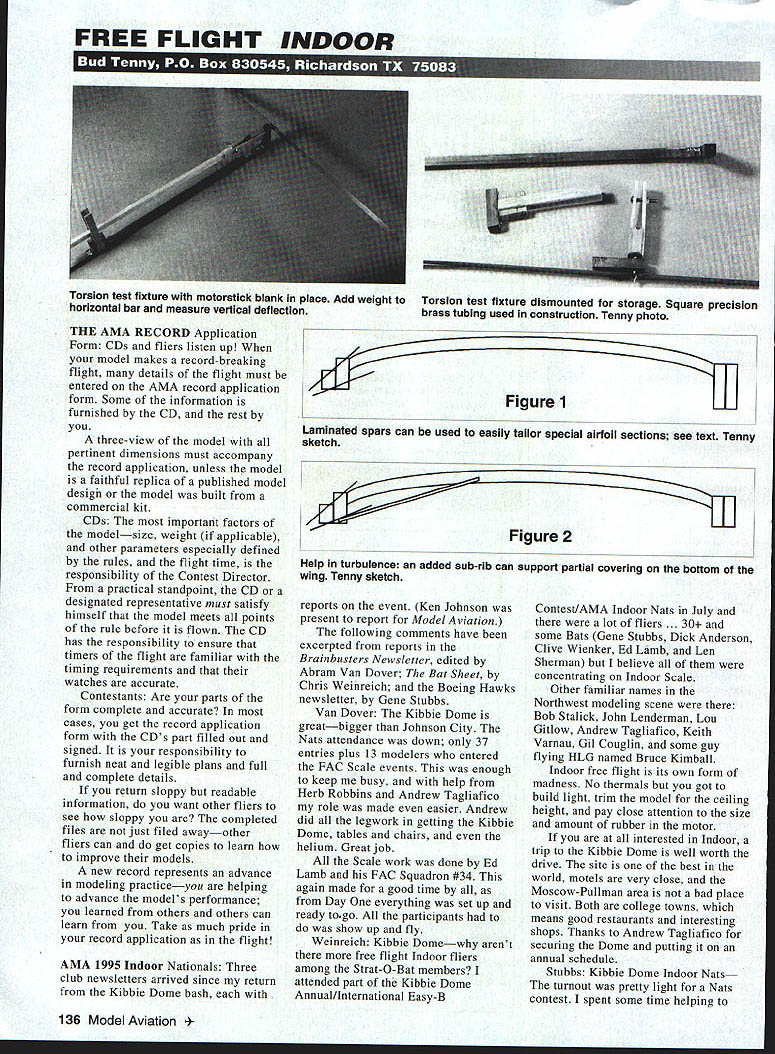
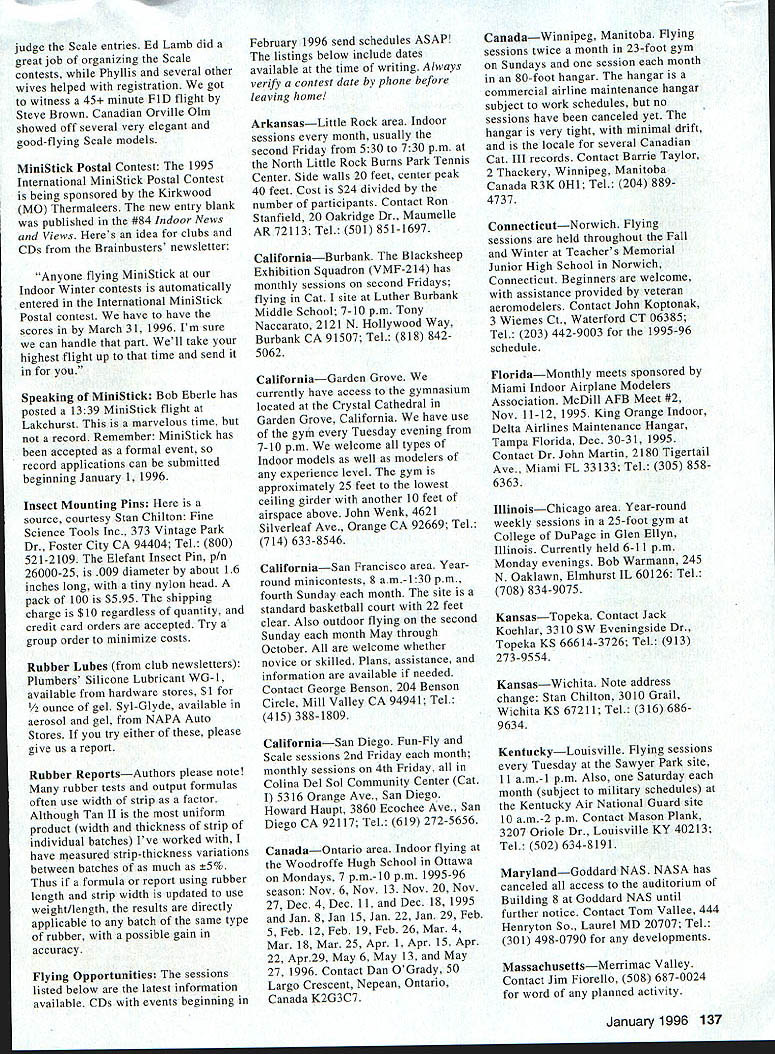
- Torsion test procedure: a motorstick blank is mounted in the test rig; twisting force applied by adding weight to the end of a horizontal bar; vertical deflection measured. A plastic ruler supported by modeling clay can be used as a scale indicator.
- Construction of test rig: fixtures are made to dismount for storage. Base and plug-in mount for the torque bar use 1/4" square precision brass tubing; rear support base and socket for the torque-bar pivot use the next largest size of precision tubing. After determining torsional deflection of the modified stick, test stick blanks until finding one strong enough, then build the new fuselage from that piece.
---
Transcribed from original scans by AI. Minor OCR errors may remain.

