
FREE FLIGHT INDOOR
Bud Tenny, P.O. Box 830545, Richardson TX 75083
1996 NATS/USIC
The 1996 Indoor Nats will be combined with the USIC at the ETSC MiniDome in Johnson City, Tenn., May 28, 1996. May 28 is a full day of practice, followed by four days of competition. Bob Champine, formerly Chief Test Pilot at Langley Field, is the keynote speaker at the banquet.
The contests will run concurrently, with Dave Thomson running USIC and Abram Van Dover as CD of the Nats.
Volunteers are needed for almost all events: event directors, processors, and timers. Volunteer your services to Abram Van Dover, 112 Tillerson Dr., Newport News VA 23602; Tel: (804) 877-2830.
Big Show at Kibbie Dome?
As of this writing, there is a strong possibility that the 1996 WC will be held in the Kibbie Dome. If this comes true, the schedule will be:
- August 1–3: Standard Kibbie Dome schedule, with HLG and Catapult Glider events running from 8 a.m. to 9:30 a.m. each day, followed by duration events until 8 p.m.
- Aug. 4: International EZB event, with classes both AMA and F1L (1.2 g EZB). Flights will be made in six rounds in each event.
- Aug. 5–8: 1996 World Championships (subject to CIAM approval).
- Aug. 5: Sign-in and practice 8 a.m.–8 p.m.
- Aug. 6: Practice 8 a.m.–8 p.m.
- Aug. 7: Three rounds of three hours each.
- Aug. 8: Three rounds of three hours each.
International Postal Meet
The international postal contest between the U.S. and Japan was flown again this year. The Great Plains/Southwest Team flew their meet at the Bedford Boys Ranch in October. We were blessed by mostly buoyant air and cursed by a steady drift lengthwise of the building that required persistent steering. Times were good:
- Stan Chilton: 33:11 + 36:20 = 1:09:31
- Jesse Shepherd, Jr.: 28:59 + 27:15 = 56:14
- Jim Clem: 16:23 + 15:15 = 31:38
As a bystander with an unfinished model I was fascinated by how easy it looked to top 25 minutes in Cat. I—provided you have a VP (variable-pitch) prop! Jim didn't have a VP for his model, so he had to ceiling-scrub too much.
The steering techniques in Cat. I are necessarily different from those for higher ceilings. It is easier to see the model, and harder to steer when the model is against the ceiling.
The Akron Finals
By the time this column is published, you doubtless will have seen the official results of the Team Selection Finals flown in the Akron Air Dock. The most interesting factor in these results is that only one WC veteran, Cezar Banks, made the cut with 49:47 + 47:12.
It is very heartening to note that the two highest scores were posted by Rich Doig (50:41 + 50:41) and Gary Underwood (49:51 + 48:52). These very good times were posted after Rich and Gary did extensive test flying in Lakehurst the week before. Both these fliers have continually improved in recent years; it is great to see hard-working younger fliers rewarded!
Cookbook Building Works
From a personal standpoint, the Akron Finals had another highlight.
Jim Clem, in his first serious attempt at FID since the 1984 program, posted exceptional times flying a replica of Bernard Hunt's tandem FID, except with a fixed-pitch prop. Jim spent less than three weeks building three sets of wings, one prop, and one motor stick. The only test flying available before going to the hangar was a Cat. I gym.
After qualifying in Cat. I, flying an Easy B stretched to 20 inches span, Jim consulted his extensive library of indoor literature—magazines, newsletters, and papers written by well-known fliers. Jim credits his success to the "recipes" written by Bernard Hunt (plans and instructions for his tandem FID model that won Indoor Stick at the 1995 USIC) and Steve Brown's excellent article on building motor sticks (from a recent Indoor News and Views).
Wingless Autogyros
Ken Johnson's column triggered a seeming avalanche of interest in provisional wingless autogyro rules.
Competition regulations: With growing interest in elevating the event to full record status, appropriate action is to verify the suitability of the rules via competition and submit a proposal. Please direct correspondence to Ken Johnson; he will coordinate whatever activity is taken. Note: rules proposals must be sent to AMA HQ within the time frame outlined in the rule book.
Another Lube
Wakefield flier Dave Wilson relates that Wakefield fliers have been using Formula 2001 exclusively to lubricate motors. Formula 2001 is available at auto supply stores and some supermarkets in four-fluid-ounce spray bottles similar to those holding Armor All. A quick glance at the label claims the product protects against UV radiation. But is it slicker than other products?
Insect Mounting Pins
Insect mounting pins are mentioned here fairly often. Once you get a bent pin, they are hard to do without.
These pins are so thin and sharp they can be used to pin directly through balsa without damaging the wood. Instead of tearing and compressing wood fibers, these pins slice between the fibers.
I had been hoarding my meager supply, hoping to locate a new supplier. Stan Chilton located a supplier so we both were able to order a new supply. This vendor sells size 000 pins (.009 inches diameter and 1.7 inches long) for $5.95 per 100 pins. The vendor is Fine Science Tools, Inc., 373-G Vintage Park Drive, Foster City CA 94404; Tel.: (415) 349-1636; fax: (415) 349-3729. Shipping charges are $10 per order; savings are available by combining orders with others.
Noticeable Contest Poster
How many dull and boring contest posters have you seen? Most of them, probably.
John Konopka of the Norwich Flying Aces solved that problem with his posters that announced the seven dates for their 1995–96 season. The top line of the poster has the banner FLY INDOORS! in one-inch headline font. Following the headline is a description of the activity, the site location, flying dates, and a color map of the area showing the site location.
This poster magic came from John's color printer and the map is an excerpt from the Rand McNally atlas on CD-ROM. If you have a computer with an ink-jet in your club, maybe you can do something similar — it is really effective!
New MRL Catalog
Curt Stevens has issued his 1995 Mail-Order Catalog. If you are into high-tech materials, this is the source. He has added a number of new items, but the most interesting part of his catalog is the preliminary three pages of commentary and wisdom. An opening comment is, "Even when you are on the right track you will get run over if you just sit there." Model Research Labs, 25108 Marguerite #100, Mission Viejo CA 92692; Fax: (714) 248-1074 (no voice lines, use mail or fax).
New Model Design Trends: The Thrush
John Lenderman designed a Limited Pennylane some time back, and named it Thrush. The model has had good contest success in John's hands, and several others have been happy with the design.
Thrush has an unusual wing configuration: 17.5 inches flat span with upturned tips. The stab has the same configuration, except there we call it tip rudders. John also built a Thrush+10 which had a 10% wider wing and stab, and 10% longer stab and nose. The larger model has done very well against biplanes, including winning Pennylane at Kibbie Dome this year.
The real importance of the Thrush wing is twofold: the climb pattern is rock-steady, easily controllable, and tolerant to excessive up-trim without stalling. If you think about it, you doubtless will remember several highly successful models using tip plates. The Thrush wing is essentially the same idea without dihedral.
Tandem Models
A long time ago (about 1974), John Kukon published plans for a tandem-configuration model. Bernard Hunt won Indoor Stick with 46:15, using an FID model. After the meet, another contestant showed Bernard the Kukon article. Bernard noticed that Kukon's design was essentially identical to his own model, except that Bernard's model is unbraced.
My view of the importance of the tandem configuration is that, like the Thrush, it tolerates a broad range of trim variations. The tandem model also seems to sink very slowly when slightly over-elevated with turns left. Jim Clem's 1.4-gram Hunt FID, with a fixed-pitch prop, did 39:27 at Akron without getting anywhere near the ceiling.
Flying Opportunities
The sessions listed below are the latest information available. CDs with events beginning in April 1996, send schedules ASAP! The listings below include dates available at the time of writing. For a listing of events on a regular schedule, see the Events column. Always verify a contest date by phone before leaving home!
- California — San Francisco area: From "Free Flight," the Oakland Cloud Duster newsletter, edited by Len Kendy: Sherm Gillespie's dates for indoor flying at Mt. Pleasant H.S. Gym (corner of White and Ocala Roads). All sessions run from 9 a.m. to 1 p.m.: Feb. 10, Mar. 16, Apr. 13, and May 18, 1996. Get there at 9 a.m. if you wish to park near the gym. Otherwise, park in the lot along White Road as the entry gate will be locked. Contact Sherman Gillespie, 6248 Bain Ln, San Jose CA 95135; Tel.: (408) 238-2981.
- Canada — Ontario area: Indoor flying at Woodroffe High School in Ottawa on Mondays, 7 p.m. to 10 p.m. 1995–96 season: Feb. 19, Feb. 26, Mar. 4, Mar. 18, Mar. 25, Apr. 1, Apr. 15, Apr. 29, May 6, May 13, and May 27, 1996. Contact Dan O'Grady, 50 Largo Crescent, Nepean, Ontario Canada K2G 3C7.
- Connecticut — Norwich: Indoor sessions at Teacher's Memorial Junior High School in Norwich from 9 a.m. to 2 p.m. on Feb. 10, Mar. 9, and Apr. 13, 1996. Contact John Kopotnak, 3 Wimes Ct., Waterford CT 06385; Tel.: (203) 442-9903.
- Maryland — Goddard NAS: NASA has canceled all access to the auditorium of Building 8 at Goddard NAS until further notice. Contact Tom Valle, 444 Herrington St., Laurel MD 20707; Tel.: (301) 498-0790 for developments.
- Oklahoma — Oklahoma City: 1996 flying sessions and contests at the Armory: Feb. 18, Mar. 24, Apr. 21, 1996. Contact Edsel Ford, 10613 W. Country Drive, Oklahoma City OK 73170; Tel.: (405) 691-5411.
- Oklahoma — Tulsa: The Tulsa Glue Dobbers 1996 indoor schedule at the National Guard Armory, 3902 E. 15th St., in Tulsa: Feb. 10, Mar. 9, 1996. Contact Robert Dunham, Tel.: (918) 258-9062.
- Oregon — Albany: The WMC indoor schedule has been firmed up as follows: a Cat. I contest on Feb. 25 and a Cat. II two-day meet on Apr. 27–28. These events will be held at South Albany High School. It has two flyable gyms (a 42-foot Cat. I and a 22-foot Cat. II). The Feb. 25 contest begins at 9 a.m. and ends at 3 p.m. The April contest begins at noon on Saturday and goes until around 10 p.m., with time off for dinner and a symposium. The second day begins at 8:30 a.m. and ends at 3 p.m. Token awards will be given to all who enter and fly. Entry fees are $3 and top cut of $6 per event. Contact Bob Stalick, 5066 NW Picadilly Cir., Albany OR 97321; Tel.: (503) 928-8101.
- Pennsylvania — Philadelphia area: Flying sessions at Memorial Hall, Fairmount Park, Philadelphia: Feb. 3, Mar. 2, and Apr. 6, 1996. It is best to call before coming in case of schedule changes. Contact Joe Krush, 409 Warren Rd., Wayne PA 19087; Tel.: (610) 688-3927.
- Texas — Ft. Worth/Dallas area: The 1996 season has an expanded schedule. Single dates are the standard format, Saturdays, 6–11 p.m. Two-day sessions are for lightweight duration only. Record/trial sessions: Saturday 6–11 p.m. and Sunday 1–6 p.m., Jan. 13, Feb. 19, Mar. 9, Mar. 23–24, 1996. Contact Jess Shepherd, 2713 Summit View, Bedford TX 76021; Tel.: (817) 282-3770.
- Virginia — Hampton area: The Langley Brainbusters' winter indoor contest schedule includes these tentative dates: Feb. 25, Mar. 24, Apr. 21, and May 5, 1996, 1–6 p.m., with test flying beginning at 11 a.m. All contests will be held at the SBH Gym and will feature the following events: EZ-13, Limited Pennyplane, Bostonian, No-Cal, A-6, 8-Inch HLG and MiniStick. All events count for scoring. Contact Abram Van Dover, 112 Tillerson Dr., Newport News VA 23602; Tel.: (804) 877-2830.
- Washington state — Seattle area: The Boeing Hawks have lost access to the Naval Reserve Center in Lake Union. Good news: recreation advisor Gary Walk has secured the Boeing Oxbow Recreation Center for flying use on the third Saturday of each month. It will be open from 9 a.m.–5:30 p.m. This is a large gym with a ceiling height of approximately 25 ft. It is located across the Duwamish River from the Museum of Flight, near the south end of Boeing Field. The most direct route is to the Oxbow bridge, visible from East Marginal Way. Access is not restricted to Boeing employees. Contact Gene Stubbs, 5505 Ann Arbor NE, Seattle WA 98105; Tel.: (206) 523-6148.
- Wisconsin — Milwaukee: The Bong Eagles have scheduled flying sessions at the Hamilton High School Auditorium at 6214 W. Warnimont Ave., Milwaukee, 7 p.m. to 9:30 p.m., Mar. 7, Apr. 4, and May 2, 1996. A contest is scheduled at Memorial Hall, 72 Seventh St., for Mar. 24, 1996. Contact Joe Adams, Box 391, Oak Creek WI 53154; Tel.: (414) 762-3492 or (414) 762-0010.
Steering Techniques: Basic Steering
Steering indoor models falls into two categories: strategic, competitive repositioning of the model to maximize flight time; and everything else except rescuing a model from hangup. The difference is that repositioning a model with an absolute minimum of disturbance to the model's flight path and altitude requires great skill and a lot of practice. "Everything else" includes interrupting a model's flight to prevent hangup when there isn't time or room to do a strategic steer, or to prevent the model from fouling another model. In this case the best strategy often is to capture the model by allowing the prop to be stopped by the string so it can be reeled in out of danger. When you do this at high altitude, it still requires enough skill to catch the model without smashing it!
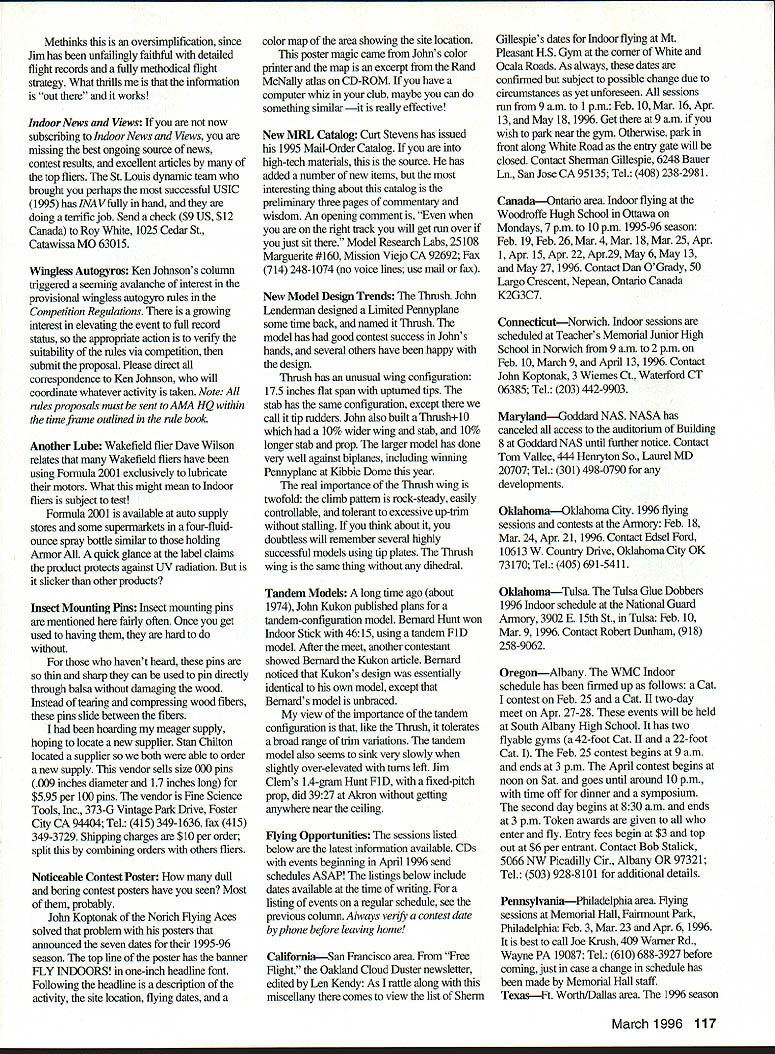
Figure 1 shows the basic steering tactic. The solid-line circle represents a model in flight, and the dashed-line circle is the desired new orbit. The easiest and quickest steer is to reverse the model's direction as in path A. If your model is stable enough to pirouette around a balloon string restraining the outboard wing, this is the quickest solution. This is fairly stressful on the wing, except during cruise.
For very light models, a better solution is to put the balloon string (or steering pole, in low ceilings) between the prop and inboard wing. Pressure against the fuselage pushes the model along path A into the new orbit. Path B is done the same way; it takes longer and requires more skill, but is the least stressful on the model.
Not shown is a third possibility: pirouette around a balloon string restraining the inboard wing. A highly stable model that won't spin out is safer, and it may be easier to move the steering mechanism clear of the model. The new orbit will be a circle overlapping the original orbit.
Cat. I Steering
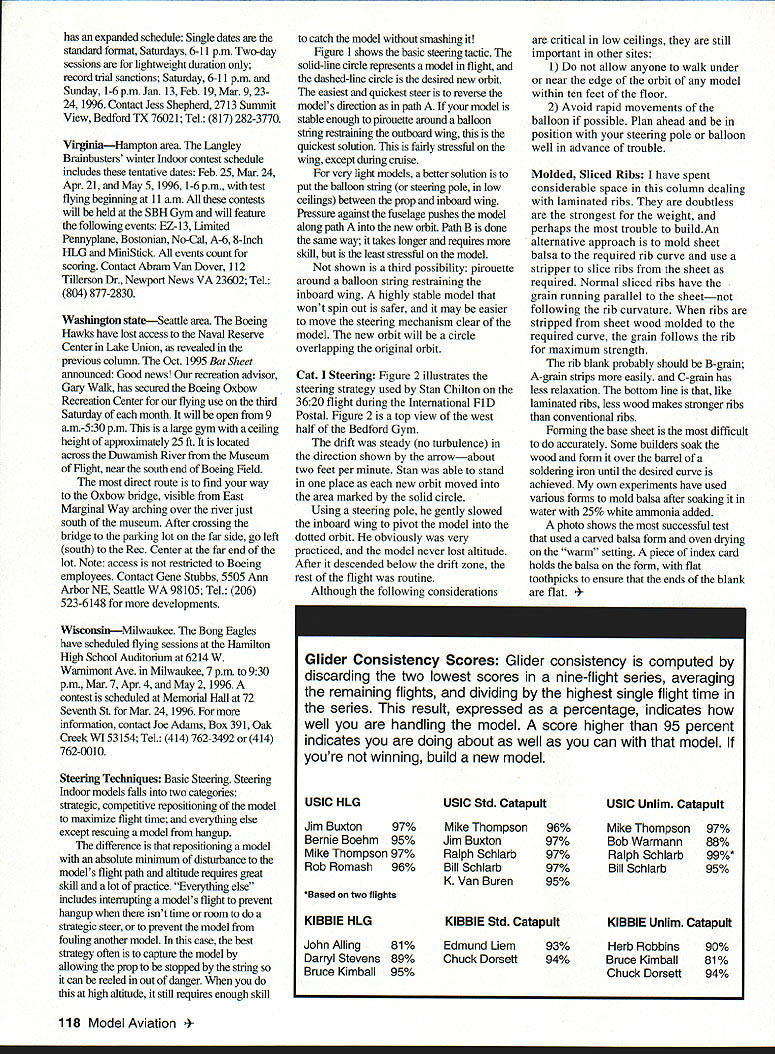
Figure 2 illustrates the steering strategy used by Stan Chilton on the 36:20 flight during the International F1D Postal. Figure 2 is a top view of the west half of the Bedford Gym.
The drift was steady (no turbulence) in the direction shown by the arrow—about two feet per minute. Stan was able to stand in one place as each new orbit moved into the area marked by the solid circle.
Using a steering pole, he gently shoved the inboard wing to pivot the model into the dotted orbit. He was clearly practiced, and the model never lost altitude. After it descended below the drift zone, the rest of the flight was routine.
Although the following considerations are critical in low ceilings, they are still important in other sites:
- Do not allow anyone to walk under or near the edge of the orbit of any model within ten feet of the floor.
- Avoid rapid movements of the balloon if possible. Plan ahead and be in position with your steering pole or balloon well in advance of trouble.
Molded, Sliced Ribs
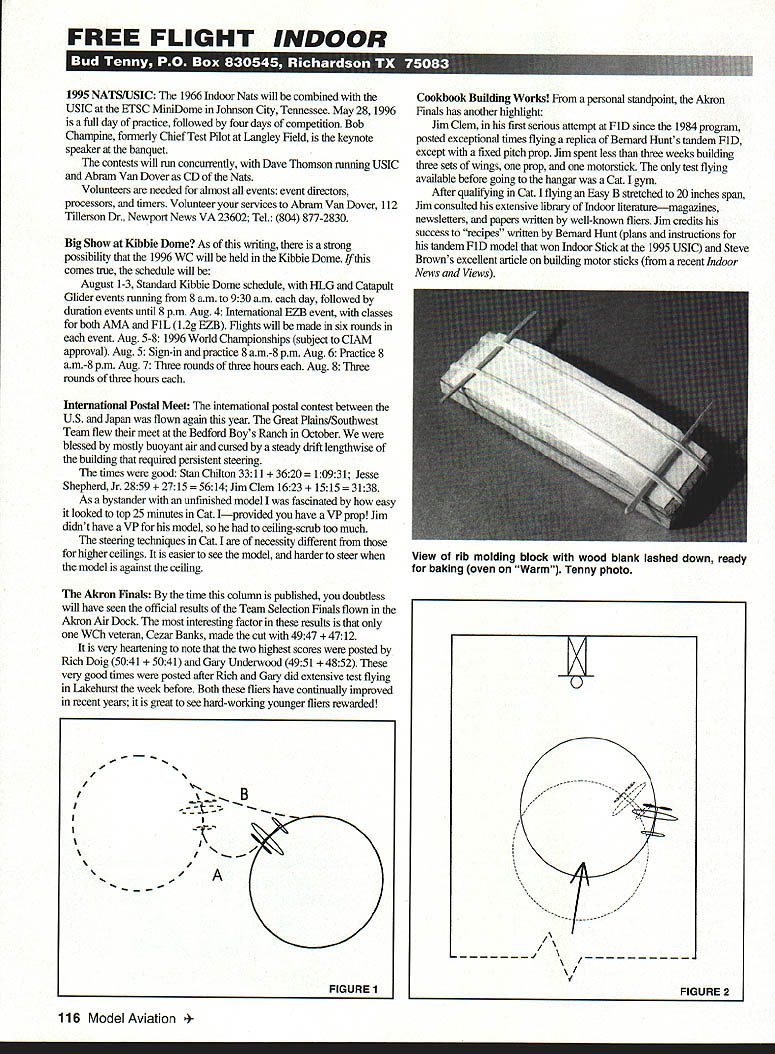
I have spent considerable space in this column dealing with laminated ribs. They are doubtless the strongest for the weight, and perhaps the most trouble to build. An alternative approach is to build sheet balsa to the required rib curve and use a stripper to slice ribs from the sheet as required. Normal sliced ribs have the grain running parallel to the sheet—not following the rib curvature. When ribs are stripped from sheet wood molded to the required curve, the grain follows the rib for maximum strength.
The rib laminator probably should be B-grain; A-grain strips more easily, and C-grain has less relaxation. The bottom line is that, like laminated ribs, less wood makes stronger ribs than conventional ribs.
Forming the base sheet is the most difficult part to do accurately. Some builders soak the wood and form it over the barrel of a soldering iron until the desired curve is achieved. My own experiments have used various forms to mold balsa after soaking it in water with 25% white ammonia added.
A photo of the most successful test used a carved balsa form and oven drying on the "warm" setting. A piece of index card holds the balsa on the form, with flat toothpicks to ensure that the ends of the blank are flat.
Glider Consistency Scores
Glider consistency is computed by discarding the two lowest scores in a nine-flight series, averaging the remaining flights, and dividing by the highest single flight time in the series. This result, expressed as a percentage, indicates how well you are handling the model. A score higher than 95 percent indicates you are doing about as well as you can with that model. If you're not winning, build a new model.
- USIC HLG
- Jim Buxton 97%
- Bernie Boehm 95%
- Mike Thompson 97%
- Rob Romash 96%
- USIC Std. Catapult
- Mike Thompson 96%
- Jim Buxton 97%
- Ralph Schlarb 97%
- Bill Schlarb 97%
- K. Van Buren 95%
- USIC Unlim. Catapult
- Mike Thompson 97%
- Bob Warmann 88%
- Ralph Schlarb 99%*
- Bill Schlarb 95%
- KIBBIE HLG
- John Alling 81%
- Darryl Stevens 89%
- Bruce Kimball 95%
- KIBBIE Std. Catapult
- Edmund Liem 93%
- Chuck Dorsett 94%
- KIBBIE Unlim. Catapult
- Herb Robbins 90%
- Bruce Kimball 81%
- Chuck Dorsett 94%
*Based on two flights
Transcribed from original scans by AI. Minor OCR errors may remain.

