
FREE FLIGHT INDOOR
Bud Tenny, P.O. Box 830545, Richardson TX 75083
CDS note
Last year some experimental Easy B models using wood bracing on the fuselage were flown in contests. Pending a formal clarification from the Indoor Contest Board, be aware that only Easy B wings may have any form of bracing, and that bracing must be wood, according to a limited informal poll of ICB members.
Change of address
A previous column listed two e-mail addresses for me. Both have been replaced by this: rten@intex.net. It is likely that every FF and Indoor club has at least one member with an e-mail address. Can we form a quick-response network? Drop me an e-mail and sign up! Also, if you have anything for the column, e-mail is much easier unless you have to send drawings or photos.
Big schedule (from Gary Underwood)
A proposal to move our activities to a yearly format was unanimously accepted. This approval will yield 110 flying dates in Hangar 1. We will begin our activities on January 6 and end on December 29, 1996.
I visited Hangar 1 just prior to Christmas and several improvements are taking place. The renovation of the northern wall is now airtight. All doors and cement blocks are in position, providing new classrooms for the Navy. This should greatly reduce the drift from side to side.
The sliding truck-door entrance is temporarily sealed for asbestos removal in the southern wall. This area will be improved in 1996 in conjunction with the Votech School. While the truck door is impassable, the Navy is utilizing another truck door at the northeastern portion of the hangar. (Tenny comment: Gee whiz! I wish I had Lakehurst in my backyard!)
Steering poles
Dedicated Cat. I fliers own steering poles. The original rules limited steering-pole length to two meters minimum and eight meters maximum. A recent ruling removed the limits; Richard Doig suggests that a toothpick is now legal for steering!
For many years fliers have used collapsible telescoping poles made from fiberglass. These poles are called crappie poles and are available from bait-and-tackle shops. Most such poles extend to at least 20 feet and require considerable skill and practice.
Part of the problem is that the two smallest-diameter sections are limber enough to start whipping around if you don't move very carefully. Modern technology (Kevlar) is now being used to build smaller-diameter, lighter poles that are much stiffer than the fiberglass poles.
Poles have another downside: in flat ceilings, when the model is close to the ceiling, it is very easy to jam the pole tip into the ceiling. This disrupts your aim, timing, and sometimes the model!
Pole modifications
- Aluminum tubing inserted into the bottom section extends the pole length by (for example) four feet, to equal the former maximum allowable length.
- Precision aluminum tubing replaces the flexible upper end.
Balloons
Any balloon useful for accurate steering at high altitude is large enough to lift a large fishing reel mounted on a short pole (four to six feet) plus some additional weight. This much lift is needed to make the balloon track your movements quickly. That is, if you move the bottom end four feet, the balloon must not take longer than about five seconds to catch up.
A soft (lower-lift) balloon can be used to intercept a drifting model or to snag the model to bring it down so it won't foul another flight. It will not be useful to safely move the model's orbit to prevent drifting into obstacles above (perhaps) 50 feet.
Choice of balloon: the lift of pure helium is a fixed quantity based solely on the volume of gas enclosed in the balloon. The weight of balloon, filler spouts, and steering line all subtract from total helium lift.
Rubber balloons lose about 50% of their lift in eight hours, so the inflated volume needs to be enough to retain steering capability at the end of the contest.
To put balloon size into perspective: lift varies with the cube of the radius; the lift of a 24-inch balloon is eight times as great as that of a 12-inch balloon.
Cat. I steering is much different than high-ceiling steering. Any balloon small enough to be useful steering a model near the ceiling has so little lift that it has no maneuverability. If the balloon has enough lift to be useful, the only useful tactic is to place the balloon so either the prop or a wingtip hits the balloon. If the model doesn't stall and drop too low, you can snag the model with the string and move it to a new orbit.
I experimented with party balloons and found that an 11-inch (package rating) party balloon will give adequate steering in Cat. I for at least four hours. At the Bedford (TX) site (which has a quonset-type curved ceiling), I was able to catch the model in the center of the building below the peak and move the orbit as needed.
Anti-fouling tubing
The rules mandate that the model be steered from the front (ahead of the wing) and it is easy to get the string tangled in the prop.
Many high-ceiling fliers use an inflatable plastic tube attached to the balloon. The steering line attaches to the lower end of the tubing, leaving about 10–15 feet of tubing that is used to contact the model.
Gary Underwood and a few others substitute flat plastic ribbon for the inflated tubing. Either tubing or ribbon prevents the prop from grabbing the string, so the model can be released when you want to release it.
Flying opportunities
- California — San Francisco area: Indoor flying at Mt. Pleasant HS Gym at the corner of White and Ocala Roads. Sessions run 9 a.m. to 1 p.m.: Apr. 13 and May 18, 1996. Get there at 9 a.m. if you wish to park near the gym. Otherwise, park in front along White Road as the entry gate will be closed. Contact Sherman Gillespie, 6248 Bauer Ln., San Jose CA 95135; Tel.: (408) 238-2981.
- Canada — Ontario area: Indoor flying at Woodroffe High School in Ottawa on Mondays, 7 p.m. to 10 p.m., 1995–96 season: Apr. 15, Apr. 22, Apr. 29, May 6, May 13, and May 27, 1996. Contact Dan O'Grady, 50 Largo Crescent, Nepean, Ontario, Canada K2G 3C7.
- Connecticut — Norwich: Indoor session at Teacher Memorial Junior High School in Norwich from 9 a.m. to 2 p.m., Apr. 13, 1996. Contact John Topolnak, 3 Wiemes Ct., Waterford CT 06385; Tel.: (203) 442-9903.
- Florida — Miami: MIAMI #6 is Apr. 20–21, 1996 at MacDill AFB; #8 is set for May 18–19, 1996. A request for more contest dates has been made. Contact Dr. John Martin, 2180 Tigertail Ave., Miami FL 33133; Tel.: (305) 858-6365 for contest details and new dates.
- Oklahoma — Oklahoma City: 1996 season finale contest at the Armory Apr. 21, 1996. Contact Edsel Ford, 10613 W. Country Drive, Oklahoma City OK 73170; Tel.: (405) 691-5411.
- Oregon — Albany: The WMC Indoor schedule wraps up with a Cat. II two-day meet Apr. 27–28 at South Albany High School. It has two flyable gyms (a 42-foot Cat. II and a 22-foot Cat. I). The contest begins at noon Saturday and goes until around 10 p.m., with time off for dinner and a symposium. The second day begins at 8:30 a.m. and ends at 3 p.m. Token awards are given to all who enter and fly. Entry fees begin at $3 and top out at $6 per entrant. Contact Bob Statkiew, 5066 NW Picadilly Cir., Albany OR 97321; Tel.: (503) 928-8101.
- New Jersey — Lakehurst: A vastly expanded schedule of 110 flying dates has been arranged by Gary and Kit Underwood. For details: Gary Underwood, 24 Kennebec Ct., Bordentown NJ 08505; Tel.: (609) 324-9004, fax (609) 324-9005, E-mail 70314.1207@compuserve.com.
- Virginia — Hampton area: The Langley Brainbusters' winter indoor contest schedule includes tentative dates: 21 Apr. and 5 May, 1996, 1 p.m. to 6 p.m., with test flying beginning at 11 a.m. All contests will be at the SBH Gym and will feature events: EZ-13, Limited Pennyplane, Bostonian, No-Cal, A-6, 8-inch hand-launch glider and MiniStick. All events count for scoring. Contact Abram Van Dover, 112 Tillerson Dr., Newport News VA 23602; Tel.: (804) 877-2830.
- Wisconsin — Milwaukee: The Bong Eagles have scheduled flying sessions at the Hamilton High School Auditorium at 6214 W. Warnimont Ave., Milwaukee, 7 p.m. to 9:30 p.m., May 2, 1996. Contact Joe Adams, Box 391, Oak Creek WI 53154; Tel.: (414) 762-3492 or (414) 762-0010.
(Calls with events beginning in June 1996: send schedules ASAP!)
Reading plans
Jim Clem avidly collects plans of all kinds of models, then studies them in great detail. For record models, particularly in classes he flies, he notes rubber weight, loop length, and launch turns on the record flight whenever these data are available.
From turns charts for the rubber he can estimate how hard the motor was pushed. From loop length and weight he infers the average strip width. From launch turns and flight time he postulates average rpm for 20% and 10% turns left. This process "primes the pump" for him; it’s his first guess on motor size for a new model.
Glide testing
I've watched Jim Clem and others test-glide indoor models such as Pennyplane and F1D, and I could never see the point. After all, the prop is free-wheeling, and there is no motor! The CG isn’t even likely to be in the right place! Jim helped me understand how useful information is gained from glide-testing:
Once a model has been trimmed for flight in the usual manner, glide-testing with the motor removed lets him develop a feel for the model’s performance in this mode.
At later flying sessions, Jim assembles the model and does all the normal preflight inspections. Just before winding the motor, the glide test is the last step that sometimes reveals a needed repair. A cracked rib, loose bracing wire—anything that didn’t show up with static inspection may be magnified by flight loads.
This is not a trim test; it is preflight.
Creepy rubber?
Most model trimming can be done in low-ceiling sites. You can make all kinds of test flights, use quarter-motor winds to predict full-motor altitude and time, determine level flight torque—all kinds of neat things. What you can’t do easily is deal with rubber-creep problems.
Competitive Cat. I flying requires shorter rubber motors with larger cross-section and relatively lower launch torque to avoid grinding the model down while ceiling-scrubbing. When you move to high ceilings, the longer loop needed to hold enough turns in Pennsylvanias and Bostonians begins to creep and crawl.
Bostonian motors bunch up near the nose or tail, upsetting trim. Even with a lot of clearance between the motor and the stick on Pennplanes, the motor curls around the prop shaft, jamming the prop. Or it works around the rear hook and jams against the stick. These knots can’t unwind, so you land with lots of turns instead of lots of time. I have been fighting this problem on Pennplanes for years.
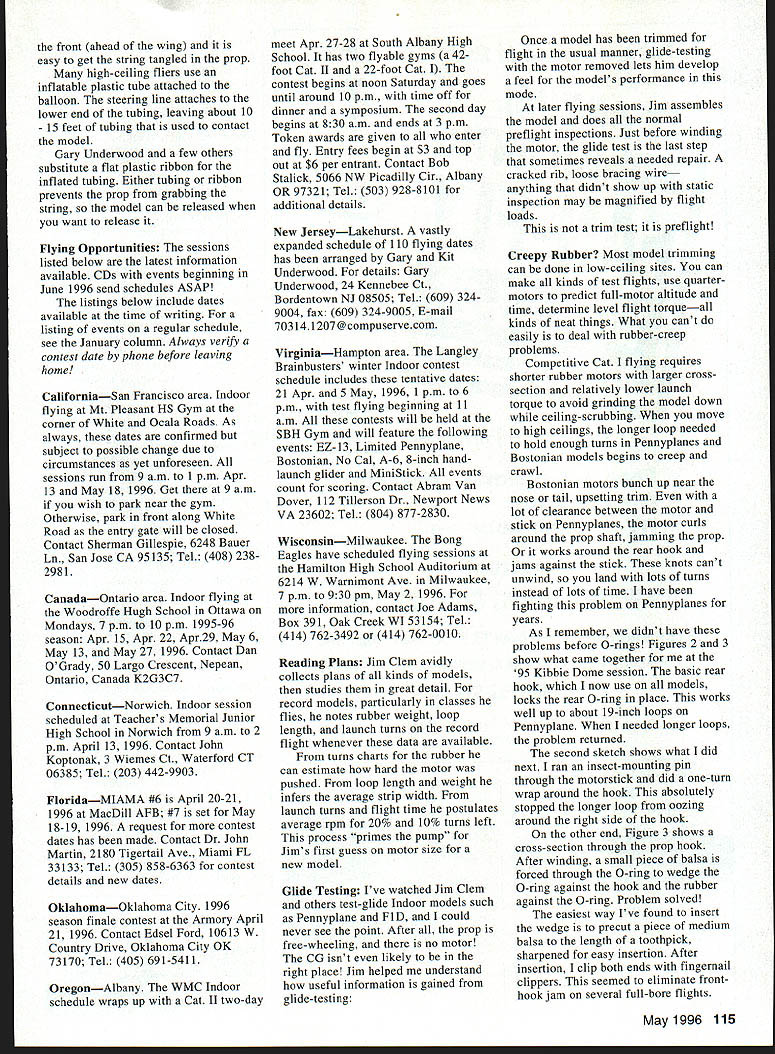
As I remember, we didn't have these problems before O-rings. The basic rear hook I now use on all models locks the rear O-ring in place. This works well up to about 19-inch loops on Pennplanes. When I need longer loops, the problem returned.
What I did next was to run an extra motor-stick mounting pin through the motorstick and do a one-turn wrap around the hook. This absolutely stopped the longer loop from oozing around the right side of the hook.
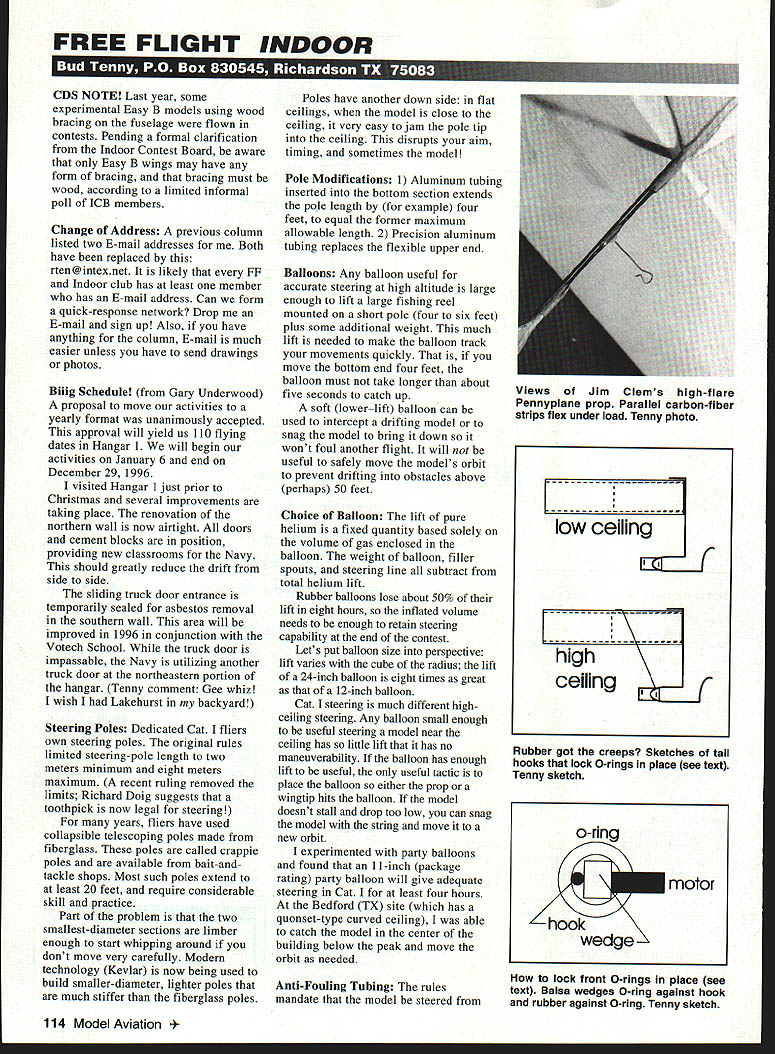
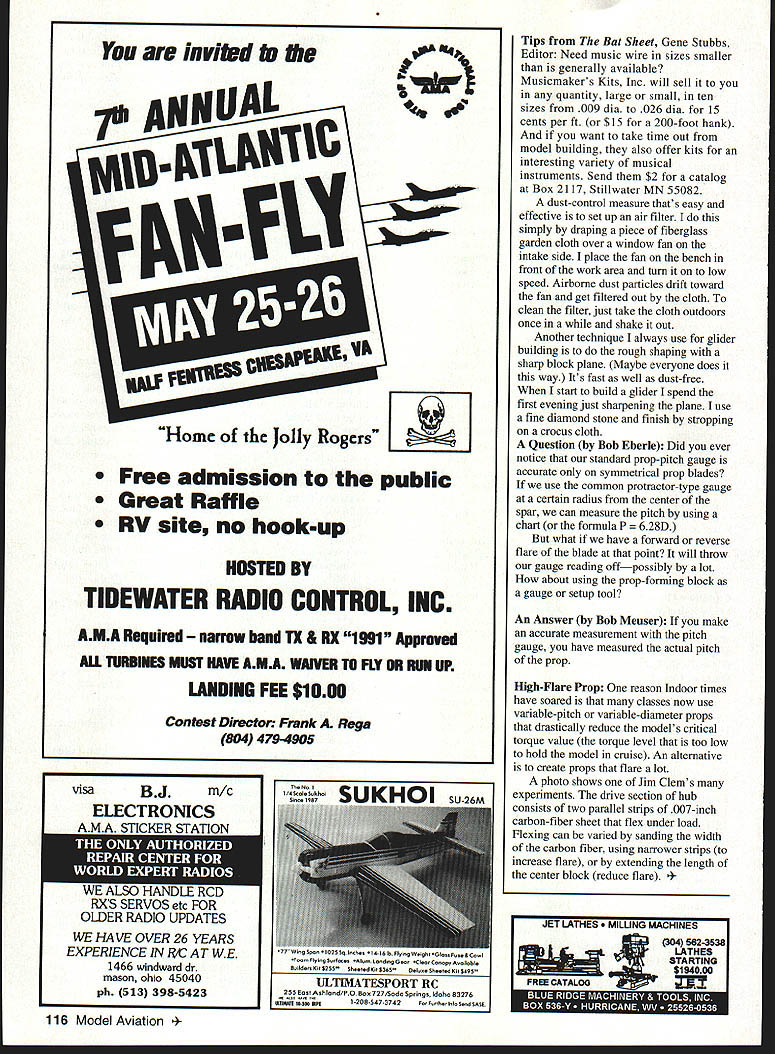
For the front hook, after winding a small piece of balsa is forced through the O-ring to wedge the O-ring against the hook and the rubber against the O-ring. Problem solved. The easiest way I've found to insert the wedge is to pre-cut a piece of medium balsa to the length of a toothpick, sharpened for easy insertion. After insertion, I clip both ends with fingernail clippers. This seemed to eliminate front-hook jam on several full-bore flights.
Transcribed from original scans by AI. Minor OCR errors may remain.

