
FREE FLIGHT INDOOR
Bud Tenny, P.O. Box 830545, Richardson TX 75083
FEEDBACK: In a past column I held up John Lenderman's Thrush Limited Pennyplane as a significant design advancement. I got the following letter from John:
"I enjoyed reading about the Thrush in the latest issue of MA. There is a correction to make—you stated the wing configuration was a 17.5-inch flat span with upturned tips. It really is 16.5-inch flat span with upturned tips. A second model was built with 0.25-inch dihedral in each tip with the upturned tips, and it flew just as well; maybe even a little bit better.
"I was hoping you might mention the prop—it's different. Others who use that prop say their times are better than before."
What is Your Opinion? Please consider this concept and respond:
A very few fliers whose models have exceeded the existing record on several successive flights on the same day submit applications for each flight. Several AMA officials have discussed this and some feel that each flier should be limited to one application per day per event, for these reasons:
- Reduced paperwork for HQ staff and for the homologator.
- The concept degrades the value of records.
Records basically reward advances in the state of the art. Successive longer flights on the same day with the same model often means one of two things:
- The flier has developed a better power combination that shows the model's true potential, or
- The conditions have continued to improve.
Here is a contest scenario for an event where the national record is 19:38. The data is presented as snapshots of the official score sheet at three times during the day.
Contestant 10:30 a.m. 1:35 p.m. 4:30 p.m. A 20:38 21:01 22:59 B 21:47 22:07 23:03 C 19:45 22:51 23:10
Contestant C wins the contest, with B second, and A third. All nine flights broke the record. If the CD did his work properly, each flight qualifies for a record, in that no time is actually a record until homologated.
The issue involved in this: should AMA HQ be involved in issuing as many as nine records, or only three? If you have strong feelings on either side of this question, send a postcard to Academy of Model Aeronautics, 5151 East Memorial Dr., Muncie IN 47302-9252. On the postcard (letters OK) state "one record/day" or "unlimited records/day." Thanks for your help!
Landmark Study?
Gene Stubbs, editor of the consistently high-quality newsletter of the Boeing Hawks, published an important what-if spreadsheet study of rubber and model performance.
Doug McLean, who was active in F1D and did development work on true tandem models, is the author of the study. Doug acknowledges that the study has limitations, but is willing to distribute copies to those interested. For anyone interested in insights about indoor model performance, this is an easy read and can give you good information. Send a business-sized self-addressed envelope with 56 cents postage to Doug McLean, 7004 S. 130th St., Seattle WA 98178 with your request.
Another Record Surge
Except for competition at major meets like the USIC, there doesn't seem to have been much Catapult Glider activity. Bob Bienenstein has pretty well shown the way with his Shooter series. After publication of the Feather Shooter, other fliers have been building the design and beating him. These flights have been homologated, and were made using the basic Feather Shooter design with a slightly different stab outline, but the models were around 14 g compared to the original at 19.7 g.
Records:
- Standard Class, Category I: 63.4, Larry Coslick, 2/11/96; 72.3, Roy White, 2/18/96.
- Unlimited Class, Category I: 72.3, Roy White, 2/18/96.
No-Touch Comments
Despite the rejection of the first rules proposal that attempted to define a no-touch event, several area contests have continued to conduct no-touch contests with rules similar to the defeated rule proposal.
Larry Coslick is very familiar with no-touch flying, since his practice site has spidery beams that specialize in capturing models. Here are some flights from Larry's logs, as related by Howard Henderson:
- In October, Larry had an AMA record Pennyplane flight in our Cat II site. It did hit the bottom of a flag that is hanging from the ceiling. The model uses a variable-pitch prop 17.5 inches diameter with low pitch 27 inches and high pitch 58 inches. The motor was May '94 Tan II, 15 inch loop, 120 launch, torque 14 in-ozs. The time was 13:54.
- In December, while flying in our 23-ft site, he made an Easy B flight of 13:28. The .048 ounce model only climbed to 18 feet altitude, using a 12/24 flaring prop and a Tan II (Aug. '93) motor, 11.8 inches by .03 inches.
Speaking of Practice Sites
Jim Clem and I have had excellent success at local YMCAs. The gymnasium areas are sometimes available during normal work hours, and have 20-foot usable space with spider beams similar to Larry Coslick's site mentioned above.
We also found a room used for karate and aerobics classes that may prove ideal for test flying of some classes. It has a 16-foot flat ceiling and zero drift after the air-conditioning is turned off. Since we are both members to use the workout equipment, this proves to be a membership bonus!
A Question
(from SAM 86) Why do seagulls always fly near the sea? If they flew near the bay they'd be bagels.
Braided Motors
Braided motors have been mentioned here several times. A braided motor has been preloaded with reverse twists so that the unwound motor wraps itself up with very low slack. Those of us who use them feel we get a better shot at minimizing bunching (in Scale/Manhattan/Bostonian models) or on long-motorstick models such as P-24s and Federation ROGs.
Previous discussions dealt with multi-strand motors, but it is also easy to braid a single loop. Just cut a strip to the same length as for a normal motor, then twist the single strand about 50 turns. Make a loop from the twisted strand and massage the tangled mess until it hangs with no doubling. If the length is about the same as the distance between hooks, tie it as a normal motor. Otherwise, adjust the number of twists to compensate. Try it—I think you will like it!
Flying Opportunities
The sessions listed below are the latest information available. CDs with events beginning in June 1996 send schedules ASAP! The listings below include dates available at the time of writing. For a listing of events on a regular schedule, see the January column. Always verify a contest date by phone before leaving home!
- New Jersey—Lakehurst. A vastly expanded schedule of flying has been arranged by human dynamos Gary and Ruth Underwood. For details: Gary Underwood, 24 Kennebec Ct., Bordentown, NJ 08505; (609) 324-9004, Fax: (609) 324-9005, E-mail: 70314.1207@compuserve.com.
- Idaho—Moscow. Confirmation has been late, but the 1996 World Championships will be held in the Kibbie Dome. The last received schedule for the week was: Standard Kibbie Dome schedule, with HLG and Catapult glider events running from 8 a.m. to 9:30 a.m. each day, followed by duration events until 6 p.m. The International EZB event will be included. Flights will be made in six rounds. For the latest schedule contact Andy Tagliafico, 10039 SW Quail Post Rd., Portland, OR 97219; Tel: (503) 452-0546.
A New Event?
An interesting suggestion! This is one of three concepts appearing in several club newsletters, but I lost the proper credit for the original publication. It seems like every week someone is trying to start a new contest, usually a watered-down version of some previous event that has become too competitive. They always require the building of a new type of airplane, and the guys with the best techniques and rubber always win. How about something different for a change? For instance:
Test Your Trimming Prowess
This event can be run either indoors or outdoors. Someone supplies the airplane—a Bostonian, say—and competitors get to take turns adjusting it for maximum duration. The airplane should be built with trim tabs for surface adjustments and a nose built to allow convenient shimming. Contestants can make their own motors from a batch of rubber supplied. If someone breaks the airplane, he's disqualified.
The CD removes all adjustments and ballast prior to giving the airplane to the next contestant. For, say, $1 you get 10 minutes with the airplane—winner takes all at the end of the day or whenever the airplane is destroyed or lost. Repeat or extended tries are allowed (e.g., 30 minutes for $3).
More Twist to the Inch? SAM 86 Speaks
Don Reid reported in from Ron Reid, who regularly escapes the Canadian winters with extended sojourns in Las Vegas.
Don told of a rubber lubricant called Sil-Glide, a fairly stiff amber goo. He lubed a couple of Gollywock motors with it and headed out to the dry lake to check them out. He normally winds to 45 in.-oz. of torque (80% of the assumed breaking torque of 55 in.-oz.), and usually gets three winds before breaking a strand when lubed with Son of a Gun. Exceeding 45 in.-oz. generally results in some bunching and an occasional tear.
A motor lubed with Sil-Glide was wound initially to 35 in.-oz. to condition it, and then wound a second time to 48 in.-oz. with no bunching. Subsequent winds were to torques of 52, 55 and 58 in.-oz., at which point he broke a couple of strands.
Don says he has never before used a lube which helped a motor wind up as smoothly as Sil-Glide. The knots are very small and tight, and at T5 there is less bunching than at T45 with Son of a Gun.
Sil-Glide is available in the U.S. at NAPA auto parts stores and is also available in silicone and 16-ounce aerosols at $3 and $6.95 (US) respectively. The spray coats evenly and dries quickly and Don reckons that it's at least as good as the tube, which he initially purchased from Al Heinlen of AeroDyne for US $4 for a four-ounce tube.
It would appear that this lubricant offers either an increase in usable torque, or extended motor life. (Columnist's note: I recently bought a four-ounce tube of Sil-Glide at my local NAPA auto parts store for $5.59.)
Universal Rib Template Revisited
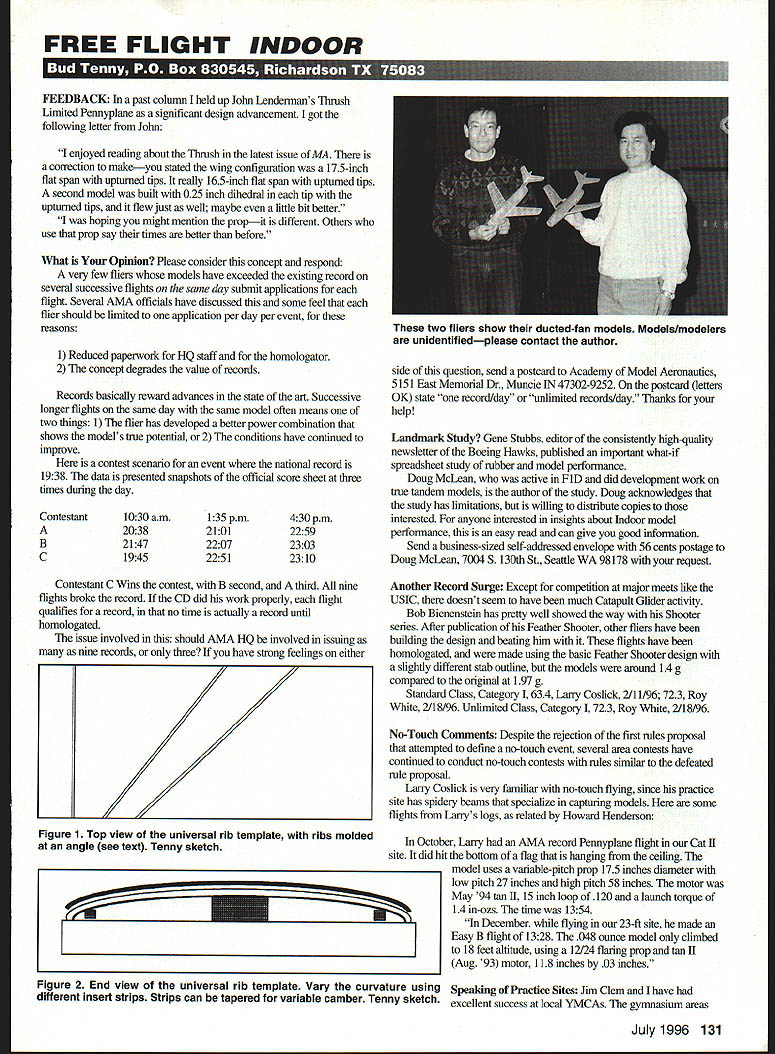
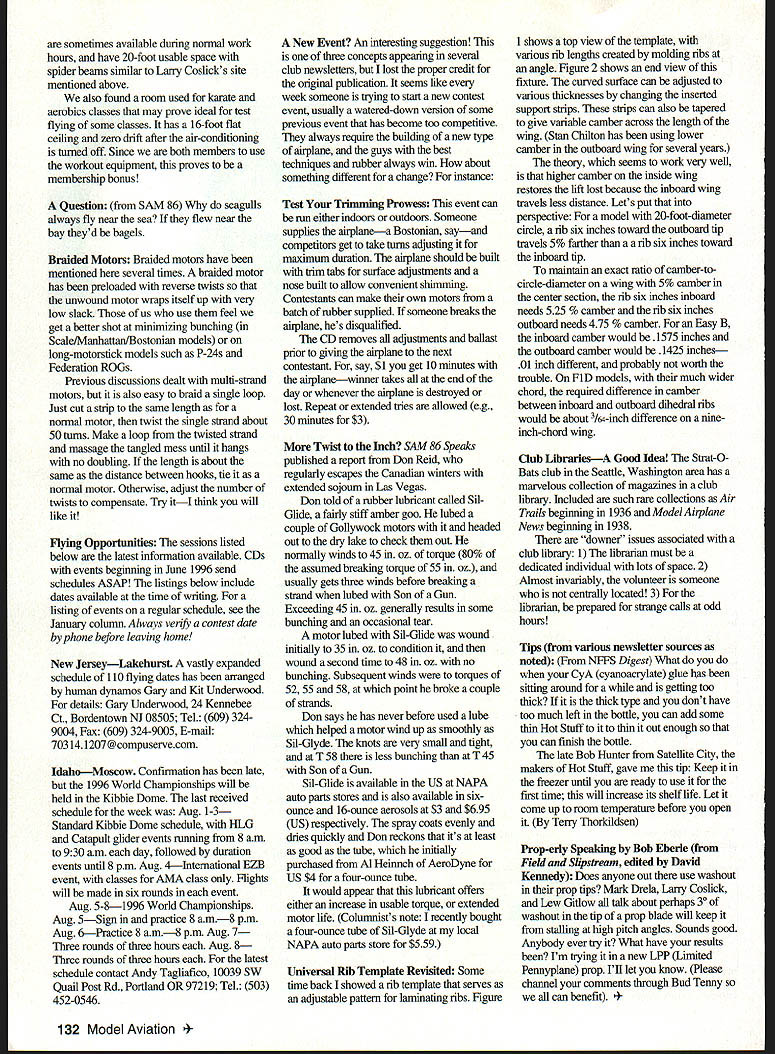
Some time back I showed a rib template that serves as an adjustable pattern for laminating ribs. Figure 1 shows a top view of the template, with various rib lengths created by molding ribs at an angle. Figure 2 shows an end view of this fixture. The curved surface can be adjusted to various thicknesses by changing the inserted support strips. These strips can also be tapered to give variable camber across the length of the wing. (Stan Chilton has been using lower camber in the outboard wing for several years.)
The theory, which seems to work very well, is that higher camber on the inside wing restores the lift lost because the inboard wing travels less distance. Let's put that into perspective: For a model with a 20-foot-diameter circle, a rib six inches toward the outboard tip travels 5% farther than a rib six inches toward the inboard tip.
To maintain an exact ratio of camber-to-circle-diameter on a wing with 5% camber in the center section, the rib six inches inboard needs 5.25% camber and the rib six inches outboard needs 4.75% camber. For an Easy B, the inboard camber would be .1575 inches and the outboard camber would be .1425 inches—no trouble. On F1D models, with their much wider chord, the required difference in camber between inboard and outboard dihedral ribs would be about .007 to .012 inch on a nine-inch chord wing.
Club Libraries—A Good Idea!
The Strat-O-Bats club in the Seattle, Washington area has a marvelous collection of magazines in a club library. Included are scarce collections such as Air Trails beginning in 1936 and Model Airplane News beginning in 1938.
There are "downer" issues associated with a club library:
- The librarian must be a dedicated individual with lots of space.
- Almost invariably, the volunteer is someone who is not centrally located.
- For the librarian, be prepared for strange calls at odd hours!
Tips
(From various newsletter sources and notes; from NFFS Digest)
- What do you do when your CA (cyanoacrylate) glue has been sitting around for a while and is getting too thick? If it is the thick type and you don't have too much left in the bottle, you can add some thin Hot Stuff to it to thin it out enough so that you can finish the bottle.
- The late Bob Hunter from Satellite City, the makers of Hot Stuff, gave me this tip: Keep it in the freezer until you are ready to use it for the first time; this will increase its shelf life. Let it come up to room temperature before you open it. (By Terry Thorkildsen)
Proper-ly Speaking
By Bob Eberle (from Field and Stream, edited by David Kennedy): Does anyone out there use washout in their prop tips? Mark Della, Larry Coslick, and Lew Gitlow all talk about perhaps 3° of washout in the tip of a prop blade will keep it from stalling at high pitch angles. Sounds good. Anybody ever try it? What have your results been? I'm trying it in a new LPP (Limited Pennyplane) prop. I'll let you know. (Please channel your comments through Bud Tenny so we all can benefit.)
Transcribed from original scans by AI. Minor OCR errors may remain.

