
Free Flight: Indoor
Bud Tenny Box 830545, Richardson TX 75083
Apology / Clarification on Blade Pitch Measurement
A couple of columns back I got careless; Bob Meuser rightly called me on it.
What I meant to say about blade-pitch measurement is this: measuring the blade angle at a single radius tells you the pitch at that radius, but that may not represent the prop as a whole, especially if the blades are not alike or the pitch varies with radius. To get the complete picture you should measure blade angle at several radii on each blade. Often a nominal pitch is quoted at an arbitrary radius (about 0.7 of the tip radius), but there is no universal standard.
Also, present formulas should define symbols. My earlier shorthand P = 6.28 D was confusing. More generally:
- Pitch = 2 × π × radius × tan(blade angle at that radius)
This requires that pitch and radius be in the same units (inches or metric), and the blade angle be specified (as you would enter it on your calculator).
We're Growing!
Two columns ago I suggested that indoor fliers on the Internet share e-mail addresses to form a quick-reaction network. We are up to 10 and growing. Send your address to rten@intex.net and I will circulate a list.
1996 MiniStick Postal Results
The following times were culled from the full report released by Larry Coslick, hosted with aid from other editors of Indoor News And Views. Fliers from seven countries participated. The totals include some fliers who posted two or more times; only each flier’s highest time is shown here. Top five times from USA and Japan are listed first; complete results from remaining countries follow.
- Walt VanGorder — USA — Time: 538 s — Ceiling: 17.916 — Multiplier: 1.733 — Score: 932.598
- Jim Clem — USA — Time: 558 s — Ceiling: ~23.3 — Multiplier: 1.618 — Score: 902.628
- Toru Yatabe — Japan — Time: 563 s — Ceiling: 29.52 — Multiplier: 1.504 — Score: 846.670
- Mark Vancil — USA — Time: 424 s — Ceiling: ~10.5 — Multiplier: 1.984 — Score: 841.139
- Bob Platt — USA — Time: 398 s — Ceiling: 8.166 — Multiplier: 2.101 — Score: 836.138
- Toru Onishi — Japan — Time: 547 s — Ceiling: 29.52 — Multiplier: 1.504 — Score: 822.608
- Larry Mizik — USA — Time: 473 s — Ceiling: 20.92 — Multiplier: 1.682 — Score: 795.698
- Gene-Francis Frugoli — France — Time: 378 s — Ceiling: 8.22 — Multiplier: 2.008 — Score: 792.969
- Walt Collins — USA — Time: 359 s — Ceiling: 8.166 — Multiplier: 2.101 — Score: 754.205
- Shigezoshi Nonaka — Japan — Time: 470 s — Ceiling: 25.92 — Multiplier: 1.562 — Score: 734.367
- Kazumasa Kihara — Japan — Time: 473 s — Ceiling: 29.52 — Multiplier: 1.504 — Score: 711.323
- Shigezashi Nonaka — Japan — Time: 438 s — Ceiling: 25.92 — Multiplier: 1.562 — Score: 685.930
- Roy Wilson — England — Time: 478 s — Ceiling: ~48.3 — Multiplier: 1.262 — Score: 668.656
- Phil Alvarez — Canada — Time: 354 s — Ceiling: 8.22 — Multiplier: 2.008 — Score: 615.803
- Edmond Roch — France — Time: 483 s — Ceiling: ~59.2 — Multiplier: 1.694 — Score: 599.506
- Dan O'Grady — Canada — Time: 453 s — Ceiling: ~59 — Multiplier: 1.694 — Score: 582.014
- George Tomkvist — Sweden — Time: ~250 s — Ceiling: ~7.8 — Multiplier: 2.122 — Score: 530.509
- Peter Olshefsky — Canada — Time: 439 s — Ceiling: ~59 — Multiplier: 1.694 — Score: 525.904
- Don Steeb — Canada — Time: 403 s — Ceiling: ~59 — Multiplier: 1.205 — Score: 485.614
- Don Long — Canada — Time: 363 s — Ceiling: 49.3 — Multiplier: 1.205 — Score: 467.614
- Yannick Grange — France — Time: 256 s — Ceiling: 19.52 — Multiplier: 1.699 — Score: 433.541
- Renzo Tabellini — Italy — Time: 279 s — Ceiling: 23.8 — Multiplier: 1.546 — Score: 421.298
- Sven Pontan — Sweden — Time: 263 s — Ceiling: 23.8 — Multiplier: 1.546 — Score: 417.902
- George V. Dimes — England — Time: 246 s — Ceiling: 19.3 — Multiplier: 1.699 — Score: 400.397
- Giacomo DeAngelo — Italy — Time: 259 s — Ceiling: 26.9 — Multiplier: 1.546 — Score: 305.160
- Daniel Hartstrein — Sweden — Time: 198 s — Ceiling: 19.84 — Multiplier: 1.686 — Score: 239.620
- Franco Pianigiani — Italy — Time: 273 s — Ceiling: 13.3 — Multiplier: 1.273 — Score: 237.870
- Luis Font-Bellot — Spain — Time: 127 s — Ceiling: 13.3 — Multiplier: 1.273 — Score: 237.819
- Santiago Rodriguez — Spain — Time: 134 s — Ceiling: 16.4 — Multiplier: 1.775 — Score: 179.328
- Stefania De Robertis — Italy — Time: 116 s — Ceiling: 26.9 — Multiplier: 1.546 — Score: 157.685
- Maurio Spagnoli — Italy — Time: 102 s — Ceiling: 26.9 — Multiplier: 1.546 — Score: 151.713
- F. Haro-Martinez — Spain — Time: 81 s — Ceiling: 13.3 — Multiplier: 1.273 — Score: 149.956
- Manuzio Fagnotti — Italy — Time: 97 s — Ceiling: 26.9 — Multiplier: 1.546 — Score: 149.956
MiniStick and Catapult Glider Records Jump Again!
MiniStick records:
- Category I — Time: 9:23 — Flier: Walt Van Gorder — Date: 4/11/96 — Model: Modified Krush K777
- Category IV — Time: 11:34 — Flier: Walt Van Gorder — Date: 4/15/96 — Model: Modified Krush K777
- Category IV — Time: 11:36 — Flier: Bob Eberle — Date: 4/20/96 — Model: Original Design
Catapult Glider — Standard Class:
- Class II — 0:29.4 +0:29.0 — Kenny Krempetz — 4/02/96 — Team Design**
- Class II — 0:50.5 +0:50.6 — Wayne Triven — 4/20/96 — Original Design
Catapult Glider — Unlimited Class:
- Class II — 0:42.0 +0:43.2 — Kurt Krempetz — 4/02/96 — Original Design
- Class II — 0:50.7 +0:51.3 — Wayne Triven — 4/20/96 — Original Design
- * denotes junior entrant
- ** father/son team
Can We Learn From These Results?
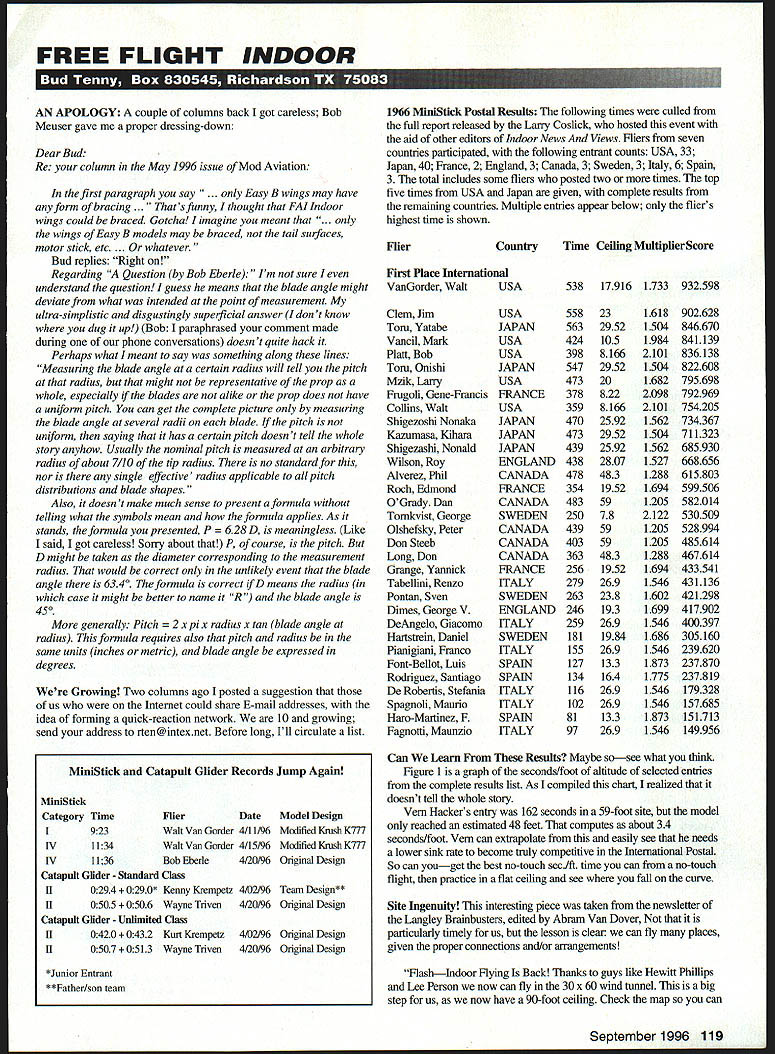
Maybe. One useful metric is seconds per foot of altitude. As I compiled a chart of seconds/foot for selected entries, I realized it doesn't tell the whole story.
Example: Vern Hacker posted a 162-second flight in a 59-foot site, but the model only reached an estimated 48 feet. That computes to about 3.4 seconds/foot. Vern can extrapolate from this to see that he needs a lower sink rate (better sec/ft) to be competitive at the International Postal. The practical tip: get the best no-touch sec/ft you can from a no-touch flight, then practice in a flat ceiling and see where you fall on the curve.
Site Ingenuity!
From the Langley Brainbusters newsletter (Abram Van Dover): Indoor flying can be arranged in unconventional venues. Example: thanks to people like Hewitt Phillips and Lee Person, one group flew in a 30 × 60 wind tunnel with a 90-foot ceiling. If you plan to visit such sites, check access rules (NASA/military stickers, gate to use, etc.) and get directions so you can get to the site without too much fuss.
Flying Opportunities
This truncated list contains some unverified data—check and verify by phone before you travel.
- California — Burbank: Black Sheep Exhibition Squadron, monthly sessions on second Fridays; Category I at Luther Burbank Middle School. Contact Tony Vaccaro, Tel.: (818) 842-5062.
- California — Garden Grove: Weekly sessions at Crystal Cathedral. Contact John Wenk, 4621 Silverleaf Ave., Orange, CA 92669; Tel.: (714) 633-8546.
- California — Marin County (20 miles north of San Francisco): Year‑round minicomets, 8 a.m.–2 p.m., 4th Sunday each month. Contact George Benson, 204 Benson Circle, Mill Valley, CA 94941; Tel.: (415) 388-1807.
- California — San Diego: Fun Fly and Scale sessions monthly in Colina Del Sol Community Center (Category I), 5316 Orange Ave., San Diego. Contact Howard Haupt, 3860 Ecochee Ave., San Diego, CA 92117; Tel.: (619) 272-5656.
- Canada — Winnipeg, Manitoba: Category I and III sessions. Contact Barrie Taylor, 2 Thackeray, Winnipeg, Manitoba R3K 0H1; Tel.: (204) 889-4737.
- Connecticut — Norwich: Saturday sessions (historical 1994–95) 9 a.m.–1 p.m. Contact John Kotonak, 3 Weems Ct., Waterford, CT 06385; Tel.: (203) 442-9003.
- Illinois — Chicago area: Year‑round weekly sessions, Monday evenings 6–11 p.m. Contact Bob Warmann, 245 N. Oaklawn, Elmhurst, IL 60126; Tel.: (708) 343-9075.
- Iowa — Cedar Rapids: Non‑sanctioned indoor flying reported Nov. 1994–Feb. 1995. Contact Paul McIlrath, 1524 8th SE, Cedar Rapids, IA 52402; Tel.: (319) 393-4677.
- Kentucky — Louisville: Regular flying sessions. Contact Mason Plank, 3207 Oriole Dr., Louisville, KY 40213; Tel.: (502) 634-8191.
- New Jersey — Lakehurst: 1995 sessions/contests/record trials at Hangar #1 continue. Contact Gary Underwood, 24 Kennebec Ct., Bordentown, NJ 08505; Tel.: (609) 324-9004.
- North Carolina — Charlotte: Weekly Friday night sessions, year‑round. Contact Cliff Culpepper, 1401 Ferncliff Rd., Charlotte, NC 28211; Tel.: (704) 366-7350.
- Ohio — Cleveland area: Weekly sessions year‑round in Category I sites. Contact Vern Hacker, 25599 Breckenridge Dr., Euclid, OH 44117-1807; Tel.: (216) 486-4990.
Flight Trim / Design
#### Trimming for Low Ceilings At Oxbow we discussed trimming power for models (for example, a Pennylane) to fly under low ceilings with lots of structure. The idea:
- Limit climb rate to avoid getting tangled in beams; a shallow climb helps the airplane bounce off the lowest beams and keep flying.
- Choose the longest motor you think will unwind most of the way, then select the rubber width so the airplane cruises or climbs gently during the plateau region of the rubber torque curve.
- Stop winding before you enter the power-burst region of the torque curve.
Bud Tenny comment on winding technique:
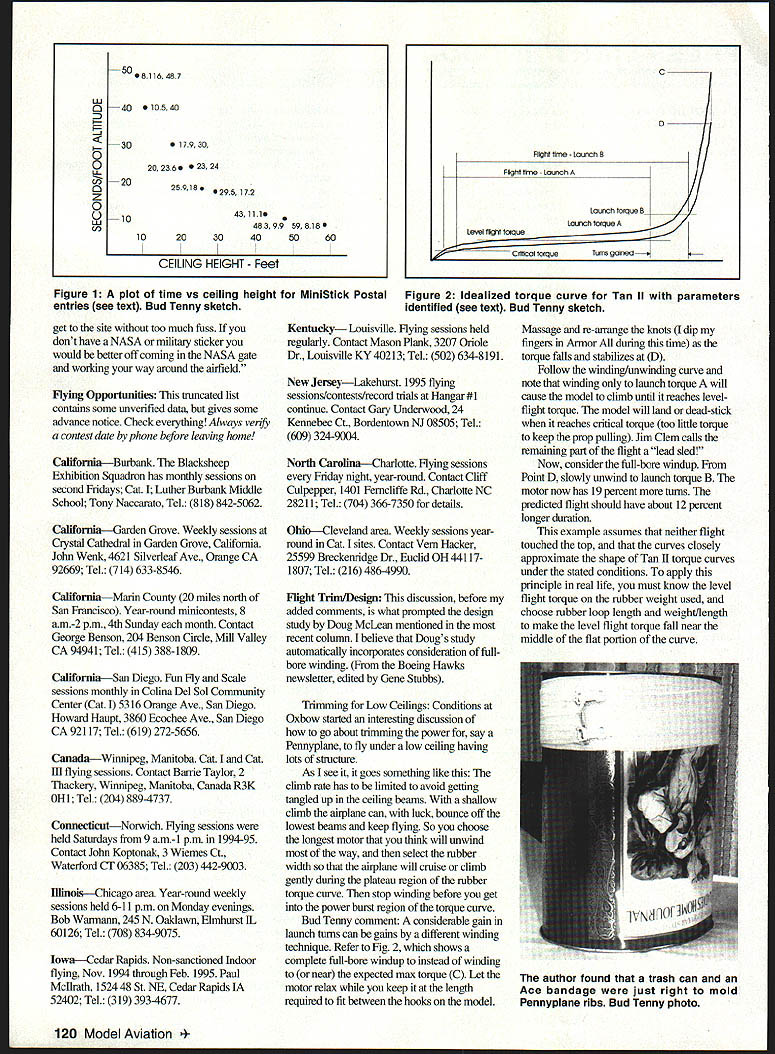
- A considerable gain in launch turns can come from a different winding technique. Figure 2 in the original shows a full-bore windup to a high torque point (C), then letting the motor relax to a lower stabilized torque (D) while held at the required motor length.
- From Point D, slowly unwind to launch torque B. The motor then has more turns available at launch. In the simple example given, this yields about 19% more turns and an expected ~12% longer duration, assuming neither flight topped and the torque curves approximate F1A-type shapes.
- To apply this in practice you must know the level‑flight torque for your rubber/weight, and choose rubber loop length and weight so the level‑flight torque falls near the middle of the flat portion of the torque curve.
Electric Power
#### Microelectric Motors Don Reich (Model Airplane Distributors) found tiny electric motors used in silent pagers — presumably the same as those in Kenway's KR-2 unit (the Kenway unit uses a capacitor because a 50 mAh battery would be too heavy). Don obtained a couple for under $5 each.
I made thrust measurements of the Kenway unit using small props and various charge voltages. The capacitor is rated only to 2.5 V, so I was cautious about higher recommended charges (Kenway suggests up to 4.2 V — three fully charged Ni‑Cd cells). Tests:
- At 2–3 V charge the motor was disappointing and seemed to lack thrust.
- At 4.2 V the motor’s performance improved dramatically (it even tore my thrust-balance sling apart in an initial test).
Best prop found: 3/16-inch black nylon Comet prop (sold by Kenway and HiLine). Performance with a 4.2 V charge (approximate):
- Initial burst thrust: 5–6 g for ~5 s
- Gradual fade thrust: 3–4 g for ~20 s
- Residual tail thrust: 1–3 g for ~20 s
By filing down the prop thickness and removing the capacitor jacket I reduced system weight to about 8.5 g. With more than 3 g thrust lasting nearly 30 s, and assuming a thrust/weight ratio of ~1:4, such a unit could fly a scale airplane weighing about 12 g (leaving ~3–4 g for the airframe). This appears feasible for a light Indoor Peanut Scale airplane, since the fuselage need not carry a rubber motor.
Bud Tenny suggestion: Could tiny capacitor‑powered motors support a free‑flight event? A controlled, fixed capacitor charge would level the playing field: competitors would try to get the most duration from a fixed amount of energy. This would reward both electronic and aerodynamic skill.
Ribs and Boxes
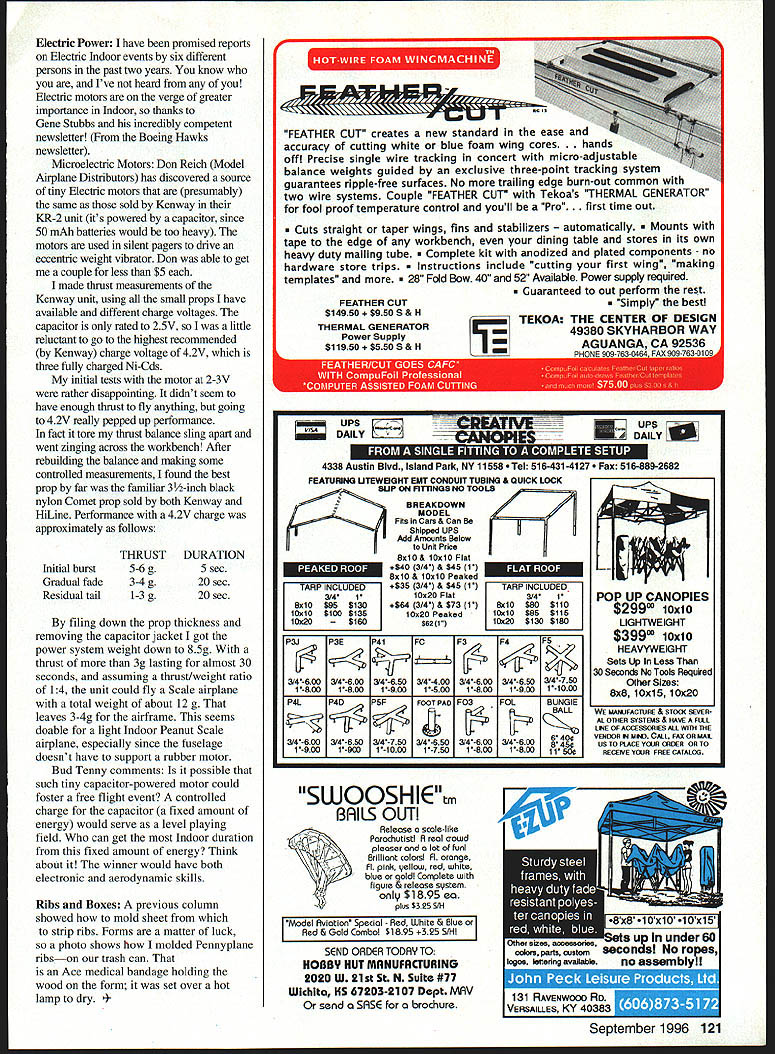
A previous column showed how to mold sheet for stripping ribs. Forms are a matter of improvisation; I molded Pennypalene ribs on a trash can, held with an Ace medical bandage and dried over a hot lamp.
Closing Notes
- If you want to be on the Internet quick‑reaction list, send your e‑mail to rten@intex.net.
- Corrections and clarifications above replace earlier sloppy statements — thanks to those who pointed them out.
Transcribed from original scans by AI. Minor OCR errors may remain.

