
Free Flight: Indoor
Bud Tenny
REMEMBER THE INSTRUCTORS! If your club is one of those with a fairly active indoor season and you have a good group of beginners of any age range, the odds are long that you have one or more of those selfless individuals who spends endless hours helping people. The same can be said of most clubs regardless of the type of model activity, but indoor is a special case. At least limited help can be found at the hobby dealer for almost any kind of model except indoor models—likely not even the supplies are available for indoor. As a result, those in your club who have learned indoor recently either dug it out for themselves or were guided by someone. So, if your club has one of these tutors, take a minute to thank him. Even if he hasn't helped you directly, he has advanced modeling all around you to the detriment of his own modeling.
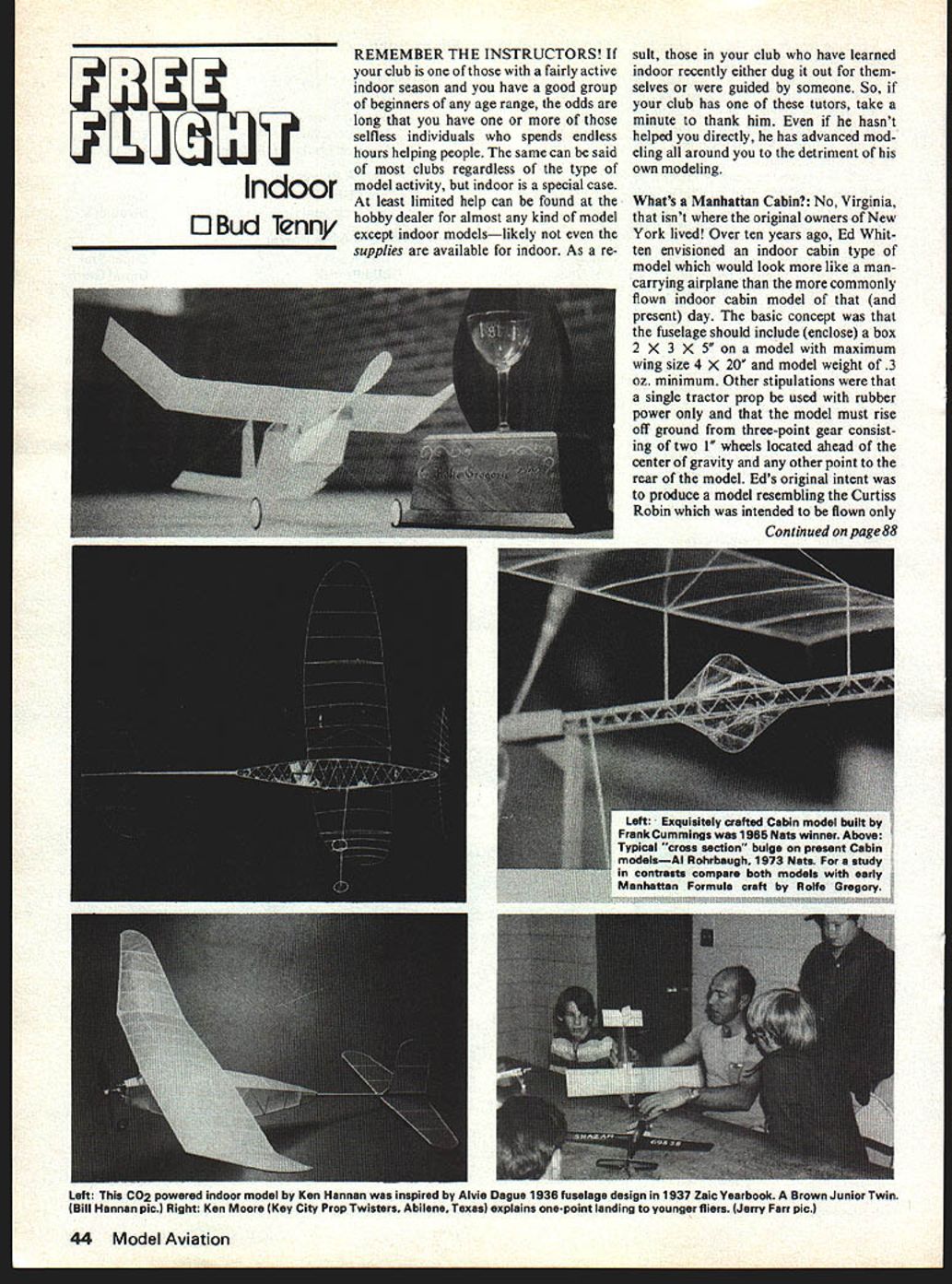
What's a Manhattan Cabin?: No, Virginia, that isn't where the original owners of New York lived! Over ten years ago Ed Whitten envisioned an indoor cabin type of model which would look more like a man-carrying airplane than the more commonly flown indoor cabin model of that (and present) day. The basic concept was that the fuselage should include (enclose) a box 2 × 3 × 5" on a model with maximum wing size 4 × 20" and model weight of .3 oz. minimum. Other stipulations were that a single tractor prop be used with rubber power only and that the model must rise off ground from three-point gear consisting of two 1" wheels located ahead of the center of gravity and one other point to the rear of the model. Ed's original intent was to produce a model resembling the Curtiss Robin which was intended to be flown only
Free Flight: Indoor
indoors.
And then? Almost nothing happened for a long time. Ed's first model was built heavy on purpose (over .7 oz.) and managed 3:40.8 in a blimp hangar at Lakehurst. This really wasn't an indoor model, and wasn't what Ed was after. Then, small groups around the country tried it and the Miami Indoor Aircraft Model Assoc. (M.I.A.M.A., based in Miami, Florida, of course!) began regular sessions. Their experience led them to these rules:
- Airframe weight: Less rubber—4 grams minimum.
- Overall length: Measured from front of prop bearing aft—20" maximum.
- Fuselage: a) Must support and enclose a single rubber motor; no motor sticks. b) Must include or exceed a "box" 2½ × 4 × 2", no diamond shapes. c) Must have a windshield of 2 sq. in. minimum area, and a window on each side of one sq. in. minimum area covered with cellophane or similar material.
- Prop: Solid wood, direct drive, fixed pitch.
- Wing: Unbraced monoplane with 4" maximum chord and 20" projected span.
- Landing gear: Rigid and fixed with at least two wheels of 1" minimum diameter.
- Flying: All flights R.O.G., unlimited attempts to record 5 flights. Flights less than 20 seconds are attempts. Best flight counts.
- Covering: Except for windshield and windows—paper covering. No film or microlite.
Using the above rules, M.I.A.M.A. sponsored two major contests in 1976 and will repeat for 1977. At the NIMS International Record Trials, held in the Atrium of Northwood Institute, five contestants flew Manhattan Formula models, Bucky Servaites winning 4:52.8. At the Nats, Dan Domina proxy-flew John Triolo's Manhattan to the winning time of 8:09.7. With these two meets to break the ice, interest began to grow and considerable correspondence has been exchanged regarding the future of the event and possible new rules. In the meantime, the same rules will be used for 1977, and predictions are being made about when some Manhattan For- mula will break 10 minutes.
Ed Whitten has put all the correspondence, speculations and history on Manhattan Formula into a special issue of the Star Skippers newsletter he has been publishing. Besides lots of words, there are three-view sketches and photos of many Manhattan models. If you would like to have a copy, send a business-sized self-addressed, stamped envelope to Ed Whitten, Box 176, Wall St. Station, New York, NY 10005.
Engine Powered Indoor Models? How about CO2 engines? A letter from Bill Hannan, one of the most active scale model proponents in California, opens up a very interesting area for speculation. First, Bill relates that The Scale Staffel, a newly-formed group of modelers in the San Diego area, have contest classes for both scale and non-scale indoor CO2 powered models. The scale model section is quite similar to other scale contests, while the non-scale event, judged solely on flight duration, is somewhat reminiscent of the early days of outdoor gas models. That is, all flights must R.O.G. and the capacity of the CO2 "gas tank" is limited to 3 cc per cylinder. At present, flights are being made on commercial plastic props (Tern Aero and Williams Brothers), but Bill expects that larger diameter, carved wood props will greatly increase the current 2 1/2 minute duration. This is silent, slow and gentle flight, contrary to one's initial concept—ultra-low power is used to stretch the engine's "mileage." This is another type of indoor model not compatible with mike ships—but apparently the action resembles that of Pennyplane models.
Bud Tenny, P.O. Box 545, Richardson, TX 75080.
Transcribed from original scans by AI. Minor OCR errors may remain.

