
FREE FLIGHT INDOOR
Bud Tenny, Box 830545, Richardson TX 75083
ONE HOUR!
A phone call from Ken Johnson passed on the astounding news that Steve Brown, flying a model with a 320-square-inch wing and a 116-square-inch stab, posted a 63:54 flight at the 9/1/96 unsanctioned session at Santa Ana. The model weighed 0.042 ounce and used an 18-inch loop of .069 Tan II rubber, weighing 0.065 ounce. The flight went off with 2,480 turns and deadsticked somewhere above 30 feet. At about 30 feet, the motor came off the prop and dangled from the rear hook, causing the model to settle straight down. Steve admits that there was very good air, which he realized when the model was still climbing slowly just above the catwalks, 45 minutes into the flight!
Not Homologated Yet, But ...
At a Tillamook hangar session held following the WCh activity, Andy Tagliafico's record-holding MiniStick model posted 14:28.
Trivia!
In what recent contest would two 45-minute flights put you in only ninth place, and two 48-minute flights be only third place? Answer: 1996 Indoor WCh. While such fierce competition was the hallmark of this meet, what didn't happen is also noteworthy. If China, Poland, Czechoslovakia, and Yugoslavia had been able to make it, there would have been 15 entrants. Also, junior teams from China, Poland, Romania, and the Ukraine were initial entrants, leaving Jake Palmer as the only junior entrant.
Kibbie Dome Annual
This meet, sponsored by Andy Tagliafico, is a three-day session with a unique competition format that results in spirited competition in a more relaxed atmosphere than most major events. Most fliers require only one visit to this contest to get hooked, so it is growing steadily. For those who can only attend one major indoor contest a year, the choice between Kibbie and the Nats can be agonizing.
Two events stood out at this meet:
- Jesse Shepherd Jr.'s experimental 35 cm tandem model. The model had two 6.5-inch-wide wings of 35 cm span, and the cabane of the rear wing was covered to form a rudder. This prototype was totally unflown at the start of the meet, so Jesse had a cram course in adjusting tandem models. Bernard Hunt, who has been pioneering tandem F1D models with excellent results, was on hand to offer advice on the most critical tandem parameter: CG location. Although Jesse didn't get zeroed on prop/rubber combination, his 19:58 used far less than the full available altitude and lent credence to Bernard's prediction of 30-minute capability for the model.
- Ornithopter Mass Launch. This impromptu event saw nine fliers line up and launch with very little fanfare. The visual impact was that of a covey of quail flushed by a hunter! Although Gil Coughlin almost always brings between two and ten ornithopters to a meet, he apparently didn't get the word in time. He watched the launch while holding two flappers—neither of them wound up. What other contest in the entire history of indoor could have hosted a mass launch of nine (or 11) ornithopters?
Entry in this esoteric event was quite high and included one very energetic and determined young lady: Anita Taylor. She seemed to go nonstop during the meet, steadily boosting her time to fourth place (7:21) by meet's end.
Easy B International Meet
The Second Annual Easy B International contest was well attended and was a really hard-fought event. AMA Easy B rules were used, but the flights were made in six rounds with no-launch periods between rounds. Scoring was best two of six flights.
Competition was so strong that Larry Coslick only placed fourth, and no one quite made 30 minutes (single flight). The closest to 30 were Laurie Barr (England) and Larry Cailliau with 29:00 and 28:48 respectively.
The most popular design flown in this meet was Larry Coslick's Easy B; at times, there were so many of that design flying at once that it was almost impossible for timers to be sure they were timing the right model!
With the continued development of Easy B to super-light models weighing 0.5–0.7 g, a few Easy B fliers are becoming discouraged by the difficulty of reaching those weights. A few fliers were thinking about introducing a weight limit for Easy B, but the FIL provisional event is a weight-limit Easy B class. Perhaps contest directors of larger meets could schedule both classes?
The Indoor Group
Thanks to contacts made at the WCh and responses to previous announcements, the Indoor Group is now 26 and growing. All it takes to join is to send your e-mail address to rten@intex.net. One benefit the group has accrued: they received word of Steve Brown's 63:54 and Andy Tagliafico's 14:28 MiniStick flights within a couple days of learning the news.
Now Hear This!
E-mail from Roger Schroeder: In the Kansas City–Lawrence–Topeka area we have a lot of indoor activity and small-but-adequate flying sites available monthly and weekly during the winter months. We also have an annual Heart of America FF Club state contest in Topeka at Washburn University (35+ feet) each spring.
Unfortunately, we are losing active indoor fliers. Some move away (like Hideo Benito) and some die (Bill Langley). The remaining fliers have discussed the problem and want to get more modelers to participate in our flying. We are open to suggestions as to what works.
Help spread the word about our group. The Internet connections you have put together may be another approach. Please give this a thought; we will be happy for any suggestions. Inquiries in the Topeka area can be directed to Jack Koehler at (913) 273-9554; in Lawrence to Ed Wiley at (913) 842-1308; and in the Kansas City area, to me at (913) 648-4265.
Roger J. Schroeder, Overland Park KS. rsch@idir.net
Electric Power Report
Ken Johnson flew an experimental electric-duration model that flew about four minutes. The model weighs 18 grams; about 16 grams of that is the power train. The two grams of airframe includes a wing 29.5 inches in span and five inches wide. Tapered tips bring the area down to about 130 square inches; the stab is about 50 percent of the wing area; and the CG is at 90% of the wing chord.
Ken has promised more information that may be available in time for the next column. The power system used two 50 mAh cells per a miniature Kenway motor driving a 1.5-inch-diameter prop with very low pitch.
Glider Consistency
A quick reminder: the consistency calculation is done by dropping the lowest two flights of nine, averaging the remaining seven, and dividing the highest score by that average. A very high consistency score shows that the flier is getting the best time the model is capable of. If that isn't good enough to win, a new glider is needed!
HLG — USIC
- Bernie Boehm — 99.0%
- Rob Eberle — 79.0%
- R. Romash — 98.8%
- M. C. Thompson — 96.0%
- John Koptonek — 94.5%
- W. Passarelli — 95.0%
Std. Cat.
- M. Thompson — 96.7%
- W. L. Schlarb — 99.0%
- Ralph Schlarb — 98.0%
- Keith Fulmer — 96.5%
- Dan Belieff — 95.0%
- Dan Belieff — 93.0%
Unlim. Cat.
- Bob Warrmann — 89.6%
- M. Thompson — 97.0%
- W. L. Schlarb — 98.1%
- Ralph Schlarb — 98.2%
- Keith Fulmer — 95.0%
Kibbie Annual Results
Std. Cat.
- Bob DeShields — 94.0%
- M. Thompson — 97.0%
- Wally Miller — 98.2%
- Ed Berry — 95.8%
- John Lenderman — 95.8%
Unlim. Cat.
- Bob DeShields — 93.0%
- M. Thompson — 97.0%
- Darryl Stevens — 85.0%
- John Buskell — 93.0%
- Rob Eberle — 98.0%
Flying Opportunities
The sessions listed below are the latest information available. Contact persons for other areas are included. See the previous column for a listing of the areas with year-round and regular schedules. Contest directors with events beginning in March 1996, send schedules ASAP! Always verify a contest date by phone before leaving home!
- California — Santa Ana. Sessions first and third Sundays; contact Bob Randolph, (909) 394-9865 or Steve Brown, (909) 394-9685 for more info and how to get base access.
- Kansas — Topeka. The Topeka Model Airplane Club (TOPMAC) flies many of their sessions in two sites: an old school building in Auburn, Kansas, and a Boys' Club site in Kansas City (Ozanam). The following tentative dates have been released: Feb. 9, Feb. 23, Mar. 9, 1997. Ozanam — Sunday, Feb. 23, Mar. 23, 1997. Also, the 9th HAFFA/SSA KIC — Kansas Indoor Champs, Sat. Apr. 5, 1997. Contact Jack Koehler, 3310 SW Eveningside Drive, Apt. 15, Topeka KS 66614-3726; Tel.: (913) 273-9554 for more details.
- Minnesota — Minneapolis. The Minneapolis Model Aero Club has set their indoor schedule. Meets will be held at the Minnetonka Christian Academy, 3500 Williston Rd., Minnetonka MN 55345. This gym has a 23-foot (very clean) ceiling. The following dates have been scheduled (AMA sanctioned): Jan. 26, Feb. 16, and Mar. 16, 1997. Contest times from 1–5:30 p.m. Contact persons include Don Berggren, 7593 Irish Ave. S., Cottage Grove MN 55016; Tel.: (612) 459-6140, and John O'Leary, 11425 Kell St., Bloomington MN 55437; Tel.: (612) 888-0638.
- Oklahoma — Oklahoma City. 1996–97 flying sessions/contests at the Armory beginning in October 1996. Contact Edsel Ford, 10613 W. Country Dr., Oklahoma City OK 73170; Tel.: (405) 691-5411.
- Oklahoma — Tulsa. Flying sessions in the National Guard Armory Nov. 1996 through March 1997. Feb. 15 and Mar. 15, 1997 are the last two sessions. The March session is their annual contest. Contact Bob Hanford; (918) 251-7564 for details.
- Wisconsin — Milwaukee. The Bong Eagles have scheduled flying sessions at the Hamilton High School Auditorium at 6214 W. Warnimont Ave., Milwaukee. For information about the 1997 schedule, contact Tony Italiano, 1655 Revere Dr., Brookfield WI 53005; Tel.: (414) 782-6256.
Super Mystery!
Out of the west ... or north (or somewhere) came a mysterious envelope with return address MiniStick Journal, 430 MGM Way, Minneapolis MN 00015, and postmarked from South Jersey NJ 080. Inside, Vol. 1, No. 1 of the MiniStick Journal proclaimed, "Finally, official recognition! Governing Body Recognizes MiniSticks. Parties Galore!" Under this banner there is a whimsical description of celebration parties all over the country. The technical article is also interesting:
"Technical Tips from the Pros: We are going to be blunt. If your idea of flying MiniSticks is to just have some fun, you are reading the wrong newsletter. MiniStick Journal is dedicated to the highest level of competition in the world of indoor free flight. We are designing, constructing and flying sophisticated, state-of-the-art miniature aircraft. If you are a serious builder and competitor, we welcome you. Read on to find out the latest technical engineering information. You may want to have your old calculus textbook handy, as well as a college-level physics book. In this column we will be using imaginary numbers, inverse negative freecell numbers, and Reynolds's Wrag numbers. We are serious about our sport.
"(This month we will talk about two subjects: Tip Vortex effect and the Antimacassar phenomenon.)
"The Tip Vortex effect is predominantly an East Coast effect. Occurrences are reported most often in New Jersey, to be specific. There is some speculation that this is happening due to the presence of oil refineries and other airborne matter (used to grow the vegetables, of course). The Vorhees effect can be noticed as a fully wound MiniStick is released. If it is released facing the ocean, it usually rolls hard left; if facing land, it rolls hard right. If released away from the ocean, it will roll counterclockwise, as viewed from the rear of the model. See if your model displays either of these tendencies.
"MiniSticks (or Living Room Sticks, as they are sometimes called) are subject to another phenomenon that causes them to drift toward covered furniture. This is known as the antimacassar phenomenon. Causes are unknown, but there is speculation among particle physicists that incompletely polymerized rubber winding in proximity to Mylar covering generates a flux capacitor capable of transcending the boundaries, thereby inducing opposite polarity attraction. Still a theory, of course, but perhaps true. Let us know what you think.
"That's all for now. Build light and strong. And until next issue, we leave you with our motto: They are not toys!"
Coming Attraction
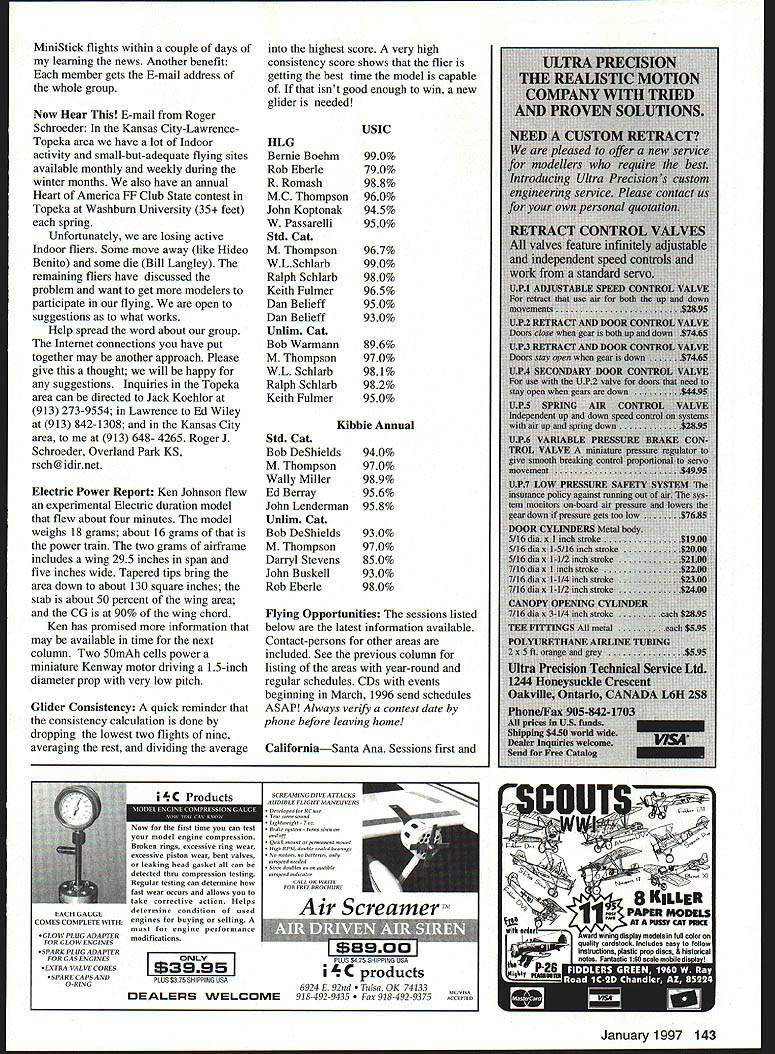
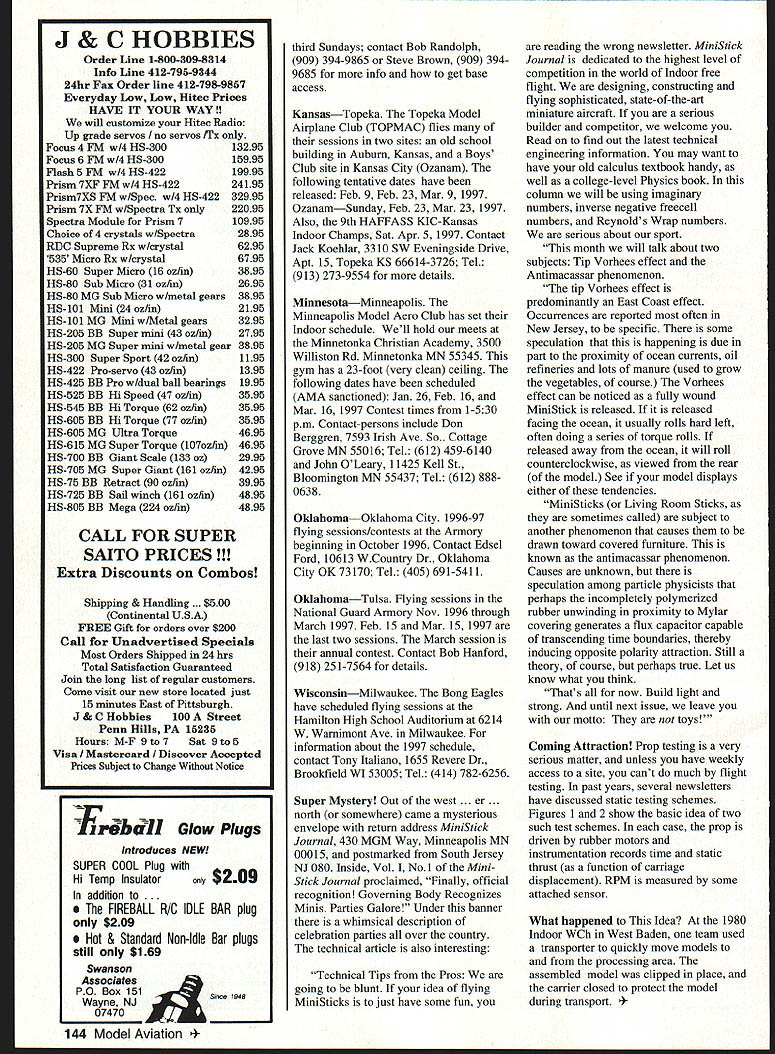
Prop testing is a very serious matter, and unless you have weekly access to a site, you can't do much by flight testing. In past years, several newsletters have discussed static testing schemes. Figures 1 and 2 show the basic idea of two such test schemes. In each case, the prop is driven by rubber motors and static instrumentation records time and static thrust (as a function of carriage displacement). RPM is measured by some attached sensor.
What Happened to This Idea?
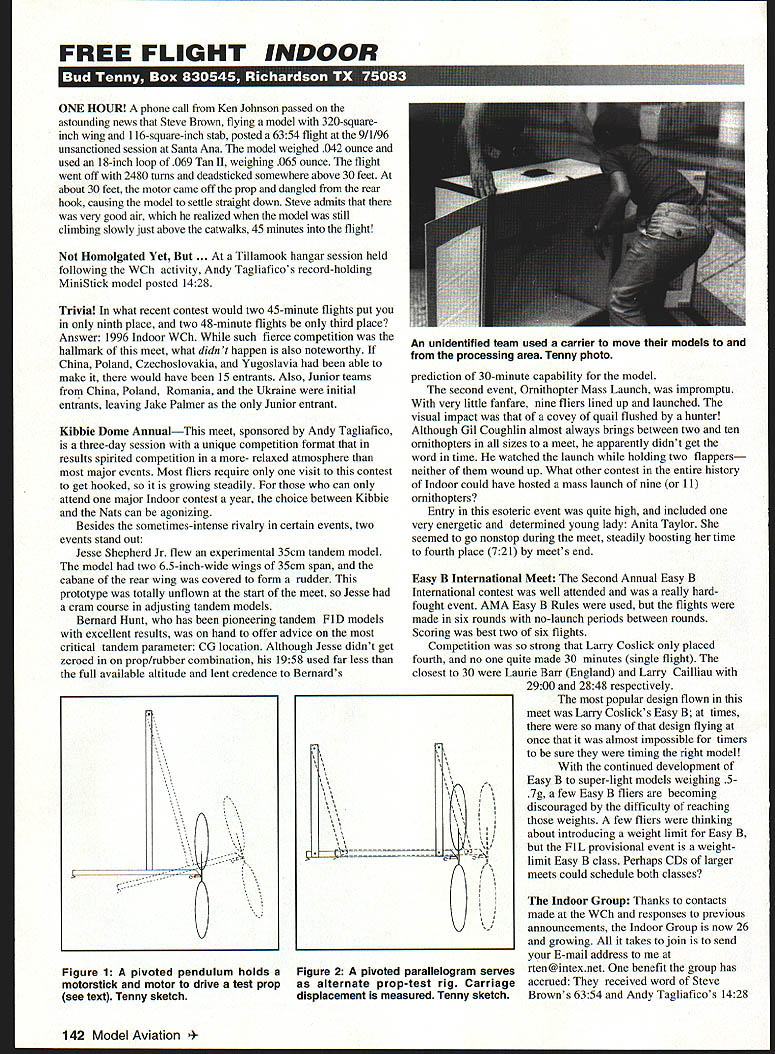
At the 1980 Indoor WCh in West Baden, one team used a transporter to quickly move models to and from the processing area. The assembled model was clipped in place, and the carrier closed to protect the model during transport.
Transcribed from original scans by AI. Minor OCR errors may remain.

