
FREE FLIGHT INDOOR
Bud Tenney, Box 830545, Richardson TX 75083
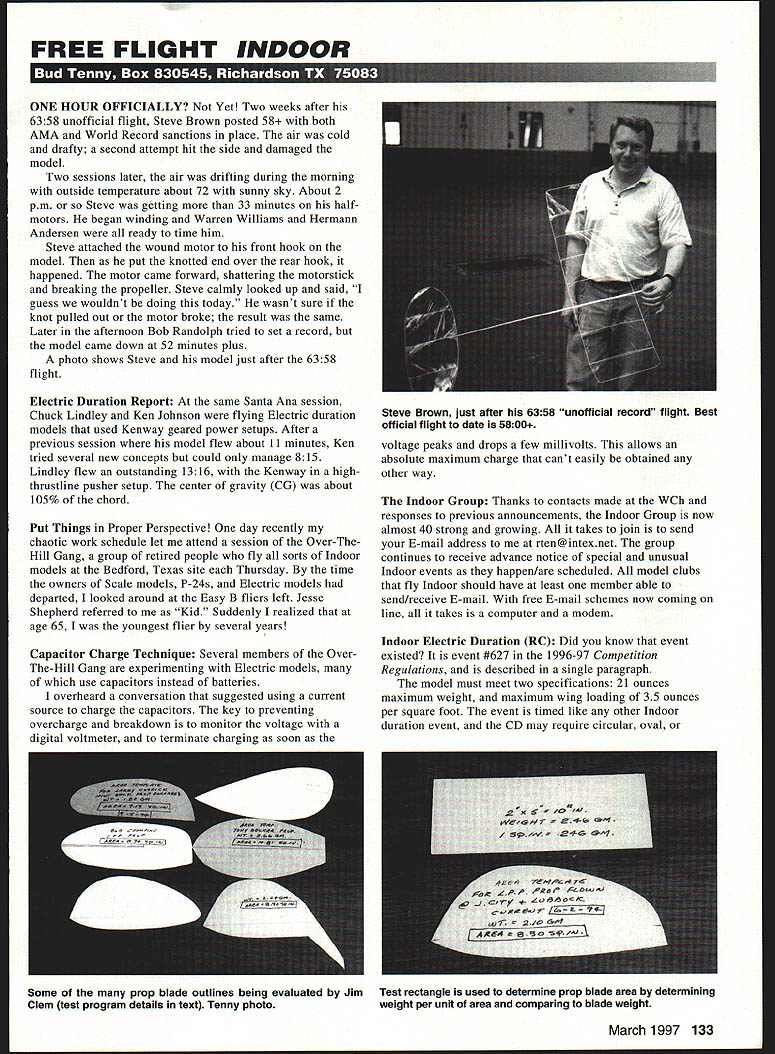
ONE HOUR OFFICIALLY? Not Yet!
Two weeks after his 63:58 unofficial flight, Steve Brown posted 58+ with both AMA and World Record sanctions in place. The air was cold and drafty; a second attempt hit the side and damaged the model.
Two sessions later, the air was drifting during the morning with outside temperature about 72°F and sunny skies. About 2 p.m. or so Steve was getting more than 33 minutes on his half-motors. He began winding and Warren Williams and Hermann Andersen were all ready to time him.
Steve attached the wound motor to his front hook on the model. Then, as he put the knotted end over the rear hook, it happened. The motor came forward, shattering the motorstick and breaking the propeller. Steve calmly looked up and said, "I guess we wouldn't be doing this today." He wasn't sure if the knot pulled out or the motor broke; the result was the same. Later in the afternoon Bob Randolph tried to set a record, but the model came down at 52 minutes plus.
Electric Duration Report
At the same Santa Ana session, Chuck Lindley and Ken Johnson were flying electric-duration models that used Kenway geared power setups. After a previous session where his model flew about 11 minutes, Ken tried several new concepts but could only manage 8:15. Lindley flew an outstanding 13:16, with the Kenway in a high-thrustline pusher setup. The center of gravity (CG) was about 105% of chord.
Put Things in Proper Perspective!
One day recently my chaotic work schedule let me attend a session of the Over-The-Hill Gang, a group of retired people who fly all sorts of indoor models at the Bedford, Texas site each Thursday. By the time the owners of scale models, P-24s, and electric models had departed, I looked around at the Easy B fliers left. Jesse Shepherd referred to me as "Kid." Suddenly I realized that at age 65 I was the youngest flier by several years!
Capacitor Charge Technique
Several members of the Over-The-Hill Gang are experimenting with electric models, many of which use capacitors instead of batteries.
I overheard a conversation that suggested using a current source to charge the capacitors. The key to preventing overcharge and breakdown is to monitor the voltage with a digital voltmeter and to terminate charging as soon as the voltage peaks and drops a few millivolts. This allows an absolute maximum charge that can't easily be obtained any other way.
The Indoor Group
Thanks to contacts made at the WCh and responses to previous announcements, the Indoor Group is now almost 40 strong and growing. All it takes to join is to send your email address to me at rten@intex.net. The group continues to receive advance notice of special and unusual indoor events as they happen or are scheduled. All model clubs that fly indoor should have at least one member able to send/receive email. With free email schemes now coming on line, all it takes is a computer and a modem.
Indoor Electric Duration (RC)
Did you know that event existed? It is event #627 in the 1996–97 Competition Regulations and is described in a single paragraph.
The model must meet two specifications: 21 ounces maximum weight, and maximum wing loading of 3.5 ounces per square foot. The event is timed like any other indoor duration event, and the CD may require circular, oval, or figure-eight orbits.
I was one timer for a record trial by Ernest Harwood, where he posted a 2:24 flight that included all three orbits. The model weighs just four ounces and the wing area is 173 square inches. This model resembled an overgrown Pennyplane.
In stark contrast, a 21-ounce model could have 864 square inches of area. Obviously, this poses a tremendous challenge from both the aerodynamic and structural aspects. Flight speed at that wing loading is about eight feet per second (about 5.5 mph), so picture the hazard of a 21-ounce model flying at that speed! As chairman of the Indoor Contest Board, I feel a certain amount of uneasiness over the existence of an indoor event I have no control over.
Flying Opportunities
Because of space limitations, this section will no longer be carried. I am working on the possibility of publishing a greatly expanded contest/flying session listing in email form (see Indoor Group).
Staggering Climbs
Some time ago I had comments about models that stagger around after launch, or even fly straight for a while instead of settling into a smooth climb. Otto Curth adds these comments:
Offset the stab to the left like the wing and use a thin boom that allows the boom to twist to the right to give left turn. Make the boom rectangular in section, with the deepest dimension vertical to retain the stab incidence setting. I got this hint from Bob Warmann, and it allowed my Bipe Pennyplane to make six-foot-diameter circles under full torque. It didn't climb until the circle got bigger.
Test Techniques
As promised, the column will have coverage on various test techniques used by indoor fliers to advance the state of the art. Many of these tests will be rubber tests, but we also test balance, strength and stiffness, flight trim, and other important factors.
Prop Testing
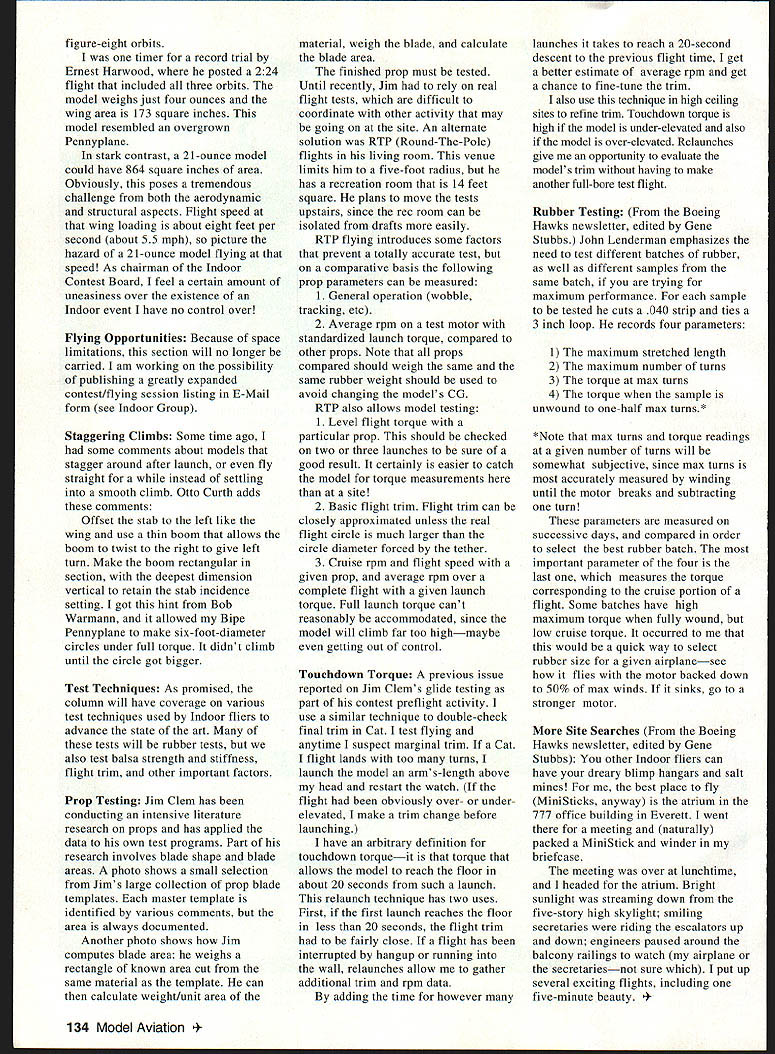
Jim Clem has been conducting an intensive literature research on props and has applied the data to his own test programs. Part of his research involved blade shape and blade areas. A photo shows a small selection from Jim's large collection of prop blade templates. Each master template is identified by various comments, but the area is always documented.
Another photo shows how Jim computes blade area: he weighs a rectangle of known area cut from the same material as the template. He can then calculate weight per unit area of the material, weigh the blade, and calculate the blade area.
The finished prop must be tested. Until recently, Jim had to rely on real flight tests, which are difficult to coordinate with other activity that may be going on at the site. An alternate solution was RTP (round-the-place) flights in his living room. This venue limits him to a five-foot radius, but he has a recreation room that is 14 feet square. He plans to move the tests upstairs, since the rec room can be isolated from drafts more easily.
RTP flying introduces some factors that prevent a totally accurate test, but on a comparative basis the following prop parameters can be measured:
- General operation (wobble, tracking, etc.).
- Average rpm on a test motor with standardized launch torque, compared to other props. Note that all props compared should weigh the same and the same rubber weight should be used to avoid changing the model's CG.
RTP also allows model testing:
- Level flight torque with a particular prop. This should be checked on two or three launches to be sure of a good result. It certainly is easier to catch the model for torque measurements here than at a site!
- Basic flight trim. Flight trim can be closely approximated unless the real flight circle is much larger than the circle diameter forced by the tether.
- Cruise rpm and flight speed with a given prop, and average rpm over a complete flight with a given launch torque. Full launch torque can't reasonably be accommodated, since the model will climb too high—maybe even getting out of control.
Touchdown Torque
A previous issue reported on Jim Clem's glide testing as part of his contest preflight activity. I use a similar technique to double-check final trim in Cat. I test flying anytime I suspect marginal trim. If a Cat. I flight lands with too many turns, I launch the model an arm's-length above my head and restart the watch. If the flight had been obviously over- or under-elevated, I make a trim change before launching.
I have an arbitrary definition for touchdown torque— it is that torque that allows the model to reach the floor in about 20 seconds from such a launch. This relaunch technique has two uses. First, if the first launch reaches the floor in less than 20 seconds, the flight trim was fairly close. If a flight has been interrupted by hangup or running into the wall, relaunches allow me to gather additional trim and rpm data.
By adding the time for however many launches it takes to reach a 20-second descent to the previous flight time, I get a better estimate of average rpm and get a chance to fine-tune the trim.
I also use this technique in high ceilings to rise to fine trim. Touchdown torque is high if the model is under-elevated and also if the model is over-climbed. Relaunches give me an opportunity to evaluate the model's trim without having to make another full-power test flight.
Rubber Testing
(From the Boeing Hawks newsletter, edited by Gene Stubbs.) John Lenderman emphasizes the need to test different batches of rubber, as well as different samples from the same batch, if you are trying for maximum performance. For each sample to be tested he cuts a .040" strip and ties a 3-inch loop. He records four parameters:
- The maximum stretched length.
- The maximum number of turns.
- The torque at max turns.
- The torque when the sample is unwound to one-half max turns.
(Note: max turns and torque readings at a given number of turns will be somewhat subjective, since max turns is most accurately measured by winding until the motor breaks and subtracting one turn.)
These parameters are measured on successive days and compared in order to select the best rubber batch. The most important parameter of the four is the last one, which measures the torque corresponding to the cruise portion of a flight. Some batches have high maximum torque when fully wound, but low cruise torque. It occurred to me that this would be a quick way to select rubber size for a given airplane—see how it flies with the motor backed down to 50% of max winds. If it sinks, go to a stronger motor.
More Site Searches
(From The Boeing Hawks newsletter, edited by Gene Stubbs.) You other indoor fliers can have your dreary blimp hangars and salt mines! For me, the best place to fly (MiniSticks, anyway) is the atrium in the 777 office building in Everett. I went there for a meeting and (naturally) packed a MiniStick in my briefcase.
The meeting was over at lunchtime, and I headed for the atrium. Bright sunlight was streaming down from the five-story skylight; smiling secretaries were riding the escalators up and down; engineers paused around the balcony railings to watch (my airplane or the secretaries—not sure which). I put up several exciting flights, including one five-minute beauty.
Transcribed from original scans by AI. Minor OCR errors may remain.

