


FREE FLIGHT INDOOR
Bud Tenny, Box 830545, Richardson TX 75083
FLYING OPPORTUNITIES: This information is available via e‑mail request (rten@intex.net) and by browsing a special Indoor Web Page maintained by Del Ogren. The URL for that web page is http://www.interaccess.com/uncledel/indoor/
Del's page has links to several other pages—two Indoor sites (one in the US and one in Sweden); a site for beginning rubber‑model fliers; an ornithopter site; a site called "Flying Contraptions." Flying Aces site also has extensive contest listings, flying‑session listings, and a list of clubs.
The Indoor Group now has more than 50 members. If you haven't heard, members register with me at rten@intex.net. They then receive contest announcements (see above) and late‑breaking news such as outstanding flights and other items of interest. All clubs holding Indoor events can send announcements of these events to me via e‑mail or snail mail (Box 830545, Richardson TX 75083) for prompt posting to members of the Indoor Group and on Del's web page. Come join us!
Easy B Postal: The results from the teams in Japan have not been received, so the listing below shows the US team entries and their times.
Japan vs United States
1996 Easy B Postal Contest — Individual Standings
- Donald Slusarczyk — Runs: 17:13, 18:25, 20:00, —, —. Best: 20:00
- Jim Clem — Runs: 14:57, 17:30, 18:41, 16:43, 18:00. Best: 18:41
- Larry Coslick — Runs: 16:21, 18:23, 02:09, 04:48, 01:58. Best: 18:23
- Larry Loucka — Runs: 13:25, 16:55, 17:20, —, —. Best: 17:20
- Dick Hardcastle — Runs: 12:49, 15:54, 15:20, 01:20, 06:57. Best: 15:54
- Thomas Vallee — Runs: 00:05, 04:44, 15:12, 01:22, 03:39. Best: 15:12
- Larry Mzik — Runs: 10:25, 14:39, 14:54, —, —. Best: 14:54
- Chuck Slusarczyk — Runs: 11:31, 12:40, 14:38, —, —. Best: 14:38
- Dan Belieff — Runs: 04:38, 13:52, 13:19, 07:40, 13:10. Best: 13:52
- Vern Hacker — Runs: 13:48, 12:21, —, —, —. Best: 13:48
- Jesse Shepherd Jr. — Runs: 13:41, 13:16, 13:26, 12:56, 07:04. Best: 13:41
- Gene Toshu — Runs: 13:25, 00:34, 02:29, 03:41, 04:32. Best: 13:25
- Ralph (Bud) Tenny — Runs: 06:57, 10:56, 12:35, 09:13, 11:56. Best: 12:35
- Phillip (Randy) Kleinert — Runs: 12:02, 10:59, 02:44, 12:05, 12:33. Best: 12:33
- Ted Seaver — Runs: 05:03, 06:47, 04:50, 05:29, 08:10. Best: 08:10
- Gordon Wisniewski — Runs: 05:46, 07:45, —, —, —. Best: 07:45
- Tom Soya — Runs: 06:39, —, —, —, —. Best: 06:39
- John Fellin — Runs: 03:35, 01:41, 06:25, —, —. Best: 06:25
Japan vs United States — Team Times
Site: Andrews School, Cleveland OH Team: USA Cleveland Clowns 1 — Ceiling: 20 feet
- Donald Slusarczyk — 17:13, 18:25, 20:00, —, —. Best: 20:00 (1)
- Larry Loucka — 13:25, 16:55, 17:20, —, —. Best: 17:20 (2)
- Larry Mzik — 10:25, 14:39, 14:54, —, —. Best: 14:54 (3)
Team Total: 52:14
Site: Ridgewood Jr. High, St. Louis MO Team: USA Thermaleers — Ceiling: 22 feet
- Larry Coslick — 16:21, 18:23, 02:09, 04:48, 01:58. Best: 18:23 (1)
- Dick Hardcastle — 12:49, 15:54, 15:20, 01:20, 06:57. Best: 15:54 (2)
- Gene Toshu — 13:25, 00:34, 02:29, 03:41, 04:32. Best: 13:25 (3)
Team Total: 47:42
Site: Bedford Boys Ranch, Bedford TX Team: USA Great Plains Southwest — Ceiling: 26 feet
- Jim Clem — 14:57, 17:30, 18:41, 16:43, 18:00. Best: 18:41 (1)
- Jesse Shepherd Jr. — 13:41, 13:16, 13:26, 12:56, 07:04. Best: 13:41 (2)
- Ralph (Bud) Tenny — 06:57, 10:56, 12:35, 09:13, 11:56. Best: 12:35 (3)
Team Total: 44:57
Site: NASA Auditorium, Greenbelt MD Team: USA Goddard Flyers — Ceiling: 18 feet, 9 inches
- Thomas Vallee — 00:05, 04:44, 15:12, 01:22, 03:39. Best: 15:12 (1)
- Dan Belieff — 04:38, 13:52, 13:19, 07:40, 13:10. Best: 13:52 (2)
- Randy Kleinert — 12:02, 11:59, 02:44, 12:05, 12:33. Best: 12:33 (3)
Team Total: 41:37
Site: Andrews School, Cleveland OH Team: USA Cleveland Clowns Too — Ceiling: 20 feet
- Chuck Slusarczyk — 11:31, 12:40, 14:38, —, —. Best: 14:38 (1)
- Vern Hacker — 13:48, 12:21, —, —, —. Best: 13:48 (2)
- Tom Soya — 06:39, —, —, —, —. Best: 06:39 (3)
Team Total: 35:05
Site: Hamilton HS, Milwaukee WI Team: USA Bong Eagles — Ceiling: 25 feet, 6 inches
- Ted Seaver — 05:03, 06:47, 04:50, 05:29, 08:10. Best: 08:10 (1)
- Gordon Wisniewski — 05:46, 07:45, —, —, —. Best: 07:45 (2)
- John Fellin — 03:35, 01:41, 06:25, —, —. Best: 06:25 (3)
Team Total: 22:20
Is FID Dying?
Even though the initial entry for the 1996 World Championships (WCh) led us to expect the largest contest ever, there were discussions about lower participation in many countries. Reasons suggested for the decline include:
- Difficulty of traveling with the large models now required to win.
- Apprehension about microfilm on the part of potential new participants.
- Unwillingness to tackle variable‑geometry props seemingly required to win.
The travel issue centers on transporting model boxes. The huge boxes that hold several full‑braced FID models can be transported only in the cargo hold of airplanes, except by very special arrangement.
Many entrants in this WCh drastically reduced the model storage volume by building unbraced models, as practiced by Bernard Hunt, or by having collapsible bracing systems. In some cases the wing posts fold back to tuck under the wing; in others the cabane folds over sideways, so that wings could be stacked closely, with the posts straddling the wings below. (The top wing bracing terminated at a tiny ring that hooked on top of the cabane. Lift the ring to release the cabane, then it can fold over.)
The microfilm issue is multifaceted:
- Microfilm is more fragile than plastic coverings.
- Microfilm inevitably ages, and either shrinks enough to warp the model or becomes so brittle that it shatters with vibration or shock.
- Microfilm is perceived as being too difficult to cover with. (Personally, I find it much easier.)
The only suggested solution for the microfilm problem is to ban its use. Similarly, banning variable‑geometry props has been suggested as a way to solve that problem. Certainly, it is difficult to build these props initially, and very few fliers really develop their props into reliable, repeatable devices.
Tan II is our best rubber power source; because of its special characteristics, we get the best results by using variable props that use all of the energy from the rubber. It is very difficult to build a non‑mechanical prop (i.e., aeroelastic or flaring) that even begins to approach 100% energy usage by varying pitch.
Are there any other ideas about increasing participation in FID?
Building Hint
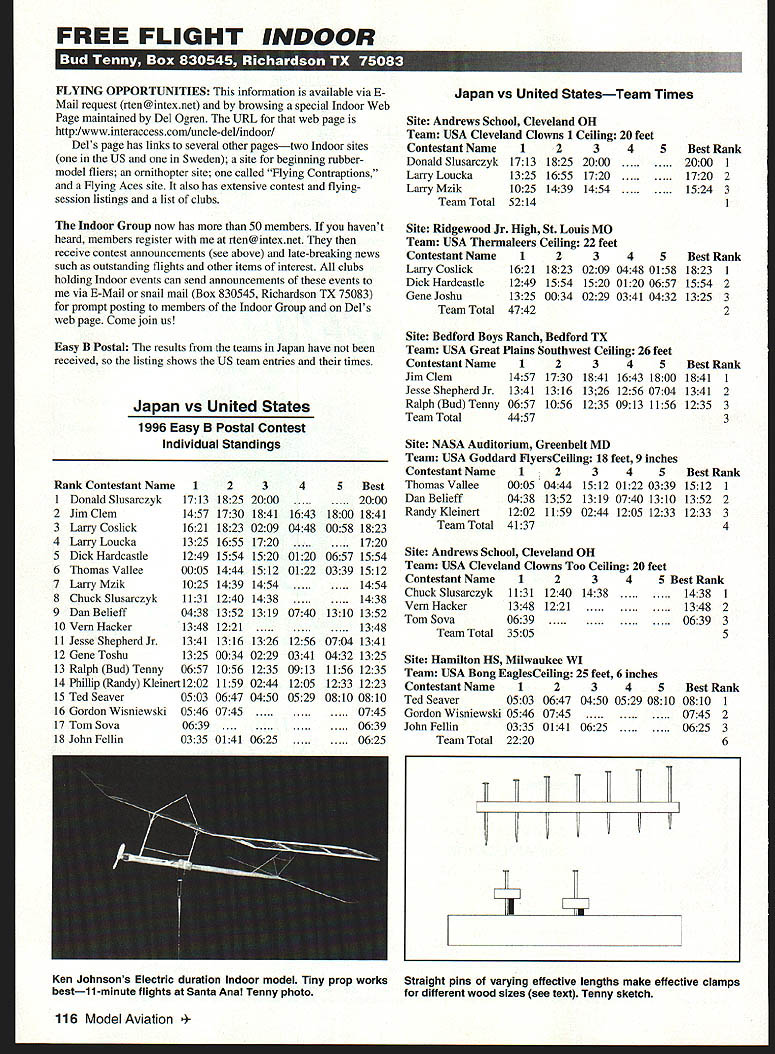
Gene Stubbs, editor of the Boeing Hawks newsletter, spotted a clever building trick in the newsletter of the Minneapolis MAC and published it again. The concept: push pins at varying distances through a balsa strip and secure the pins with glue or epoxy. Cut the balsa into short strips and use each pin to anchor model parts on the building board. Differing pin lengths accommodate differing wood sizes and shapes.
Aeroplastic Props
A previous column described Jim Clem’s continuing search for better (read: more effective) ways to make propellers that flare in controllable and repeatable fashion.
One success uses carbon‑fiber sheet, stripped to narrow widths, as a bifilar suspension for the blades. Flare is increased by using narrower filaments and by reducing the distance between the filaments. It works wonderfully well.
Electric Duration
Another photo shows Ken Johnson’s electric‑duration model. A previous column has most of the design details, but this photo highlights one important difference between electric and other power sources: the tiny hand‑carved prop gave about 11 minutes’ duration, whereas larger props would outclimb the Santa Ana hangar. This tiny prop gives reduced thrust and greatly increased power run because of the low energy needed to turn it.
Transcribed from original scans by AI. Minor OCR errors may remain.

