
FREE FLIGHT INDOOR
Bud Tenny, Box 830545, Richardson TX 75083
RECORD TRIALS ALERT
Record application forms require two timers' signatures if the flight is made at a record trials instead of at a contest. An increasing number of applications are being submitted on which the Contest Director (CD) has signed as a timer. This is not permitted.
- Contestants: be sure that your application is signed by two timers, neither of whom is the Contest Director.
- CDs: it is your responsibility to make sure that contestants have two qualified timers for each attempt.
KIBBIE DOME ANNUAL
This meet is scheduled for August 2–4, 1997, with the Easy B International meet on August 5.
Contact: Andy Tagliafico, 10039 Quail Post Rd., Portland OR 97219; Tel.: (503) 452-0546.
INDOOR GROUP
There are 74 members—and counting! Anyone who wants advance notice of special indoor news and late-breaking contest announcements should send e-mail to rten@intexnet to register for the group.
Other indoor information is available at:
- http://www.interaccess.com/uncle-del/indoor/
- http://www.ultranet.com/~davison/indoor.htm
- http://www.earthlink.net/~pazuzu/om.html
One Hour? Not Yet!
Ken Johnson has continued to report activity at the Tustin Hangar, Santa Ana, CA. Several fliers with models larger than F1D, including Cezar Banks and Bob Randolph, have joined Steve Brown in the quest for the first official one-hour flight. Steve damaged two models after an unofficial 63:54 flight that was made in favorable air before colder weather set in. Stan Chilton visited at least two sessions, and Jim Richmond is expected to attend.
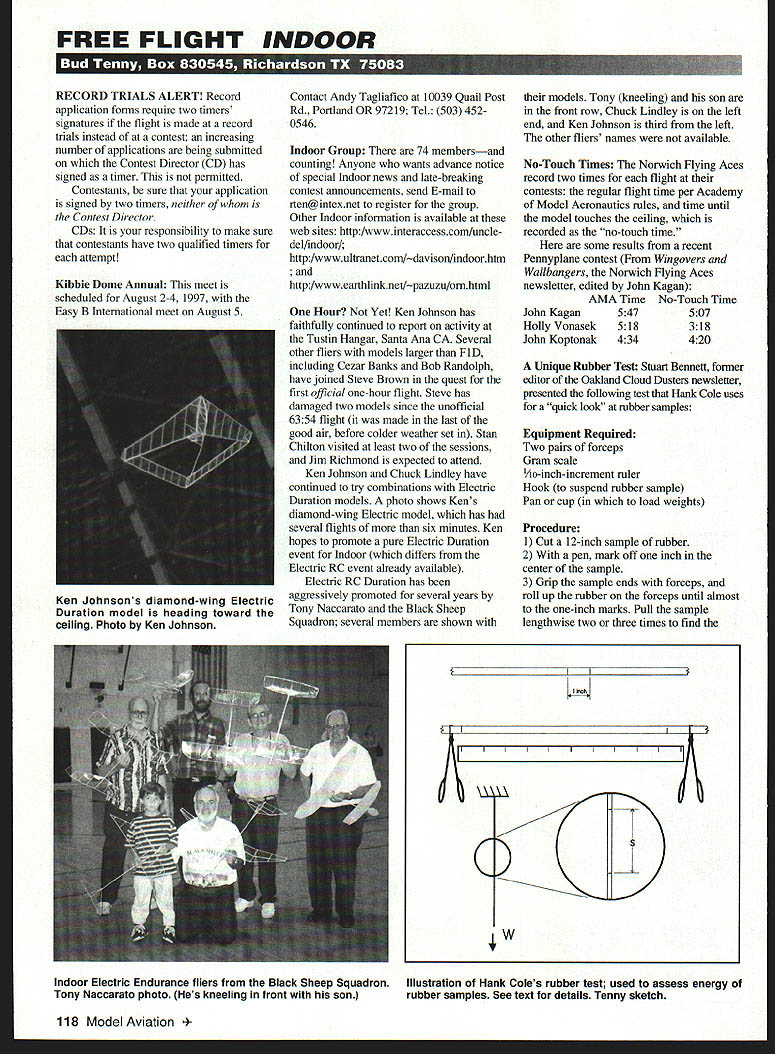
Ken Johnson and Chuck Lindley have also been experimenting with electric-duration models. Ken's diamond-wing electric model has recorded several flights of more than six minutes. Ken hopes to promote a pure Electric Duration event for indoor flying (different from the Electric RC events already available).
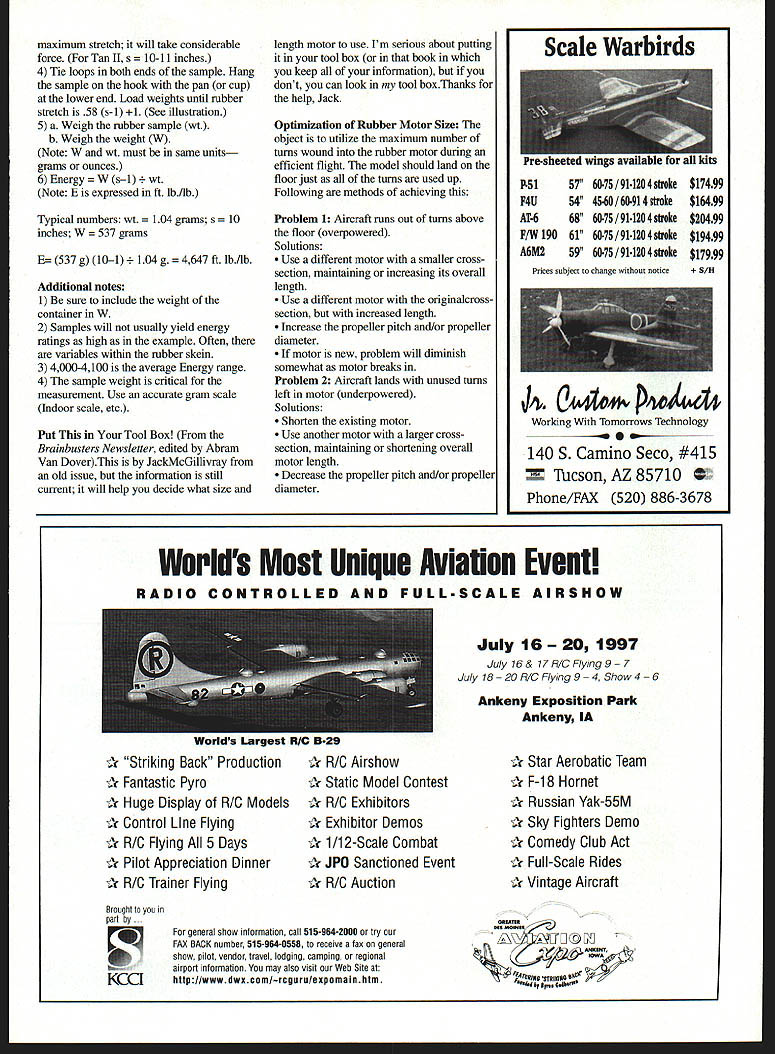
Electric RC Duration has been promoted for several years by Tony Naccarato and the Black Sheep Squadron. Several members have been active in this area; Tony is shown kneeling with his son, Chuck Lindley is at the left end, and Ken Johnson is third from the left.
NO-TOUCH TIMES
The Norwich Flying Aces record two times for each flight at their contests: the regular flight time (per Academy of Model Aeronautics rules) and the "no-touch time"—the time until the model first touches the ceiling. The no-touch time is recorded separately.
Results from a recent Pennyplane contest (from Wingovers and Wallbangers, the Norwich Flying Aces newsletter, edited by John Kagan):
- John Kagan — AMA Time 5:47, No-Touch Time 5:07
- Holly Vonasek — AMA Time 5:18, No-Touch Time 3:18
- John Koptonak — AMA Time 4:34, No-Touch Time 4:20
A UNIQUE RUBBER TEST
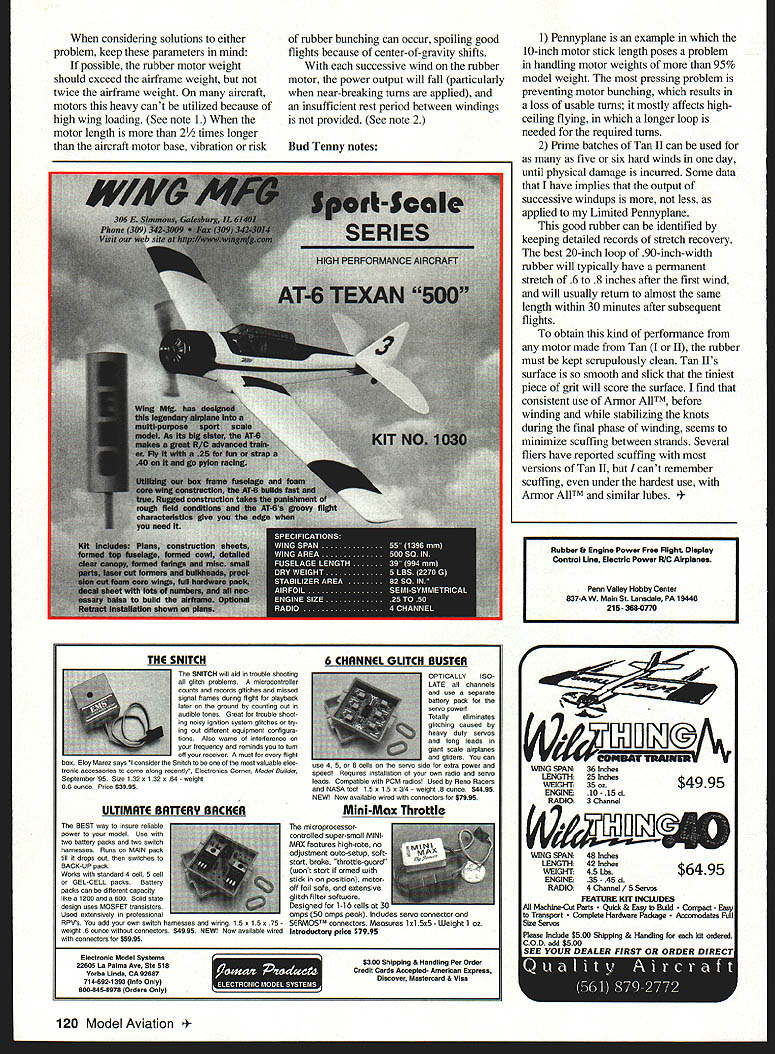
Stuart Bennett, former editor of the Oakland Cloud Dusters newsletter, presented the following quick-look rubber test used by Hank Cole.
Equipment Required
- Two pairs of forceps
- Gram scale (accurate)
- 1/8-inch-increment ruler
- Hook (to suspend rubber sample)
- Pan or cup (to hold weights)
Procedure
- Cut a 12-inch sample of rubber.
- Mark off a 1-inch section in the center of the sample with a pen.
- Grip the sample ends with forceps and roll the rubber on the forceps until almost to the 1-inch marks. Pull the sample lengthwise two or three times to find the maximum stretch it will take (and to remove twists).
- Tie loops on both ends of the sample. Hang the sample on the hook with the pan or cup attached to the lower loop. Load weights until the rubber stretches the desired amount (for this test, about 5/8 inch beyond the mark).
- Weigh the rubber sample (wt).
- Weigh the load weight (W). Note: wt and W must be the same units (grams or ounces).
Energy note: E is expressed in ft·lb per lb (ft·lb/lb). Typical test results will give energy ratings; record wt (sample weight), stretch (inches), W (load in grams), and computed E.
Additional Notes
- Include the weight of the container (pan or cup) when weighing W.
- Samples will usually yield higher-than-expected energy ratings; variables within a rubber skein are common (expect variation). Sample weight is a critical measurement—use an accurate gram scale.
PUT THIS IN YOUR TOOL BOX!
(From the Brainbusters Newsletter, edited by Abram Van Dover. Submitted by Jack McGillivray.)
Optimization of Rubber Motor Size
The object is to utilize the maximum number of turns wound into the rubber motor during an efficient flight. The model should land just as the last turns are used up. The following methods help achieve that.
#### Problem 1: Aircraft runs out of turns above the floor (overpowered) Solutions:
- Use a motor with a smaller cross-section, maintaining or increasing overall length.
- Use a motor with the original cross-section but increase the overall length.
- Increase propeller pitch and/or propeller diameter.
- If the motor is new, performance may improve after it breaks in.
#### Problem 2: Aircraft lands with unused turns left in motor (underpowered) Solutions:
- Shorten the existing motor.
- Use a motor with a larger cross-section, maintaining or shortening overall motor length.
- Decrease propeller pitch and/or propeller diameter.
When considering solutions, keep these parameters in mind:
- If possible, the rubber motor weight should exceed the airframe weight but not be twice the airframe weight. Many aircraft cannot use motors this heavy because of high wing loading.
- When the motor length is more than 2½ times the aircraft motor base, vibration or rubber bunching can occur, causing poor flights due to center-of-gravity shifts.
- With each successive wind on the rubber motor, power output will fall (especially near-breaking turns). Insufficient rest between windings will reduce performance.
Transcribed from original scans by AI. Minor OCR errors may remain.

