
FREE FLIGHT INDOOR
Bud Tenny, Box 830545, Richardson TX 75083
INTERNATIONAL POSTAL MEET
Sixty-five entrants from eight countries flew in nineteen sites in this contest. Larry Coslick and other fliers from St. Louis scheduled the contest to cover the time from January 1–March 31, 1977. The abbreviated results below include the traditional award winners plus the high time from each country. The fudge factors were rounded to four significant digits and the corrected time was rounded to 0.1 second.
Results
- First Overall — Collins, Walt (USA)
Raw Time: 438 | Ceiling (ft.): 8.166 | Fudge Factor: 2.101 | Corrected Time: 920.2
- First USA — Van Gorder, Walt (USA)
Raw Time: 528 | Ceiling (ft.): 17.91 | Fudge Factor: 1.734 | Corrected Time: 915.3
- First International — Danjo, Akihiro (Japan)
Raw Time: 527 | Ceiling (ft.): 24.23 | Fudge Factor: 1.594 | Corrected Time: 839.9
- Second USA — Clem, Jim (USA)
Raw Time: 519 | Ceiling (ft.): 23 | Fudge Factor: 1.618 | Corrected Time: 839.5
- Third USA:
- Brocks, Peter (USA) — Raw Time: 390 | Ceiling (ft.): 8.166 | Fudge Factor: 2.101 | Corrected Time: 819.3
- Mzik, Larry (USA) — Raw Time: 485 | Ceiling (ft.): 20 | Fudge Factor: 1.682 | Corrected Time: 815.9
- Platt, Bob (USA) — Raw Time: 386 | Ceiling (ft.): 8.166 | Fudge Factor: 2.101 | Corrected Time: 810.9
- Second International — Keller, Peter (Switzerland)
Raw Time: 377 | Ceiling (ft.): 8.04 | Fudge Factor: 2.108 | Corrected Time: 794.7
- Third International:
- Z. Fujiwara (Japan) — Raw Time: 528 | Ceiling (ft.): 29.52 | Fudge Factor: 1.504 | Corrected Time: 794.0
- O'Grady, Dan (Canada) — Raw Time: 484 | Ceiling (ft.): 25.25 | Fudge Factor: 1.579 | Corrected Time: 764.4
- Tenny, Bud (USA) — Raw Time: 421 | Ceiling (ft.): 16.23 | Fudge Factor: 1.786 | Corrected Time: 752.0
- Shigezoshi Nonaka (Japan) — Raw Time: 471 | Ceiling (ft.): 24.23 | Fudge Factor: 1.594 | Corrected Time: 750.6
- Hua-Ngoc Trung (France) — Raw Time: 485 | Ceiling (ft.): 27.55 | Fudge Factor: 1.535 | Corrected Time: 744.5
- Slusarczyk, Don (USA) — Raw Time: 439 | Ceiling (ft.): 20 | Fudge Factor: 1.682 | Corrected Time: 738.5
- Shigeyoshi Nonari (Japan) — Raw Time: 461 | Ceiling (ft.): 24.23 | Fudge Factor: 1.594 | Corrected Time: 734.7
- S. Miuya (Japan) — Raw Time: 488 | Ceiling (ft.): 29.52 | Fudge Factor: 1.504 | Corrected Time: 733.9
- Toru Yatabe (Japan) — Raw Time: 488 | Ceiling (ft.): 29.52 | Fudge Factor: 1.504 | Corrected Time: 733.9
- Sadayoshi Tomita (Japan) — Raw Time: 485 | Ceiling (ft.): 29.52 | Fudge Factor: 1.504 | Corrected Time: 729.4
- Raymond-Jones, Collin (Canada) — Raw Time: 461 | Ceiling (ft.): 25.25 | Fudge Factor: 1.579 | Corrected Time: 728.1
- Grange, Yannick (France) — Raw Time: 300 | Ceiling (ft.): 19.52 | Fudge Factor: 1.693 | Corrected Time: 508.1
- Pentan, Sven (Sweden) — Raw Time: 300 | Ceiling (ft.): 23.06 | Fudge Factor: 1.616 | Corrected Time: 484.8
- Halhis, Kai (Finland) — Raw Time: 279 | Ceiling (ft.): 23 | Fudge Factor: 1.618 | Corrected Time: 451.3
- Martinez, Fernando (Spain) — Raw Time: 91 | Ceiling (ft.): 13.3 | Fudge Factor: 1.873 | Corrected Time: 170.4
New Newsletter
For several months, Joe Kehr of the Tulsa Glue Dobbers has been editing an indoor newsletter. From issue #2, here is a statement of his purposes:
"One of the goals of this news sheet is to provide communications to the entry-level indoor modeler or to those who are casually participating in this unique sport. The end result will hopefully be to introduce them/you to the hobby and convince them/you that they/you don't have to be a rocket scientist to participate. We challenge you to join us as we have a great time.
"There are a variety of classes and types of indoor models and everyone should be able to find a suitable place to fit in. To your benefit are the number of good builders in every class in our area that can help you get started."
Joe is distributing the newsletter free, but he does accept donations toward postage. Indoor Model Airplane News, 7405 East 82nd Pl., Tulsa, OK 74133.
The Cobra Strikes!
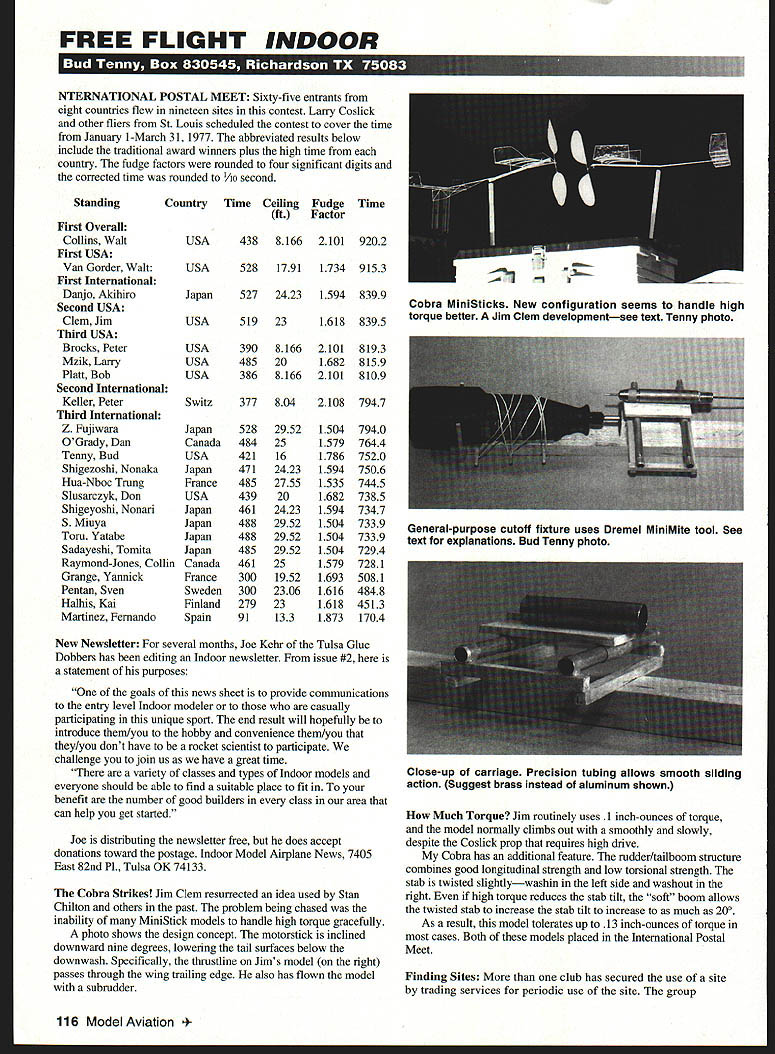
Jim Clem resurrected an idea used by Stan Chilton and others in the past. The problem being chased was the inability of many MiniStick models to handle high torque gracefully. A photo shows the design concept. The motorstick is inclined downward nine degrees, lowering the tail surfaces below the downwash. Specifically, the thrustline on Jim's model (on the right) passes through the wing trailing edge. He also has flown the model with a subrudder.
How Much Torque?
Jim routinely uses 1 inch-ounce of torque, and the model normally climbs out smoothly and slowly, despite the Coslick prop that requires high drive.
My Cobra has an additional feature. The rudder/tailboom structure combines good longitudinal strength with low torsional stiffness. The stabilizer (stab) is twisted slightly — wash-in on the left side and wash-out on the right. Even if high torque reduces the stab tilt, the "soft" boom allows the twisted stab to increase the stab tilt to as much as 20°.
As a result, this model tolerates up to 1.3 inch-ounces of torque in most cases. Both of these models placed in the International Postal Meet.
Finding Sites
More than one club has secured the use of a site by trading services for periodic use of the site.
Variable Prop Hinges
The weak point of most variable-diameter props is the blade hinges. Several fliers are now using wire-and-tubing hinges, made from hypodermic needle stock and small stainless steel wire.
One source for the tubing and the wires is Small Parts Inc., Box 4650, Miami Lakes, FL 33014-0650; sales: (800) 220-4242, fax: (800) 423-9009.
How Do I Cut It?
I have often used razor saws to cut precision tubing, but these tubes are barely larger than the pitch of a razor saw. A photo shows a cutoff fixture that works with any size tubing that can be secured on the carriage. The cutter is a Dremel MiniMite turning a carbide cutoff disk at 10,000 rpm. The tubing to be cut is held by a pin vise which can be rotated.
Another photo shows the carriage, constructed from telescoping aluminum tubing, 1/4" square brass, and hard balsa. The base of the fixture is scrap balsa and the dowels that hold the rubber bands are 5/8" hard balsa. While crude, this rig makes a clean cut on even the smallest tubing. The only change in materials I would recommend is to use brass instead of aluminum tubing on the carriage.
State of the Art (or What Hath Tan II Wrought?)
Now that Tan II use is widespread, a review of the national records shows many outstanding times, and many contest flights push close to the records.
For some time, Bob Gibbs has been maintaining a Forty Minute Club list. We are well on the way to needing these additional lists:
- Fifteen Minute MiniStick Club
- Twenty Minute Pennyplank Club
- Thirty Minute Easy B Club
- Thirty Minute Pro 20 Club
- Forty Minute Intermediate Stick Club
- Fifty Minute F1D Club (Two candidates already: Rick Doig and Steve Brown)
Computer-Aided Free Flight (by Rob Eberle)
During the last few months, Gary Underwood and I have been preparing for the upcoming F1D Team Selection Finals, and this year's flying season, completely through our computers.
No, we haven't found a way for our computers to actually build the models yet. But if you really think about it, we aren't too far from that. Our prop blocks from Superior are done by a computer. Any carbon fiber that you buy was woven by a computer; in fact, almost all composite products are made by computers.
Anyone who flies Wakefields knows that most of the props, motor tubes, tailbooms, Kevlar, and any other items that you order for your models are aided in the manufacturing process or made completely by computers.
The physical building part isn't where computers are most helpful right now, though—it is the design stage where we can benefit the most from technology.
If you walk into any major engineering facility, you won't see a bunch of people sitting around at drafting tables with large sheets of paper and T-squares. In fact, you may not see anyone at all; you may just be able to see the faint glow of a few computer monitors in a dark, unlit room, as you may hear the quiet tapping of a few keyboards coming from this small room.
Almost all engineering is now done on computer programs like AutoCAD, CADkey, GeneriCAD, or some similar program. We can use the same programs to design models, do structural analysis, or design our model boxes. Gary and I have been doing just that.
Gary has made a few dimensional drawings for his F1Ds in GeneriCAD, and designed spreadsheets for weights of models and specific parts. I have been working in AutoCAD a few nights each week, making three-views of my F1D and calculating sizes and lengths of parts, specifically for the site where the finals are being held.
I have also been working on a model box. I started by limiting my dimensions for the box, drawing the parts I wanted to put into the box, then moving them around inside the box until they all fit. And just think, I never had to brush any of my eraser dust or wipe that grimy graphite off the side of my hand!
You don't need to limit yourself to model designs and drafting programs, though. With a simple writing program you can set up spreadsheets, charts, or type up articles for our newsletter! Whatever you do, have fun, and good computing!
(From Field and Stream, the newsletter of the Scale Old Timer Society)
Transcribed from original scans by AI. Minor OCR errors may remain.

