
FREE FLIGHT INDOOR
Bud Tenny, Box 830545, Richardson, TX 75083
Finally! Thanks to faithful scribe Ken Johnson, we have the following report. Ken has continued to report each biweekly session since Steve Brown's 64:54 unofficial flight last September.
Ken's report (June 15, at the Tustin Hangar) noted that everything was rather quiet after the session of June 1, 1997. On that day a historic event took place: Steve Brown of the Tustin Group set a national and world indoor microflight record of 60:01.
Flight data:
- Air conditions: 83°F, 53% humidity
- Launch time: 1:50 p.m.
- Model weight: 1.83 grams
- Motor weight: 1.93 grams
- Motor: Tan II, .070 x 19.5 inches; 2,530 turns
- Prop: 21-inch diameter; low pitch 21 inches, high pitch 34 inches; weight: 0.008 oz
- Wing: 37-inch span; 9-inch center chord, 8-inch tip chord; weight: 0.0145 (units as reported)
Flight description:
- The climb after launch was moderate, reaching about 150 feet.
- As torque decreased the prop shifted to low pitch and the airplane climbed again.
- The second climb started at 22 minutes and the flight stabilized at 27 minutes.
- Four steers with a total of six seconds prop-stop time were required.
- The model was still at catwalk height (137 feet) at 45 minutes.
- As the model descended, turbulence was noted at about 25 feet.
- The flight ended with 30 turns remaining and an average of 41.4 rpm.
- Watch time: 60:07 with six seconds prop-stop time → official time: 60:01.
The International E-Mail A-6 Indoor Contest
The A-6 is a simple, entry-level indoor stick model that flies well and is capable of 4–6 minutes' duration in normally available sites. It is quickly built from commonly available materials and can provide hours of enjoyment.
Contest period: October 1, 1997 – March 31, 1998.
Submission:
- E-mail flight times to Contest Director Roger Schroeder: rsch@idir.net
- Postal submissions: Roger Schroeder, 4111 West 98 St., Overland Park, KS 66207, USA
- Results will be posted on Del Ogren's Indoor web site: www.n-lemma.com/indoor/
A-6 rules (Clarence Mather):
- 30 sq. in. maximum wing area (no limits on shape)
- 15 sq. in. maximum stabilizer area
- 6" maximum propeller diameter
- 6" maximum motor stick length measured from the propeller thrust bearing to the rear hook
- Strip wood construction minimum: 1/16" x 1/16" cross-section (wing, stab, rudder outlines)
- Sheet wood construction (propeller blades, wing ribs, stab ribs): minimum 1/32" thick
- All wing and stab ribs: minimum 1/2" x 1/16" cross-section
- Tissue covering only (Gampi tissue recommended)
- Only wood, wire and tissue may be used for construction
- Propeller shaft: minimum 1/32" dia. wire
- Rubber power only; no weight limits on model or rubber power
Flying and entries:
- Fly at any indoor site from October 1 through March 31.
- You may time your own flights.
- Steering is acceptable if not used to control altitude.
- Record your best time and submit it with: name; club/group (if any); location/site; country/state/province; date flown; ceiling height (FAI measurement method); a brief description of the model (a photo for posting on the web is encouraged).
Normalization of scores:
- Flight times will be normalized against the highest ceiling entered using this formula:
(Highest ceiling height / Local ceiling height) × Local time
- Example:
- Highest ceiling entered: 38 ft
- Local ceiling: 22 ft
- Local time: 97 seconds
- Corrected time = (38 / 22) × 97 ≈ 168 seconds
Notes:
- Interim scores posted on the web will be raw times; final placing will use normalized scores after entry completion.
- A beginner-level A-6 plan by Clarence Mather is available on Del Ogren's web site.
- For a more competitive plan, send $2 (U.S.) or $3 (outside USA) to receive an 11 × 17 plan of the model being flown in the contest, or design your own. Suggested areas for experimentation: stabilizer area/shape, wing aspect ratio, wing taper, tailboom length.
The Indoor Group now numbers more than 100 members registered with Bud Tenny (rten@intex.net). Send e-mail to join and receive late-breaking news.
Transporting Indoor Models
These comments were included with Richard Doig's memo to Team Finalist Qualifiers. Good information!
Tips:
- Carry on your models if at all possible.
- Prefer aircraft with large overhead bins (Boeing 737, 757, 767).
- Airlines generally limit carry-on to about 9 × 13 × 23 inches, but boxes up to 30 inches long will usually fit on most jets.
- A 9 × 13 cross-section will not fit on older DC-9 Stretch aircraft unless one corner is beveled back about 2½ inches.
- Avoid commuter aircraft with small overheads.
Practical experience:
- One flier carried two boxes (7¾ × 10⅜ inches and 8⅛ × 10⅝ inches, both 26¾ inches long) on a United 737 by fitting one behind the other in the overhead—tight fit and required persuasion to get the second box onboard.
- Some fliers have successfully checked models with regular baggage; gate checking may also help.
- Escort service at the gate is ideal if you can arrange it (extra cost and must be arranged in advance).
- Bring at least one model in the overhead; use the smallest box possible.
- If needed, tracings of overheads for several aircraft are available—contact if you need help with sizing.
Indoor Electric Duration
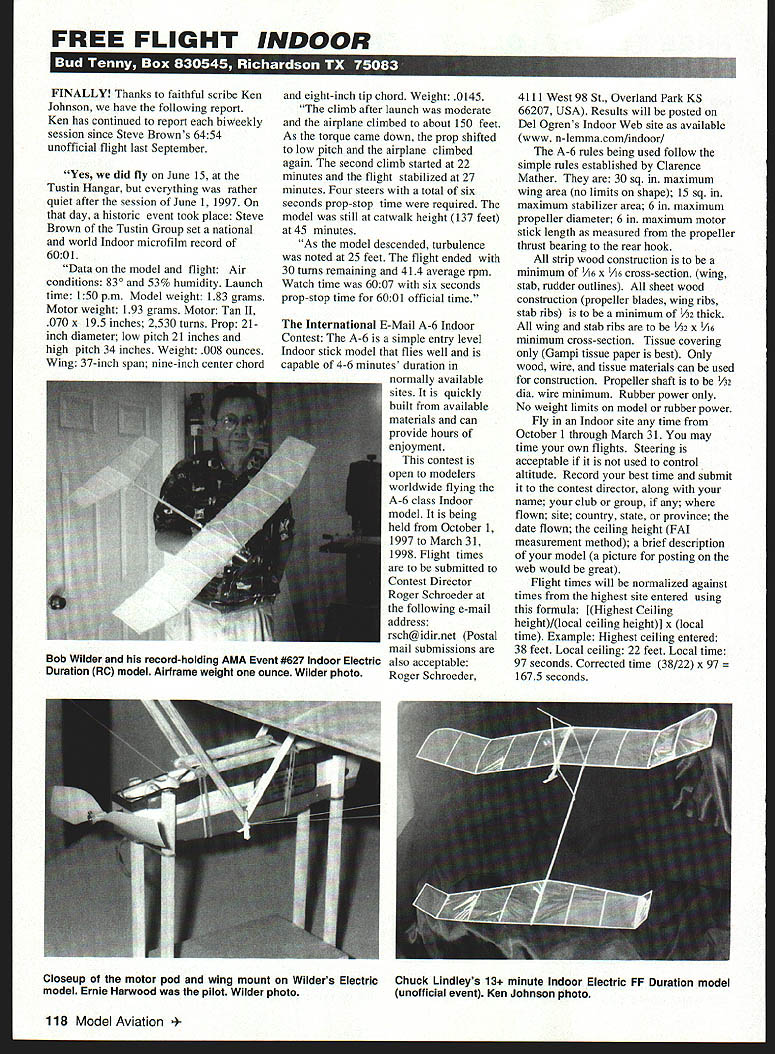
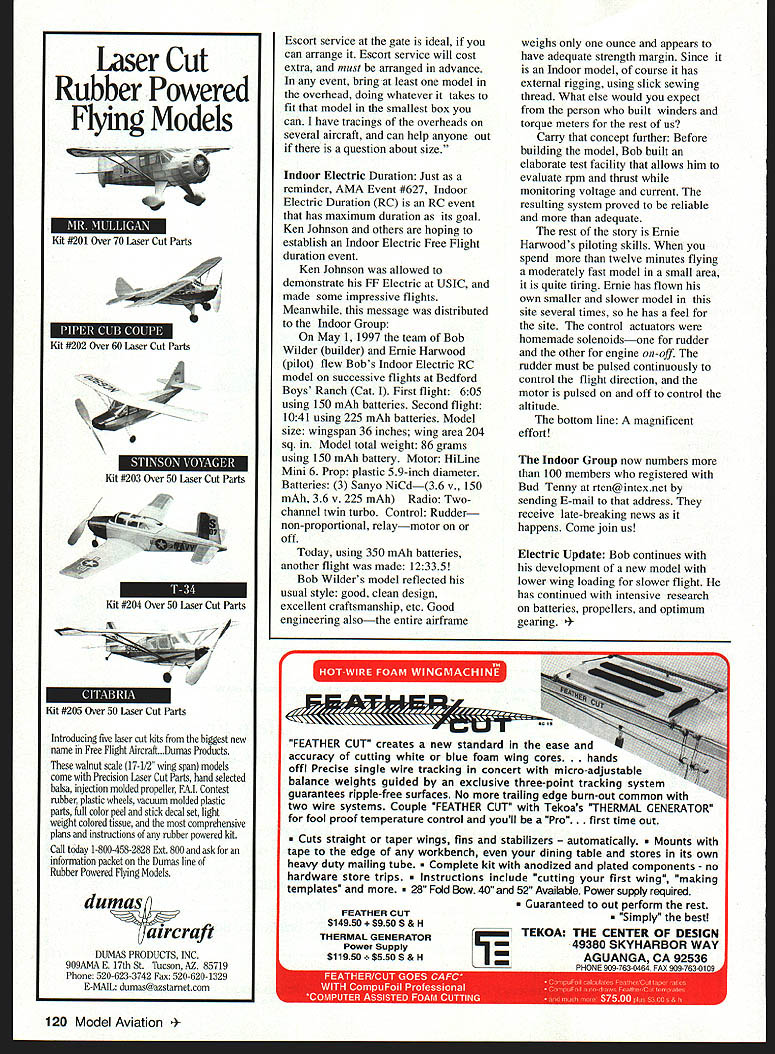
AMA Event #627, Indoor Electric Duration (RC) is an RC event with maximum duration as its goal. Ken Johnson and others are working to establish an Indoor Electric Free Flight duration event.
Demonstrations and recent flights:
- Ken Johnson was allowed to demonstrate his FF electric at USIC and made impressive flights.
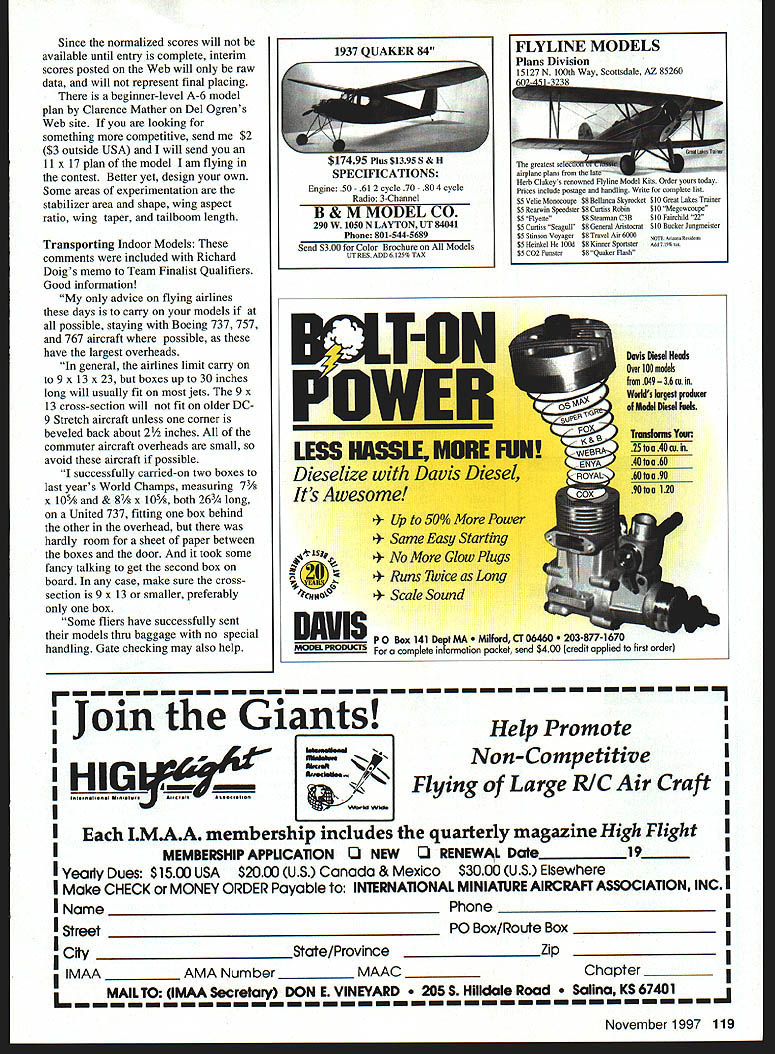
- On May 1, 1997, the team of Bob Wilder (builder) and Ernie Harwood (pilot) flew Bob's indoor electric RC model at Bedford Boys' Ranch (Cat. I):
- First flight: 6:05 using 150 mAh batteries
- Second flight: 10:41 using 225 mAh batteries
- Model details:
- Wingspan: 36 inches
- Wing area: 204 sq. in.
- Total weight: 86 grams (using 150 mAh battery)
- Motor: HiLine Mini 6
- Prop: plastic, 5.9-inch diameter
- Batteries: (3) Sanyo NiCd; 3.6 V, 150 mAh and 3.6 V, 225 mAh variants
- Radio: two-channel twin turbo
- Control: rudder—non-proportional; relay—motor on/off
- Later flights:
- Using 350 mAh batteries, another flight recorded: 12:33.5
Notes on construction and operation:
- Bob Wilder's model shows good clean design and craftsmanship; the airframe weighs about one ounce with adequate strength margins.
- The model uses external rigging with slick sewing thread.
- Bob built an elaborate test facility to evaluate rpm and thrust while monitoring voltage and current; this produced a reliable system.
- Ernie Harwood piloted the long flights using homemade solenoid actuators: one for rudder (pulsed continuously to control heading) and one for engine on/off (pulsed to control altitude). Long flights in a small area are tiring; pilot skill and site familiarity are important.
Bottom line: a magnificent effort.
A-6 Indoor Contest (Summary)
- Contest open worldwide for A-6 class indoor models: October 1, 1997 – March 31, 1998.
- Submit times to Roger Schroeder (rsch@idir.net) or by mail to: 4111 West 98 St., Overland Park, KS 66207, USA.
- Results posted at Del Ogren's Indoor web site: www.n-lemma.com/indoor/
- Follow the A-6 rules listed above.
- Send $2 (U.S.) or $3 (outside USA) for an 11 × 17 plan, or design your own model.
Electric update:
- Bob Wilder continues developing a new model with lower wing loading for slower flight and continues research on batteries, propellers, and optimum gearing.
Transcribed from original scans by AI. Minor OCR errors may remain.

